

Buyer behavior has shifted permanently toward researching the founder before researching the company. Founders who invest in personal branding in 2026 build compounding authority. Founders who delay lose 2 to 3 years of compounding to competitors who start now.
Key Takeaways:
AI-generated content online has increased 300% since 2023 (Originality.ai 2025 Report). Personal branding is the trust filter that separates human expertise from machine-generated noise.
Google AI Overviews, ChatGPT, and Perplexity cite founders with entity recognition. Founders without structured content are invisible to AI-powered discovery.
73% of B2B buyers research the founder online before purchasing (2024 Edelman Trust Barometer). The personal brand is the first trust filter in the buyer's decision process.
Intangible assets represent 90% of S&P 500 market value, up from 17% in 1975. The personal brand is the primary intangible asset for founders.
The cost of waiting is not zero growth. The cost of waiting is negative positioning. Competitors who build personal brands now occupy the market position the waiting founder loses access to.
Personal branding in 2026 requires authority architecture (search visibility, entity recognition, AI citation), not social media posting alone.
Three Forces Make Personal Branding Non-Optional in 2026
Personal branding transitioned from competitive advantage to survival requirement between 2023 and 2026.
The transition happened because three forces converged simultaneously. Each force independently increases the importance of personal branding. Together, the three forces make personal branding the single most important investment a founder makes in 2026.
I have built personal brands for founders across every market condition since 2011. The urgency in 2026 is structurally different from previous years. In 2020, personal branding was a growth accelerator. In 2026, personal branding is the trust infrastructure that determines if a founder's expertise is discoverable at all.
Force 1: The AI Content Flood Destroyed the Information Advantage

AI-generated content increased 300% between 2023 and 2025. The flood made information free and trust scarce.
The Originality.ai 2025 Report documented 300% growth in AI-generated content across blogs, social media, and professional platforms. The volume continues accelerating in 2026. The consequence: information is no longer the differentiator. Every topic has thousands of AI-generated articles that are grammatically correct, factually adequate, and structurally identical.
The differentiator in 2026 is trust. The audience cannot distinguish machine-generated information from human expertise by reading the content alone. The audience uses the personal brand as the trust filter. The question shifts from "is this information accurate?" to "do I trust the person behind this information?"
Three trust signals that AI cannot replicate:
Named intellectual property. A proprietary framework named, documented, and validated through client results signals human expertise. AI generates generic frameworks. Founders create named ones.
Practitioner proof. Specific client outcomes with dollar amounts, timelines, and measurable results signal direct experience. AI generates plausible examples. Founders reference real ones.
Consistent positioning over time. A personal brand that maintains the same positioning across 3 to 5 years of published content signals commitment. AI generates whatever the prompt requests. Founders demonstrate conviction.
Personal branding in 2026 is AI-proof because the trust signals are built on assets that generative AI structurally cannot produce: named IP from real experience, published proof from real clients, and consistent positioning maintained across years of content.
Force 2: AI Discovery Systems Cite Recognized Entities
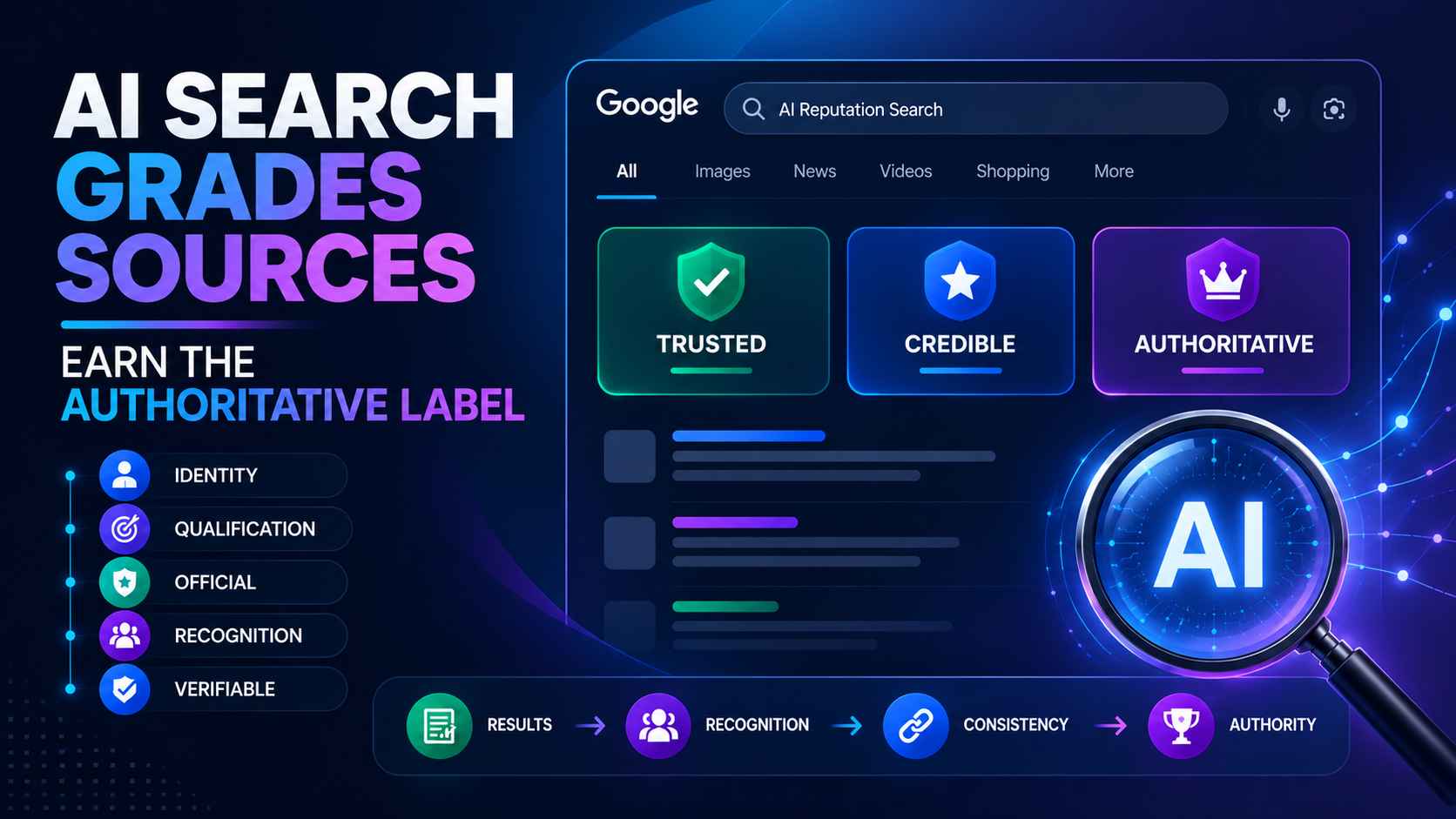
Google AI Overviews, ChatGPT, Perplexity, and Gemini cite founders who have entity recognition. Founders without entity recognition are invisible to AI-powered discovery.
AI discovery is the fastest-growing channel for how buyers find experts. A 2025 BrightEdge study found that 42% of domains lost visibility after Google AI Overview algorithm updates. The domains that retained or gained visibility shared one characteristic: recognized entities with structured content.
Entity recognition is the process by which search engines and AI systems classify a founder as a known expert in a specific field. The classification depends on four signals:
Structured content on the founder's website with schema markup.
Consistent terminology across website, LinkedIn, YouTube, and third-party mentions.
Named intellectual property referenced across multiple sources.
Third-party citations from podcasts, media, and industry publications.
Founders who build personal brands in 2026 with these four signals appear in AI-generated answers. The AI citation becomes a permanent trust signal. A prospect who asks ChatGPT "who is the best personal branding consultant for founders?" receives an answer that includes or excludes the founder based entirely on entity recognition.
Personal branding in 2026 is not optional because the discovery channel is shifting from search results pages to AI-generated answers. The founder who is absent from AI answers is absent from the buyer's consideration set.
Force 3: Buyer Behavior Changed Permanently
73% of B2B buyers research the founder online before making a purchasing decision. The research happens before the first conversation, not during the conversation.
The 2024 Edelman Trust Barometer documented a permanent shift: buyers trust individuals more than institutions. The founder's personal brand is the first trust filter the buyer applies. The company brand is the second.
Three buyer behavior changes that make personal branding non-optional in 2026:
Change 1: The buyer researches the founder before the product. The buyer Googles the founder's name. The buyer reads the LinkedIn profile. The buyer scans published content. The buyer forms an opinion before the sales conversation starts. A strong personal brand converts the research into a sales meeting. A weak personal brand ends the evaluation at the Google search results page.
Change 2: The buyer trusts published expertise over sales claims. A founder who has published 50 articles demonstrating deep expertise generates more trust than a founder who has a polished sales deck. The published content is proof of thinking. The sales deck is a claim about thinking. Buyers in 2026 demand proof.
Change 3: The buyer checks AI systems for recommendations. A growing percentage of buyers ask ChatGPT, Perplexity, or Google AI Overviews for recommendations before starting a traditional search. The AI answer is the new first impression. The founder who appears in the AI answer starts the relationship with trust. The founder who does not appear starts with invisibility.
The Cost of Waiting Is Not Zero. The Cost of Waiting Is Negative.

Every month a founder delays personal branding, a competitor occupies the market position the founder loses access to.
The cost of waiting is calculated in three dimensions:
Dimension 1: Lost compounding time. A blog post published in January 2026 ranks in Google for 2 to 5 years. A blog post published in January 2028 ranks for the same duration but starts 2 years later. The founder who published in 2026 accumulated 2 years of inbound leads, entity recognition, and authority compounding that the 2028 founder cannot recover.
Dimension 2: Competitor positioning. The personal branding space has a finite number of positioning claims in every niche. The founder who claims "authority architecture for wellness founders" in 2026 occupies that position.
The competitor who attempts the same claim in 2028 faces an incumbent with 2 years of published content, search rankings, and entity recognition. The latecomer competes against compounded authority. The race is uneven.
Dimension 3: AI training data windows. AI systems train on published content. The content published in 2026 enters the training data that shapes AI answers in 2027 and beyond. The content published in 2028 enters a later training cycle.
The founders who published early have a structural advantage in AI citation that latecomers cannot close without significantly more effort.
I watched this dynamic in real time. Founders who delayed personal branding by 12 months required 3x the content investment to reach the same authority level as founders who started on time. The delay is not neutral. The delay is expensive.
What Personal Branding Looks Like in 2026 vs 2020
Personal branding in 2020 meant posting on social media. Personal branding in 2026 means building authority architecture.
Dimension | 2020 | 2026 |
Primary platform | Instagram and LinkedIn | Website, LinkedIn, and AI citation |
Content goal | Engagement and followers | Inbound leads and entity recognition |
Discovery channel | Social media feeds | Google AI Overviews, ChatGPT, Perplexity |
Trust signal | Follower count | Named IP, published depth, search rankings |
Content lifespan | 24 to 48 hours (social post) | 2 to 5 years (website article) |
Measurement | Likes, comments, shares | Inbound inquiries, AI citations, sales cycle length |
Required investment | 15 hours per week (content creation) | 5 hours per month (authority architecture) |
The founder who practices 2020 personal branding in 2026 misses the AI discovery channel, builds no search authority, and produces content that expires in 48 hours. The founder who practices 2026 personal branding builds compounding assets across every discovery channel simultaneously.
The Five Reasons Personal Branding Matters for Specific Founder Types
Personal branding matters differently for different founder types. The reason to invest depends on the business model and growth stage.
For service-based founders: Personal branding replaces outbound sales. The founder who has a personal brand generates inbound inquiries from prospects who already trust the expertise. The sales cycle shortens. The pricing power increases. The dependency on referrals decreases.
For product-based founders: Personal branding creates the trust layer that makes the product launch successful. The audience trusts the founder before trusting the product. The founder's personal brand pre-sells the product through demonstrated expertise.
For funded founders: Personal branding attracts talent, partners, and follow-on investors. 75% of candidates research company leadership before applying (2024 LinkedIn Global Talent Trends). The founder's personal brand is the recruiting tool that no job posting replicates.
For exiting founders: Personal branding increases the valuation multiple. Intangible assets represent 90% of S&P 500 market value. The personal brand is the intangible asset that acquirers pay a premium for because the founder's authority transfers trust to the acquiring entity.
For solopreneur founders: Personal branding is the entire business model. The positioning strategy determines the niche. The named IP determines the pricing. The content architecture determines the lead flow. The personal brand is not a marketing channel for the solopreneur. The personal brand is the business.
Where to Start in 2026
Three actions in one afternoon begin the personal branding process.
Action 1: Define the positioning. Write an 8-word statement that declares what the founder does, for whom, and through which method. The positioning governs every subsequent decision.
Action 2: Name one framework. Take the process the founder uses with every client. Give the process a name. Document the steps. The named framework is the trust asset that compounds.
Action 3: Publish one article. Write one 1,500-word article that demonstrates the framework in action with a specific example. Publish on the founder's website. The article begins the compounding process in search and AI systems.
Three actions. One afternoon. The personal branding books on this site provide deeper frameworks for each subsequent step.
Frequently Asked Questions
Why is personal branding important in 2026?
Personal branding is important in 2026 because three forces converged: AI-generated content destroyed the information advantage, AI discovery systems cite recognized entities, and buyer behavior shifted permanently toward researching the founder before the company. Founders without personal brands are invisible to the fastest-growing discovery channels.
Is personal branding still relevant with AI?
Personal branding is more relevant with AI, not less. AI systems cite founders with entity recognition. AI-generated content makes trust scarce, which increases the value of personal brands built on named IP and practitioner proof. The founders who invest in personal branding in 2026 gain an AI citation advantage that compounds over time.
How quickly does personal branding produce results?
Early trust signals (inbound inquiries, prospect profile views, speaking invitations) appear within 60 to 90 days of consistent execution. Measurable authority (search rankings, AI citations, shortened sales cycles) matures within 6 to 12 months. The compounding accelerates after the first year.
What happens to founders who delay personal branding?
Founders who delay lose compounding time, surrender positioning to competitors, and miss AI training data windows. A 12-month delay requires approximately 3x the content investment to reach the same authority level as a founder who started on time. The delay is not neutral. The delay is expensive.
What is the minimum investment for personal branding in 2026?
The foundation (positioning statement, named framework, first published article) takes one afternoon. The ongoing investment is 3 to 5 hours per month for content publishing, LinkedIn distribution, and authority measurement.
The minimum viable personal brand in 2026 requires less time than most founders assume because the strategy prioritizes depth over frequency.