
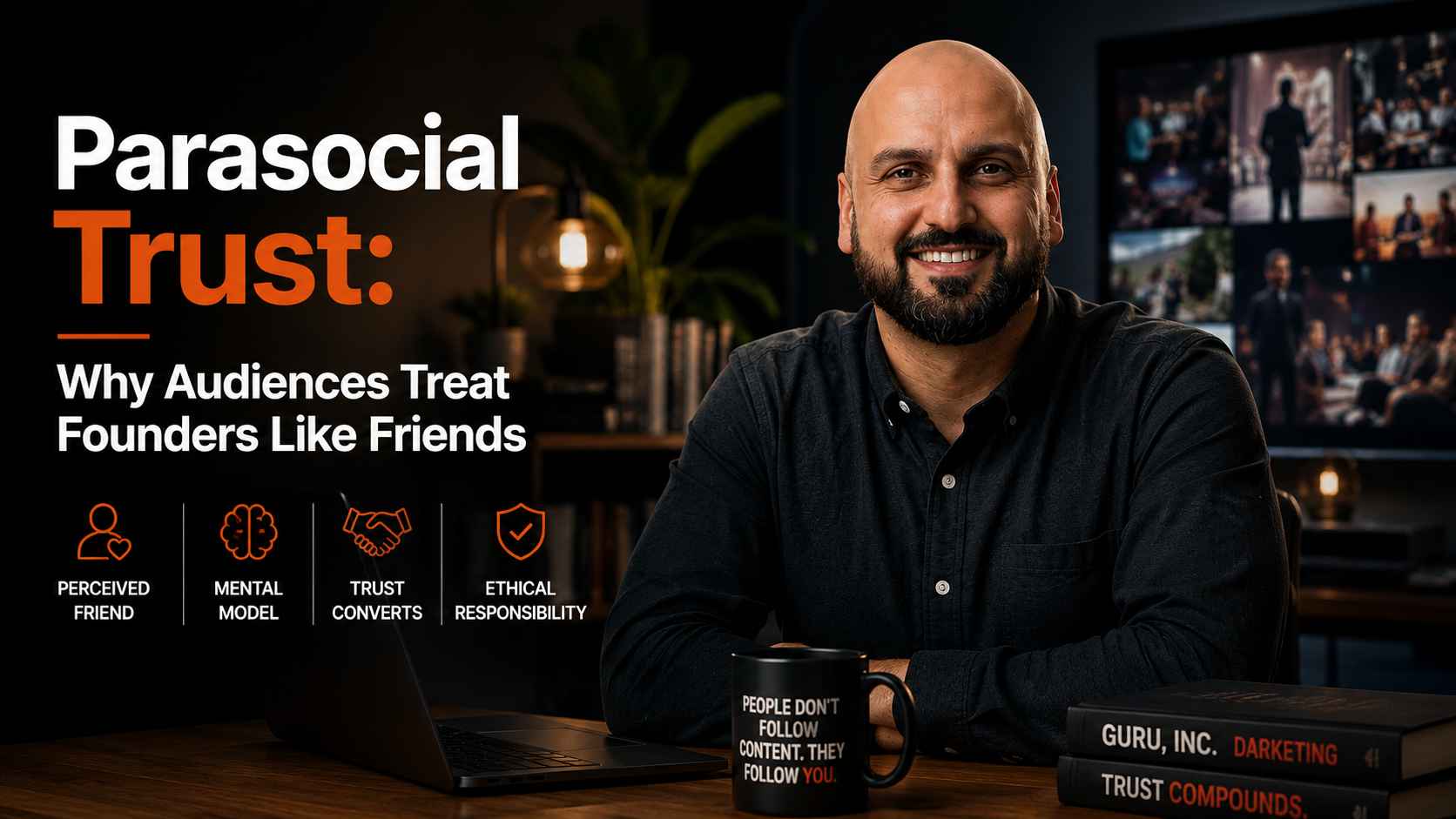
The client has never seen this person before. The person has spent two hundred hours with the client. The relationship is real on one side, and that one-sided reality moves more money, loyalty, and forgiveness than any marketing channel a founder owns.
Key Takeaways
Parasocial trust is a one-sided relationship where the audience builds a stable mental model of a founder across hundreds of touchpoints.
The brain's social machinery does not draw a hard line between a real friend and a reliably present digital one.
The economic weight is real: recommendations from a perceived friend skip the comparison shopping a stranger's claims trigger.
The trust is asymmetric, and the asymmetry is a responsibility, not a loophole.
Manufactured intimacy, fake vulnerability, and false urgency exploit the same mechanism and define the dark side I call Darketing.
Do not perform intimacy. Practice reliability.
What Parasocial Trust Is
Parasocial trust is the confidence an audience places in a person they know entirely through media. The term is old, born in the broadcast era, and the mechanism never changed.
A person shows up reliably, sounds like themselves every time, and lets the audience watch them think. Across hundreds of small exposures, the audience assembles a working model of that person: how they judge, what they value, what they would say about a problem.
Here is the everyday version. A morning radio voice rides in a million cars for a decade. Listeners feel its absence on vacation. They grieve when it retires. Nobody in those cars ever met the host, and the loss is still real. The founder posting daily is running the same machine on a different stage.
The Mental Model the Audience Builds
The model forms from unglamorous inputs: voice, tone, repeated exposure, reliable delivery. Consistency is the raw material. Every piece of content either confirms the model or breaks it, and confirmation compounds the same way authority compounds.
After enough confirmations, the audience stops evaluating each new claim from scratch. The model answers for you. That shortcut is the entire commercial power of the mechanism, and the entire risk.
Why It Works on Adults Who Know Better
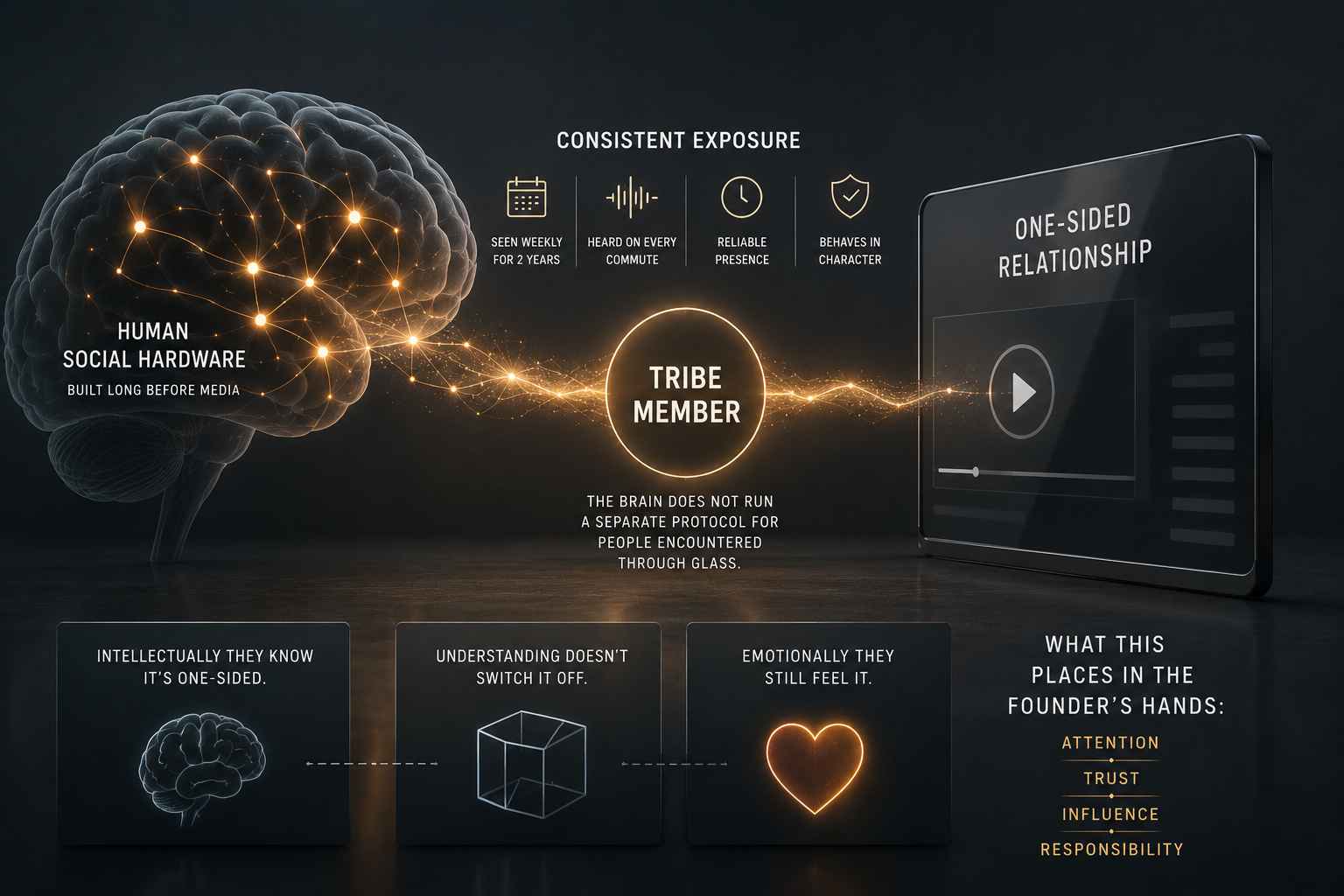
Parasocial trust is not gullibility, and treating it as a weakness misreads the machinery. The human brain built its social hardware long before media existed.
For that hardware, a face seen weekly for two years, a voice heard on every commute, a person who reliably shows up and behaves in character, is a member of the tribe. The brain does not run a separate protocol for people encountered through glass.
Adults who understand the one-sidedness intellectually still feel the relationship, the same way understanding an optical illusion does not switch it off.
A founder who grasps this stops being surprised by the strangers who speak to them like old friends, and starts understanding what has been placed in their hands.
The Sunday Morning Mechanism
The clearest modern operator of this mechanism sounds like a friend, not a preacher. Joel Osteen built an audience of millions on exactly that register: he does not lecture, he arrives.
The delivery is warm, personal, and relentlessly consistent, and the audience relationship it builds runs far deeper than agreement with any individual sermon. The founder publishing daily on the feed is the Sunday morning voice of the algorithm era. Same trust mechanism, different stage.
Most founders aim at credible. The ones who compound aim at recognizable: a friend who happens to be credible. Credible earns a nod. Recognizable earns the return visit, and the return visits are where the mental model, and everything it carries, gets built.
The Economics of Feeling Known
Trust from a perceived friend converts differently than trust from a proven stranger. When a friend whose taste you respect recommends a restaurant, you do not check reviews. When a doctor you trust names a medication, you do not comparison shop.
Parasocial trust imports that behavior into markets, which is why reputation operates as an economic force across every authority brand: the recommendation of a perceived friend skips the evaluation gauntlet a stranger's claim must survive.
This is trust value in its purest form, the second component ROAC measures. Attention that built a stable, trusted mental model converts on a fraction of the friction cold attention requires.
The founder with a smaller audience and deeper parasocial trust outsells the founder with triple the reach and none of it, and the dashboards never explain why, because dashboards count exposure and the mechanism runs on relationship.
The Ethical Line
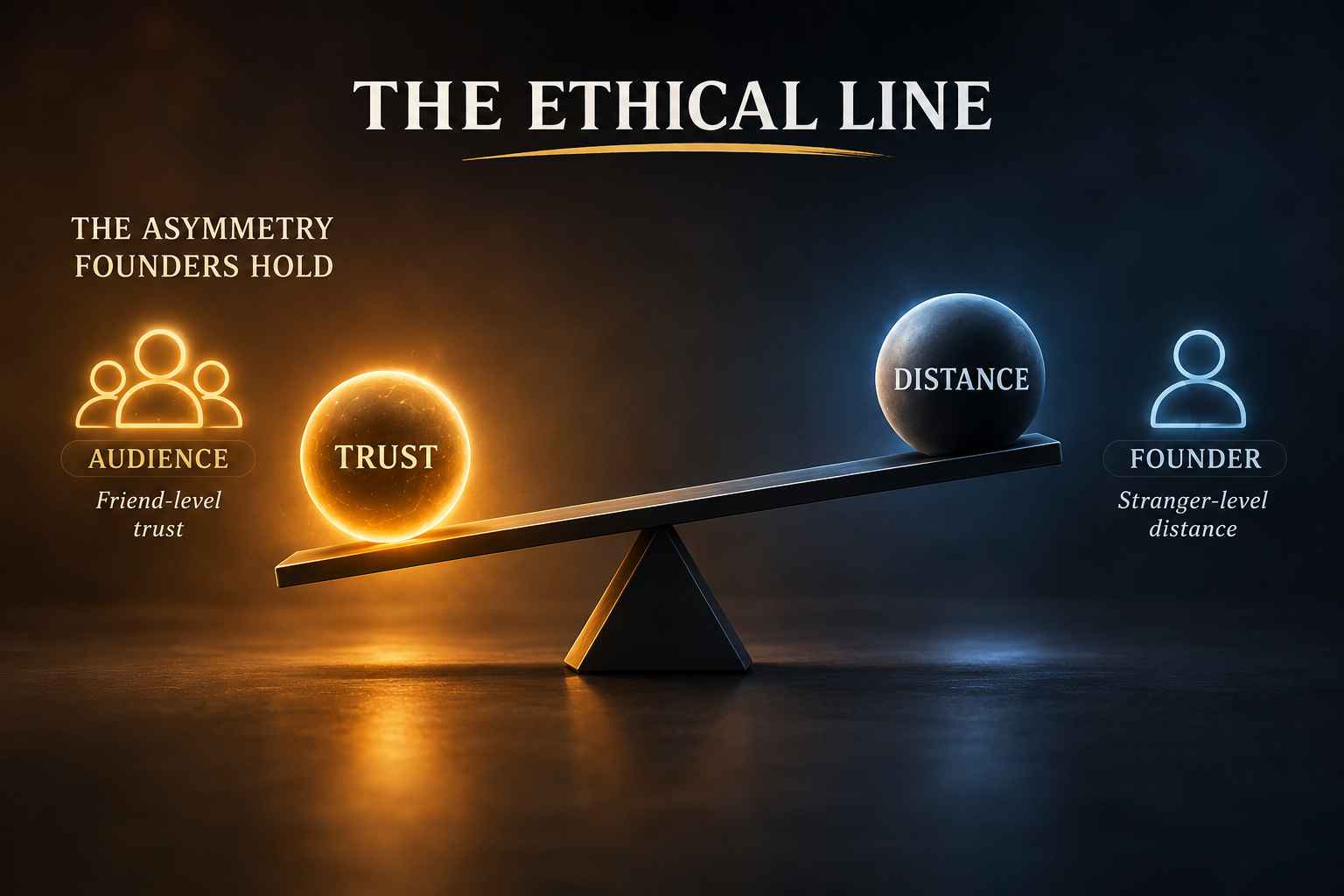
So is the mechanism manipulation? It depends entirely on what the founder does with an asymmetry the audience cannot see.
The Asymmetry Founders Hold
The audience knows the founder deeply, in one direction. The founder does not know the audience at all. That asymmetry means the audience extends friend-level trust while the founder holds stranger-level distance, and every recommendation lands with friend-level weight regardless of the founder's actual care.
In GURU, INC. I name the dark side of this Darketing: the deliberate exploitation of influence mechanics by operators who understand them. Manufactured intimacy, scripted vulnerability, false scarcity, urgency theater, all of it runs on the same machinery described above, aimed at extraction instead of service.
The mechanism itself is neutral. The morning radio voice and the manipulative guru use identical hardware. The difference is entirely in intent and in what the trust gets spent on, which is why understanding the mechanism obligates a founder instead of licensing them.
The Test Before Every Recommendation
One question keeps the line visible: would this recommendation survive the audience knowing everything you know? Every affiliate arrangement disclosed, every limitation admitted, every incentive on the table.
A recommendation that survives full transparency is trust honestly spent. A recommendation that needs the asymmetry to work is Darketing, whatever the founder tells himself about it.
Building Parasocial Trust Honestly
The honest version is built from reliability, and the dishonest version is built from performance. The table below draws the line attribute by attribute:
Attribute | Honest trust building | Manufactured intimacy |
Foundation | Reliable presence over years | Performed closeness on demand |
Vulnerability | Real lessons from real cost | Scripted confession as content |
Consistency | Same person every time | Persona adjusted per campaign |
Recommendations | Survive full transparency | Depend on the asymmetry |
What the audience gets | Judgment they can bank on | A relationship aimed at extraction |
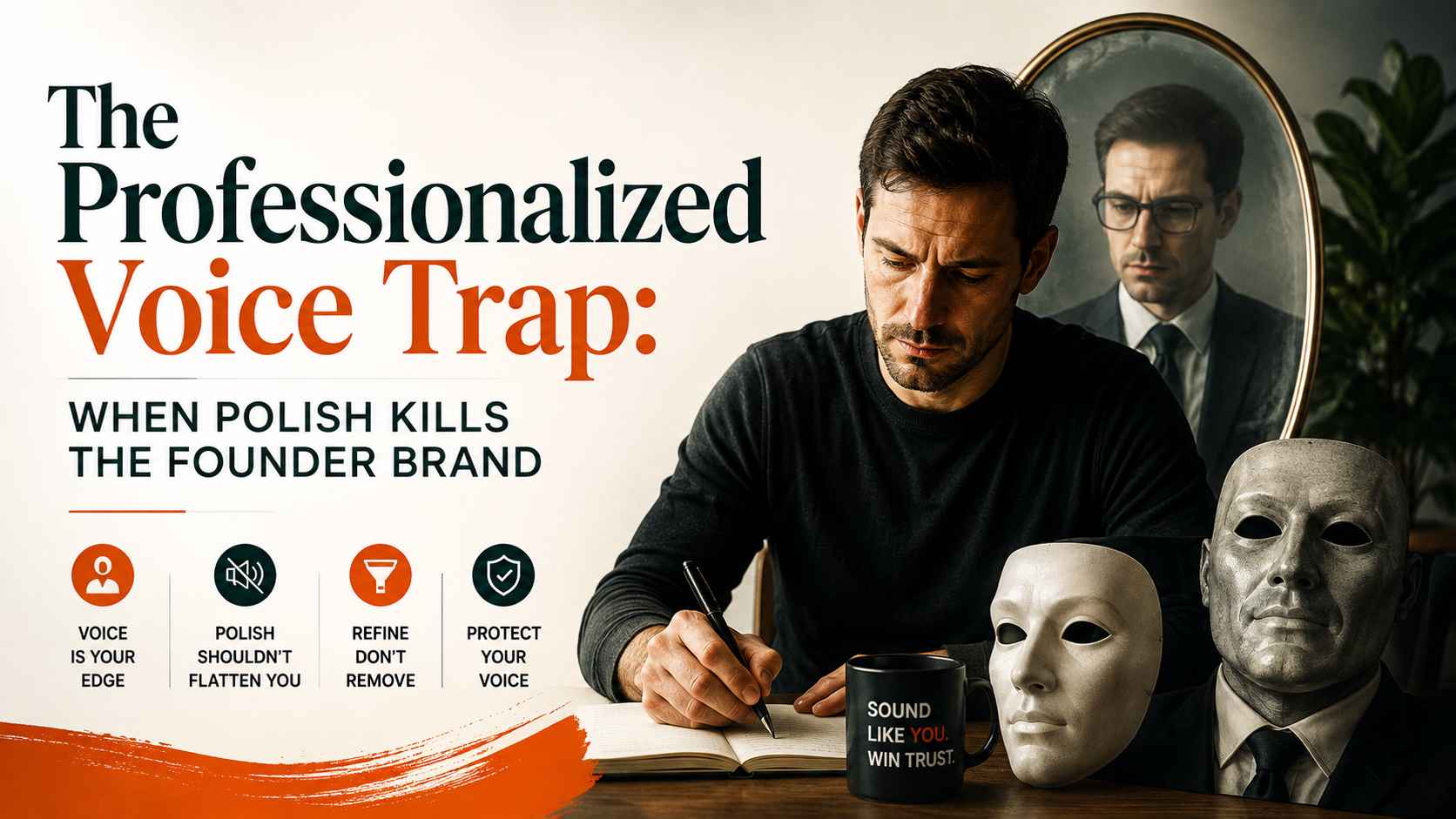
The honest practice list is short. Show up on a schedule the audience can rely on. Sound like the same person every time, which is exactly why the flattened voice kills the mechanism: the audience cannot build a model of a person who keeps disappearing from their own writing.
Let the audience watch real thinking, including the misses. And hold the boundary honestly: a founder owes the audience honesty, never access. The relationship is one-sided by design, and pretending otherwise is itself a performance.
Watchable, consistent delivery is also why edutainment compounds this mechanism faster than any format: the audience that finishes builds the model faster than the audience that skims.
Building the whole system deliberately, the presence, the voice, the ethical spine, is standing work inside my consulting practice, because the founders who hold this trust and the founders who deserve it are not automatically the same group.
Parasocial trust is a one-sided friendship the audience builds from a founder's reliable presence, and it converts with a weight no cold channel matches. The asymmetry is a responsibility. Spend the trust on things that survive transparency. Do not perform intimacy. Practice reliability.
What Is Parasocial Trust in Personal Branding
Parasocial trust is the one-sided relationship an audience forms with a founder through repeated media exposure. The audience builds a stable mental model of the founder's judgment and character, then extends friend-level trust the founder never individually earned.
Why Do Audiences Trust Founders They Have Never Met
The brain's social machinery predates media and does not separate a reliably present digital person from a real acquaintance. Hundreds of consistent touchpoints assemble a working model of the founder, and the model answers for each new claim.
Is Building Parasocial Trust Manipulative
The mechanism is neutral. Building it through reliable presence and honest judgment serves the audience. Exploiting it through manufactured intimacy, scripted vulnerability, or false urgency is the dark pattern I call Darketing, and the transparency test separates the two.
How Does a Founder Build Parasocial Trust Without Faking Intimacy
Show up on a reliable schedule, sound like the same person every time, share real thinking including the misses, and hold honest boundaries. Reliability builds the trust. Performance of closeness is the counterfeit version, and audiences eventually detect counterfeits.