


The numbers called it collapse. I stopped being surprised years ago, and I started leading with this in every diagnostic call: if you stopped sounding like you, you stopped being the reason people came in the first place.
Key Takeaways
The professionalized voice trap is the flattening of a founder's distinct voice in the name of polish, followed by a measurable drop in inbound.
The voice is a demand asset, not a style preference. Audiences arrive for a specific person and leave when that person disappears from the writing.
Polish belongs in three places: the frameworks, the production, and the offers. Never the voice.
Refining sharpens the same voice. Flattening removes the person. The two get confused because both feel like improvement.
The read-aloud test protects the voice: if the founder cannot hear himself in the sentence, the sentence goes back.
Polish the frameworks, the production, the offers. Never the voice.
The Pattern in Every Diagnostic
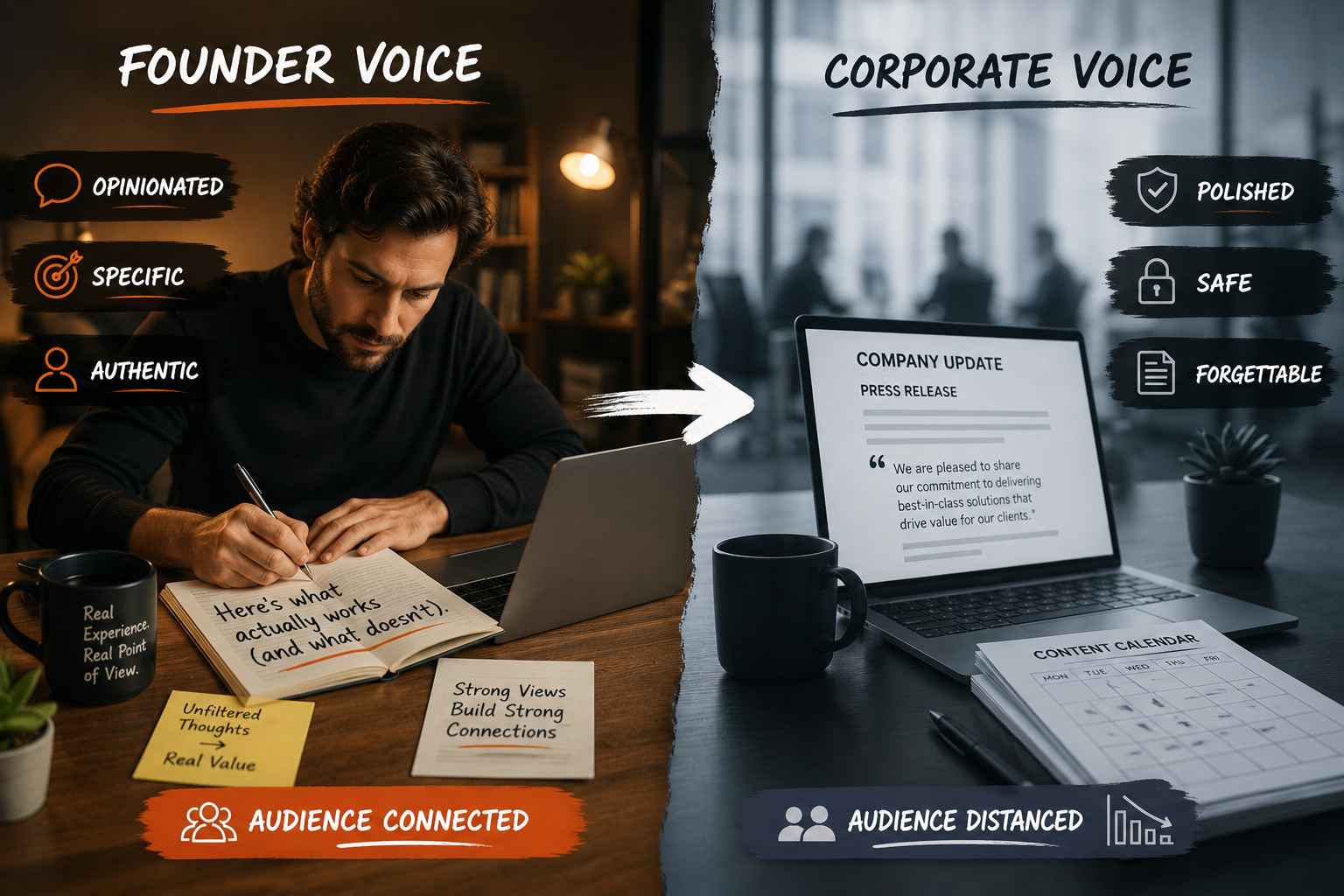
The story arrives in the same order every time. A founder builds an audience sounding exactly like himself: opinionated, specific, occasionally rough. Revenue grows. The company matures.
Somewhere past the eight-figure mark, an advisor decides the content sounds unprofessional next to the company's new size. The recommendation lands: elevate the voice, tighten the messaging, sound like the category leader.
The team complies. The posts start reading like press releases. The claims get hedged. The phrasing gets safe. Six months later the founder is asking me why engagement fell and the inbound pipeline thinned, holding a content calendar more professional than anything the company ever produced.
Nothing in the strategy changed. The person disappeared from the writing, and the audience noticed before the dashboard did.
Why the Flattened Voice Kills Inbound
The Voice Is the Reason They Came
An audience does not follow a company's content. An audience follows a person it recognizes. The specific way a founder argues, the phrases they repeat, the things they refuse to say, all of it forms the recognition the audience returns for.
That recognition is a commercial asset. It converts strangers into followers and followers into inbound, because people buy judgment from a person they feel they know.
Flattening the voice liquidates the asset. The information stays. The person leaves. The audience experiences the change the way anyone experiences a friend who starts speaking in corporate statements: nothing is wrong with any sentence, and the reason for listening is gone.
The trust value that voice built, the same trust value ROAC measures in any founder brand, stops compounding the day the voice stops being recognizable.
Polish Reads as Anybody
Professional is the most crowded sound on the internet. Every competitor with a content budget produces polished, credible, hedged writing.
A distinct voice is scarce by definition, since only one person owns it. Professionalizing a founder's voice trades the scarce asset for the abundant one and calls the trade an upgrade.
Here is the metaphor I use with clients. Professionalizing a voice is decaffeinating it: same color, same cup, none of the reason people drink it. The audience cannot always name what changed.
They simply stop coming back, and the analytics record a decline nobody can attach to any single decision, because the decision was made one hedged sentence at a time.
Where Polish Belongs
So where does the polish go? Into the three places it compounds instead of kills. The three places are given below:
Polish the Frameworks
The thinking deserves every hour of refinement the voice was getting. Sharper definitions, cleaner structures, named methodologies with real edges.
A rough voice arguing a precise framework outperforms a polished voice arguing mush, in every market I have worked. Framework polish is what separates an expert with opinions from an authority with property.
Polish the Production
Better cameras, cleaner edits, tighter formats, faster load times, professional design. Production polish raises the perceived value of everything the founder says without touching a single word of how they say it.
This is where the professionalize instinct is correct, and teams that aim it here get the upgrade the consultant promised without the collapse the consultant caused.
Polish the Offers
Pricing, packaging, positioning of the products and services behind the content. Offer polish converts the demand the voice creates. It is the highest-leverage polish available, and it is usually the most neglected, because teams spend the polish budget sanding down the one asset generating the demand the offers exist to catch.
Refining vs Flattening
The trap survives because refining and flattening feel identical from inside the process. Both involve edits. Both produce cleaner drafts. Both get called improvement in the meeting. The difference only shows in what survives the edit, and the table below draws the line:
Attribute | Refining | Flattening |
What changes | Filler, repetition, weak structure | Opinions, phrasing, personality |
What stays | The founder's argument and sound | The information, stripped of the person |
The claims | Sharper and more specific | Hedged and safer |
The approval question | Is this the founder at their clearest | Does this sound professional enough |
The result | Same voice, higher signal | Anybody's voice, falling engagement |
The Read-Aloud Test
One test separates the two in practice. Read the edited draft aloud and ask one question: does this still sound like the founder on their best day? Refining passes the test every time, because refining is the founder at their clearest. Flattening fails it immediately, because the sentences belong to no one.
Any founder can run the test in thirty seconds, and any team can adopt the question as the final gate before publishing.
Professionalizing Without Losing the Voice

The fix is not refusing all editing. The fix is building guardrails that let the team polish everything except the person. Four guardrails do the work in my client engagements.
First, a written voice document: the founder's repeated phrases, positions, metaphors, and the corporate vocabulary they never use. The document turns voice from a feeling into a spec any editor can check against.
Second, raw capture: the founder records or drafts in their natural register, and the team edits around the voice, cutting and arranging, never rewriting the sound.
Third, a ban list: the hedge phrases and committee diction that signal flattening, caught at the edit stage. Fourth, the read-aloud test as the final gate, with authority to send sentences back.
The same discipline applies whether the founder writes alone or with support. A technical founder who hates writing still owns a position and a natural register, and every production path around the writing problem preserves both or fails.
Voice is also what makes the whole edutainment approach function, since nobody watches a flattened person to the end of anything.
Rebuilding a flattened voice, and installing the guardrails that keep it from flattening again, is work I now run inside my consulting practice more often than I expected to, because the trap catches exactly the founders who succeeded enough to attract advisors.
The professionalized voice trap flattens the one asset the audience came for and calls it maturity. Refine the thinking, upgrade the production, sharpen the offers, and guard the sound of the person. Polish the frameworks, the production, the offers. Never the voice.
What Is the Professionalized Voice Trap
The professionalized voice trap is the flattening of a founder's distinct voice in the name of sounding more professional, followed by declining engagement and inbound. The information survives the edit. The person the audience came for does not.
Why Does Professionalizing a Founder's Voice Reduce Inbound
Audiences follow a recognizable person, and inbound converts from that recognition. Flattening the voice removes the person while keeping the information, so the content loses the only quality separating it from every polished competitor saying similar things.
How Does a Founder Polish Content Without Losing the Voice
Aim the polish at the frameworks, the production, and the offers, and protect the voice with guardrails: a written voice document, raw capture with editing around the sound, a ban list of corporate diction, and the read-aloud test as the final gate.
When Does Refining a Voice Become Flattening It
Refining cuts filler and sharpens the founder's own argument, so the edited draft sounds like the founder at their clearest. Flattening hedges the claims and rewrites the phrasing, so the draft sounds professional and belongs to no one. The read-aloud test catches the difference immediately.