
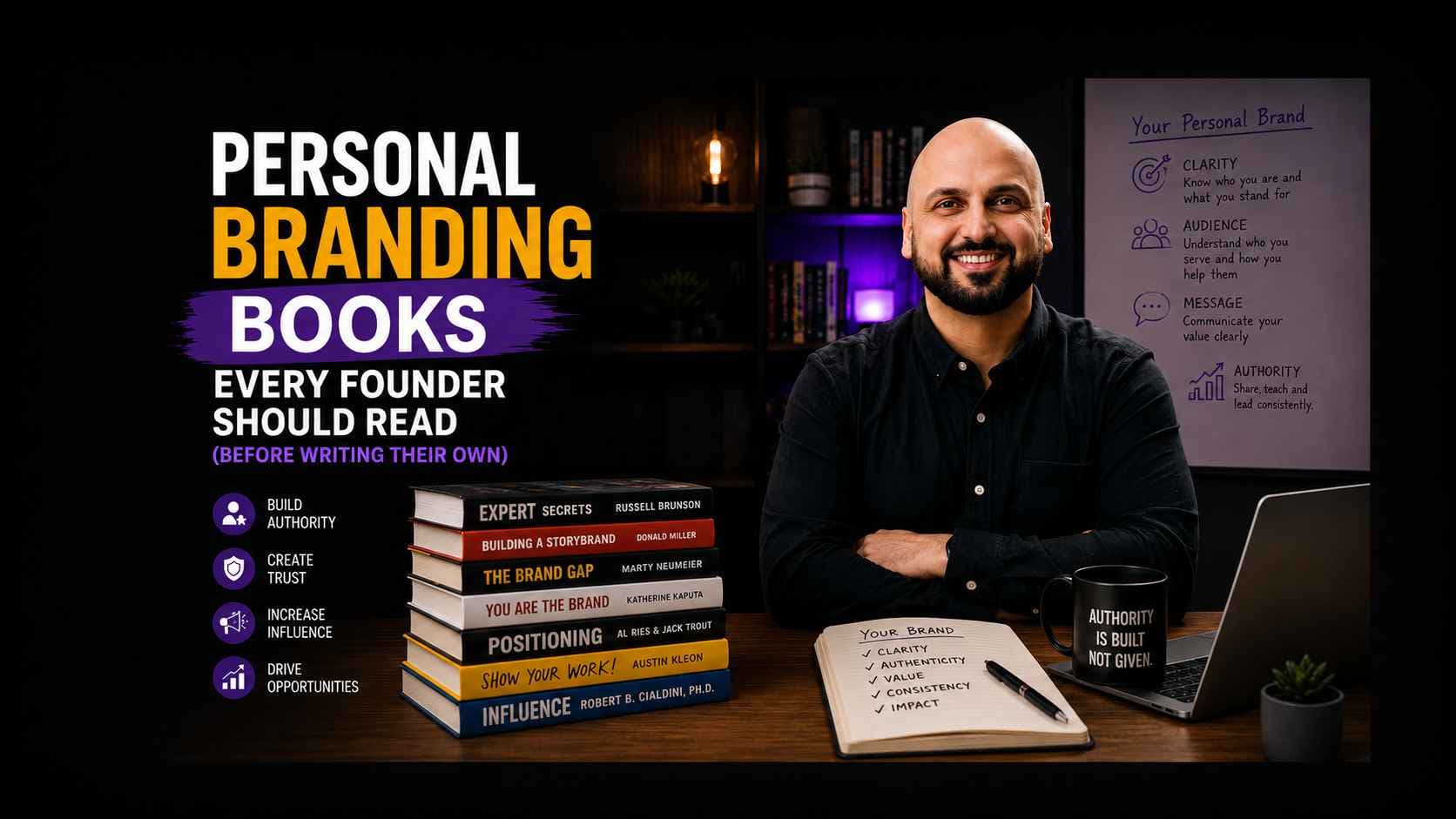
The seven personal branding books below each cover a specific layer of the authority-building process: positioning, intellectual property, content systems, audience mechanics, offer structure, movement building, and brand messaging.
Reading all seven gives a founder the complete blueprint. Reading one gives a founder a starting point. The order below is the order I recommend to clients.
Key Takeaways:
Seven personal branding books cover seven distinct layers of authority architecture.
The recommended reading order follows the building sequence: positioning first, then IP, then content, then audience, then offers, then movement, then messaging.
Each book teaches one principle that no other book on the list covers.
Founders who read personal branding books without implementing the frameworks waste the investment. Each book below includes a specific action to take after reading.
The strongest personal branding books are written by practitioners who built the brands they describe, not by observers who studied them from a distance.
How to Read Personal Branding Books as a Founder
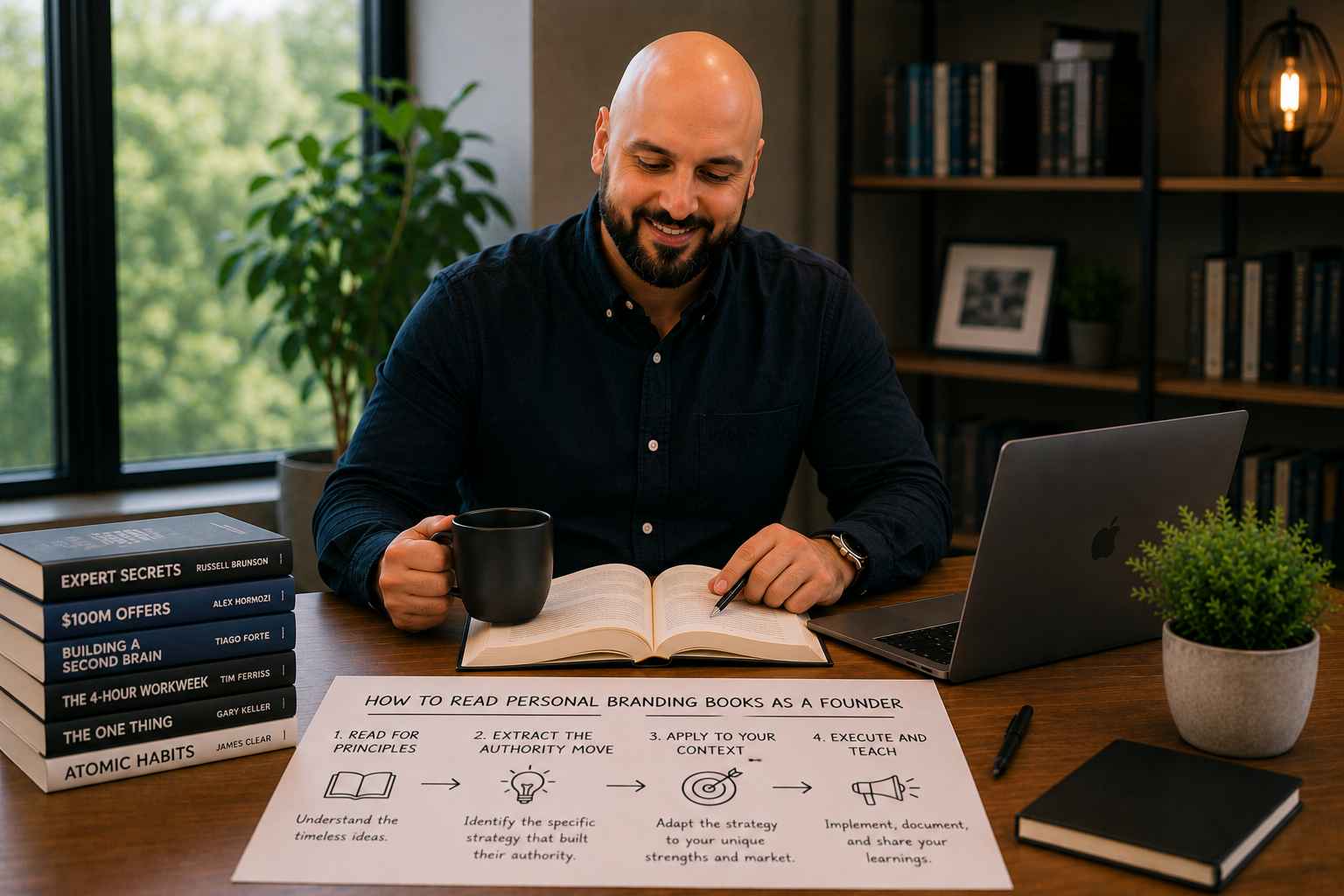
Founders read personal branding books differently than marketers, consultants, or students.
A marketer reads for tactics. A founder reads for architecture. The difference: tactics are individual moves. Architecture is the system that connects moves into a compounding structure.
I read every book on this list before writing my own. The books that changed my approach to building authority brands were the books that taught systems, not the books that taught tips. A tip expires when the platform changes. A system survives because the system is built on human psychology, not algorithm mechanics.
Three rules for reading personal branding books as a founder:
Read for the one principle. Each book has one central idea. Identify the principle. Ignore the padding. The principle is the asset. The padding is the page count.
Apply before finishing. Implement the first applicable framework from the book before reading the next chapter. Founders who finish 7 books without implementing one framework have consumed content, not built authority.
Cross-reference with experience. Every framework in every book is filtered through the author's context. The founder's context is different. Adapt the framework to the specific industry, audience, and revenue stage.
GURU, INC. by AJ Kumar
GURU, INC. teaches founders how to build an iconic authority brand in the creator economy using a structured system, not random content.
Published by Matt Holt Books (BenBella Books) in February 2026. Foreword by Neil Patel, cofounder of NP Digital and New York Times bestselling author.
I wrote GURU, INC. because no existing personal branding book addressed the specific challenge facing founders in 2026: building authority that works in Google search, AI-powered discovery, and social media simultaneously.
The book introduces frameworks including ROAC (Return on Attention Created), the Guru Ladder, and the Five Anchors model for structuring a founder's authority brand around intellectual property, not personality.
The one principle: A personal brand built on named intellectual property and authority architecture outlasts any platform change, algorithm update, or market shift.
Who reads this: Founders at the $100K to $10M stage who have expertise but lack the strategic architecture to make the expertise visible and monetizable.
Action after reading: Name one proprietary framework and publish the first piece of content that references the framework by name.
$100M Offers by Alex Hormozi
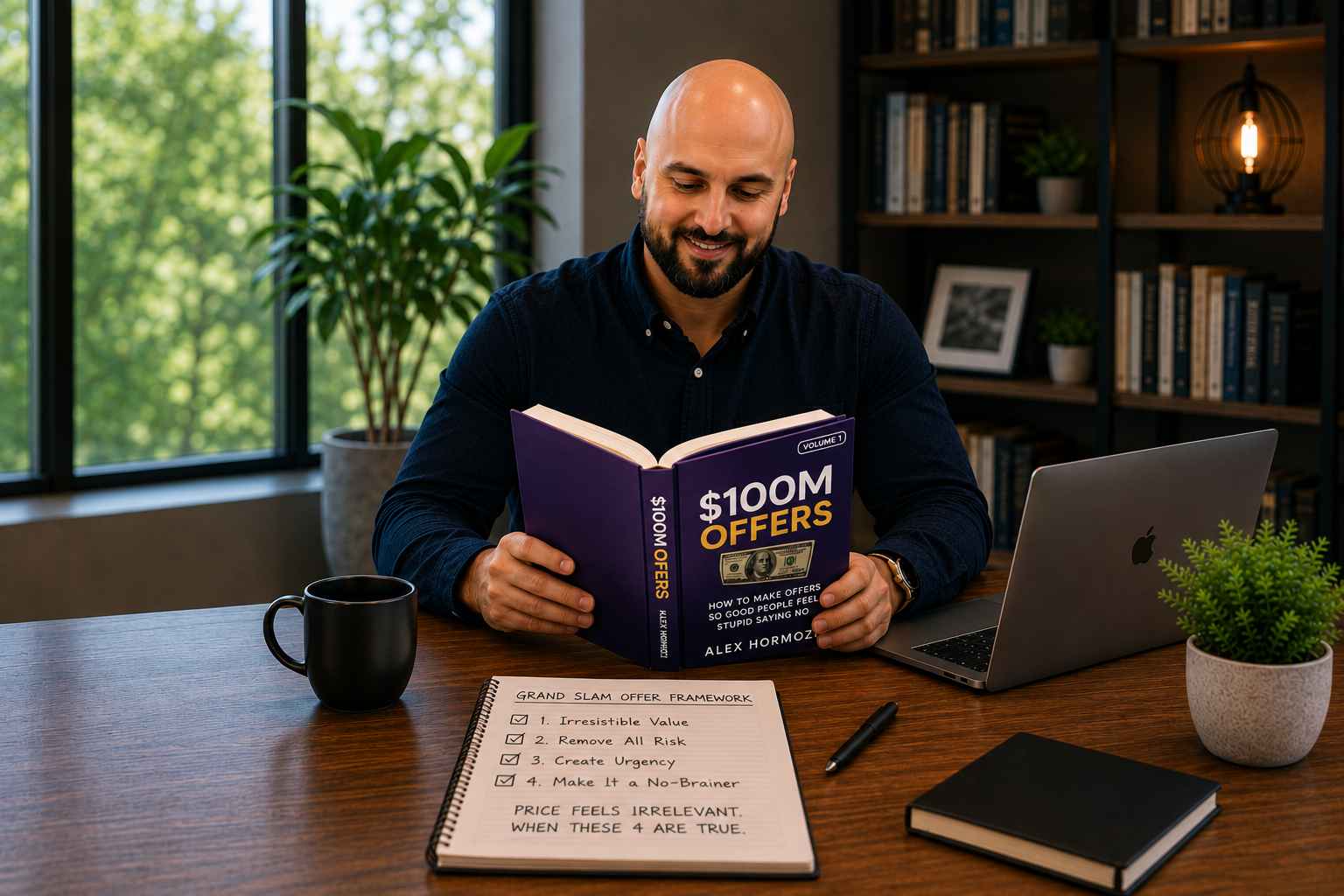
$100M Offers teaches founders how to structure an offer so compelling that the audience feels foolish saying no.
Published by Acquisition.com in 2021. Over 1 million copies sold.
Hormozi's core argument: the offer is the brand. A founder with a strong personal brand and a weak offer generates interest without revenue. A founder with a strong offer and a strong personal brand generates compounding deal flow.
The one principle: The offer structure determines the revenue ceiling. A "Grand Slam Offer" bundles value, removes risk, and creates urgency in a way that makes the price feel irrelevant.
Who reads this: Founders who have built personal brand visibility but struggle to convert attention into revenue. The book fills the monetization gap.
Action after reading: Restructure one existing offer using the Grand Slam Offer framework. Test the restructured offer with 10 prospects. Measure the conversion rate change.
Expert Secrets by Russell Brunson
Expert Secrets teaches founders how to position themselves as the expert authority in a market and build a movement around a core idea.
Published by Hay House in 2017. Revised edition in 2020.
Brunson's framework breaks authority positioning into three components: the origin story, the new opportunity, and the future-based cause. The founder does not sell a product. The founder sells a new way of thinking about a problem. The personal brand becomes the vehicle for the new way of thinking.
The one principle: Authority is built by creating a "new opportunity" rather than improving an existing solution. The founder who offers a new category wins. The founder who offers a better version of an existing category competes on price.
Who reads this: Founders who have expertise but position themselves as "better than the competition" instead of "different from the competition."
Action after reading: Rewrite the positioning statement to describe a new opportunity, not an improvement on an existing approach.
Building a StoryBrand by Donald Miller
Building a StoryBrand teaches founders how to structure every piece of brand messaging as a conversation, not a presentation.
Published by HarperCollins Leadership in 2017. Over 1 million copies sold.
Miller's framework positions the customer as the hero and the founder as the guide. The founder's personal brand messaging follows a 7-part story structure: character, problem, guide, plan, call to action, failure, success.
The framework eliminates the most common personal branding mistake: making the founder the hero of the story instead of making the audience the hero.
The one principle: Clear messaging beats clever messaging. The founder who communicates clearly converts more prospects than the founder who communicates creatively. Clarity is the mechanism of trust.
Who reads this: Founders whose website, LinkedIn profile, and pitch deck describe what they do but fail to connect the description to the audience's problem.
Action after reading: Rewrite the homepage using the StoryBrand 7-part framework. Test the conversion rate against the current version.
Known by Mark W. Schaefer
Known teaches founders the systematic process of moving from unknown to recognized authority in a digital market.
Published in 2017.
Schaefer breaks the "becoming known" process into four steps: find a sustainable interest, define a primary content space, create and publish consistently, and build an audience through strategic sharing. The framework is practical and sequential. Each step depends on the previous step.
The one principle: Becoming known is a process, not an event. The process has a defined sequence. Founders who follow the sequence in order build recognition faster than founders who skip steps.
Who reads this: Founders at the earliest stage of personal branding who have zero online presence and need a structured starting point.
Action after reading: Define one "content tilt" (Schaefer's term for the unique angle within a content space) and publish the first 10 pieces of content within that tilt before expanding.
Tribes by Seth Godin
Tribes teaches founders how to build a movement around a personal brand instead of building an audience around content.
Published by Portfolio in 2008.
Godin's argument: the internet eliminated the need for mass media to lead a movement. A founder with a specific point of view and a willingness to lead attracts a tribe. The tribe is not an audience. An audience consumes. A tribe acts. The personal brand built around tribe leadership generates advocacy, referrals, and community-driven growth.
The one principle: Leadership creates the tribe. The founder does not find an audience. The founder declares a point of view. The people who agree become the tribe. The tribe becomes the distribution channel.
Who reads this: Founders who have built visibility but lack community engagement. The book shifts the objective from "grow the audience" to "lead the movement."
Action after reading: Identify the one belief that defines the founder's point of view. Publish a manifesto-style piece of content that declares the belief. Measure how many people actively share the declaration.
Crushing It! by Gary Vaynerchuk
Crushing It! teaches founders how to use social media platforms as personal brand distribution engines through specific platform-by-platform strategies.
Published by HarperBusiness in 2018.
Vaynerchuk profiles dozens of entrepreneurs who built personal brands on specific platforms: YouTube, Instagram, podcasting, Twitter, and LinkedIn. Each case study includes the specific tactics that generated growth on that platform. The book is platform-specific and tactic-heavy.
The one principle: The personal brand is the living system that adapts to every platform. The founder who commits to one platform for 3 to 5 years before expanding builds deeper authority than the founder who spreads across every platform simultaneously.
Who reads this: Founders who have positioning and frameworks but need platform-specific distribution strategies. Read this book after Expert Secrets or GURU, INC., not before. Distribution without positioning is noise.
Action after reading: Choose one platform based on where the target audience spends time. Commit to daily or weekly publishing on that platform for 90 days before evaluating results.
The Reading Order for Founders
The recommended order follows the authority-building sequence: strategy first, then structure, then distribution.
GURU, INC. Authority architecture and framework development.
Expert Secrets. Positioning as the expert through a new opportunity.
$100M Offers. Offer structure that converts authority into revenue.
Building a StoryBrand. Messaging clarity across all touchpoints.
Known. Systematic process from unknown to recognized.
Tribes. Movement building and community leadership.
Crushing It! Platform-specific distribution tactics.
Founders who need strategic guidance beyond what books provide benefit from working with a personal branding consultant who implements the frameworks alongside the founder.
Frequently Asked Questions
What is the best personal branding book for beginners?
Known by Mark W. Schaefer is the best starting point for founders with zero online presence. The book provides a sequential, step-by-step process for moving from unknown to recognized.
Founders who already have some visibility start with GURU, INC. or Expert Secrets for deeper authority architecture.
How many personal branding books does a founder need to read?
Seven books cover the complete authority architecture: positioning, IP development, offer structure, messaging, audience building, movement leadership, and platform distribution. Reading all seven gives the complete blueprint.
Reading the first three (GURU, INC., Expert Secrets, $100M Offers) gives the strategic foundation that produces the highest immediate leverage.
Are personal branding books worth reading in 2026?
Personal branding books that teach architecture and frameworks remain valuable because human trust patterns do not change with platform updates.
Books that teach platform-specific tactics lose value faster because platforms evolve. The seven books on this list prioritize architecture over tactics.
What is the difference between a personal branding book and a marketing book?
A personal branding book teaches how to make the founder's expertise visible, trusted, and monetizable. A marketing book teaches how to promote products or services. The personal brand is the trust engine. Marketing is the distribution channel for trust.
Founders benefit from reading personal branding books before marketing books because the brand determines what gets marketed.
Can reading personal branding books replace hiring a consultant?
Books provide frameworks. Consultants provide implementation, accountability, and customization. A founder who reads all seven books and implements the frameworks independently builds authority effectively.
A founder who reads the books and works with a consultant builds authority faster because the consultant adapts the frameworks to the founder's specific industry, audience, and revenue stage.