
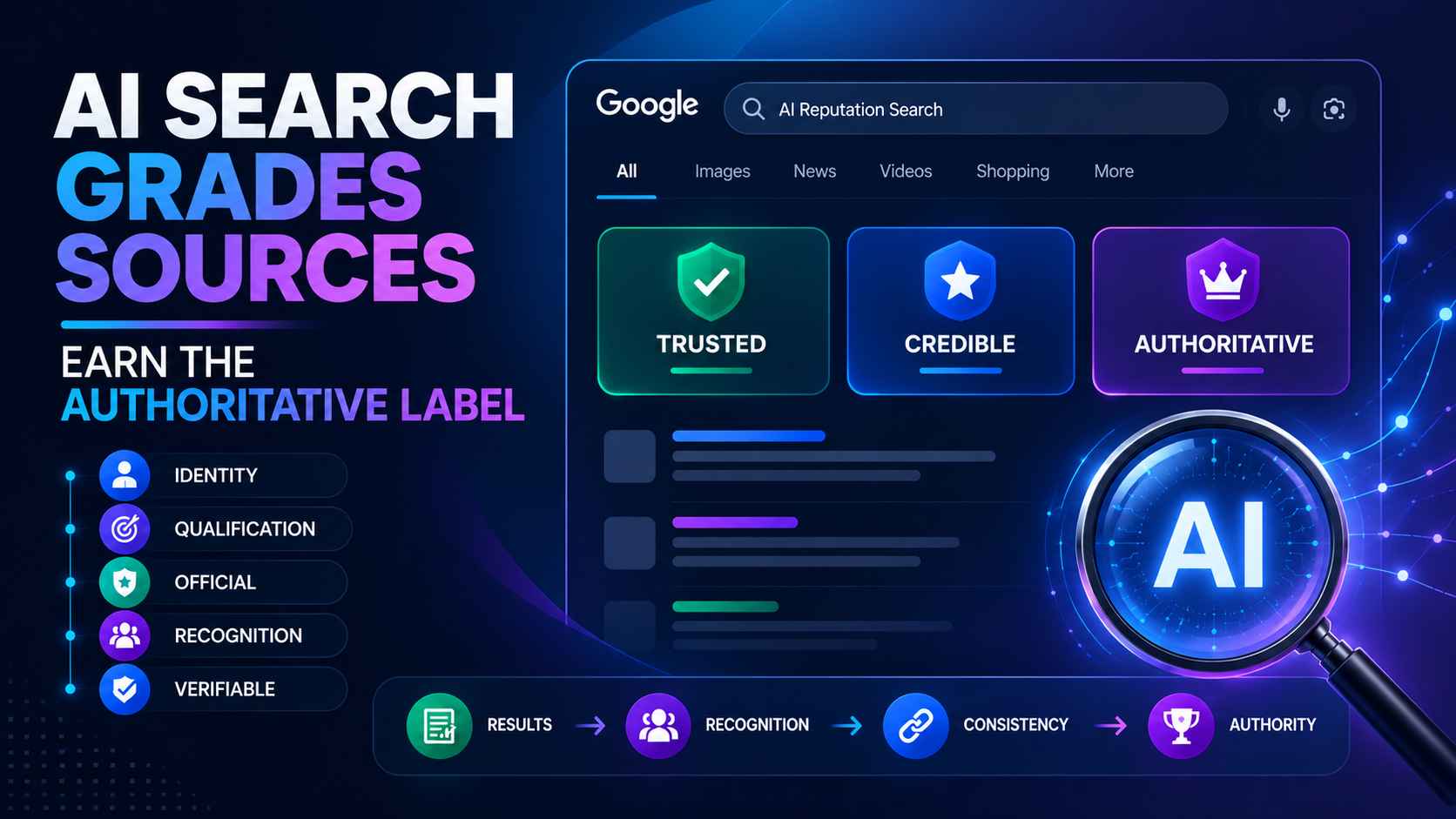
That question is changing underneath us. AI platforms are starting to ask who is behind the information, what they are qualified to speak on, and whether anyone credible agrees. Visibility was the asset. Reputation is becoming the asset, and visibility is becoming the result.
Key Takeaways
Perplexity has started labeling sources Trusted, Credible, and Authoritative, with a stated reason for each label.
No official announcement exists yet, which suggests a quiet rollout or a test worth watching.
Classic search graded pages. AI search checks the identity, qualifications, and recognition of the person behind them.
Reputation becomes the asset in AI search. Visibility becomes the downstream result.
Founders earn the labels through evidence: documented results, third-party recognition, and one consistent description everywhere.
Do not build content the engines can rank. Build a reputation the engines can verify.
The Labels Perplexity Is Quietly Testing
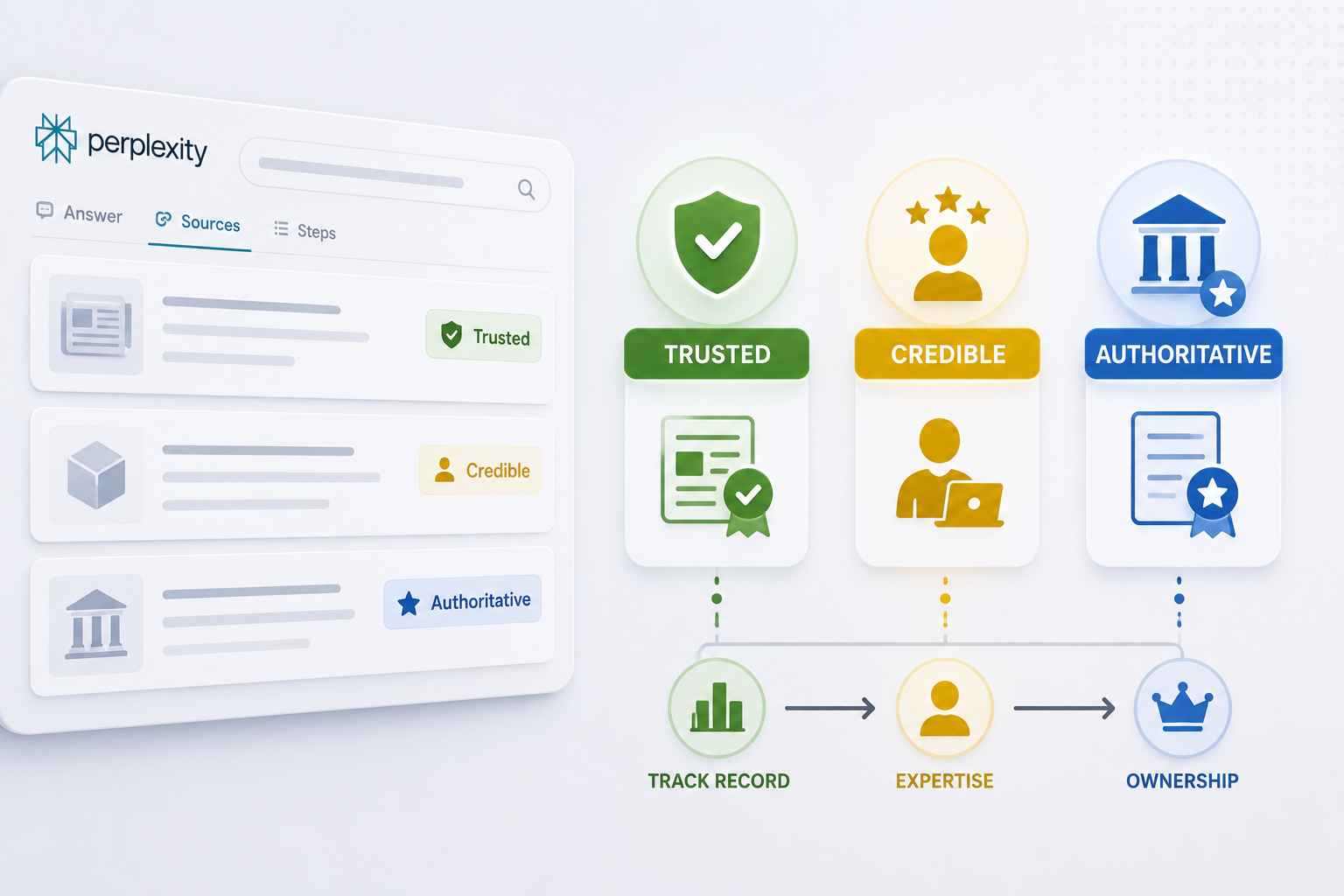
A quiet feature has started appearing inside Perplexity results: sources labeled Trusted, Credible, or Authoritative, each with a reason attached. The observed examples draw the lines clearly. A media outlet earned Trusted for its history of factual reporting.
A software company earned Credible for explaining its own tools, pricing, and workflows. Google's developer site earned Authoritative because it is the official source for Google's own documentation.
No official announcement explains the feature yet, so honesty requires saying this plainly: the labels may be a test, and tests change. The direction they point in does not change, because the labels match everything AI platforms already reward underneath the interface. The grading was always happening. The labels put it on screen.
What Each Label Signals
The three labels answer three different questions. Trusted answers a track-record question: has this source been factually reliable over time.
Credible answers a firsthand-knowledge question: is this source qualified on its own domain, the company explaining its own product, the practitioner describing their own field. Authoritative answers an ownership question: is this the official, canonical source for the subject itself.
A founder reading those three definitions closely sees the opportunity inside them. Trusted takes years. Authoritative belongs to official owners of a subject.
Credible is available now, to any expert who documents real firsthand knowledge, and Authoritative is available to any founder who owns a named subject outright: a framework, a methodology, a body of work with their name on it.
The Question AI Search Asks Is Different
Classic search graded the paper. AI search checks the ID of the person who wrote it. That is the whole shift in one line. For two decades, ranking rewarded the page: the keywords, the links, the structure. The author was nearly invisible to the system.
AI platforms invert this. Before citing a claim, the system wants to resolve who made it, what they are qualified to say, whether they are the official source, whether independent sources recognize them, and whether the claim can be verified.
So the question becomes: what does the machine already believe about you? Every founder has an answer sitting inside these systems right now. Most have never checked it.
From Visibility as Asset to Reputation as Asset
The old model treated visibility as the thing you built. Publish, rank, get seen, and trust followed the exposure. The new model runs the sequence backward.
The system forms a judgment about who you are first, from evidence scattered across the open web, and that judgment decides whether you get surfaced at all.
Discovery is moving from ranked pages to machine-formed answers, and a machine-formed answer needs a machine-readable reputation to cite.
Publishing more content does not fix a weak reputation in this model. A thousand pages from an unresolved, unrecognized author read as a thousand pages of noise.
Ten pages from a clearly identified, third-party-recognized expert read as citable. The volume game and the reputation game are different sports, and only one of them is getting rewarded going forward.
How AI Systems Decide Who You Are
The machine builds its picture of a founder from evidence it can cross-reference, and the picture forms with or without the founder's participation.
The inputs are unglamorous: how consistently the name and descriptor appear across the web, whether independent sources describe the founder the same way the founder describes himself, whether official records exist for the claims made, and whether the founder owns any subject outright.
The Five Checks Behind the Label
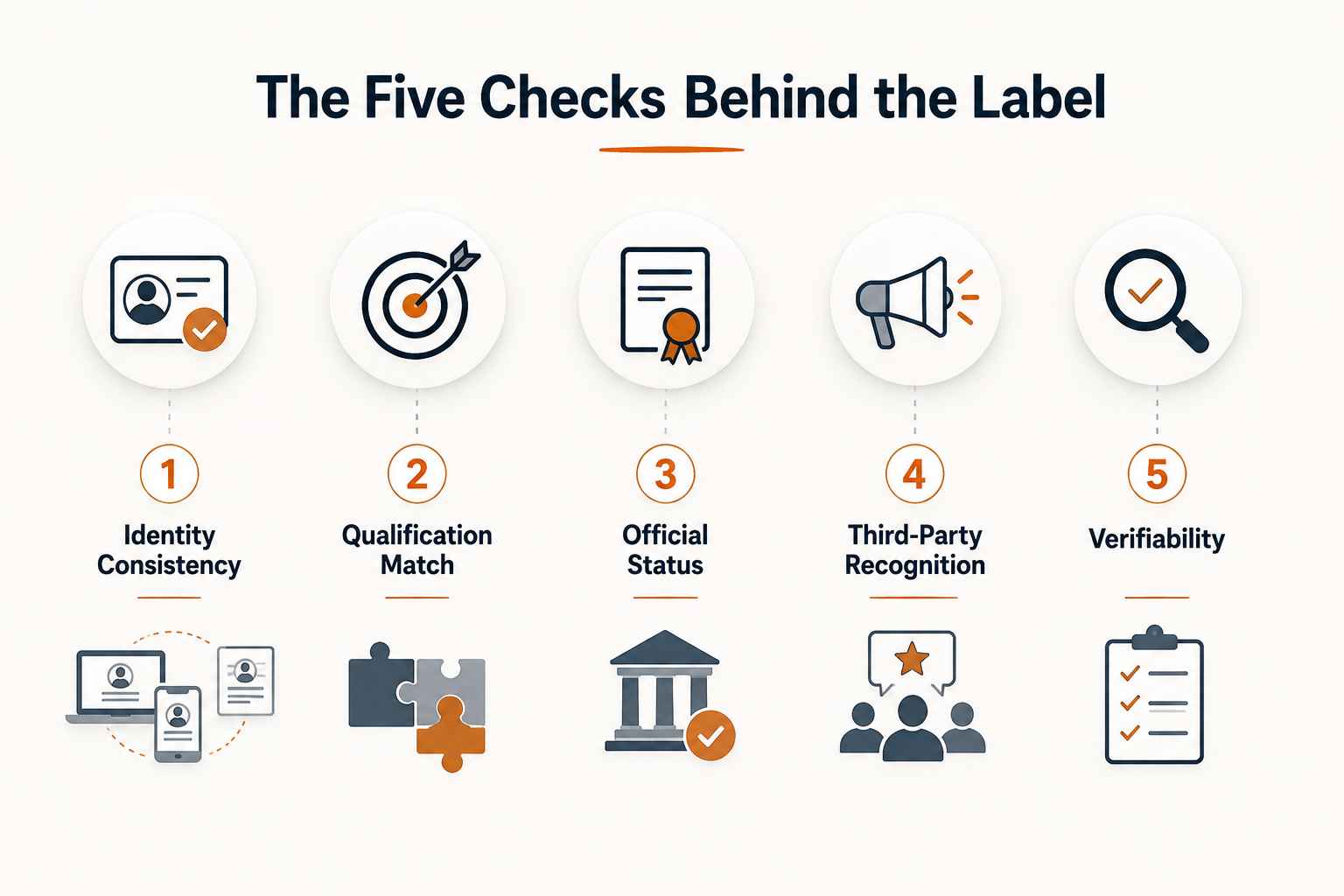
Five checks sit underneath any credibility judgment an AI system makes. The five checks are given below:
Identity consistency. The same name, the same descriptor, the same story across every profile, byline, and mention. Fragmented identities read as unresolved entities, and unresolved entities do not get cited.
Qualification match. The subjects the founder speaks on match the subjects the evidence supports. Credibility is domain-specific. An expert in one field claiming ten reads as an expert in none.
Official status. Where the founder is the actual source, the author of the book, the creator of the framework, the operator of the business, the official record exists and says so.
Third-party recognition. Independent sources mention, cite, list, and describe the founder without being paid to. Documented proof outranks self-described credentials, and machines weigh independence the same way skeptical humans do.
Verifiability. Claims trace to checkable evidence: named clients, published work, real numbers. A claim the system cannot verify is a claim the system quietly discounts.
The Evidence Founders Build to Earn the Labels
Reputation, to a machine, is a pile of evidence with a consistent name on it. The founders who get described accurately and cited confidently are the ones who built the pile on purpose. Three layers of evidence do most of the work.
Documented Results and Named Proof
Anonymous success stories carry no weight with machines or people. Named clients, real numbers, and published outcomes give the system claims it can verify and attach to the founder's identity.
Every documented result is a brick in the qualification-match wall: proof the founder is qualified on exactly the subject they speak about.
Third-Party Recognition
A founder's own site can claim anything, which is exactly why it settles nothing. The recognition layer lives on other people's property: podcast appearances, guest articles, industry lists, media mentions, citations by other experts. Each one is an independent witness confirming the founder's description of himself.
Video platforms feed this layer directly, since interviews and appearances generate the show notes, transcripts, and cross-references machines parse. The pattern to build is simple: your site makes the claim, and other sites confirm it.
One Consistent Description Everywhere
The least glamorous asset is the most load-bearing: one descriptor, used identically everywhere. The same sentence on the website, the LinkedIn profile, the podcast bios, and the book jacket. Machines resolve identity through repetition, and every variation splits the evidence pile.
A published book anchors this layer harder than anything else, because a book is the most difficult credential to fake and the easiest official record to verify.
Classic SEO vs AI Reputation Search
Attribute | Classic search | AI reputation search |
Asset built | Visibility of pages | Verifiable reputation of the person |
Unit graded | The page | The source behind the page |
Question asked | Does this page deserve to rank | Does this person deserve to be believed |
Winning move | Publish and optimize more | Build evidence others can verify |
Failure mode | Thin content | Unresolved identity, unsupported claims |
The table understates one thing: the two systems run at the same time. Structured, extractable pages still matter, because machines still read pages. The reputation layer sits on top of page quality, never instead of it. A founder needs both, and most have invested in exactly one.
The Reputation Audit I Run With Founders Now
Every diagnostic I run now starts with one exercise: ask the AI engines who you are, and read the answer without flinching. The machine's current description of a founder is the baseline, and it is usually thinner, vaguer, or wronger than the founder expects.
From there the work is evidence construction, not content volume: fixing the identity inconsistencies, building the third-party layer, and putting official records where official records belong.
The measurement side already exists in my framework. Identity value inside ROAC, Return on Attention Created, asks whether attention made the founder known for one specific thing.
AI reputation is identity value made machine-readable: the same association, now stored in systems that decide who gets cited. A founder scoring high on identity value is already building the evidence pile. A founder scoring low is invisible to the exact systems taking over discovery.
Building the full evidence architecture, the descriptor, the third-party layer, the official records, and the named IP that earns the Authoritative label outright, is the standing work of my consulting practice, and it has quietly become the most consequential work I do. The labels on screen are new. The grading behind them was always coming.
AI search is grading sources on identity, qualification, official status, recognition, and verifiability, and the labels are starting to appear on screen. The founders who win build evidence, not volume. Do not build content the engines can rank. Build a reputation the engines can verify.
What Are Perplexity's Source Labels
Perplexity has been observed labeling sources Trusted, Credible, or Authoritative, each with a stated reason: factual track record, firsthand domain knowledge, or official ownership of the subject. No official announcement exists yet, which suggests a quiet rollout or test.
How Does AI Search Decide a Source Is Authoritative
Authoritative status attaches to official ownership: the creator of the framework, the author of the book, the operator of the documented business. A founder earns it by owning a named subject outright and holding the verifiable official record for it.
How Do Founders Show Up in AI Search Results
Founders show up through evidence machines can cross-reference: one consistent descriptor everywhere, documented results with named proof, third-party mentions on independent sites, and official records for the subjects they own. Content volume without that evidence layer stays invisible.
Does AI Reputation Search Replace Traditional SEO
No. The two systems run together. Structured, extractable pages still feed every engine, and the reputation layer decides whose pages get believed and cited. Founders who invest in both hold the position founders who invest in either one alone cannot reach.