
Entrepreneurs who define positioning before publishing content build authority that compounds. Entrepreneurs who publish content before defining positioning produce volume that leads nowhere.
The Guru Ladder framework gives entrepreneurs a structured system for moving from unknown to unchallenged authority in a specific market.
Key Takeaways:
A personal brand positioning strategy answers one question: what does the market associate with this founder's name?
90% of entrepreneurs position too broadly. "I help businesses grow" competes with 100,000 people. "I build authority brands for founders scaling past $1M" competes with a handful.
The Guru Ladder framework has five levels: Unknown, Contributor, Expert, Authority, and Category Owner. Each level requires a different positioning strategy.
Positioning narrows the audience and expands the pricing power. The narrower the positioning, the higher the perceived expertise, the higher the rate.
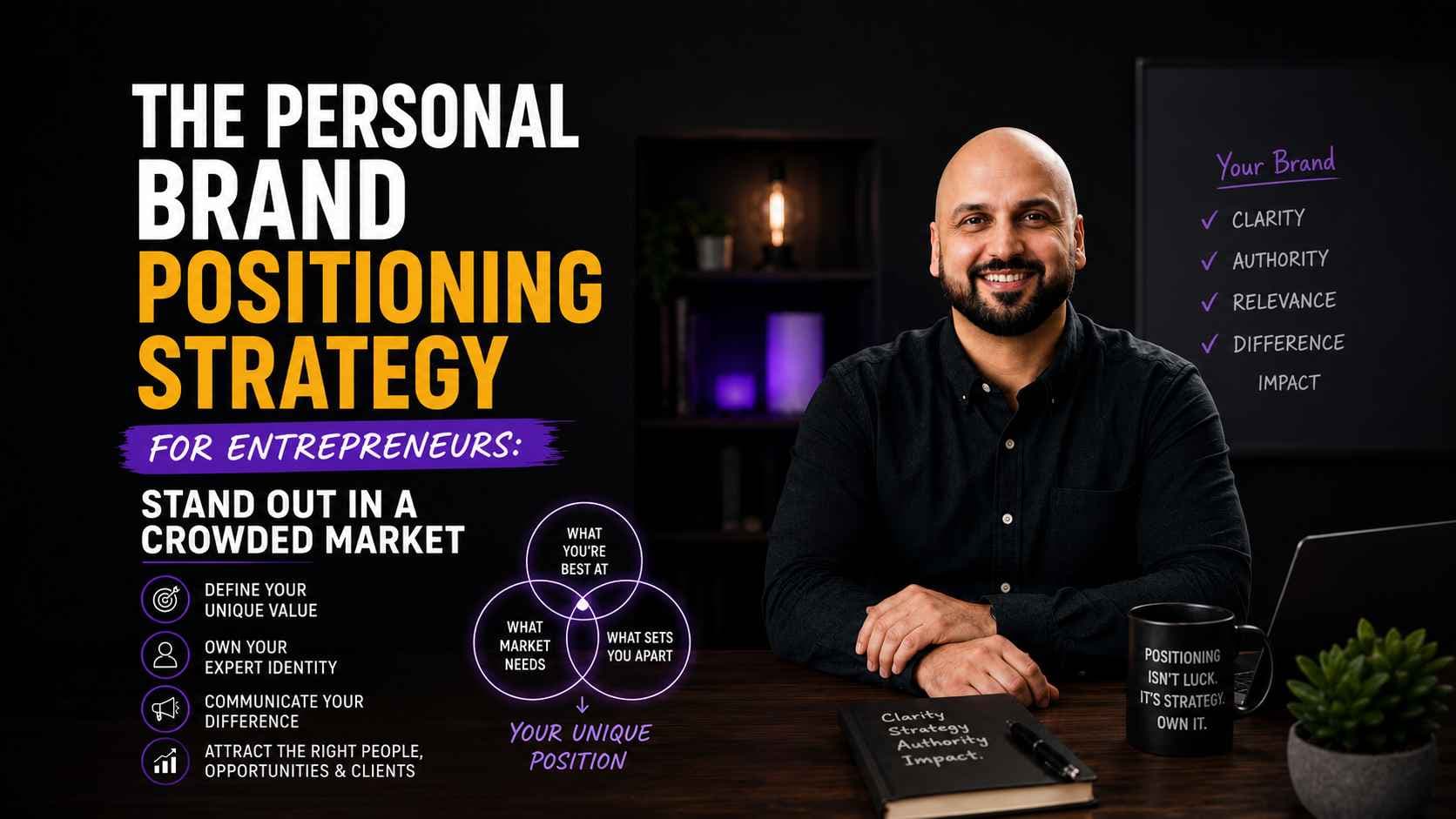
The three inputs to a personal brand positioning strategy are: the founder's deepest expertise, the market's underserved demand, and the named intellectual property that bridges the two.
Testing the positioning takes one week. Building the positioning takes one afternoon. Committing to the positioning takes courage.
Why Most Entrepreneurs Fail at Positioning
Most entrepreneurs fail at personal brand positioning because they describe what they do instead of declaring what they own.
"I am a marketing consultant." That describes a function. Every marketing consultant in the world shares that description. The prospect reads the description and has no reason to choose this founder over the next one.
"I architect authority brands for founders who have outgrown their reputation." That declares ownership. A specific type of brand (authority). A specific audience (founders). A specific problem (outgrown their reputation). The prospect reads the declaration and immediately knows if the founder is relevant.
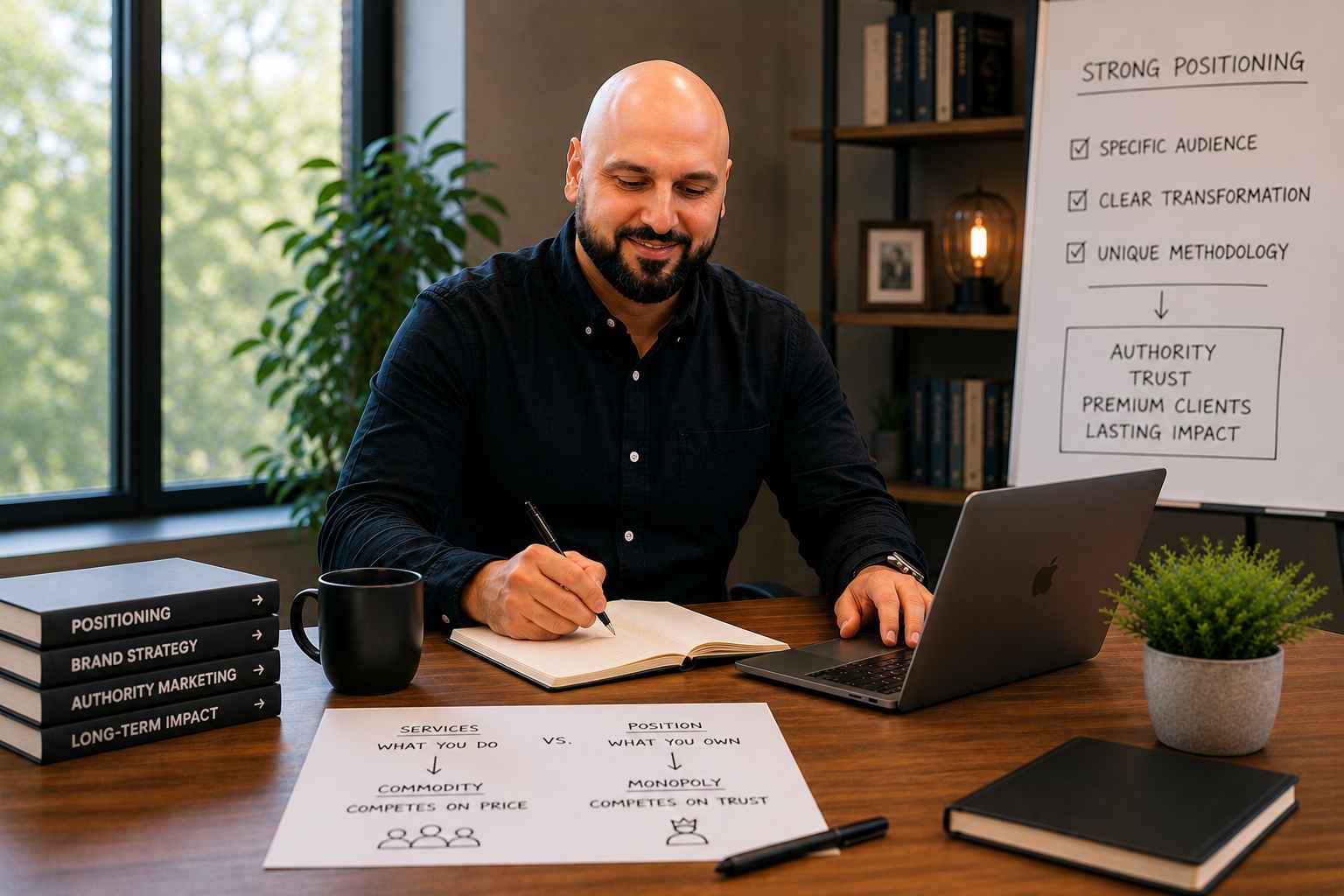
I have reviewed hundreds of entrepreneur positioning statements over the past 20+ years. The failure pattern is consistent. The entrepreneur lists services instead of declaring a position. Services are commodities. Positions are monopolies. A commodity competes on price. A monopoly competes on trust.
Three reasons entrepreneurs fail at positioning:
Reason 1: Fear of exclusion.
The entrepreneur worries that narrowing the positioning eliminates potential clients. The opposite is true. Narrowing the positioning attracts the highest-value clients because specificity signals expertise. Generality signals availability.
Reason 2: Unclear intellectual property.
The entrepreneur has deep expertise but has not named, structured, or documented the methodology. Without named IP, the positioning lacks the differentiator that separates the founder from every other expert in the space.
Reason 3: Copying competitors.
The entrepreneur studies competitors and mirrors their positioning language. The result: identical positioning across 10 competitors. The prospect cannot distinguish one from another. The differentiation disappears because the positioning source was imitation, not introspection.
The Guru Ladder: A Personal Brand Positioning Framework
The Guru Ladder is a five-level framework that maps the personal brand positioning strategy an entrepreneur needs at each stage of authority.
I developed the Guru Ladder and published the framework in GURU, INC. because entrepreneurs need different positioning strategies at different authority levels. A founder at Level 1 does not need the same positioning approach as a founder at Level 4. The ladder provides the map.
Level 1: Unknown
The market does not recognize the founder's name or expertise. The personal brand positioning strategy at this level focuses on one action: publish one specific claim consistently. The claim is narrow. The audience is small. The depth is extreme.
Founders at Level 1 do not need a social media presence. Founders at Level 1 need a structured website and one long-form content piece per month. The content establishes the specific claim. The repetition builds recognition.
Level 2: Contributor
The market recognizes the founder's name within a small professional circle. Guest podcast appearances, industry event participation, and published articles have established initial credibility. The personal brand positioning strategy at this level focuses on naming the first proprietary framework.
A named framework is the asset that moves a founder from Contributor to Expert. The framework does not need to be complex. The framework needs a name, a structure, and documented results.
Level 3: Expert
The market seeks the founder's opinion on specific topics. Media outlets, podcasts, and industry events invite the founder to contribute. The personal brand positioning strategy at this level focuses on publishing a definitive content piece (a book, a viral article, or an in-depth guide) that the market references as the go-to resource on a specific topic.
The founders who reached this level all published one breakthrough piece of content that the market refused to ignore. Hormozi published $100M Offers. Ferriss published The 4-Hour Workweek. Godin published Tribes. The breakthrough piece is the positioning accelerant.
Level 4: Authority
The market considers the founder the default recommendation for a specific problem. When a prospect asks their network "who handles X?", the founder's name comes up without prompting.
The personal brand positioning strategy at this level focuses on building systems that make the authority self-sustaining: a content ecosystem, an IP licensing model, and a team that distributes the founder's frameworks without the founder's daily involvement.
Level 5: Category Owner
The market cannot think about the category without thinking about the founder. The founder IS the category. This level is rare. Oprah owns a "media empire built on trust." Hormozi owns "founder-level offer strategy." Tony Robbins owns "live event transformation."
The personal brand positioning strategy at this level focuses on expanding the category definition rather than defending the position. The founder at Level 5 has no competitors because the founder created the category.
How to Build a Personal Brand Positioning Strategy in Three Steps

A personal brand positioning strategy requires three inputs: the founder's deepest expertise, the market's underserved demand, and the named intellectual property that bridges the two.
Step 1: Identify the Deepest Expertise
The deepest expertise is not the broadest skill. The deepest expertise is the area where the founder has the most specific, verifiable, differentiated knowledge.
Three diagnostic questions:
What topic generates the most detailed answers in client conversations?
What problem do clients hire the founder to solve that other providers consistently fail to solve?
What process does the founder follow that no competitor replicates?
The answers reveal the positioning territory. The territory is narrow. The narrowness is the advantage.
Step 2: Map the Underserved Demand
The market has gaps. The positioning strategy targets the gap, not the center. The center is crowded. The gap is empty.
"Personal branding" is the center. 100,000 providers compete. "Personal brand positioning strategy for entrepreneurs scaling past $1M" is the gap. A handful of providers compete. The gap is where the pricing power lives.
I map underserved demand by analyzing three sources: prospect language in sales conversations, search queries with low competition, and questions in industry forums that nobody answers well.
Step 3: Name the Intellectual Property
The named IP bridges the founder's expertise and the market's demand. The framework name becomes the positioning anchor. Every piece of content references the framework. Every client conversation introduces the framework. Every speaking engagement features the framework.
The personal brand statement is the output of this step. The statement declares the positioning in 8 words: what the founder does, for whom, and through which named methodology.
The Positioning Trap: Appealing to Everyone
The entrepreneur who positions for everyone positions for no one.
Three symptoms of the positioning trap:
Symptom 1
The website homepage describes multiple services for multiple audiences. The prospect who lands on the page cannot determine in 3 seconds what the founder specializes in. The prospect leaves. Not because the founder lacks expertise. Because the positioning failed to communicate the expertise.
Symptom 2
The founder's elevator pitch changes depending on the audience. Inconsistent positioning fragments the entity signal that search engines and AI systems use to classify the founder. A personal brand strategist defines one positioning and maintains the positioning across every touchpoint.
Symptom 3
The content covers 10 different topics with no central thesis. Each piece of content performs in isolation. No compounding occurs because the content lacks a unifying positioning claim. The content library becomes a collection of unrelated articles instead of an authority architecture.
The fix: narrow the positioning until the founder feels uncomfortable. The discomfort is the signal that the positioning is specific enough to differentiate.
Positioning at Different Revenue Stages
The personal brand positioning strategy evolves as revenue grows. The positioning at $100K per year is not the positioning at $5M per year.
$0 to $100K: The positioning is maximally narrow. One audience. One problem. One methodology. The founder competes on specificity. "I help SaaS founders at $500K ARR build authority that closes enterprise deals" is narrow enough to attract the right 10 clients.
$100K to $500K: The positioning deepens. The founder adds proof points, case studies, and published IP to the existing narrow position. The audience stays the same. The credibility increases. Pricing power rises.
$500K to $2M: The positioning begins to widen strategically. The founder adds a second adjacent audience or a second problem within the same domain. "SaaS founders" becomes "B2B founders." The widening is deliberate and backed by published proof in the adjacent space.
$2M to $10M: The positioning shifts from personal to categorical. The founder's name becomes associated with a category, not a service. The personal brand and business brand both carry the positioning. The founder is the authority. The company is the delivery mechanism.
How to Test a Positioning Strategy in Seven Days
A positioning strategy is a hypothesis until prospects validate the claim.
Day 1 to 2: Write the positioning statement in 8 words. Share the statement with 5 existing clients. Ask: "Does this describe what I do for you?" If 4 out of 5 agree, the positioning reflects reality.
Day 3 to 4: Share the positioning statement with 5 prospects who have never hired the founder. Ask: "Does this make you want to learn more?" If 3 out of 5 say yes, the positioning generates curiosity.
Day 5 to 6: Search the positioning statement in Google. Count how many competitors use identical or near-identical language. If more than 3 competitors use the same language, the positioning lacks differentiation. Rewrite the differentiator.
Day 7: Update the LinkedIn headline, website homepage, and email signature with the validated positioning statement. Publish one piece of content that demonstrates the positioning claim with a specific example from practitioner experience.
The positioning is now live. Measure inbound inquiries over the next 30 days. If inquiries increase, the positioning is working. If inquiries stay flat, the positioning needs refinement. The personal branding books on this topic provide additional frameworks for refinement.
Frequently Asked Questions
What is a personal brand positioning strategy?
A personal brand positioning strategy is the system that determines what the market associates with the founder's name. The strategy defines the specific audience served, the specific outcome delivered, and the named methodology that differentiates the founder from every other provider.
The output of the strategy is a positioning statement that governs all content, messaging, and business decisions.
How is positioning different from branding?
Positioning is the strategic decision about what the founder stands for. Branding is the visual and verbal expression of that decision (logo, colors, voice, messaging).
Positioning precedes branding. A founder who brands before positioning produces attractive visuals with no strategic foundation. Positioning is the architecture. Branding is the paint.
How narrow does positioning need to be?
The positioning is narrow enough when the founder feels uncomfortable about the number of potential clients excluded.
The discomfort is the signal that the positioning is specific enough to differentiate. "I help businesses" is too broad. "I build authority brands for wellness founders scaling past $1M through IP-first positioning" is narrow enough to attract the ideal 10 to 20 clients per year.
Can positioning change over time?
Positioning evolves as the founder's authority grows and the market shifts. The core audience and differentiator remain stable for 12 to 24 months. The specificity of the outcome and the sophistication of the named intellectual property increase over time.
The positioning does not pivot randomly. The positioning deepens and widens strategically based on proven results.
What is the biggest positioning mistake entrepreneurs make?
The biggest mistake is describing services instead of declaring a position. "I offer marketing consulting, brand strategy, and content creation" is a service list. "I architect authority brands for founders who have outgrown their reputation" is a position.
The service list competes on price. The position competes on trust. The founder who declares a position attracts higher-value clients at higher rates.