
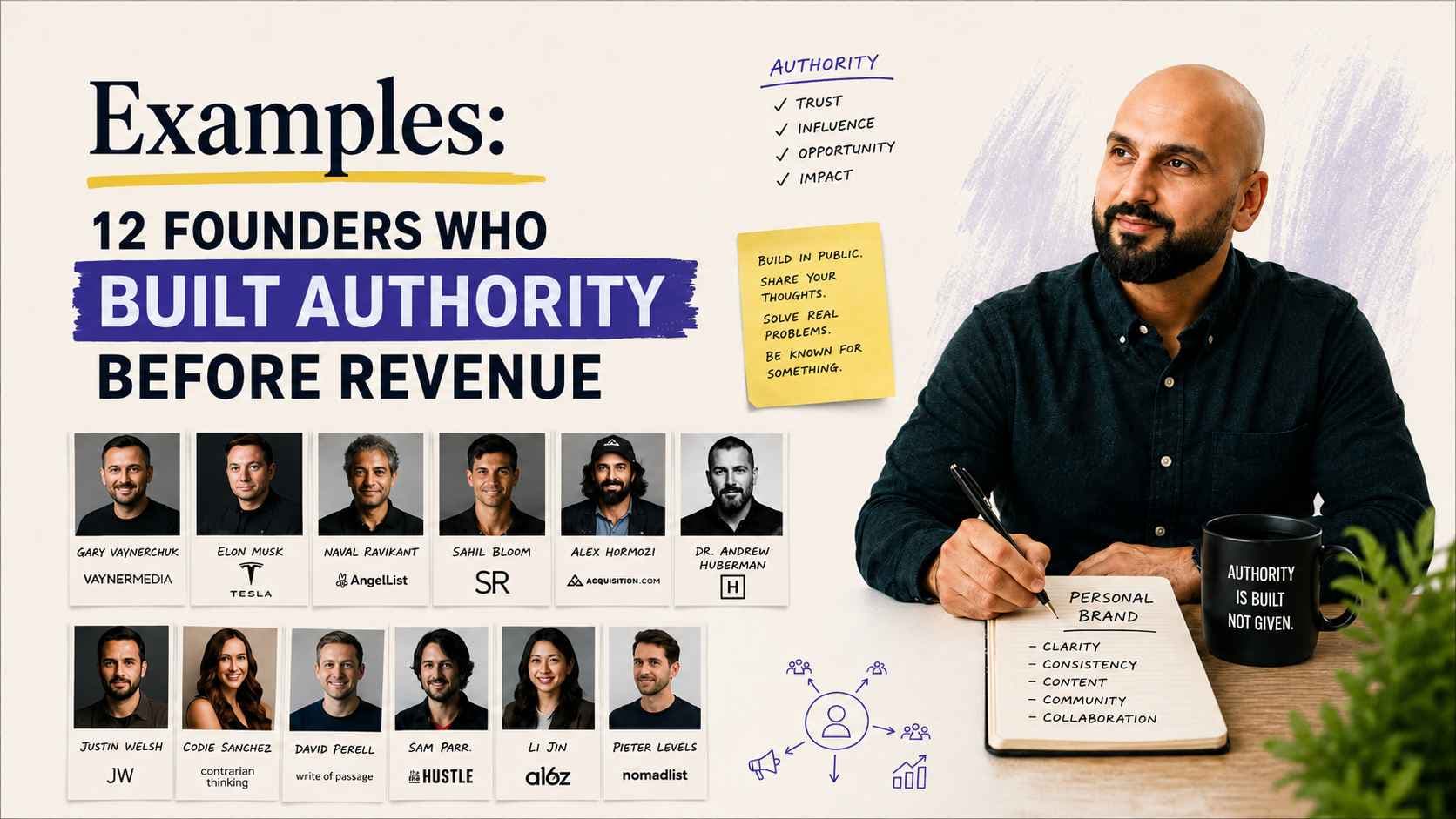
The personal brand was the foundation the business launched from. Every example below includes the specific authority-building action and the revenue outcome that followed.
Key Takeaways:
All 12 founders built measurable authority before generating significant revenue from their personal brands.
The most common authority-first action is publishing free intellectual property: books, tools, frameworks, or educational content.
The timeline from authority investment to revenue breakthrough ranges from 18 months to 7 years across these examples.
Nine of the 12 founders named a proprietary framework or system before launching paid offerings.
Personal brand examples built on free IP consistently outperform personal brand examples built on paid advertising.
The pattern is consistent: give away the thinking, charge for the implementation.
Authority Before Revenue Is the Pattern Behind Every Strong Personal Brand Example
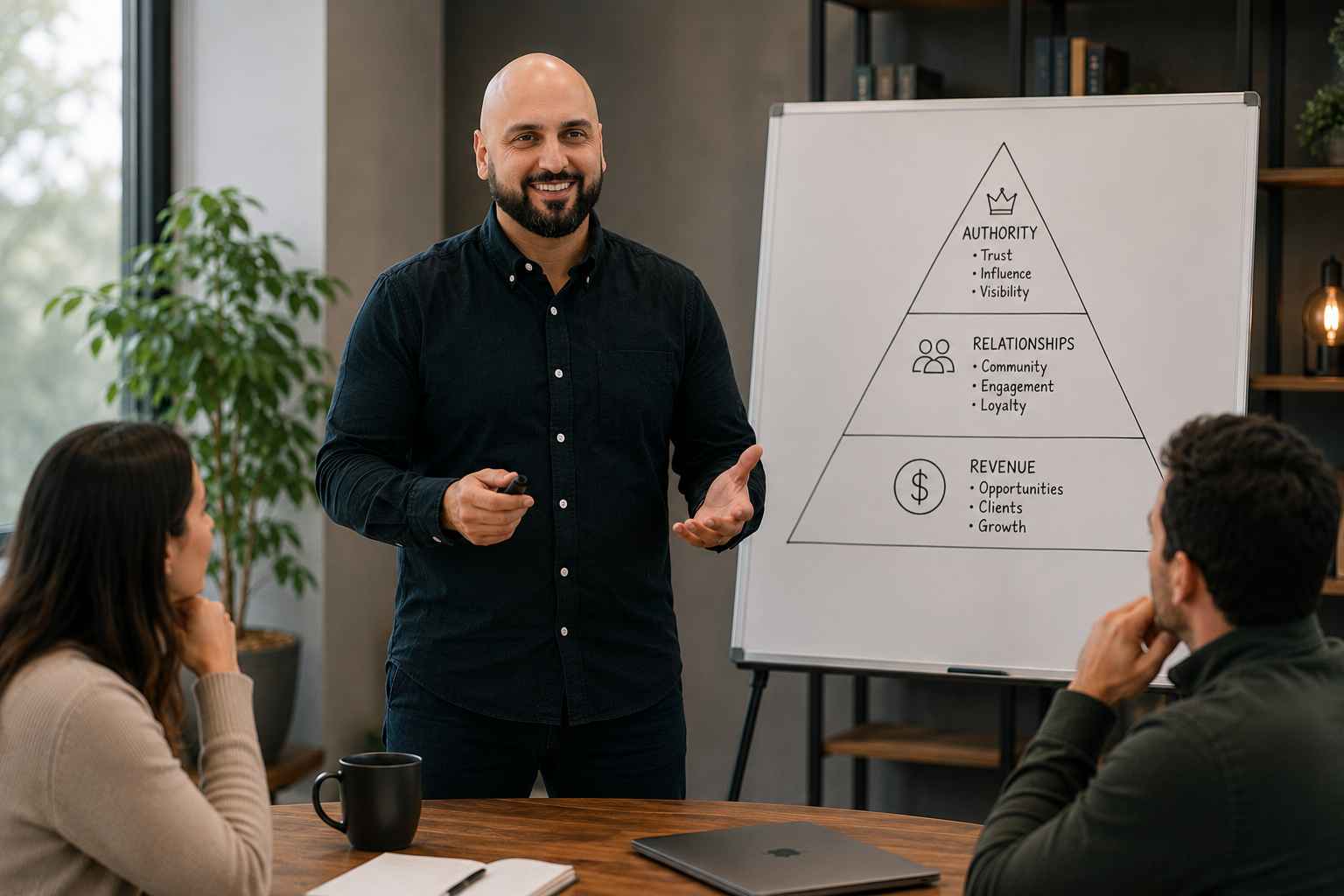
The strongest personal brand examples in every industry followed the same sequence: build trust first, monetize second.
The reverse sequence (monetize first, build trust later) produces short-term revenue and long-term obscurity. The authority-first sequence produces a slow start and compounding returns.
I have studied this pattern across every client engagement and every founder I have analyzed over more than 20 years. The founders who built authority before revenue are the founders who still have authority a decade later. The founders who monetized before establishing trust are the founders nobody remembers.
The 12 personal brand examples below span media, technology, wellness, real estate, finance, and the creator economy. The industries differ. The pattern does not.
Founders Who Gave Away Intellectual Property First
The first category of personal brand examples built authority by giving away their best thinking for free.
Alex Hormozi
Alex Hormozi published two books at $0.99 each. The books contained the exact frameworks that consulting firms charge $50,000 to deliver. He distributed 2.9 million copies in 24 hours and set a Guinness World Record.
The books replaced the sales team for Acquisition.com. Founders who read the books arrive with trust pre-built. The portfolio now generates over $200 million in annual revenue across portfolio companies.
The authority move: give away the IP at the lowest possible price. The revenue follows because the trust is already established.
Neil Patel
Neil Patel built free SEO tools (Ubersuggest, AnswerThePublic) that competitors charged thousands to access. The tools generate millions of monthly users. A fraction convert into NP Digital agency clients. NP Digital grew to over 1,000 employees and serves enterprise clients globally.
I learned this principle directly from Neil. The free tools are not lead magnets. The free tools are authority infrastructure that builds trust at a scale paid advertising cannot replicate.
Justin Welsh
Justin Welsh published a free weekly newsletter (The Saturday Solopreneur) for two years before launching The Creator MBA course at $897. The newsletter grew to 175,000 subscribers. The personal brand generated $12 million in revenue at 90% margins. One person. No employees. No venture capital.
The authority move: publish free high-value content consistently for 24 months before asking for a dollar.
Pat Flynn
Pat Flynn published the Smart Passive Income blog and podcast for 18 months before generating meaningful revenue. The content documented his journey from layoff to online business in real time. The transparency built trust.
The trust converted into course sales, affiliate revenue, and a media company that generated over $2 million per year.
The authority move: document the process publicly. The audience watches the journey unfold and trusts the expertise because they witnessed the learning.
Founders Who Built Audiences Before Products
The second category of personal brand examples built audiences on one platform before launching any paid offering.
Gary Vaynerchuk
Gary Vaynerchuk filmed Wine Library TV from 2006 to 2011. Five years of daily video content about wine. No product to sell. No agency to promote. The show grew the family wine business from $3 million to $60 million in revenue.
The audience attention built through 1,000 episodes became the foundation for VaynerMedia, which now generates over $300 million in annual revenue.
The authority move: commit to one platform for five years with no monetization plan. The authority compounds. The revenue finds the authority.
Sahil Bloom
Sahil Bloom built a Twitter and newsletter audience by publishing free frameworks about finance, decision-making, and personal growth. The audience grew to over 1 million followers before he launched SRB Ventures.
Investors, founders, and brand partners approached him because the personal brand made outbound unnecessary.
The authority move: publish frameworks consistently on one platform. The specificity of the frameworks attracts a specific audience. The specific audience becomes the business.
Tim Ferriss
Tim Ferriss published The 4-Hour Workweek in 2007. The book sold over 2 million copies and defined a category. The personal brand built through the book and subsequent podcast (over 900 million downloads) became the distribution channel for angel investments in companies like Uber, Shopify, and Alibaba.
The investment returns exceeded $100 million. The authority move: publish one definitive piece of intellectual property that defines a category. The category ownership compounds into every subsequent venture.
Marie Forleo
Marie Forleo built MarieTV on YouTube for three years before launching B-School, an online business training program. The free video content established her as the trusted voice for female entrepreneurs. B-School generated over $10 million in a single launch.
The authority built through free video content created the demand that the paid program captured. The authority move: deliver free education at the quality level of a paid course. The audience trusts the quality. The paid offering sells on reputation, not promotion.
Founders Who Used One Format at Extreme Depth
The third category of personal brand examples built authority through one content format executed at a depth competitors refused to match.
Mike Ferry
Mike Ferry built a $50 million annual coaching empire using one format: multi-hour live seminars. No blog. No podcast. No social media strategy. Real estate agents paid premium prices to sit in a room and watch Mike think through their problems for hours.
The format is the trust signal. The depth of the format created the depth of the trust. The authority move: choose one format and execute at a depth nobody else in the industry matches.
Joel Osteen
Joel Osteen reaches millions weekly through one 30-minute sermon format. One performance per week. Five days of rehearsal. Six-platform distribution. The single-format authority model generates the deepest parasocial trust because the audience bonds with one consistent experience repeated over decades.
The authority move: master one format. Distribute everywhere. The consistency of format builds deeper trust than variety.
Naval Ravikant
Naval Ravikant published a single Twitter thread in 2018 titled "How to Get Rich (Without Getting Lucky)." The thread generated millions of impressions and defined his personal brand.
The authority built through that one thread and subsequent podcast appearances became the foundation for his role at AngelList and his position as one of the most cited voices in startup investing.
The authority move: compress an entire philosophy into one piece of content so specific and dense that the market cannot stop referencing it.
Founders Who Converted Expertise Into Ecosystems
The fourth category of personal brand examples converted deep expertise into multi-platform personal brand ecosystems.
Kimberly Snyder
Kimberly Snyder worked as a celebrity nutritionist at $500 per hour. The expertise was deep. The reach was narrow. The personal brand conversion scaled her from one-on-one celebrity clients to three New York Times bestselling books, 16 million unique visitors, 150,000 email subscribers, a co-authored book with Deepak Chopra, and a 22,000-member online community. Annual revenue reached $8 to $10 million.
I worked directly on scaling the authority architecture behind this brand. The transition from trading time for money to selling IP at scale is the model every expert-turned-founder follows.
The authority move: convert practitioner expertise into published intellectual property. The IP scales. The hourly rate does not.
The Three Principles Every Personal Brand Example Shares
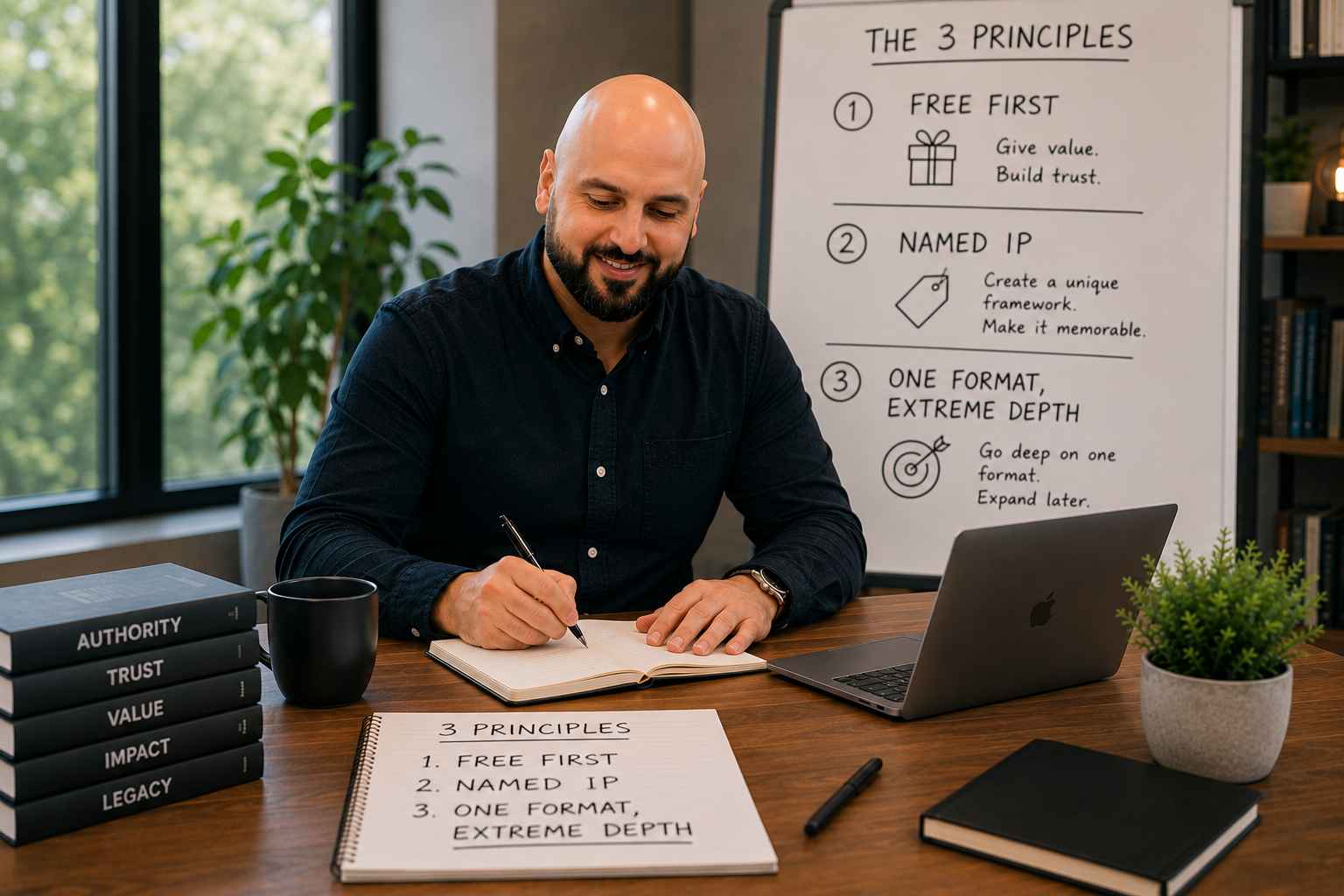
Twelve founders. Different industries. Different timelines. Three identical principles.
Principle 1: Free first.
Every personal brand example on this list gave away significant intellectual value before charging for anything. Books at $0.99. Free tools. Free newsletters. Free video series. The generosity is not charity. The generosity is the trust-building mechanism that makes future revenue possible.
Principle 2: Named IP.
Nine of the 12 founders named a proprietary framework, methodology, or system. Hormozi named $100M Offers. Ferriss named The 4-Hour Workweek. Naval named "How to Get Rich Without Getting Lucky." The name makes the thinking citable, memorable, and distributable. Unnamed expertise disappears. Named IP compounds.
Principle 3: One format, extreme depth.
Every personal brand example on this list achieved authority through depth on one platform or format before expanding. Gary Vaynerchuk committed to daily video for five years. Justin Welsh committed to weekly newsletters for two years. Mike Ferry committed to live seminars for decades. Breadth came after depth. Never before.
The pattern is learnable. The execution requires patience. The results compound beyond what any advertising budget replicates.
Frequently Asked Questions
What are the best personal brand examples for founders?
The 12 examples in this post demonstrate the authority-before-revenue pattern across multiple industries. Alex Hormozi, Neil Patel, and Justin Welsh represent the strongest modern personal brand examples for founders because each built measurable authority through free intellectual property before generating significant revenue.
How long does a personal brand take to build before generating revenue?
The timeline ranges from 18 months to 7 years across the 12 examples in this post. Justin Welsh published free content for 24 months before launching a paid product. Gary Vaynerchuk filmed daily video content for five years before launching VaynerMedia.
The median timeline is approximately 2 to 3 years of consistent authority building before a major revenue breakthrough.
What is the most common personal brand strategy among successful founders?
The most common strategy is publishing free intellectual property (books, tools, frameworks, educational content) consistently on one platform before launching paid offerings. Nine of the 12 founders in this post used this approach. The free IP builds trust at scale. The trust converts into revenue that advertising cannot replicate.
Can a personal brand generate revenue without a large audience?
Kimberly Snyder scaled to $8 to $10 million in annual revenue without a massive social media following. Mike Ferry built $50 million in annual revenue without any social media presence. Audience size does not determine revenue.
Trust depth per audience member determines revenue. A small audience with deep trust outperforms a large audience with shallow recognition.
What personal brand examples work for founders starting from zero?
Justin Welsh and Pat Flynn both started from zero with no existing audience, no investment, and no industry recognition. Both published free educational content consistently for 18 to 24 months before generating meaningful revenue.
The starting point for founders at zero is one specific positioning claim, one content format, and 18 months of consistent publishing.