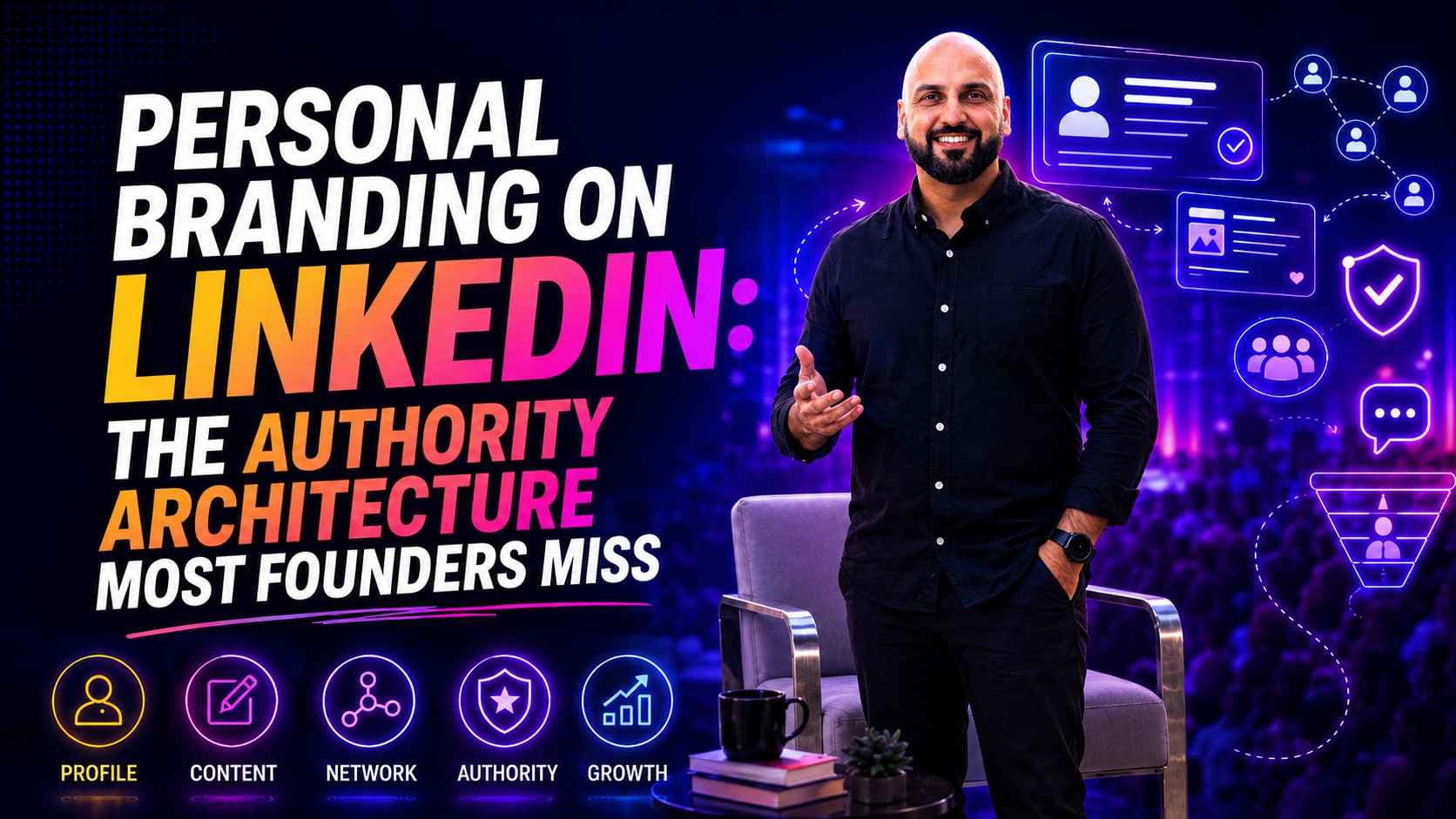
The profile, content, and engagement system on LinkedIn determine if the buyer reaches out or moves on. Most founders treat LinkedIn as a social media feed. The founders who generate inbound demand treat LinkedIn as a trust infrastructure layer within a broader personal brand architecture.
Key Takeaways:
LinkedIn is the highest-intent professional platform. 4 out of 5 LinkedIn members drive business decisions (LinkedIn 2024 B2B Marketing Benchmark Report).
The LinkedIn profile is not a resume. The LinkedIn profile is a landing page for the founder's authority claim.
Four LinkedIn posts per month (one per week) generate more authority than 20 posts per month because depth compounds and volume dilutes.
The LinkedIn headline is the single most important line of text in a founder's personal brand. The headline replaces the job title with the positioning statement.
LinkedIn personal branding generates results within 60 to 90 days when paired with a structured website. LinkedIn alone produces awareness. LinkedIn plus a website produces inbound leads.
The five metrics that measure LinkedIn personal branding success are profile views from target prospects, connection requests from decision-makers, inbound messages, content saves, and link clicks to the website.
LinkedIn Is an Authority Platform, Not a Social Media Platform
Founders who treat LinkedIn as social media produce content that entertains. Founders who treat LinkedIn as an authority platform produce content that generates inbound demand.
The distinction shapes every decision: what to post, how often to post, and what metrics matter.
Social media platforms (Instagram, TikTok, Twitter) reward volume, trends, and entertainment value. LinkedIn rewards depth, expertise, and professional credibility. A founder who posts a meme on LinkedIn gets engagement. A founder who posts a framework on LinkedIn gets consulting inquiries.
I have managed LinkedIn personal branding strategies for founders across consulting, wellness, technology, and media. The pattern is consistent. The founders who post less frequently but with more depth generate more inbound demand than the founders who post daily with surface-level observations.
LinkedIn personal branding works for founders because the platform audience is pre-qualified. 4 out of 5 LinkedIn members drive business decisions (LinkedIn 2024 B2B Marketing Benchmark Report). The audience is not browsing for entertainment. The audience is evaluating expertise. The founder's LinkedIn presence is the evaluation they conduct.
The LinkedIn Profile Architecture That Generates Inbound Demand

The LinkedIn profile is a landing page, not a resume. Every section serves a specific trust-building function.
The Headline
The LinkedIn headline is the most valuable line of text in a founder's personal brand. The headline appears in search results, connection requests, comments, and direct messages. Every LinkedIn interaction displays the headline.
Most founders waste the headline on a job title: "CEO at Company Name." The job title communicates a function. The function communicates nothing about the founder's expertise.
The headline replaces the job title with the positioning statement. "I build authority brands for founders scaling revenue" tells the viewer exactly what the founder does, for whom, and through which approach. The viewer decides in 3 seconds if the founder is relevant.
The Banner Image
The banner image reinforces the positioning. The banner displays one of three elements: the book cover, the named framework visual, or a speaking photo with the founder's positioning statement overlaid. The banner is not decorative. The banner is a trust signal.
The About Section
The About section answers three questions in 300 words or fewer:
What specific problem does the founder solve?
What named methodology does the founder use?
What proof exists that the methodology works?
The About section is written in first person. The tone is direct. The structure is: problem statement, methodology introduction, proof points, call to action. No autobiography. No chronological career history. The About section is not about the founder. The About section is about the problem the founder solves for the viewer.
The Featured Section
The Featured section displays three to five assets that demonstrate authority:
The founder's most-read article or blog post.
The book or published framework document.
A case study or client results summary.
A speaking reel or podcast appearance.
A lead magnet or consultation booking link.
The Featured section converts profile viewers into website visitors. Every asset in the Featured section links back to the founder's website where the full authority architecture lives.
The Experience Section
The Experience section is not a job history. The Experience section documents the founder's positioning through the lens of each role. Each entry answers: what authority did the founder build in this role? What frameworks were developed? What measurable results were produced?
The LinkedIn Content System: Four Posts Per Month
Four LinkedIn posts per month (one per week) generate more authority than 20 posts per month because each post has depth.
The content system for LinkedIn personal branding has four post types. One post type per week.
Week 1: The Framework Post.
Share one element of a named framework with a specific example. The post demonstrates intellectual property. The viewer learns the framework name and associates the founder with the methodology.
Week 2: The Proof Post.
Share a specific client result, case study, or measurable outcome. The post demonstrates practitioner experience. No client names required. Specific numbers are required. "Increased inbound inquiries 3x in 90 days through authority architecture" is a proof post. "Helped a client grow" is not.
Week 3: The Perspective Post.
Share an opinion on an industry trend, a common misconception, or a counter-narrative. The post demonstrates independent thinking. The market pays for opinions, not information. Information is free on Google. Opinions backed by evidence are rare and valuable.
Week 4: The Repurposed Post.
Extract one key insight from a blog post published on the founder's website. The post drives traffic from LinkedIn to the website. The website captures the viewer who wants more depth than LinkedIn delivers.
Four posts. Four purposes. One hour per week. The system produces consistency without the burnout that daily posting creates.
LinkedIn Personal Branding Plus Website: The Dual-Platform System

LinkedIn generates awareness and trust. The website captures inbound demand and builds search authority. The two platforms work as one system.
LinkedIn personal branding without a website produces awareness that expires. The LinkedIn post reaches the feed for 48 hours. The viewer engages, scrolls, and forgets. No searchable archive exists. No AI system indexes the post. No search engine ranks the content.
LinkedIn personal branding with a structured website produces authority that compounds. The LinkedIn post drives the viewer to the website. The website article ranks in Google for 2 to 5 years. The AI system indexes the website content and cites the founder in generated answers.
The dual-platform system:
Publish the long-form article on the website first.
Extract three insights for LinkedIn posts.
Each LinkedIn post links to the full article.
The website article captures the email address or consultation booking.
Google indexes the website article and builds entity recognition.
AI systems cite the website content and strengthen the founder's authority.
LinkedIn is the attention layer. The website is the authority layer. Founders with limited time invest in the website first and LinkedIn second because the website compounds. LinkedIn amplifies the compound.
The Five LinkedIn Personal Branding Mistakes Founders Make
Five mistakes prevent founders from generating inbound demand through LinkedIn personal branding.
Mistake 1: Using the headline as a job title.
"CEO at Company Name" communicates a function. The positioning statement communicates expertise. The headline is the most viewed text in the founder's personal brand. A job title wastes the highest-visibility real estate.
Mistake 2: Posting without a content system.
The founder posts when inspiration strikes. The content covers different topics every week. No compounding occurs because the content lacks a central positioning thesis. The four-post system (framework, proof, perspective, repurpose) eliminates the inconsistency.
Mistake 3: Engaging for visibility instead of trust.
The founder comments on trending posts to increase visibility. The comments are generic: "Great post!" "Love this!" Generic engagement builds no authority. Substantive comments that demonstrate expertise on the topic build trust with the original poster and every viewer who reads the thread.
Mistake 4: Ignoring the profile while focusing on content.
The founder publishes strong content but has a weak profile. A viewer who reads a strong post clicks the profile. The profile has a generic headline, no Featured section, and a chronological resume. The viewer leaves without taking action because the profile failed the trust check.
Mistake 5: Measuring likes instead of inbound demand.
A post with 500 likes and zero inbound inquiries generated awareness. A post with 50 likes and 3 inbound inquiries generated authority. LinkedIn personal branding success is measured by trust-driven actions, not engagement volume.
How to Measure LinkedIn Personal Branding Success
Five metrics measure LinkedIn personal branding success. Follower count is not one of them.
Metric 1: Profile views from target prospects.
LinkedIn shows who viewed the profile. The percentage of profile viewers who match the founder's ideal client profile measures positioning accuracy. High match rate means the content attracts the right audience. Low match rate means the positioning needs refinement.
Metric 2: Connection requests from decision-makers.
The volume and quality of inbound connection requests indicate authority perception. Decision-makers connect with founders they perceive as relevant to their needs.
Metric 3: Inbound direct messages.
The number of LinkedIn messages that ask about the founder's services, availability, or expertise. Inbound messages are the clearest signal that the LinkedIn personal branding strategy is converting awareness into demand.
Metric 4: Content saves.
The number of times viewers save the founder's posts. A saved post indicates the viewer found the content valuable enough to reference later. Saves measure content depth. Likes measure content visibility.
Metric 5: Website link clicks.
The number of viewers who click from LinkedIn to the founder's website. Link clicks measure the conversion from LinkedIn awareness to website authority. The website captures the viewer who wants more depth than LinkedIn delivers.
Monthly measurement takes 15 minutes. Review all five metrics. Identify which post type generated the most inbound demand. Publish more of that type next month.
Founders who need strategic support building the LinkedIn and website system together benefit from working with a personal branding consultant who architects both platforms as one integrated authority system.
Frequently Asked Questions
How often do founders need to post on LinkedIn for personal branding?
Four posts per month (one per week) is the minimum effective frequency for LinkedIn personal branding. Each post follows a specific type: framework, proof, perspective, or repurposed long-form content. Daily posting is unnecessary and often counterproductive because volume dilutes the positioning signal.
What is the best LinkedIn personal branding strategy for founders?
The best LinkedIn personal branding strategy has three layers: an optimized profile (positioning headline, structured About section, Featured assets), a content system (four post types, one per week), and a measurement system (five trust metrics reviewed monthly).
LinkedIn personal branding generates the strongest results when paired with a structured website that captures the inbound demand LinkedIn creates.
Does LinkedIn personal branding work for B2B founders?
LinkedIn personal branding is the highest-ROI personal branding channel for B2B founders because 4 out of 5 LinkedIn members drive business decisions. The audience intent on LinkedIn matches B2B business outcomes (consulting, partnerships, enterprise sales). No other platform has the same concentration of professional decision-makers.
How long does LinkedIn personal branding take to produce results?
Profile views from target prospects increase within 2 to 4 weeks of optimizing the headline and About section. Inbound connection requests and direct messages begin within 60 to 90 days of consistent content publishing. Measurable inbound consulting demand typically emerges within 6 months as the content library and authority signals compound.
Can LinkedIn personal branding replace a website?
LinkedIn personal branding cannot replace a website because LinkedIn owns the content and controls the distribution. The founder's website is the only platform the founder owns.
The website ranks in search engines and gets indexed by AI systems. LinkedIn amplifies the website. The website is the foundation. Both platforms work as one system, not as alternatives.