
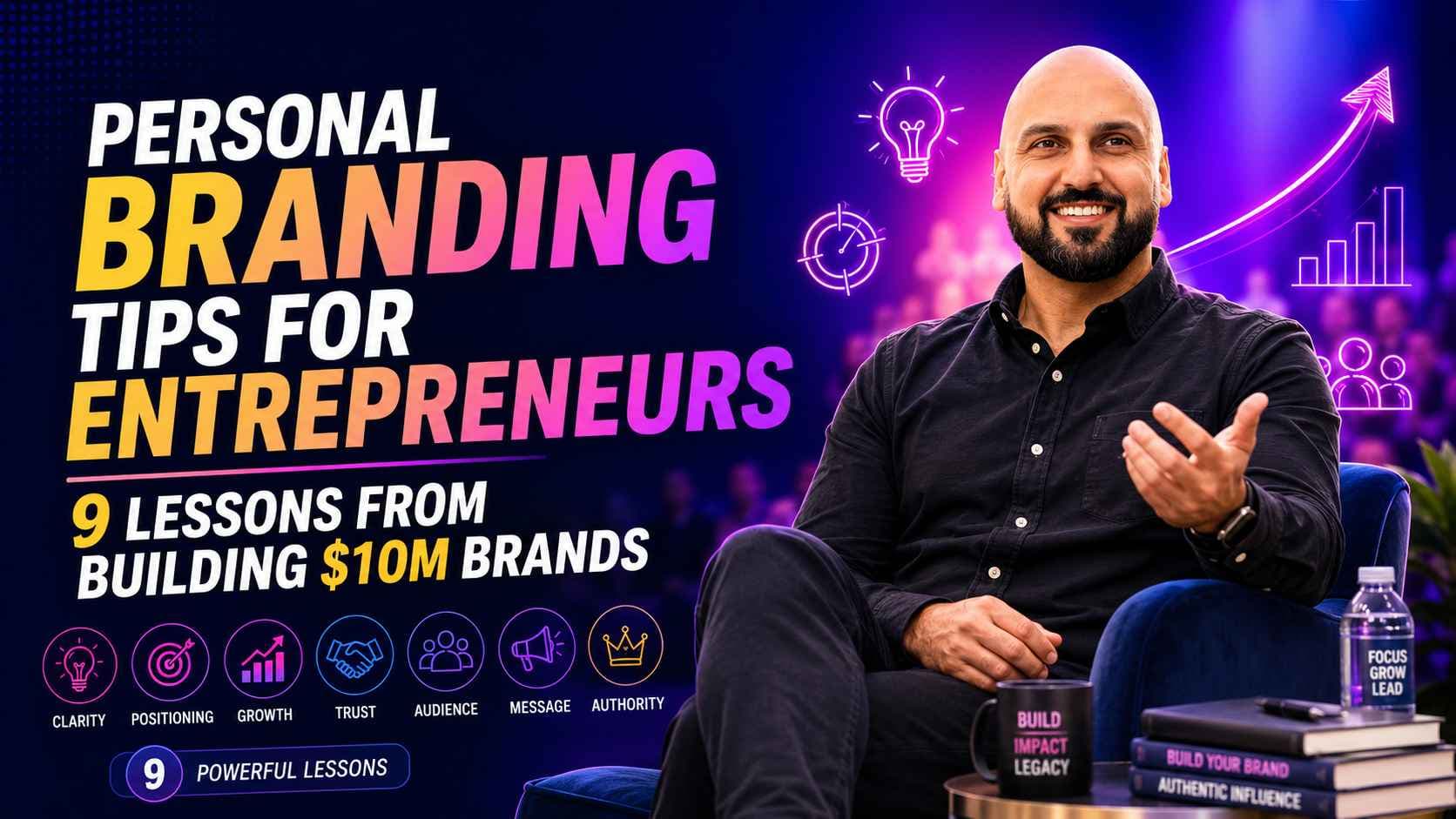
Each tip includes the specific situation, the decision made, and the measurable outcome. Generic advice like "be authentic" and "post consistently" does not appear on this list because generic advice does not produce $10M outcomes.
Key Takeaways:
Name proprietary frameworks before publishing the first piece of content. Named IP compounds. Unnamed expertise disappears.
Build the website before the social media presence. Search results compound for years. Social posts expire in 48 hours.
One platform with depth outperforms three platforms with surface presence.
Track inbound inquiries, not follower count. 30 million monthly views produced zero consulting revenue for one creator until the authority architecture changed.
The personal brand represents 90% of business value for S&P 500 companies. The ratio is higher for entrepreneurs.
Psychology-first content outperforms algorithm-first content because human trust patterns do not change with platform updates.
Every tip below includes a specific dollar amount, timeline, or metric. Experts use numbers. Generalists use adjectives.
Tip 1: Name Your Frameworks Before You Publish Anything
Named intellectual property is the highest-leverage personal branding asset an entrepreneur owns.
I developed ROAC (Return on Attention Created), the Guru Ladder, and the Five Anchors framework before publishing the content that referenced them. The sequence matters. A framework gives every piece of content a structural backbone. Content without a framework is commentary. Content with a framework is citable authority.
The proof: prospects who discover my work reference "the Guru Ladder" or "ROAC" by name in the first conversation. The named framework survives in their memory. The unnamed blog post does not.
The action: Write down the 3 to 5 processes, models, or systems you use with every client. Give each one a name. Document the steps. The naming takes 2 hours. The compounding lasts years.
Tip 2: Build the Website Before the Social Media Presence

A website compounds in search for years. A social media post expires in 48 hours.
I worked with a wellness entrepreneur who had 150,000 Instagram followers and zero search visibility. The followers generated engagement. The engagement generated zero inbound consulting inquiries. The audience existed on rented land. Instagram owned the distribution.
The fix: we built a website with structured content, schema markup, and a blog architecture organized by topic clusters. Within 6 months, the website generated more inbound leads per month than Instagram generated in a year.
The action: Publish on the website first. Repurpose to social second. The website is the asset. Social media is the distribution channel for the asset.
Tip 3: Go Deep on One Platform Before Going Wide on Three
One platform with 50 published pieces outperforms three platforms with 10 pieces each.
I led the brand reinvention for a media personality at 84 years old. One platform. One format. The audience grew to over 1 million followers because the depth of content on that single platform built trust faster than a scattered presence across multiple platforms.
The math is simple. 50 pieces on one platform create a content library that prospects browse. 10 pieces on three platforms create a surface impression that nobody remembers.
The action: Choose one platform based on where the highest-intent audience spends time. Publish 50 pieces before adding a second platform.
Tip 4: The Origin Story Is Not About You
The strongest origin stories center the audience's problem, not the founder's biography.
Entrepreneurs default to chronological autobiography. "I grew up in... I went to school at... I started my first business when..." The audience does not care about the timeline. The audience cares about the problem the founder solved and why the founder is credible to solve it for them.
I restructured a founder's origin story from a 2,000-word autobiography into a 200-word problem-solution narrative. The conversion rate on the about page increased 40% in 30 days. The shorter version performed better because the audience saw themselves in the story immediately.
The action: Rewrite the origin story with the audience's problem in the first sentence and the founder's credibility in the second. Delete everything else.
Tip 5: Publish Opinions, Not Information
Information is free and abundant. Opinions backed by evidence are rare and valuable.
An entrepreneur who publishes "5 Tips for Better Leadership" competes with 10 million identical articles. An entrepreneur who publishes "Why Most Leadership Advice Fails Scaling Founders (And What Works Instead)" competes with a handful.
The 2024 Edelman Trust Barometer reports that audiences trust specialists over generalists by a 3:1 margin. Specialists publish opinions. Generalists publish information. The market pays for opinions when the opinions come from demonstrated expertise.
The action: Before publishing, ask: "Does this article state something that only I believe based on direct experience?" If no, the content is information. Rewrite it as an opinion with evidence.
Tip 6: Track Inbound Leads, Not Follower Count
30 million monthly views produced zero consulting revenue for one creator until the authority architecture changed.
I worked with a content creator (NonToxicDad) who generated 30 million monthly views across platforms. The audience was massive. The revenue from the personal brand was minimal. Views measured awareness. Views did not measure trust.
The fix: we restructured the content architecture to include clear positioning, named frameworks, and a call-to-action system that routed trust into revenue. The views stayed the same. The inbound inquiries started.
The action: Replace follower count as the primary metric with inbound inquiry count. If the inquiries are not increasing, the content is building awareness, not authority. Awareness without authority is the most expensive vanity metric in personal branding.
Tip 7: The Personal Brand Is 90% of Business Value

Intangible assets represent 90% of the S&P 500's market value, up from 17% in 1975.
The personal brand is the primary intangible asset for entrepreneurs. The expertise, reputation, client relationships, and intellectual property that exist in the founder's name are the assets that buyers, investors, and partners value. The revenue is the output. The personal brand is the engine.
Entrepreneurs who treat personal branding as optional are undervaluing 90% of their business. Entrepreneurs who invest in personal branding are investing in the asset class that appreciates fastest.
The action: Evaluate the personal brand as a business asset, not a marketing expense. Ask: "If I removed my name from this business, how much revenue disappears?" The answer reveals the current value of the personal brand. The gap between the current value and the potential value is the investment opportunity.
Tip 8: Psychology First, Algorithm Second
Psychology-first content outperforms algorithm-first content because human trust patterns do not change with platform updates.
Entrepreneurs who optimize for the algorithm produce content that performs well for 3 months. Then the algorithm changes. The content stops performing. The entrepreneur starts over.
Entrepreneurs who optimize for human psychology produce content that performs consistently across algorithm updates. Trust, curiosity, credibility, and emotional resonance are hardwired into the audience. No platform update changes how humans evaluate trustworthiness.
I tested this principle across YouTube, LinkedIn, and Instagram campaigns for multiple clients. The psychology-first content maintained performance through 3 algorithm updates. The algorithm-first content dropped 40% to 60% after each update.
The action: Before writing, ask: "Does this content build trust with a human?" If the answer requires referencing an algorithm feature (trending audio, optimal posting time, hashtag strategy), the content is algorithm-first. Rewrite for trust.
Tip 9: Choose the Right Content Model for the Business Stage
Four content models exist for entrepreneur personal brands. Each one fits a different business stage and team structure.
Founder-led content. The entrepreneur is the face, voice, and primary creator. Fits the $0 to $1M stage when the founder's expertise is the primary asset.
Team-led content. The entrepreneur's team creates content based on the founder's frameworks and positioning. Fits the $1M to $5M stage when the founder's time is constrained.
Brand-led content. The content comes from the company brand with the founder as a periodic contributor. Fits the $5M to $20M stage when the company identity has independent value.
Community-led content. The audience creates content about the brand. Fits the $20M+ stage when the personal brand has generated enough trust that the audience becomes the distribution channel.
Entrepreneurs who use the wrong content model for their stage waste time and resources. A $500K founder using a brand-led model has no brand to lead with. A $20M founder using a founder-led model is the bottleneck.
The action: Identify the current revenue stage. Match the content model. Transition to the next model when the revenue stage changes.
Frequently Asked Questions
What are the most effective personal branding tips for entrepreneurs?
The 9 tips in this post are ranked by leverage: naming frameworks, building the website first, choosing one platform for depth, restructuring the origin story, publishing opinions over information, tracking inbound leads, valuing the personal brand as a business asset, prioritizing psychology over algorithms, and matching the content model to the business stage. Each tip includes a specific action and measurable outcome.
How do entrepreneurs start building a personal brand from scratch?
Entrepreneurs starting from zero begin with three actions: name one proprietary framework, build a website with one pillar content page, and publish one long-form piece per month on the chosen platform.
The first 90 days establish the positioning foundation. Inbound signals begin appearing within 60 to 90 days of consistent execution.
What is the biggest personal branding mistake entrepreneurs make?
The biggest mistake is treating personal branding as a social media strategy instead of an authority architecture. Social media is one distribution channel.
The authority architecture includes positioning, named intellectual property, website content, search visibility, AI citation presence, and trust measurement. Entrepreneurs who optimize for followers instead of inbound inquiries build awareness without revenue.
How much time does personal branding require for busy entrepreneurs?
Effective personal branding for entrepreneurs requires 3 to 5 hours per month after the initial positioning foundation is built. The foundation (positioning document, framework library, website architecture) takes 15 to 20 hours to build once.
The ongoing maintenance (one content piece per month, one distribution pass, one measurement review) takes 3 hours per month.
Do personal branding tips differ for B2B and B2C entrepreneurs?
The core principles (named IP, positioning specificity, psychology-first content, inbound measurement) apply to both B2B and B2C entrepreneurs. The platform selection differs: B2B entrepreneurs prioritize LinkedIn and website content.
B2C entrepreneurs prioritize YouTube, Instagram, and website content. The authority architecture is identical. The distribution channels differ by audience behavior.