
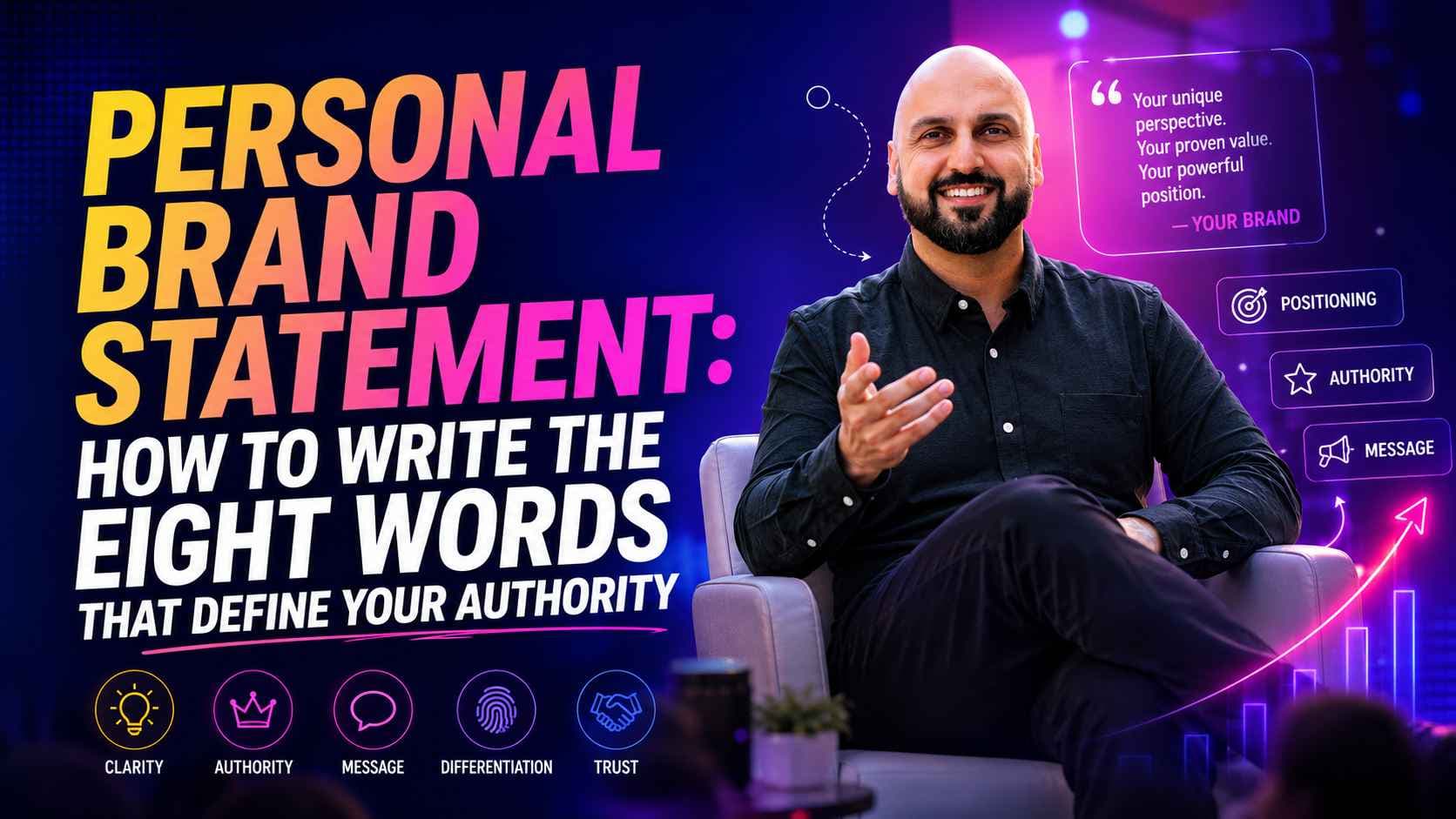
Strong personal brand statements follow a specific formula: verb plus outcome plus audience plus differentiator. Weak personal brand statements use vague language that applies to everyone and distinguishes no one.
Key Takeaways:
A personal brand statement is 8 words that declare what the founder stands for in the market.
The formula is: action verb + specific outcome + defined audience + differentiator.
Strong personal brand statements pass the "only I" test: no other person in the market uses the same 8 words.
Weak personal brand statements use vague terms like "help businesses grow" or "empower leaders to succeed" that apply to thousands of people.
The personal brand statement appears in the LinkedIn headline, website homepage, speaker bio, and every introduction.
Writing the statement takes 30 minutes. Validating the statement takes a week of testing with real prospects.
9 personal brand statement examples are included below with analysis of what makes each one effective.
A Personal Brand Statement Is Not a Tagline

A personal brand statement is a positioning claim. A tagline is a marketing phrase. The two serve different functions.
A tagline is designed to be catchy. "Think Different." "Do It." A tagline creates emotional resonance. A tagline does not explain what the person does, for whom, or how.
A personal brand statement is designed to be specific. The statement tells the market exactly what the founder does, for exactly which audience, through exactly which approach. The specificity is the value. A prospect who reads a strong personal brand statement knows within 3 seconds if the founder is relevant to their situation.
I test every personal brand statement with one question: Does this statement eliminate 90% of the market? A strong personal brand statement attracts the right 10% and repels the wrong 90%. A weak personal brand statement tries to attract everyone and resonates with no one.
The Eight-Word Personal Brand Statement Formula
A personal brand statement follows a four-part formula: action verb, specific outcome, defined audience, and differentiator.
The formula:
[Action verb] + [specific outcome] + [for/with] + [defined audience] + [through/via] + [differentiator]
The target length is 8 words. Some statements run to 10. Some compress to 6. Eight words is the target because 8 words fit a LinkedIn headline, a speaker bio, and a verbal introduction without editing.
Part 1: The Action Verb
The action verb declares what the founder does. The verb is specific, not generic.
Strong verbs: build, architect, scale, convert, engineer, position, structure, launch.
Weak verbs: help, empower, inspire, guide, support, enable.
The difference: strong verbs imply a measurable outcome. "Build" implies a tangible deliverable. "Help" implies a vague contribution. The action verb sets the credibility tone for the entire personal brand statement.
Part 2: The Specific Outcome
The outcome declares what the audience receives. The outcome is concrete, not abstract.
Strong outcomes: authority brands, inbound demand, category ownership, premium pricing, deal flow.
Weak outcomes: success, growth, transformation, impact, results.
The difference: strong outcomes can be measured. "Inbound demand" is countable. "Growth" is vague. A prospect who reads "I build authority brands" knows the deliverable. A prospect who reads "I drive growth" does not.
Part 3: The Defined Audience
The audience declares who the founder serves. The audience is narrow, not broad.
Strong audiences: scaling founders, Series A CEOs, independent consultants, wellness entrepreneurs, SaaS founders at $1M to $10M.
Weak audiences: businesses, leaders, professionals, entrepreneurs, people.
The difference: a narrow audience feels spoken to directly. "Scaling founders" recognizes a specific person at a specific stage. "Businesses" recognize no one.
Part 4: The Differentiator
The differentiator declares how the founder's approach differs from every competitor. The differentiator is often a named framework, a specific methodology, or a unique constraint.
Strong differentiators: through authority architecture, using the Guru Ladder, via IP-first positioning, without paid advertising.
Weak differentiators: with proven strategies, using best practices, and through innovative solutions.
The difference: a strong differentiator cannot be claimed by a competitor. "Through authority architecture" is specific to one person's methodology. "With proven strategies" applies to anyone.
Nine Personal Brand Statement Examples With Analysis
Nine personal brand statement examples demonstrate the formula across different industries and founder types.
Example 1: "I build authority brands for founders scaling revenue."
Verb: build. Outcome: authority brands. Audience: founders scaling revenue. Differentiator: implied through "authority" (not generic "brands").
Why it works: 8 words. Specific deliverable. Narrow audience. A founder at $500K who wants to reach $5M reads this and immediately self-identifies.
Example 2: "I turn founder expertise into inbound demand."
Verb: turn. Outcome: inbound demand. Audience: founders with expertise. Differentiator: inbound (not outbound, not advertising).
Why it works: 7 words. The word "turn" implies transformation. The word "inbound" eliminates every founder who wants paid advertising help.
Example 3: "I position consultants as the obvious choice."
Verb: position. Outcome: becoming the obvious choice. Audience: consultants. Differentiator: "obvious choice" implies category dominance, not incremental improvement.
Why it works: 8 words. The consultant reading this statement feels the gap between where they are (one of many) and where they want to be (the obvious one).
Example 4: "I architect content systems that replace sales teams."
Verb: architect. Outcome: replacing sales teams. Audience: implied (founders who rely on sales teams). Differentiator: content systems, not content marketing.
Why it works: 8 words. The outcome is measurable and bold. "Replace sales teams" is a specific promise that attracts founders spending $500K or more per year on outbound sales.
Example 5: "I scale wellness brands from practitioner to platform."
Verb: scale. Outcome: platform (from practitioner). Audience: wellness brands. Differentiator: the practitioner-to-platform journey is a specific transformation.
Why it works: 8 words. A wellness practitioner earning $200 per hour reads this and sees the path to an ecosystem with courses, community, and IP licensing.
Example 6: "I engineer executive visibility through structured authority."
Verb: engineer. Outcome: executive visibility. Audience: executives. Differentiator: structured authority (not social media posting).
Why it works: 7 words. "Engineer" signals technical precision. "Structured authority" signals a system, not a personality-driven approach.
Example 7: "I convert speaking stages into consulting pipelines."
Verb: convert. Outcome: consulting pipelines. Audience: speakers. Differentiator: the conversion from stage to pipeline is a specific mechanism.
Why it works: 7 words. A speaker who earns $5,000 per keynote but converts zero attendees into clients reads this and recognizes the gap immediately.
Example 8: "I build media companies around founder expertise."
Verb: build. Outcome: media companies. Audience: founders. Differentiator: media company (not a blog, not a social media presence).
Why it works: 7 words. "Media company" signals an enterprise asset, not a marketing channel. The founder who wants to own the distribution layer, not rent it, self-identifies.
Example 9: "I help founders become the brand the market trusts."
Verb: help (acceptable here because the outcome is specific). Outcome: becoming the trusted brand. Audience: founders. Differentiator: trust (not awareness, not reach).
Why it works: 9 words. The word "trust" is the differentiator. Most personal branding promises visibility. This statement promises trust, which is the metric that converts into revenue.
The "Only I" Test for Personal Brand Statements

A strong personal brand statement passes one test: no other person in the market uses the same 8 words.
The test has three levels:
Level 1: Substitution. Replace the founder's name with a competitor's name. Does the statement still make sense? A statement that works for any competitor is too generic. Rewrite until the statement is true for one person only.
Level 2: Specificity. Remove the differentiator. Does the statement lose meaning? A statement that survives without a differentiator lacks a differentiator. The differentiator carries the positioning weight. Without the differentiator, the statement is a commodity description.
Level 3: Prospect reaction. Read the statement to 5 ideal prospects. Do they immediately ask "how?" A strong personal brand statement creates curiosity about the method. A weak personal brand statement creates no reaction because the claim is too vague to provoke interest.
A personal brand statement that passes all three levels is ready for deployment across every touchpoint in the authority architecture.
Where the Personal Brand Statement Appears
A strong personal brand statement appears in seven locations across the founder's authority architecture.
LinkedIn headline. The first text a prospect reads after the name. The personal brand statement replaces generic titles like "CEO at Company Name."
Website homepage. The statement appears above the fold as the primary positioning claim.
Speaker bio. The opening line of every speaking bio. Event organizers copy the bio directly into the event materials.
Email signature. Below the name, above the contact information.
Podcast introduction. The host reads the statement when introducing the founder. A specific statement gives the host specific language. A vague statement forces the host to improvise.
Social media bios. Twitter, Instagram, and YouTube channel descriptions. The same 8 words across every platform create positioning consistency.
Book or article byline. The statement follows the author's name in every published piece.
Consistency across all seven locations reinforces the positioning. A prospect who encounters the same 8 words on LinkedIn, the website, and a podcast introduction builds a stronger mental association than a prospect who encounters different descriptions in different places.
Frequently Asked Questions
What is a personal brand statement?
A personal brand statement is a concise positioning claim (6 to 10 words) that declares what a founder does, for whom, and how the approach differs from competitors.
The statement is not a tagline, mission statement, or elevator pitch. The personal brand statement is the positioning foundation that governs all content, introductions, and client conversations.
How long is a personal brand statement?
A personal brand statement targets 8 words. Effective statements range from 6 to 10 words. The constraint forces specificity. Statements longer than 10 words typically contain vague filler that dilutes the positioning. Statements shorter than 6 words lack the audience and differentiator components.
What is the difference between a personal brand statement and an elevator pitch?
A personal brand statement is a positioning claim (8 words). An elevator pitch is a persuasion tool (30 to 60 seconds). The personal brand statement declares what the founder stands for.
The elevator pitch explains why the prospect benefits from caring. The statement is the foundation. The pitch is built on the foundation.
How do I know my personal brand statement is strong enough?
A strong personal brand statement passes the "Only I" test: no competitor uses the same words, the differentiator carries meaning, and ideal prospects respond with "how do you do that?" A statement that provokes curiosity about the method is strong. A statement that provokes no reaction is too generic.
Can I change my personal brand statement over time?
A personal brand statement evolves as the founder's positioning deepens. The core audience and differentiator remain stable.
The specificity of the outcome and the sophistication of the language increase over time. Founders typically refine the statement every 6 to 12 months as the authority architecture matures and the market position clarifies.