
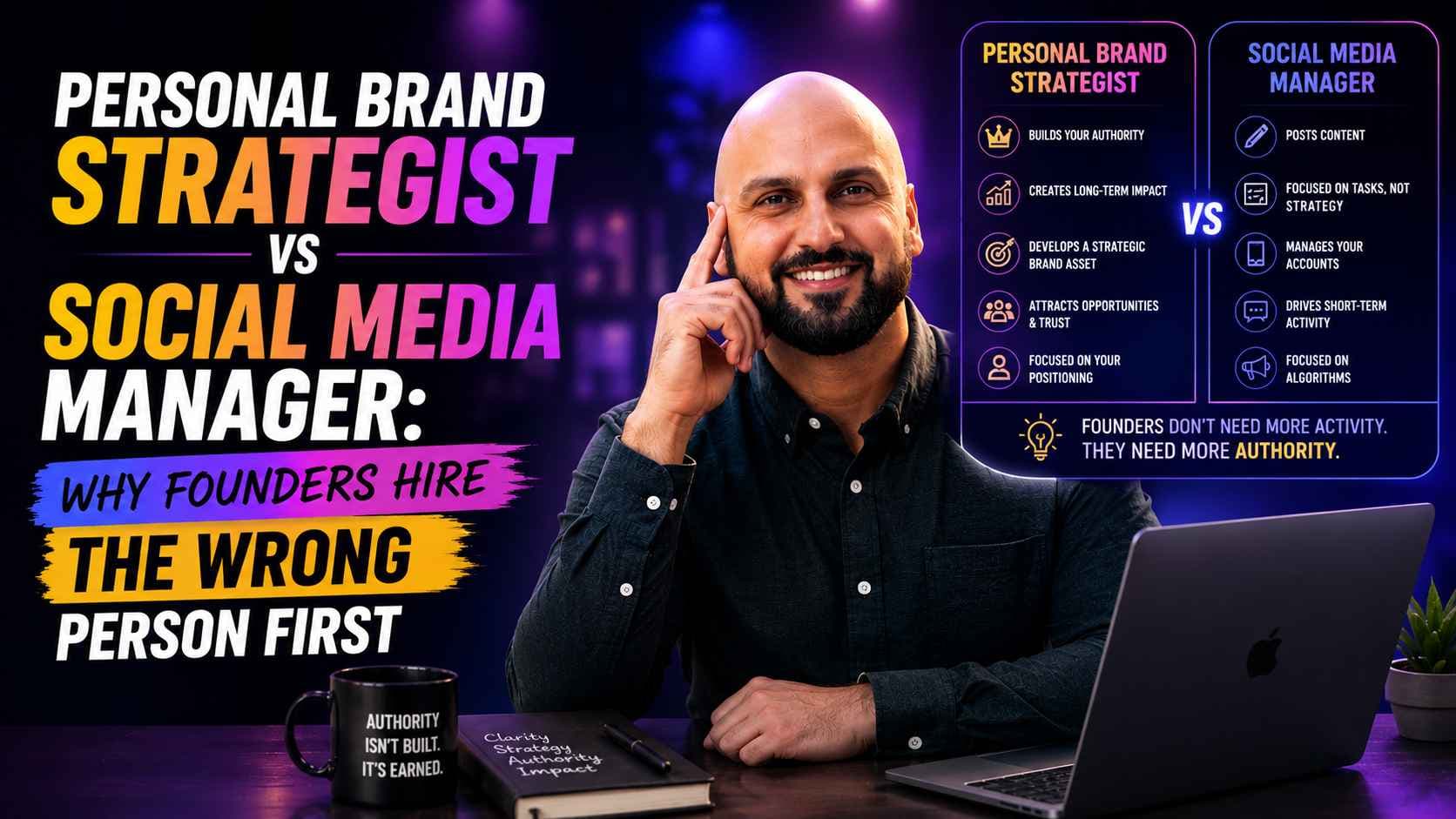
Founders who hire the social media manager first produce polished content that communicates nothing specific. Founders who hire the personal brand strategist first build an authority architecture that every subsequent hire executes against.
Key Takeaways:
A personal brand strategist defines the what, why, and for whom. A social media manager handles the when, where, and how often.
Founders who hire a social media manager before defining positioning waste an average of 6 to 12 months producing content without strategic direction.
The personal brand strategist creates three deliverables before any content gets published: a positioning document, a named framework library, and a content architecture map.
A social media manager at $3,000 per month without a strategist produces volume. A personal brand strategist at $5,000 per month produces the architecture that makes volume effective.
73% of B2B buyers research the founder online before purchasing (2024 Edelman Trust Barometer). The content they find is shaped by the strategist, not the social media manager.
The correct sequence is strategist first, then social media manager. Never the reverse.
The Two Roles Solve Different Problems
A personal brand strategist solves the "what do I stand for" problem. A social media manager solves the "how do I stay visible" problem.
The distinction is the difference between architecture and construction. An architect designs the building. A contractor builds it. Hiring the contractor before the architect produces a structure with no blueprint.
The same dynamic applies to founder personal branding.
What a personal brand strategist delivers:
Positioning clarity. The specific claim the founder owns in the market.
Intellectual property. Named frameworks, methodologies, and structured systems that differentiate the founder from every other voice in the space.
Content architecture. Which platforms serve which function, how content flows between them, and how each piece reinforces the positioning.
Entity strategy. The structured signals that make search engines and AI systems recognize the founder as an authoritative entity in a specific domain.
Authority measurement. Tracking inbound leads, speaking invitations, and AI citations. Not tracking likes, comments, and follower count.
What a social media manager delivers:
Content creation and publishing across platforms.
Community management and engagement.
Posting schedule optimization.
Analytics reporting on platform metrics.
Trend monitoring and content adaptation.
Both roles are valuable. The sequence determines the outcome.
What Happens When Founders Hire the Social Media Manager First

The founder gets consistent content that nobody remembers.
I have audited dozens of founder personal brands where the first hire was a social media manager. The pattern is identical every time.
Month 1: The social media manager creates a posting schedule. Three LinkedIn posts per week. Two Instagram Reels. One Twitter thread. The founder provides general direction. "Post about leadership. Share industry insights. Be authentic."
Month 3: The content looks polished. The engagement is modest. LinkedIn posts get 15 to 30 likes. Instagram Reels get 200 to 500 views. The founder feels productive.
Month 6: The founder asks: "Where are the inbound leads?" The answer is nowhere. Six months of content produced zero consulting inquiries, zero speaking invitations, and zero media features. The content was consistent but generic. A prospect who reads 10 posts cannot articulate what the founder stands for.
The failure is not the social media manager's fault. The social media manager executed the assignment. The assignment had no strategic foundation. No positioning document. No named frameworks. No content ecosystem architecture. The manager published content into a vacuum.
What Happens When Founders Hire the Personal Brand Strategist First
The founder gets a strategic foundation that every future hire executes against.
The personal brand strategist delivers three foundational assets before any content gets published:
The Positioning Document
The positioning document answers three questions:
What specific problem does the market associate with this founder's name?
What named methodology distinguishes this founder from every other expert in the space?
What measurable proof exists that the methodology produces results?
The positioning document is 2 to 5 pages. The personal brand strategist produces it through interviews with the founder, competitive analysis, and market positioning research. Every piece of content published after this document exists serves a specific strategic purpose.
The Framework Library
The personal brand strategist helps the founder name, structure, and document proprietary intellectual property. A named framework is the highest-leverage asset in personal branding.
I named and structured ROAC (Return on Attention Created) because unnamed expertise disappears. Named frameworks get referenced in conversations, cited in articles, and remembered by prospects. The social media manager cannot create frameworks. The social media manager distributes them.
The Content Architecture Map
The content architecture map defines:
Which platforms the founder uses (three maximum for time-constrained founders).
What content format serves each platform (long-form on website, insights on LinkedIn, depth on video).
How content flows from source to distribution (one recorded conversation becomes five published assets).
Which topics belong to the founder's positioning and which topics fall outside the scope.
The social media manager receives this map and executes against it. Without the map, the social media manager creates content based on trends, gut instinct, or competitor imitation.
The Cost Comparison That Founders Get Wrong
A social media manager without a strategist costs more than a strategist without a social media manager.
The math:
Scenario A: Social media manager first ($3,000/month)
Month 1 to 6: $18,000 spent. Content produced. Zero strategic foundation. Zero inbound leads. Zero authority assets that compound.
Month 7: Founder realizes the content is not converting. Hires a personal brand strategist. The strategist rebuilds the positioning from scratch. The previous 6 months of content is misaligned with the new positioning and cannot be reused.
Total cost of the wrong sequence: $18,000 wasted plus the opportunity cost of 6 months without authority building.
Scenario B: Personal brand strategist first ($5,000/month)
Month 1 to 2: $10,000 spent. Positioning document, framework library, and content architecture map delivered. The founder publishes 2 to 4 pieces using the architecture. Inbound signals begin.
Month 3: Founder hires a social media manager at $3,000/month. The manager receives the strategic foundation and executes against it. Every post serves the positioning. Content compounds.
Total cost of the correct sequence: $10,000 for strategy plus $3,000/month for execution. Zero waste. Every dollar builds on the previous investment.
The strategist-first approach costs less because nothing gets thrown away. The manager-first approach costs more because the first 6 months of content is strategically useless.
How to Know Which Role You Need Right Now
The role a founder needs depends on which problem is unsolved: direction or distribution.
Three diagnostic questions:
Question 1: Can you describe your positioning in one sentence?
If yes: you have direction. You need a social media manager to distribute it. If no: you need a personal brand strategist to define it.
Question 2: Do you have at least one named framework or methodology?
If yes: you have intellectual property. A social media manager can distribute it. If no: you need a personal brand strategist to build the doctrine before distribution starts.
Question 3: Do prospects reference your ideas before the first meeting?
If yes: your authority architecture is working. A social media manager amplifies it. If no: the authority architecture is missing. A personal brand strategist builds it.
Founders who answer "no" to any of the three questions need the strategist first. Founders who answer "yes" to all three are ready for the social media manager.
The Hybrid Model for Founders Who Need Both
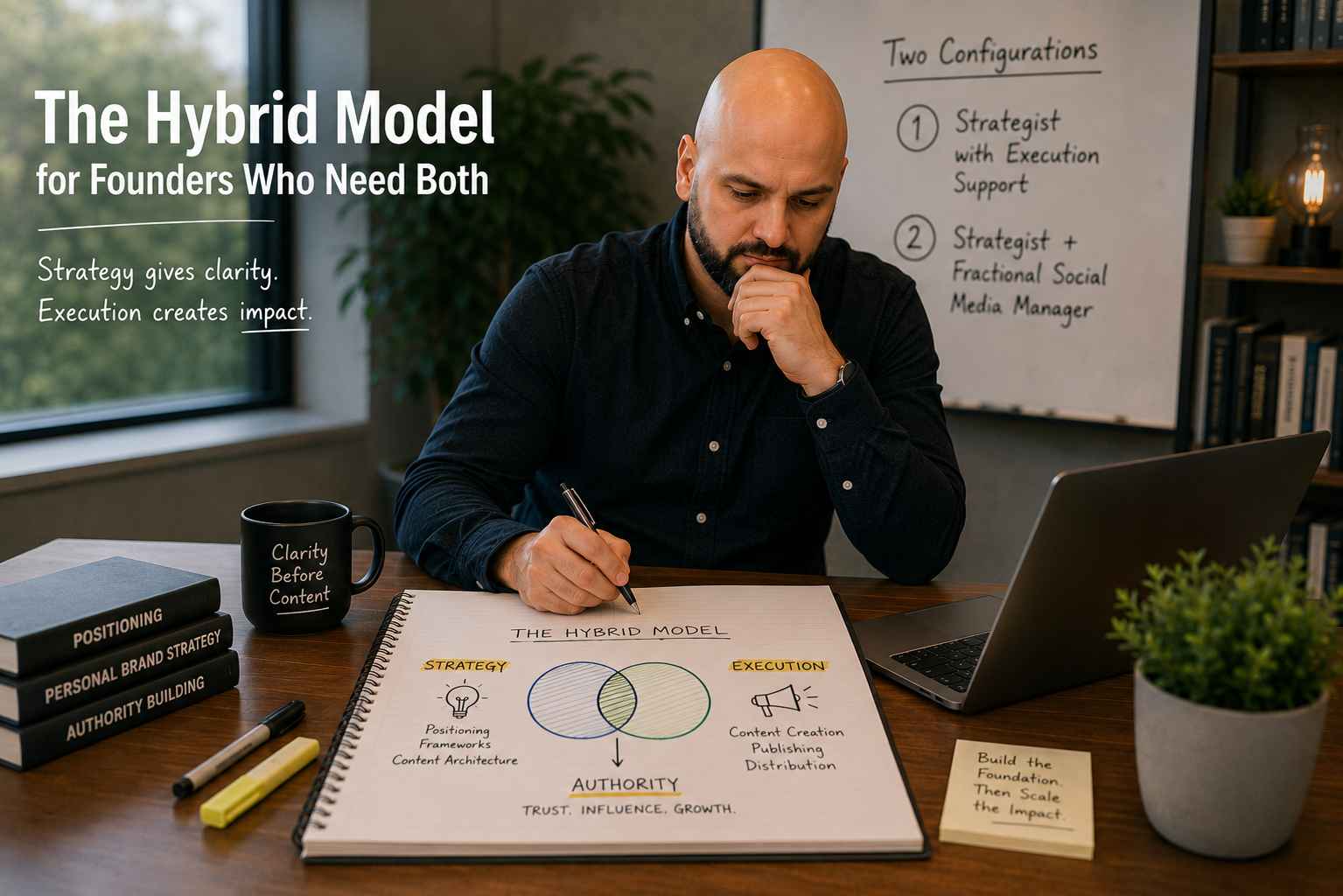
Some founders need strategy and execution simultaneously. The hybrid model solves this without doubling the cost.
The hybrid model works in two configurations:
Configuration 1: Strategist with execution support. The personal brand strategist defines the positioning, frameworks, and content architecture. The same strategist or a junior team member handles the publishing. The founder pays one provider for both layers. This configuration works for founders at $30K to $100K per month in revenue.
Configuration 2: Strategist plus fractional social media manager. The personal brand strategist delivers the strategic foundation in month 1 to 2. A fractional social media manager (10 hours per week) executes against the architecture starting month 3. The consulting engagement covers the strategic layer. The fractional manager covers the execution layer. This configuration works for founders at $100K to $500K per month.
In both configurations, strategy precedes execution. The founder never pays for content that lacks strategic direction.
The Five Signs a Founder Hired the Wrong Person First
Five symptoms reveal that the execution hire came before the strategy hire.
Sign 1: The content looks professional but sounds generic.
The posts are well-designed and grammatically clean. A prospect who reads 10 posts cannot name a single framework or specific point of view. The content built fame without substance.
Sign 2: Follower count grows but inbound leads do not.
The audience expands. The revenue stays flat. Awareness without authority is an expensive vanity metric.
Sign 3: The founder cannot explain what their content strategy is.
The social media manager handles everything. The founder has no positioning document, no content architecture map, and no framework library. The strategy lives in the manager's head, not in a transferable system.
Sign 4: Every post performs the same regardless of topic.
Engagement is flat across all topics because no topic has strategic depth. The content skims the surface of many subjects instead of owning one.
Sign 5: The founder feels dependent on the social media manager.
The manager leaves and the content stops. No system exists independent of the individual. A personal brand strategist builds a system. A social media manager runs it. The system survives personnel changes. The individual does not.
Frequently Asked Questions
What is a personal brand strategist?
A personal brand strategist defines the positioning, intellectual property, and content architecture that make a founder's expertise visible to the right market. The strategist operates at the strategy layer: what the founder stands for, who the content serves, and how authority compounds over time. The strategist does not publish posts or manage social media accounts.
How much does a personal brand strategist cost compared to a social media manager?
Personal brand strategists charge $5,000 to $25,000 per month depending on scope and experience. Social media managers charge $1,500 to $5,000 per month.
The strategist costs more per month but produces foundational assets (positioning, frameworks, architecture) that compound in value. The social media manager costs less per month but produces content that expires without strategic direction.
Can one person do both strategy and social media management?
A personal brand strategist with execution capabilities handles both layers for founders at the $30K to $100K per month revenue stage. At higher revenue stages, the strategic and execution layers benefit from separate roles because the complexity of both increases.
How long does a personal brand strategist engagement last?
The foundational engagement (positioning, frameworks, content architecture) takes 2 to 3 months. Ongoing strategic advisory for content direction, authority measurement, and positioning refinement continues on a monthly or quarterly basis depending on the founder's growth stage and goals.
What qualifications distinguish a strong personal brand strategist from a generic marketing consultant?
A strong personal brand strategist has published intellectual property, specific client results with measurable outcomes, personal search visibility and entity recognition, and strategic depth beyond content advice.
The strategist discusses positioning, entity architecture, and authority measurement as interconnected systems. A generic marketing consultant discusses posting frequency and engagement tactics.