
He built it on a worldview. Eric Hoffer wrote the rule in 1951. AJ Kumar maps the doctrine test and the neuroscience of belief. He explains why the content calendar is a trap most founders never escape.
Key Takeaways
Naval Ravikant posted 40 tweets in 2018. They became one of the most cited founder doctrines on the internet. He still posts rarely.
Doctrine is a worldview, not a topic. Most founders have content pillars. Cult brands have doctrine.
Doctrine does not need to be true. It needs to be unfalsifiable and promise a future. Hoffer wrote it in 1951.
Your brain processes belief in the same circuit it uses for self-knowledge. Harris and colleagues mapped this in 2007.
The Doctrine Test has four criteria. Worldview, Unfalsifiable, Resonant, Repeatable. Cult brands pass all four.
The content calendar is a trap. It fills the schedule and starves the worldview. Founders post topics. Founder brands repeat doctrine.
Doctrine beats content. Most founders have it backwards.

Doctrine beats content. Most founders have it backwards. Founder authority compounds on doctrine, not on calendars.
The default founder posture is the content calendar. Pick three pillars. Schedule three posts a week. Rotate the topics. The result is content that looks like a brand but functions like a feed. Every week the feed resets. The audience consumes the latest post and forgets the last one.
Doctrine is different. A doctrine is a claim about how the world should be. Naval Ravikant's doctrine is one sentence: specific knowledge plus leverage equals wealth. He has been repeating it since 2018. His audience finishes the sentence for him.
Most founders confuse pillars with doctrine. A pillar is a topic. A doctrine is a worldview. A pillar fills a calendar. A doctrine builds a brand moat no competitor can copy.
Eric Hoffer wrote the rule in The True Believer in 1951. Movements do not run on topics. Movements run on doctrine. Every founder brand worth following runs on Hoffer's code, even when the founder has not read him.
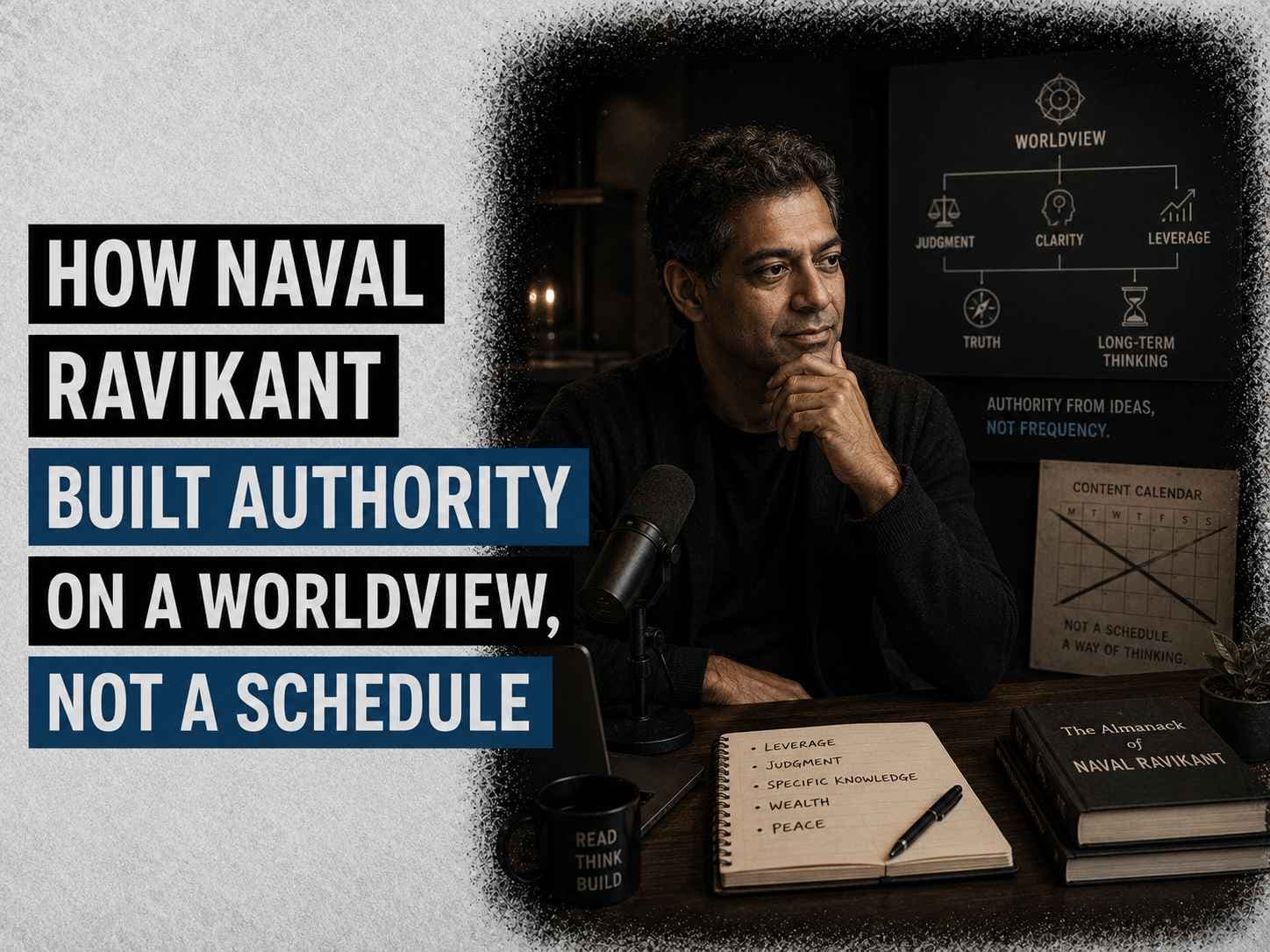
Naval Ravikant built authority on a worldview, not a schedule.
Naval founded AngelList in 2010. He is a venture capitalist by trade. He could have built his brand the way most VCs do, through deal announcements and portfolio updates. He did not. In May 2018, he posted a thread of forty tweets titled How to Get Rich (without getting lucky).
The thread named his doctrine in plain language. Specific knowledge cannot be trained for. Leverage is labor, capital, code, and media. The arithmetic of wealth is compounding plus principles plus time.
The thread did not go viral by accident. It went viral because it named a worldview the audience already half-believed. Eric Jorgenson compiled the doctrine into The Almanack of Naval Ravikant in 2020. The book has been downloaded millions of times. It is given away for free.
Naval has roughly 2.5 million followers on X. He posts rarely. The audience does not need the new posts. The audience repeats the doctrine. Every quote you have ever read attributed to him comes from a worldview he has been refining for two decades.
The brand is the doctrine. The doctrine is the brand. The content calendar is irrelevant.
A doctrine is unfalsifiable on purpose.

Hoffer's most controversial observation is the one most useful for founder brands. Doctrine does not need to be true. It needs to be unfalsifiable and promise a future. He was talking about religion and revolution. The brand application is identical.
Naval's claim that specific knowledge plus leverage equals wealth is unfalsifiable in the strict sense. You cannot run a controlled experiment that disproves it. You can argue with it. You can point to counterexamples. But you cannot kill the doctrine because the doctrine is a worldview, not a hypothesis. Worldviews are immune to counterexamples. That is the design.
Ray Dalio did the same with Principles. Dalio's claim that radical transparency plus algorithmic decision-making produces better outcomes is unfalsifiable in any clean way. His audience does not need it to be falsifiable. They need it to be defendable. They need it to feel true.
The brand application is brutal. A doctrine that can be argued out of is not a doctrine. It is a position. A position changes when the data changes. A doctrine survives the data. Doctrine pairs with a named devil to form the spine of every modern cult brand.
Your brain processes doctrine differently from content.
Sam Harris, Sameer Sheth, and Mark Cohen published foundational fMRI work on belief in 2007 in Annals of Neurology. They scanned subjects evaluating statements they believed, disbelieved, or were uncertain about. The finding was clean.
Belief activated the ventromedial prefrontal cortex, the same region that fires during self-knowledge and value processing. Disbelief activated regions associated with conflict detection and disgust.
The implication for founder brands is direct. A doctrine that the audience accepts is processed using self-knowledge circuits. The audience does not evaluate the doctrine. The audience integrates the doctrine into the self. That is why audiences defend founder doctrines like they are defending themselves.
Content does not get this treatment. Content is evaluated, scrolled past, forgotten. The brain stores it in a faster pathway built for novelty. Doctrine is stored in the slow pathway built for identity.
This is the same Reinforce gate I mapped in ROAC. Content fires the Resonate gate at best. Doctrine fires the Reinforce gate, where loyalty compounds for years.
The Doctrine Test.
The Doctrine Test has four criteria. Worldview, Unfalsifiable, Resonant, Repeatable. Pass all four and you have doctrine. Pass none and you have content.
Worldview. A doctrine is a claim about how the world should be. Not a topic. Not a frame. A claim. Naval's claim is specific knowledge plus leverage equals wealth. Ray Dalio's claim is radical transparency produces better outcomes. Seth Godin's claim is permission replaces interruption. Each one is a sentence that names a worldview, not a tactic.
Unfalsifiable. The doctrine cannot be argued out of with a single data point. You can disagree. You cannot kill it. Worldviews are immune to counterexamples because worldviews are not hypotheses. They are organizing principles for how the audience reads the world.
Resonant. The audience already half-believes it. The doctrine names a tension the audience already feels. The job of the founder is not to invent the belief. The job is to be the first person to say it cleanly. Naval did this with luck. Dalio did this with workplace politics.
Repeatable. A doctrine that cannot survive ten thousand repetitions is a slogan. The test is volume. Will the audience still nod the ten-thousandth time? Naval has tested this for eight years. The audience finishes his sentences. That is the only proof that matters.
Pass all four. Repeat the doctrine until the audience defends it. The brand follows.
The content calendar trap.
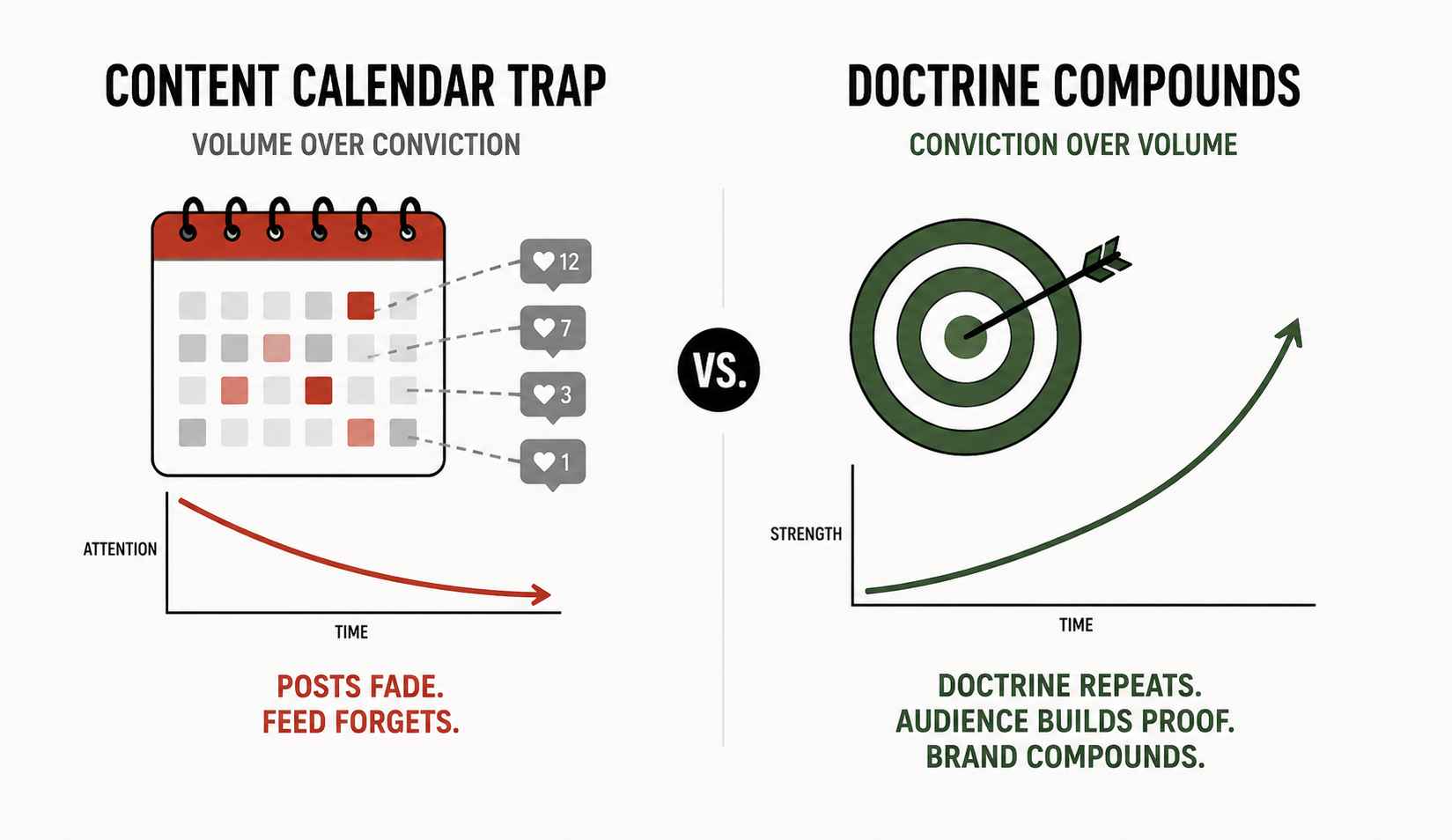
The content calendar trap is the default state of the founder brand industry. It is also the reason most founder brands stay forgettable.
The trap is seductive. A content calendar feels like work. You can fill it. You can schedule it. You can outsource it. You can measure it. None of that produces a brand. It produces a feed.
The feed has a half-life. Every post fades faster than the one before. The audience moves on to the next feed. The brand does not compound because nothing in the feed is worth defending.
Doctrine has no half-life. A doctrine repeated for eight years gets stronger every year because the audience accumulates evidence inside the worldview. Naval's claim about luck is stronger in 2026 than it was in 2018. The words have not changed. The audience built the proof.
The founder content calendar is also a Darketing trap in disguise. It rewards volume over conviction. It punishes the founder for repeating the same worldview. It pushes founders toward novelty, novelty, novelty. Novelty is the enemy of doctrine.
The fix is to flip the order. Doctrine first. Content after. Every post is one repetition of a doctrine the audience can recite without prompting. That is when the calendar stops being a trap. It becomes the rhythm of the worldview.
How to write your doctrine this week.
First, finish this sentence in eight words or fewer. The world should be instead of. Not a topic. A claim about how the world should be. If you cannot finish the sentence in eight words, you do not have a doctrine yet. You have a vague conviction.
Second, run the Doctrine Test. Worldview, Unfalsifiable, Resonant, Repeatable. If the doctrine fails any test, rewrite. Most founders will rewrite three or four times before they have it.
Third, kill your content calendar in its current form. Do not throw away the scheduling discipline. Throw away the topic-driven planning. From this week forward, every piece of content is one repetition of the doctrine in a new form. A new story. A new angle. The same sentence underneath.
Fourth, repeat for ten years. The brand does not appear from the doctrine. The brand appears from the audience hearing the doctrine so many times they finish your sentences in their head.
I have watched this happen with founders for more than 20 years. The ones who land their doctrine in year one compound. The ones who chase topics churn. Doctrine first. Content after. The audience does the rest.
Frequently Asked Questions
What is the difference between content pillars and doctrine?
Content pillars are topics you cover. A doctrine is a claim about how the world should be. Pillars fill a calendar. A doctrine builds a brand moat. The strongest founder brands have doctrine the audience can recite.
What is Naval Ravikant's doctrine?
Naval's doctrine is that specific knowledge plus leverage equals wealth. He named it in a 2018 tweet thread called How to Get Rich (without getting lucky). The thread became the spine of his brand for the next decade.
Does doctrine have to be true to work?
Hoffer's observation is that doctrine works through unfalsifiability and promised futures, not strict truth. The mechanic does not care about epistemic accuracy. The founder's job is to choose a doctrine that improves the audience's life. The wrong doctrine is extracted from it.
How long does it take to build a doctrine?
The first draft can be written in an hour. The defensible version usually takes three or four rewrites. The doctrine itself has to be repeated for years before the audience finishes the sentences. Naval has been refining his doctrine for eight years.
What makes a doctrine repeatable?
A doctrine is repeatable when it survives ten thousand repetitions without sounding stale. Worldviews are repeatable. Slogans are not. The test is this: does the audience still nod on the ten-thousandth time you say it?
Can I have more than one doctrine?
No. Hoffer wrote that the ideal devil is one. The same applies to doctrine. Multiple doctrines dilute the audience's signal of what the brand is for. One doctrine repeated for a decade builds the brand.