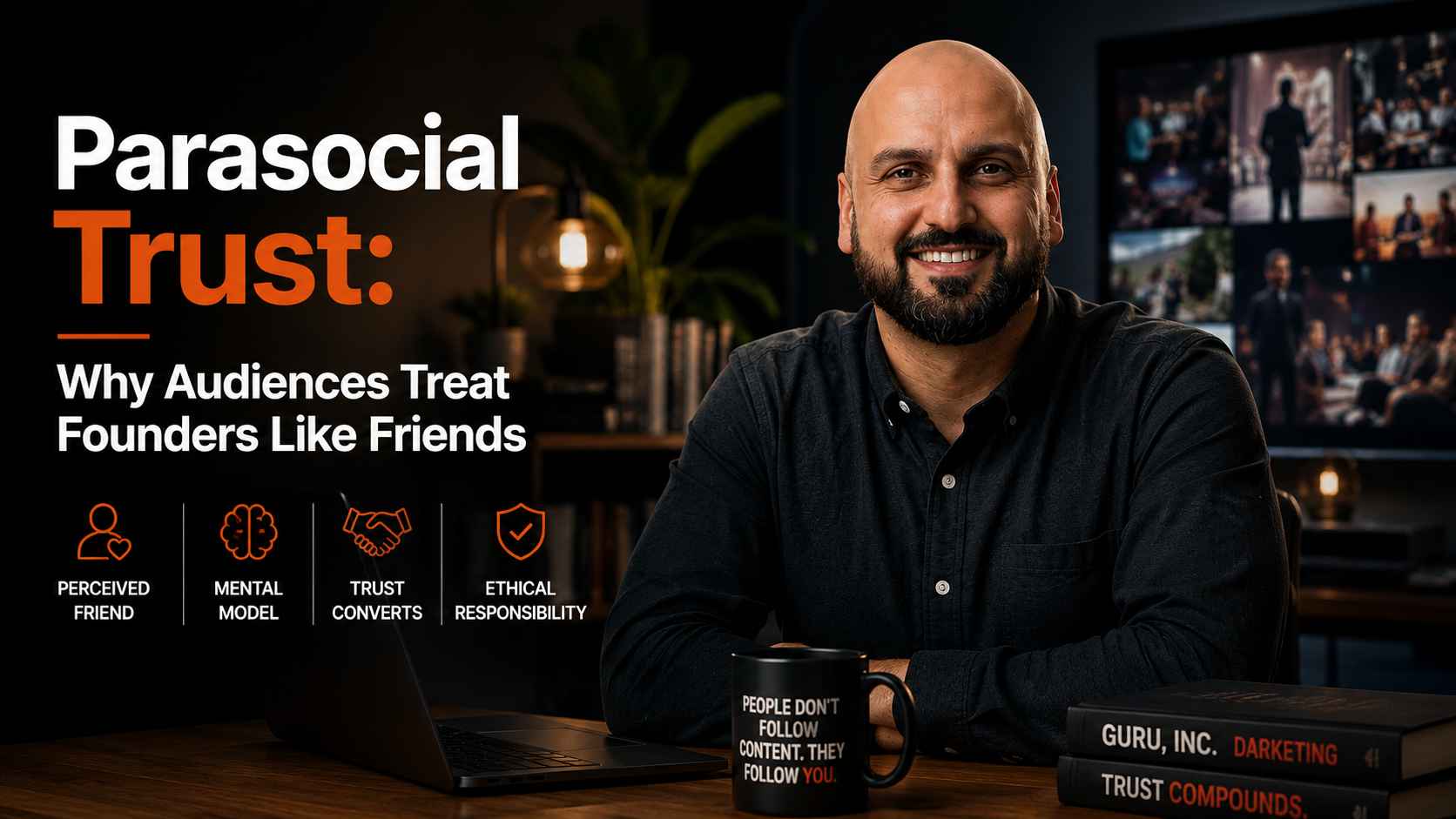

AJ Kumar's Business Architect Framework reorients founders, athletes, and celebrities around three pillars: a Content Engine that builds authority, a Relationship System that captures an owned audience, and a Revenue System that converts trust into compounding income. The result is a fortress, not a sandcastle.
Key Takeaways
Fame is rented attention. The creator economy will approach half a trillion dollars by 2027 but most creators stay structurally fragile.
A Creative Assistant produces more content. A Business Architect designs the system that converts attention into authority and authority into revenue.
The Content Engine separates viral reach from authority. Long-form video generates leads 18 months after publish. Short-form vanishes in days.
The Relationship System turns rented followers into owned email and SMS lists, automated indoctrination sequences, and private communities you control.
The Revenue System replaces brand deals with owned products, live experiences, and subscription assets that monetize trust into consistent cash flow.
I built Kimberly Snyder from a $500-per-hour nutritionist into a multi-million dollar authority brand using this exact three-pillar architecture.
The Influencer Trap
There is a version of success that looks incredible from the outside and is hollow on the inside.
You have seen it. A professional athlete with two million followers and no email list. A reality TV personality whose DMs are flooded but whose bank account depends on the next brand deal. A fitness influencer posting three times a day, grinding on a content hamster wheel, celebrating metrics with zero connection to revenue.
From the outside, these people look like they made it. From the inside, they are one algorithm change away from starting over.
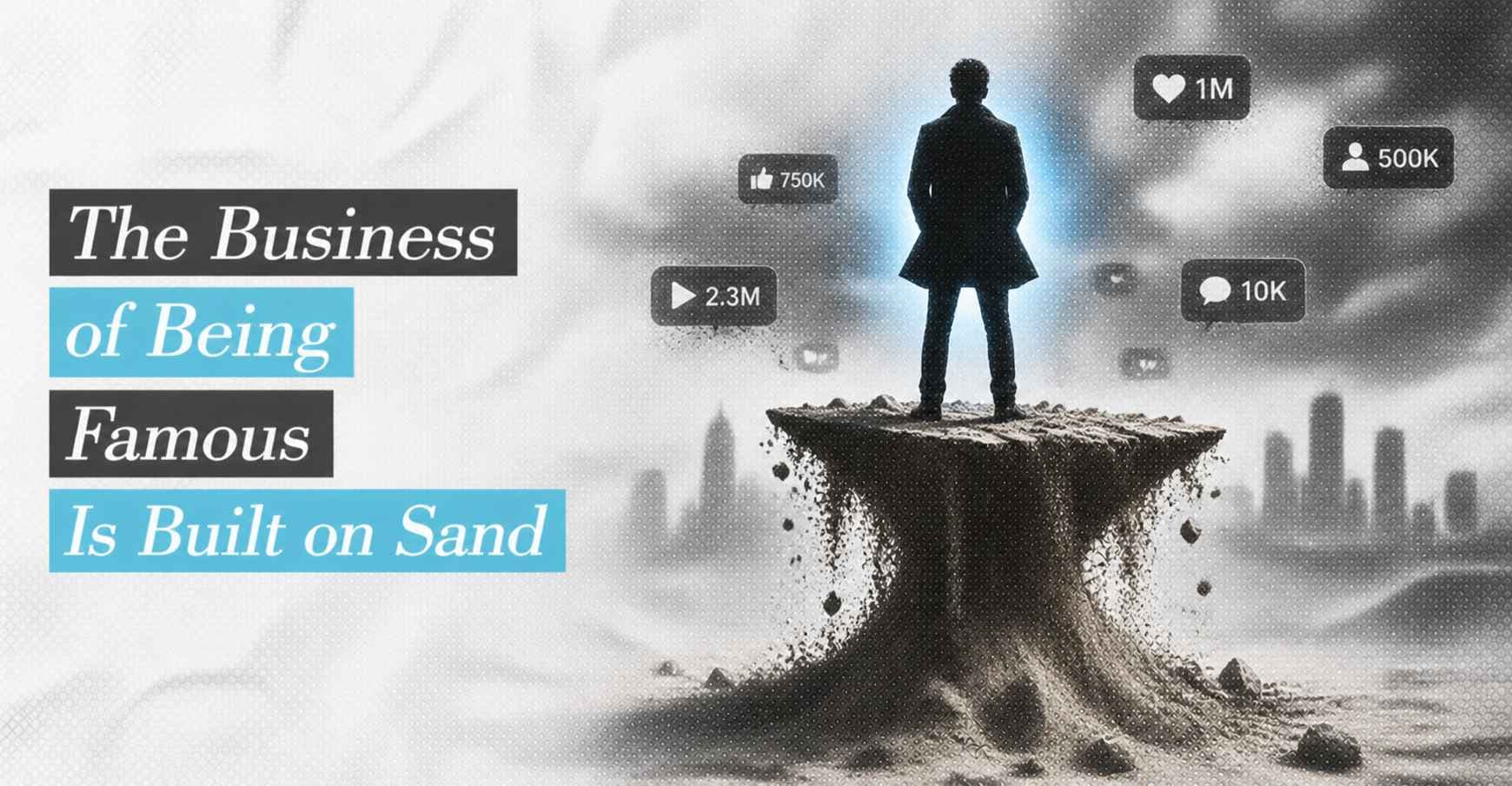
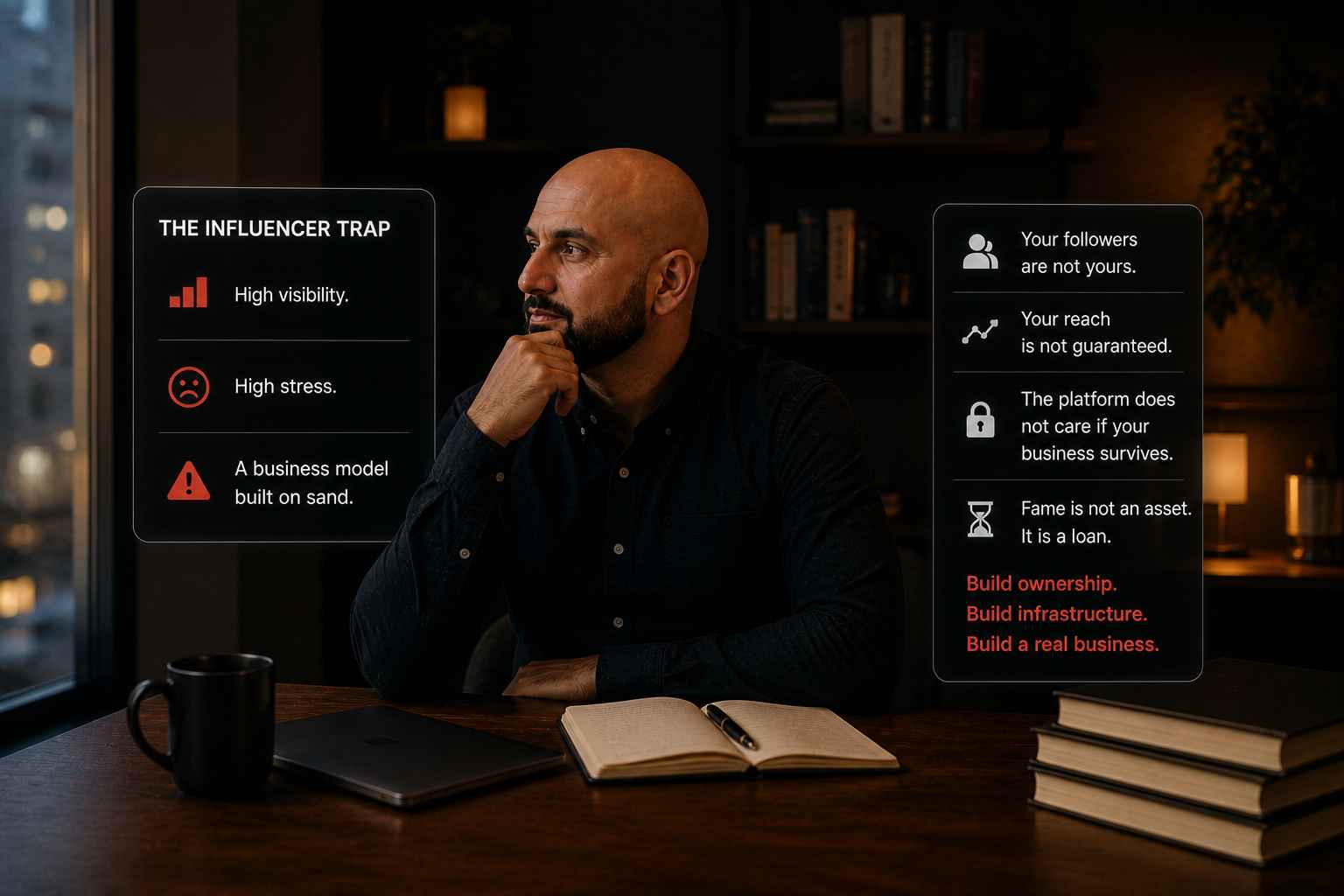
I call this the Influencer Trap. High visibility. High stress. A business model built on sand.
Your followers are not yours. Your reach is not guaranteed. The platform you built your livelihood on does not care if your business survives. Instagram, TikTok, YouTube. They are attention merchants. The algorithm satisfies the broadest possible audience, not your income.
You are renting space in someone else's marketplace, and the landlord can change the terms any time.
The creator economy is projected to nearly double in value by 2027, approaching half a trillion dollars according to Goldman Sachs. Most of that value will concentrate with creators who own infrastructure. The rest keep renting attention month to month, wondering why their revenue feels fragile despite millions of impressions.
Fame is not an asset. It is a loan. The interest rate is your time.
For an athlete whose contract ends in three years or a TV personality whose show may not get renewed, this is not abstract. It is an expiration date. The cheering stops. The views drop. You realize you never built a company. You had a spotlight.
The Scrambled Rubik's Cube

Most personal brands feel like a scrambled Rubik's Cube.
When I sit with high-level clients, professional athletes, celebrity chefs, media personalities, the conversation starts the same way. They feel foggy. A hundred good ideas. Leads sitting in a database that nobody has contacted. An audience clearly wanting something with no system to deliver it. Every piece is there. Nothing is aligned.
The instinct is to hire someone to make more content. A creative assistant. More videos. More posts. Push harder.
This is a multi-million dollar mistake.
The problem is not content volume. The problem is architecture. More content without a system is an engine in a car with no wheels. You burn fuel, make noise, and go nowhere.
There is a critical distinction I draw for every client. The difference between a Creative Assistant and a Business Architect. A creative assistant oils the gears. A Business Architect builds the machine those gears belong to. They design the system that turns attention into authority, authority into trust, and trust into revenue.
There is also a neurological reason talented people stay stuck. When the brain faces too many options without a framework, the prefrontal cortex throttles decision-making. Psychologists call this decision fatigue. The smartest person in the room can be paralyzed by their own potential. Not from lack of ability. From lack of architecture.
My work moves people from content creators to founders of personal media companies. Scrambled to cohesive. Three pillars do the work.
The Business Architect Framework
Every fortress stands on three pillars: a Content Engine, a Relationship System, and a Revenue System.
Most personal brands have a version of one. Almost none have all three working together. The connection between them is where the real value lives.
Pillar I: The Content Engine
Most content strategies optimize for reach. More views. More impressions. More followers. On the surface, that looks like progress.
Reach without authority is noise with volume.
The algorithm rewards content that satisfies the broadest possible audience. Your business does not need the broadest audience. It needs your Core Audience. The people who trust your perspective enough to buy from you, hire you, or follow your recommendations.
Viral content is the hook. Authority content is the anchor. The mistake I see is creators treating short-form as the entire strategy. Short-form is fast fashion. It gets attention for hours, then disappears. A well-structured YouTube video is still generating leads 18 months after you publish it. That is not content. That is infrastructure.
What you need is a Studio System. Think the way a network thinks about programming. A Core Series that solves specific problems for your niche. A Viral Layer of high-reach hooks that bring people in. An Authority Layer of long-form work that proves you are the expert.
There is a reason this works at the neurological level. The brain rewards insight discovery with dopamine through prediction error. When your content delivers more value than the viewer expected, the brain creates a shortcut. "This person reliably delivers." That shortcut is trust. Trust is the only asset in personal branding that compounds without additional spend.
Pillar II: The Relationship System
The greatest tragedy in modern personal branding is the Relationship Gap.
I have seen it dozens of times. Hundreds of leads who raised their hand. They signed up. They sent a DM. They filled out a form. They sit in a CRM and nobody is talking to them. The leads go cold while the creator films the next batch of content that produces the next batch of leads that also go cold. A leaking bucket. No content volume will fix a structural hole.
If you have 800 leads in a database and nobody is communicating with them, you do not have a content problem. You have an architecture problem.
A Business Architect builds a Relationship System that turns rented followers into an owned audience. The system has three components.
First, Owned Channels. Email and SMS lists you control regardless of what an algorithm does tomorrow. If Instagram disappears overnight, your email list is still there. Second, Indoctrination Sequences. Automated communication flows that educate leads on your value, methodology, and worldview 24 hours a day.
They build trust while you sleep. Third, Community Platforms. Moving your most engaged people into a private ecosystem where you own the data.
Your audience already has a parasocial relationship with you. Through repeated exposure, the brain runs long-term potentiation. The neural pathways tied to your identity strengthen with every view. They feel like they know you. The Relationship System does not create the feeling. It captures it.
Distribution trumps product every time. You can have the best offer in the world. If you do not own the channel between you and your audience, you do not own the business.
Pillar III: The Revenue System
Most influencers and celebrities monetize through brand deals.
On the surface, brand deals look great. Quick money. Someone pays you to post. But brand deals are transactions, not revenue. They stop when you stop showing up. They fluctuate based on conditions you cannot control. They often require you to compromise your creative integrity for a check.
A media company runs on Owned Revenue Systems. A subscription-based academy, digital products, online courses, live retreats. Owned revenue monetizes trust into consistent cash flow. The trust your Content Engine built and your Relationship System captured converts into dollars through products you designed and control.
The creator economics of a personal media company run in three tiers. Core Revenue is predictable monthly income from owned products, subscriptions, and digital assets. Your floor. Expansion Revenue is live events, retreats, and high-ticket consulting that monetize your physical presence at premium pricing.
Leverage Revenue is where brand deals belong, not as the lifeblood of the company, but as bonus income on top of a foundation you already own.
This creates what I call Passive Exit Value. The architecture keeps generating revenue after you stop posting, after the season ends, after the contract expires. When your revenue system is bigger than your daily presence, you do not have a personal brand. You have a company.
The goal is not to monetize your fame. It is to build something that makes money if you are famous tomorrow or not.
Strategy Over Speed
The three pillars do not work in isolation.
Most founders I work with think they need to move faster. More posts. More videos. More output. They need to think bigger.
The pillars need a Management Layer. Strategic coordination that ensures every video you film is a brick in a larger building, not a random act of content. This means three things. Strategy and Alignment, where every piece of content maps to a business outcome.
Intelligence, where you track signals that matter, like leads generated, conversions, and trust metrics, instead of vanity numbers. I developed a diagnostic system called Return on Attention Created (ROAC) to replace guessing with reading.
ROAC tracks how attention moves through four neurological gates: Register, Retention, Resonate, Reinforce. The full framework lives in GURU, INC. Operations is the third element, where the team is coordinated so the founder can stay in their zone of genius.
Without the Management Layer, you are stacking bricks without a blueprint. You might build something. It will not be a fortress.
What the Sherpa Has Seen
I did not develop this framework from theory.
I built it from over a decade inside personal brands at the highest level. When I partnered with Kimberly Snyder, she was a celebrity nutritionist doing well with private clients at $500 per hour in Hollywood kitchens. No digital infrastructure. No scalable systems.
We built the entire architecture together. Content engine, relationship system, revenue machine. Her email list grew past 150,000 subscribers. Her website generated over 16 million unique visitors from 240 countries.
We launched a digital course that produced $100,000 in revenue within 24 hours and went on to generate millions. She landed three New York Times bestsellers, one of which hit number two.
She was featured on Ellen, Dr. Oz, Today Show, Vogue, and Vanity Fair. Her brand became a multi-million dollar authority operation. Not from chasing virality. From building systems.
I have replicated this architecture across industries. A sales trainer who generated hundreds of thousands of dollars in coaching revenue. A TV personality who turned her online presence into a personal media company generating millions. Real estate experts. Health and wellness founders.
Each one started with the same problem. Plenty of talent. Plenty of attention. Zero infrastructure to convert it into lasting business value like Hormozi built at Acquisition.com.
If you want to climb a mountain, you do not find someone who can talk about the climb. You find someone who has done it before and knows where every crevasse is hiding.
The Real Question
You have two choices.
Stay on the hamster wheel. Keep posting. Keep hoping the algorithm favors you tomorrow. Keep celebrating metrics with no connection to your bank account. Keep building on rented land and hoping the landlord does not change the locks.
Or build a fortress. The creators and celebrities who win the next decade are not the ones who went viral the most. They are the ones who built something that did not need virality to survive. They are the ones who stopped asking for more followers and started asking for the blueprint of a brand moat.
Stop chasing views. Start owning an asset.
The business of being famous does not have to be built on sand. Right now, if you are honest, it probably is. Sand can be replaced with stone. You need the right architect.
Frequently Asked Questions
What is a personal media company?
A personal media company is a vertically integrated business built around a founder's identity, expertise, and audience. It owns its content engine, distribution channels, and revenue products instead of renting attention from algorithms.
How do I turn social media followers into an owned audience?
Move them off the platform. Capture them through a high-value lead magnet into an email or SMS list, then build automated indoctrination sequences that deepen the relationship. The goal is to own the conversation regardless of what any platform does next.
What is the difference between a creator and a founder of a media company?
A creator produces content and hopes for revenue. A founder builds a system where content is one input that drives audience capture, product sales, live experiences, and equity creation. The founder owns infrastructure. The creator rents attention.
How long does it take to build real authority online?
Real authority compounds in 18 to 36 months when the architecture is in place from day one. Without infrastructure, creators can post for five years and still feel structurally fragile because the asset never converts into ownership.
Should celebrities and athletes build their own media companies?
Yes, especially when fame has a built-in expiration. A retired athlete with an owned audience and a revenue system has a second career. An athlete with only followers has nostalgia.
What is the biggest mistake influencers make with revenue?
They depend on brand deals. Brand deals are transactions, not revenue, and they evaporate the moment audience growth slows or a sponsor changes priorities. Owned products and subscriptions create the floor brand deals never can.
How does ROAC measure content performance?
ROAC, Return on Attention Created, tracks attention through four neurological gates: Register, Retention, Resonate, and Reinforce. The framework replaces vanity metrics with diagnostic signals that show what attention produces for the business.