
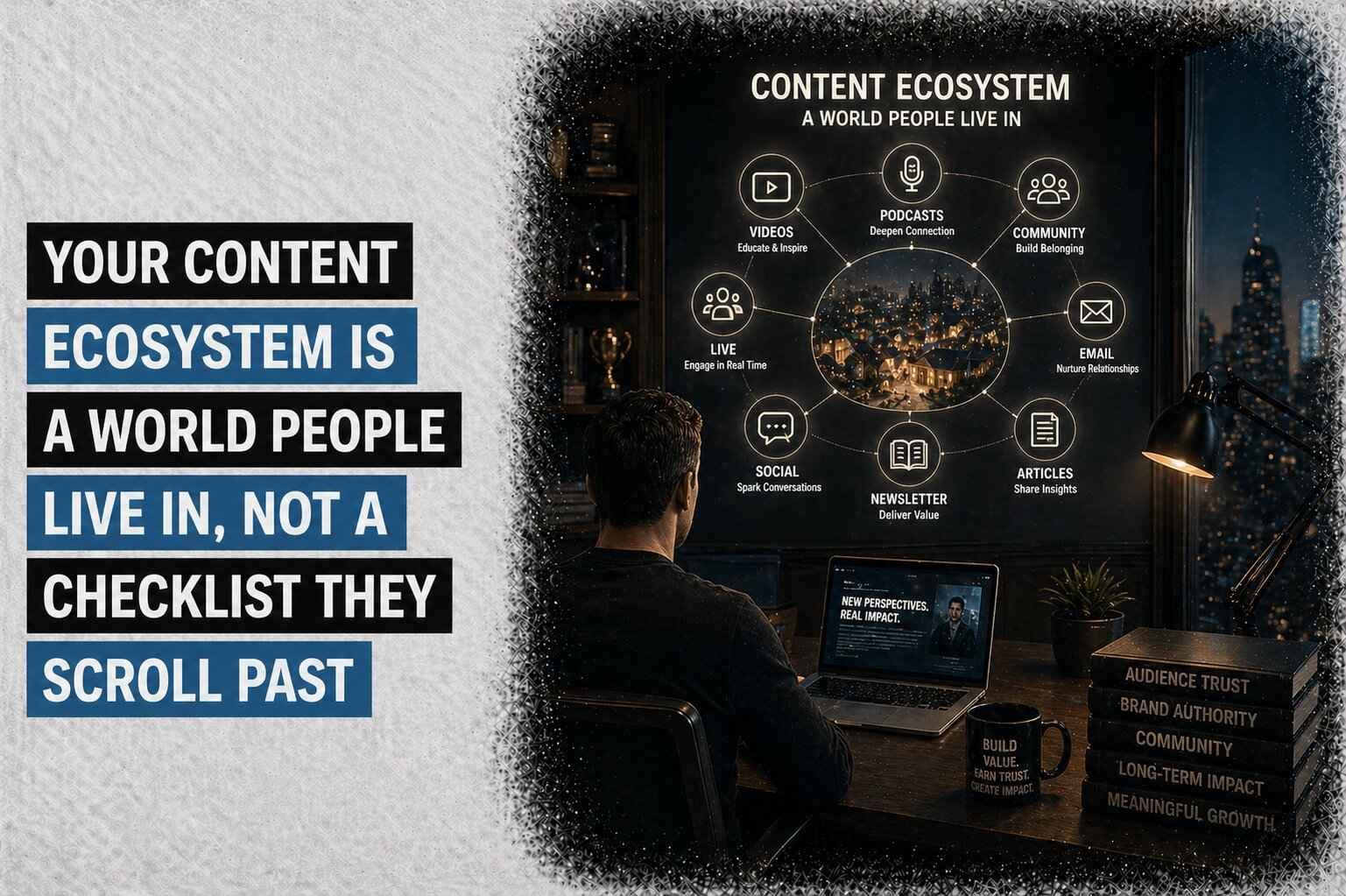
That shift, from follower to inhabitant, is the real moat. Virality is a spike. Omnipresence with one coherent throughline is what compounds into authority, demand, and revenue.
Key Takeaways
A content ecosystem is a world audiences inhabit, not a checklist of platforms to post on.
Omnipresence across channels with one coherent identity is the moat. Virality is a temporary spike.
Apple's ecosystem proves the throughline at scale: every touchpoint, from packaging to retail to OS, feels like one brand.
One long-form anchor cascades into platform-native variants. The waterfall is how omnipresence gets produced.
TBPN sold to OpenAI for $200 million because the format was engineered for clippability across every surface.
Repeated exposure across multiple contexts encodes memory and trust more durably than one viral spike.
Most Founders Build a Checklist Instead of a World
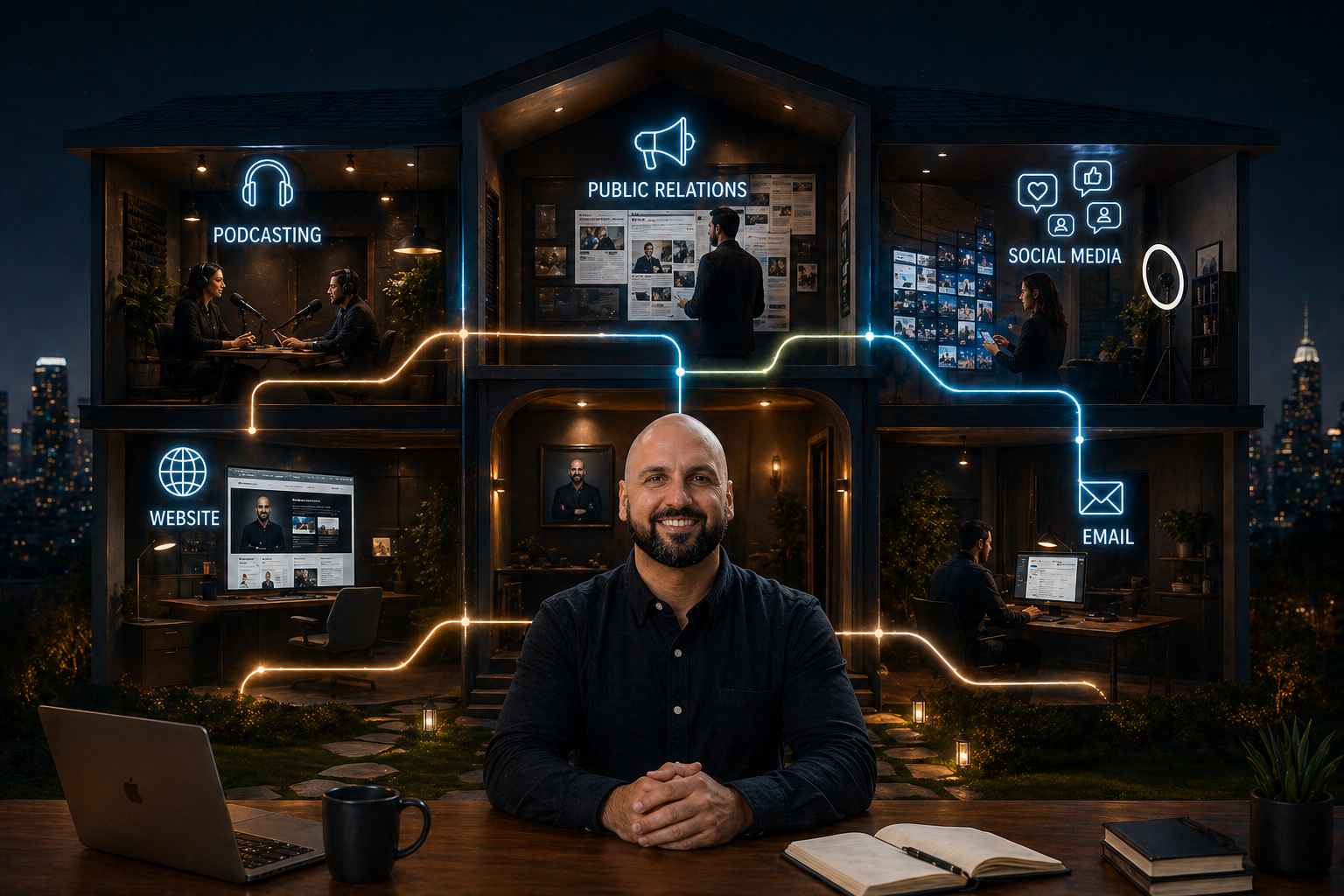
Most founders look at a content ecosystem and see a to-do list. Blog posts. Podcasts. Instagram. TikTok. YouTube. LinkedIn. Email. Speaking gigs. Lead magnets. Line items to check off.
Every one of those is a room in a house you are building. The people who follow you do not consume your content the way they read a brochure. They move through your world the way they move through a novel that updates every day. They watch you on YouTube. They read your blog at their desk. They listen on their commute. They open your email at night. Somewhere along the way, they stop being an audience and start being inhabitants.
That shift is the entire game. The reason most founders fail at content is not a lack of effort. It is a lack of architecture. The full ecosystem I map for clients at The Limitless Company spans five areas: public relations, podcasting, website, social media, and email. Approached as isolated tasks, it is overwhelming. Approached as one interconnected world, every input compounds. I map this in detail inside GURU, INC..
Omnipresence Is the Real Moat, Not Virality
The goal is not to win one platform. The goal is to become inescapable across all of them.
Virality is a spike. Omnipresence is a moat. A viral video produces one peak of attention that decays inside seventy-two hours. Omnipresence produces a permanent low hum of recognition that compounds for years. When someone sees your face on YouTube, hears your voice on a podcast, finds your blog through Google, reads your LinkedIn post at lunch, gets your newsletter at night, and watches you keynote a conference, you stop being a person they follow and start being a presence they live alongside. That presence is the asset.
Most founders chase the spike because the spike is measurable in real time. Omnipresence is invisible until it is unstoppable. The dashboard does not light up. Then a year passes and inbound flips. Buyers say things like "I see you everywhere." That sentence is the leading indicator that the world has formed. It is also the moment competitors can no longer catch up.
This is what a Personal Media Company is built to produce. Not a viral hit. A world the audience returns to.
Apple Built a Trillion-Dollar Empire on One Throughline
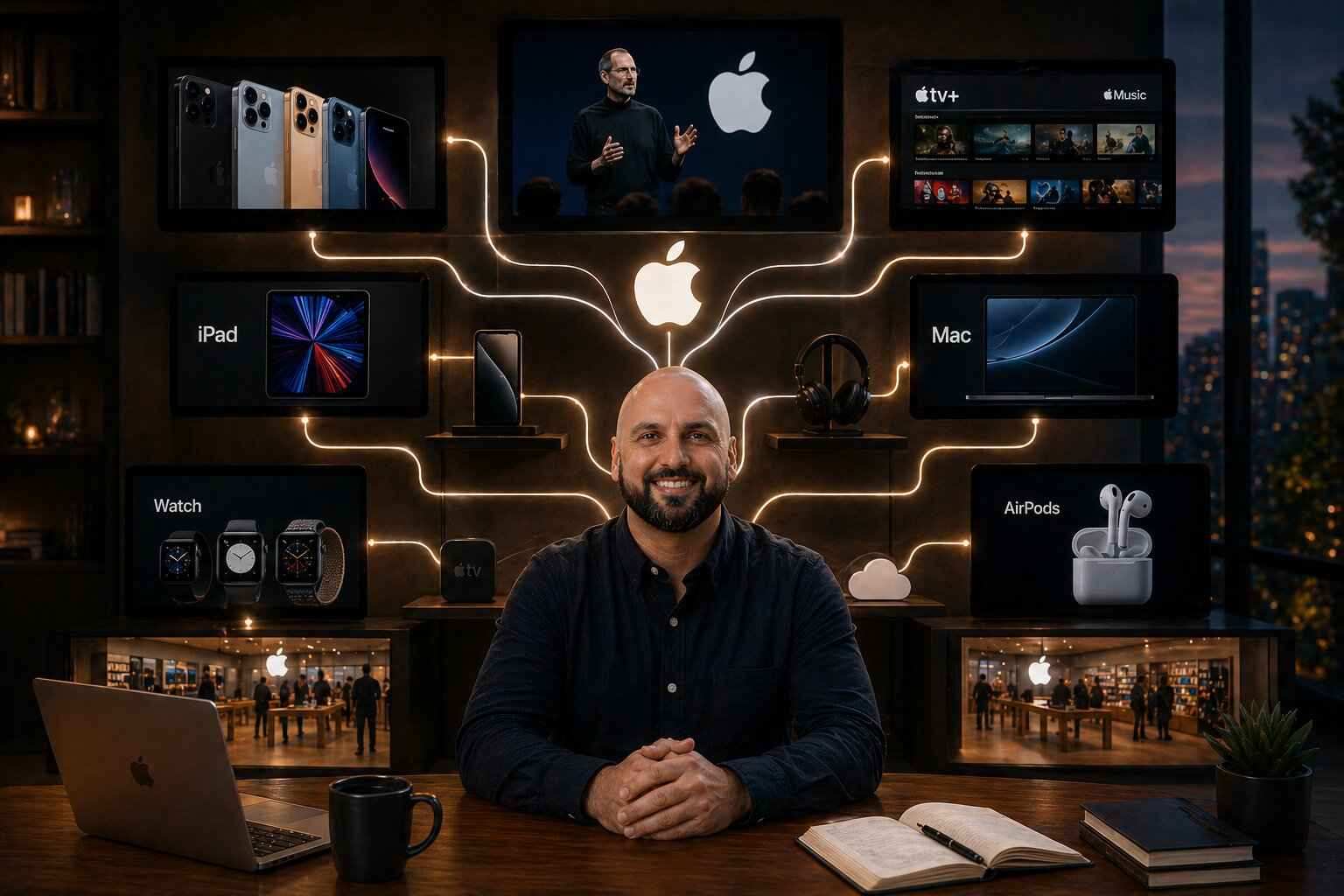
Apple is the proof that omnipresence with a coherent identity scales to planetary size. The ecosystem spans hardware, software, services, retail, and entertainment. iPhone, iPad, Mac, Apple Watch, AirPods, Apple TV+, Apple Music, iCloud, the App Store, Apple retail. Every product connects to the others. Every touchpoint, from the unboxing to the chime to the typography, carries one identity.
Steve Jobs obsessed over consistency because the throughline is the asset. The packaging feels like Apple. The store feels like Apple. The ad feels like Apple. The operating system feels like Apple. None of those touchpoints are the product. The product is the world they collectively create. The hardware is the entry ticket.
A founder ecosystem runs on the same physics. Your YouTube channel, podcast, LinkedIn presence, email list, and speaking deck must feel like the same person. Same voice. Same visual grammar. Same beliefs. When the throughline holds, every platform reinforces every other platform. When it breaks, the surfaces compete and the audience never builds a stable model of who you are.
The Waterfall Is How Omnipresence Gets Produced
Omnipresence sounds like more work. With the right architecture, it is less. One long-form anchor sits at the top of the ecosystem and cascades down into every other asset.
The anchor is a long-form video, a podcast, a keynote, or a livestream. It needs runtime long enough for a viewer to form a stable mental model of the person speaking. I make the case for why depth beats frequency in long-form YouTube versus daily Shorts. Once the anchor exists, the cascade begins. A 90 minute conversation produces eight to fifteen clips.
A 30 minute solo essay generates a Substack draft, a LinkedIn carousel, three Twitter threads, a YouTube short, an Instagram Reel, a TikTok, an email feature, and a blog post optimized for search. One recording. Twenty assets. Each shaped for the platform it lands on.
The waterfall has one rule. Each downstream asset must be optimized for its platform, not copy-pasted across them. The same idea wears a different uniform on each surface. A LinkedIn carousel reads like a deck. A TikTok opens with a hard cut. A blog post indexes on search intent. The idea is identical. The shape changes.
TBPN's $200 Million Sale Proves the Format Can Be Engineered for the Cascade
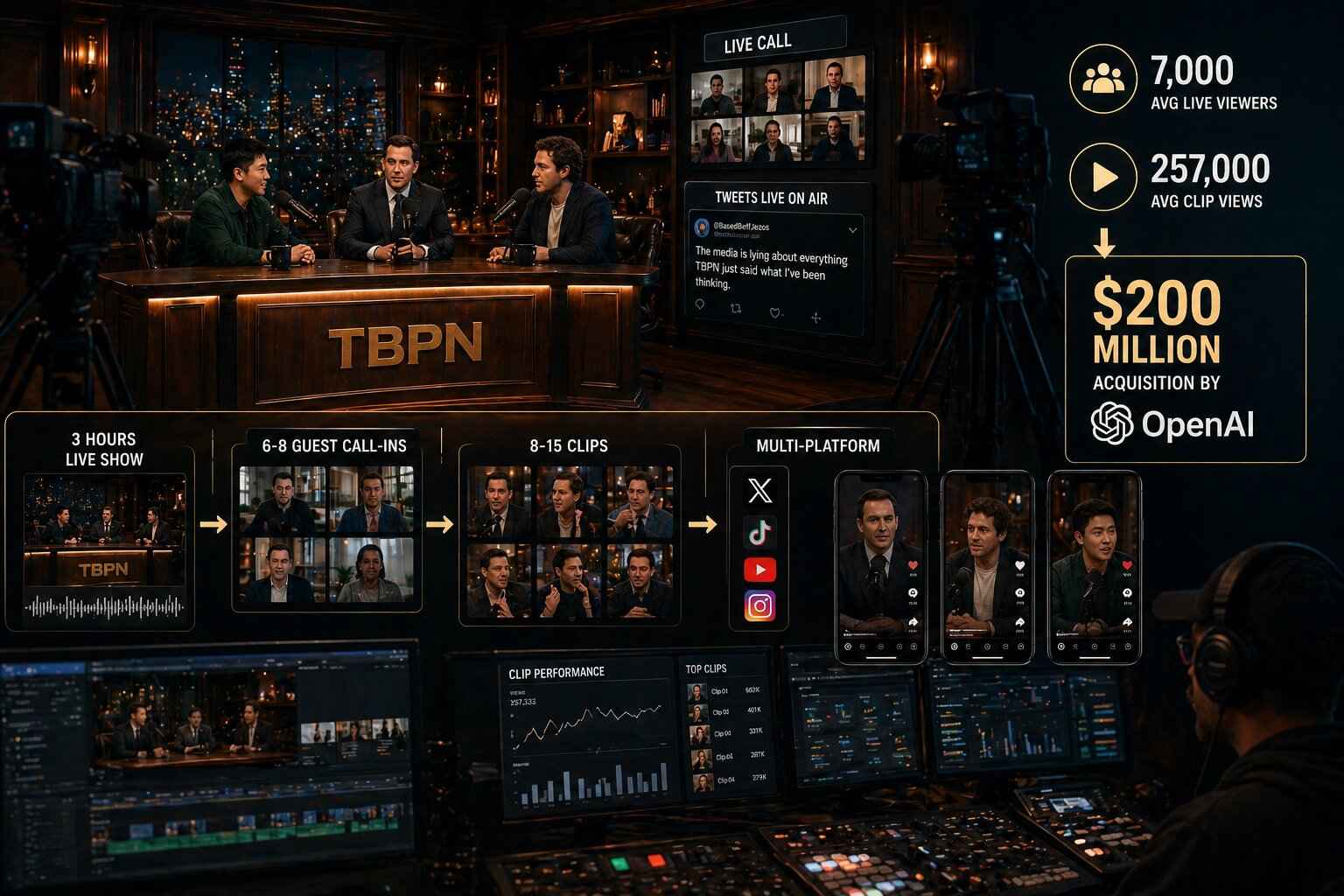
TBPN runs three hours of live show, five days a week, with around 7,000 average live viewers. Their average clip pulls 257,000 views. The show sold to OpenAI for $200 million because the format was engineered for clippability from the start.
The structure is the strategy. Six to eight guest call-ins per show act as pre-packaged five to ten minute segments, each with a hook, arc, and payoff. Hosts read tweets live on air, which creates a distribution loop because the tweet author shares the clip back.
The aesthetic pairs mahogany desk and cinematic lighting with group-chat casual content. That contrast makes clips feel premium and authentic in the same frame. Native horizontal on X. A 9:16 re-cut for TikTok, Shorts, and Reels. Eight to fifteen clips per episode posted across the day.
The clips are a symptom, not the cause. The real edge is timeline control: reading when a topic is peaking, coining phrases that spread, getting the right guest on the day a story breaks. The format converts timeline control into omnipresence at scale.
Each Platform Is a Different Room in the Same House
Each platform inside the ecosystem does a different job. The return profiles are not equivalent. The mistake is treating them as if they are.
YouTube long-form is the trust engine where authority compounds through search and recommendation. Podcast is the parasocial layer where listeners build intimacy with the host's voice. TikTok and Shorts are the discovery engine where the algorithm ignores follower count. LinkedIn is the boardroom where founders and executives evaluate you.
Instagram is the gallery where visual presence keeps you in the daily scroll. X is the timeline control surface where clips loop back into culture. Email is the owned relationship layer no algorithm can revoke. The blog is search-indexed real estate that compounds for a decade.
The content strategy decision is which combination matches your business and which you will commit to optimizing for. Not all of them. The right ones, held together by the throughline.
Public Relations Is the Door Other People Open
Public relations is the most underestimated layer of the ecosystem. It is not press releases. It is positioning yourself inside other people's worlds so they discover yours.
When I authored content for sites like Forbes and Entrepreneur early in my career, the same ideas published on those platforms outperformed identical content on my own site. Psychologists call this a context effect: the environment changes the perceived value of the thing inside it. Your guest articles place your ideas in the concert hall instead of the subway.
Brand mentions also do quiet work in the AI layer. ChatGPT, Perplexity, and Google AI Overviews scan third-party citations to decide who the authority on a topic is. Fresh mentions on credible outlets feed the signal architecture behind modern search and AI at the same time they reach human readers. The same Forbes byline that borrows context for a person also strengthens the entity for the machine. Podcast appearances do the same job through trust transfer. M. Olguta Vilceanu's 2025 analysis of 12,000+ podcast listener reviews found listeners reference hosts by first name, a depth of connection text rarely matches.
The Science Behind Compounding Surface Area
Google introduced the concept of the Zero Moment of Truth in 2011. Their research found people consume seven to thirteen pieces of content from a brand before deciding to buy. Every component in your ecosystem is a possible touchpoint inside that journey.
Each touchpoint registers in the brain differently. Cynthia Vinney, PhD, has documented how context-dependent memory encodes information more durably when learning happens across multiple environments. Hearing your voice on a podcast during a morning walk, reading your blog at a desk, and seeing a Reel on the couch at night encodes your ideas across multiple contexts.
You become harder to forget. Retail data confirms the business outcome. Gowrie, Shetty, Chopra, and Ligaraba (2026) found omnichannel coherence explains 53.9% of customer loyalty variance. Coherence beats fragmentation. The brain rewards a unified world. This is the mechanism behind Reinforcement, the fourth gate in the ROAC framework.
Build the World, Not the Checklist
Your audience does not need more content. They need a world worth returning to.
Build the long-form anchor first. Engineer it for the cascade. Optimize each downstream asset for the platform that will carry it. Hold the throughline like Apple does. When every surface reinforces the same identity, you stop competing for attention and start owning a position no algorithm can revoke.
The viral creator vanishes after the spike. The omnipresent founder compounds for a decade. Build the world. The audience will move in.
FAQ
What does omnipresence mean for a founder's content?
Omnipresence means appearing across every platform your audience uses with one coherent identity. The audience encounters you in multiple contexts, and the repeated exposure builds trust faster than one viral spike on a single channel.
Is omnipresence different from being everywhere?
Yes. Omnipresence requires a throughline. Being on every platform without coherence creates noise, not authority. The same voice, visual grammar, and beliefs must travel with you across every surface or the audience never builds a stable model of who you are.
What is a content waterfall?
A content waterfall is the model where one long-form anchor produces every downstream platform asset. A 90 minute video, podcast, or keynote becomes clips, carousels, posts, threads, blogs, and emails, each optimized for its platform.
Why is long-form content the anchor of the ecosystem?
Long-form is the only format that lets a viewer form a stable mental model of the person speaking. Belief forms during sustained runtime. Every shorter asset downstream borrows trust from the anchor.
Should every founder be on every platform?
No. The right combination depends on the business and the audience. Choose where stakeholders already spend attention, commit to optimizing for those surfaces, and hold the throughline across them. Coverage without coherence dilutes the world.
What does Apple teach a founder building a content ecosystem?
Apple holds one throughline across every product, store, ad, and interface. The lesson is consistency at scale. Every platform a founder appears on must feel like the same person, or the audience never builds a stable model of who you are.
How long before omnipresence starts compounding?
Twelve to eighteen months for early signal. Three to five years for category authority. The curve is non-linear. Most quit before it bends.