
Founders who treat personal brand and SEO as separate budgets are paying twice. Google evaluates content in the context of the entity that produced it. The mechanism mirrors how the brain registers authority before retaining anything.
Key Takeaways
Google's entity graph identifies people, brands, and concepts as nodes before evaluating the URLs they produce.
Founders without a defined entity start every published URL from zero, regardless of how good the content is.
Personal brand work and SEO work are two views of the same process at the entity-graph layer.
The four inputs Google uses to build a founder entity are owned data, third-party citations, reference databases, and surface consistency.
A confirmed entity makes content inherit authority weight and makes AI systems like ChatGPT cite you by name.
Building a founder entity takes twelve to twenty-four months of consistent identity reinforcement across owned and earned surfaces.
Google ranks content in the context of the entity that produced it.

Most founders treat search as a content problem. They write the post. They optimize the keywords. They wait for traffic. The traffic does not come. They blame the content. The content was not the problem.
Google's ranking systems sit on top of an entity layer. Every URL the system evaluates connects to an author, a brand, or an organization. The system has tried to identify each one. When the entity is confirmed, the URL inherits authority weight from the entity. When the entity is unknown, the URL floats without context. Two posts on the same topic do not compete on equal ground. The post from a recognized entity beats the one from a digital ghost.
This is the part founders miss. You do not rank content. Your entity ranks content. The work of building a recognized founder identity is upstream of every SEO tactic you will run.
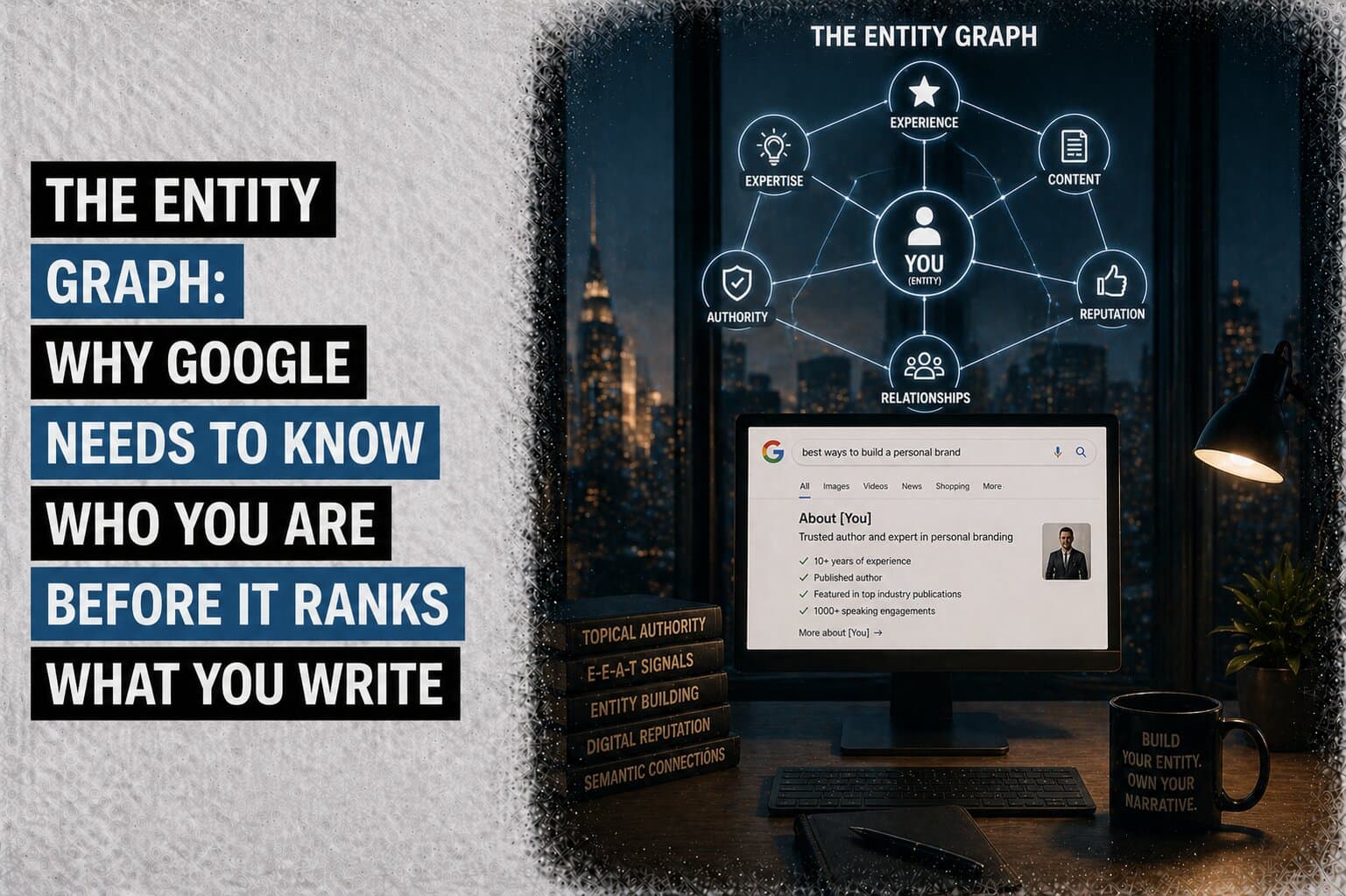
The entity graph is a map of who matters and what they connect to.
Google's Knowledge Graph launched in May 2012 with 500 million entities and 3.5 billion facts about them. The system maps three things. Nodes are entities like a person, a company, a concept, or a place. Attributes are properties of those entities like job title, location, founder of, author of. Edges are relationships between nodes. Neil Patel cofounded NP Digital. I wrote GURU INC. Kimberly Snyder authored The Beauty Detox Solution.
If Google can draw a clean graph of you and your work, it has a confident entity. The graph includes your topics and your relationships to other known nodes. If the graph has gaps or contradictions, the entity stays fuzzy. A fuzzy entity does not transfer authority to the URLs it publishes.
Most founders publish content without first telling Google who they are.

The most common founder mistake is publishing content before defining the entity behind it. The founder builds a website. The founder writes blog posts. The founder buys SEO tools and tracks rankings. None of it moves. Google has the URL. Google does not have the human.
I see this with founders who have built real businesses. They have revenue, customers, and proof. They are entities in the real world. They are not entities in Google's index. Their data is scattered across LinkedIn, a personal site, an old podcast appearance, and an outdated Crunchbase entry. The Crunchbase entry lists the wrong company. Google cannot resolve a clean identity from inconsistent surfaces.
The result is paying for content that has no entity to inherit from. Every post starts at zero. The founder thinks the content is failing. The identity layer is failing.
Four inputs build a founder entity, and Google triangulates from all of them.
Google does not build an entity from one signal. The system triangulates from four inputs that compound when consistent. This is what every founder serious about personal brand authority needs to understand.
The first input is owned structured data. This is the schema markup on your own site. It includes Person and Organization objects. The sameAs property links your name to verified profiles on LinkedIn, YouTube, X, Wikipedia, and Amazon. Owned data tells Google what you claim about yourself.
The second input is third-party citations. These are mentions of you by name on websites Google already trusts. A podcast appearance on a known show. A press feature in a publication with topical authority. A foreword written by a recognized author. Third-party citations tell Google what others claim about you.
The third input is reference databases. Wikipedia, Wikidata, Amazon author pages, ISBN registries, patent databases. These are the canonical record. Reference data tells Google you exist as a documented entity, not a self-claim.
The fourth input is cross-surface consistency. Same name, same bio attributes, same primary topic association across every place you appear. Inconsistency tells Google the entity is unstable. Consistency tells Google the entity is real.
The strongest founder entities have all four inputs reinforcing one identity. Most founders have one or two. That is why they stay invisible to the system.
Personal brand work and SEO work are two views of one job.

This is the reframe most founders need. They run two budgets. One pays for personal brand including LinkedIn ghostwriters, podcast bookings, and photography. One pays for SEO including content agencies, link building, and keyword research. They treat the two as separate disciplines.
At the entity-graph layer, they are the same discipline.
A podcast appearance is a personal brand asset and an entity citation. A book is a personal brand asset and a Wikipedia-eligible reference object. A consistent bio is a personal brand asset and a sameAs reinforcement. Every personal brand action either strengthens or weakens your entity. Every entity input is a personal brand action in disguise.
I learned this from Neil Patel. He cofounded NP Digital, scaled it past 1,000 employees, and put his name on the company. He taught me SEO when I was eighteen. The thing I noticed years later was that Neil never separated the two. His name was the brand. His name was the ranking factor. His name was the citation. He understood at the entity level what most founders are still treating as two budgets.
The Register gate of ROAC describes this in neurological terms. The brain has to recognize you before it retains anything. Google's systems are modeling the same biological logic. I map the full mechanism in GURU INC.
Three things change once Google confirms your entity.
Your content inherits entity weight. Two posts on the same topic, one from your domain and one from a no-name site, do not compete on equal ground. Your post starts ranked. The competitor's post starts unranked. The gap compounds with every additional URL you publish.
AI systems cite you by name. ChatGPT, Perplexity, Gemini, and Claude pull from named entities when they generate answers. A user asking about personal brand strategy sees known entities cited first. Anonymous experts with the same content do not get the citation. The citation engine rewards entities the system can name.
Competitors cannot copy your entity. They can copy your tactics, your content structure, even your phrasing. They cannot copy that you are the recognized entity for your topic. Tactical authority is fragile. Entity authority is a moat.
Building a founder entity is identity reinforcement, not technical optimization.
The timeline is twelve to twenty-four months of consistent identity reinforcement. The work spans every owned and earned surface.
Define yourself once across every owned surface. Use the same headline, primary topic, canonical bio, and image everywhere. Your website, LinkedIn, YouTube, podcast guest profiles, and Amazon author page should match at the attribute level.
Get cited by named third parties. Pursue podcast appearances on shows with topical authority in your category. Get quoted in articles. Pursue book endorsements from recognized authors. Each citation is a vote that your entity exists.
Link your work to known entities. Reference recognized authorities in your category. Mention the companies and people Google already classifies as confirmed nodes. Co-citation tells Google you operate in the same graph as known authorities.
Reinforce attributes consistently. Hold the same primary topic association for at least eighteen months. Hold the same job title. Hold the same company. Founders who change positioning every six months never give Google enough signal to confirm anything.
The digital world Google has built rewards founders who treat identity as infrastructure. Identity is not a marketing layer. It is the substrate every ranking decision sits on top of.
Frequently Asked Questions
What is the difference between Google's Knowledge Graph and a Knowledge Panel?
The Knowledge Graph is the underlying database of entities and their relationships. A Knowledge Panel is the visible card Google sometimes displays on the search results page. The panel is the surface. The graph is the substrate that decides if a panel appears.
Can a founder have an entity without a Wikipedia page?
Yes. Wikipedia is one strong signal but not the only one. Founders with consistent owned data, structured profiles on authoritative platforms, and named third-party citations can be confirmed entities without ever appearing on Wikipedia.
How long does it take to build a recognized entity for a founder?
For most founders the timeline is twelve to twenty-four months of consistent reinforcement. The signal compounds with every aligned citation. Founders who change positioning frequently extend the timeline because they reset the system's confidence in the entity.
Does AI search like ChatGPT and Perplexity use the same entity data Google uses?
They draw from overlapping sources. Wikipedia, Wikidata, authoritative publishers, and structured data appear in both pipelines. A founder entity recognizable to Google is more likely to be citable in AI answers as well.
What is the sameAs property and why should founders care?
SameAs is a schema.org property that tells Google two profiles describe the same entity. It connects your website's Person object to your LinkedIn, YouTube, Wikipedia, and Amazon author page. Without sameAs, Google may treat each profile as a separate, unverified identity.
Do small founders need to worry about the entity graph or is this only for large brands?
Small founders benefit more, not less. Large brands already have entity confidence from press and reference data. Small founders compete in markets where the entity layer is the deciding factor between ranking and remaining invisible.