
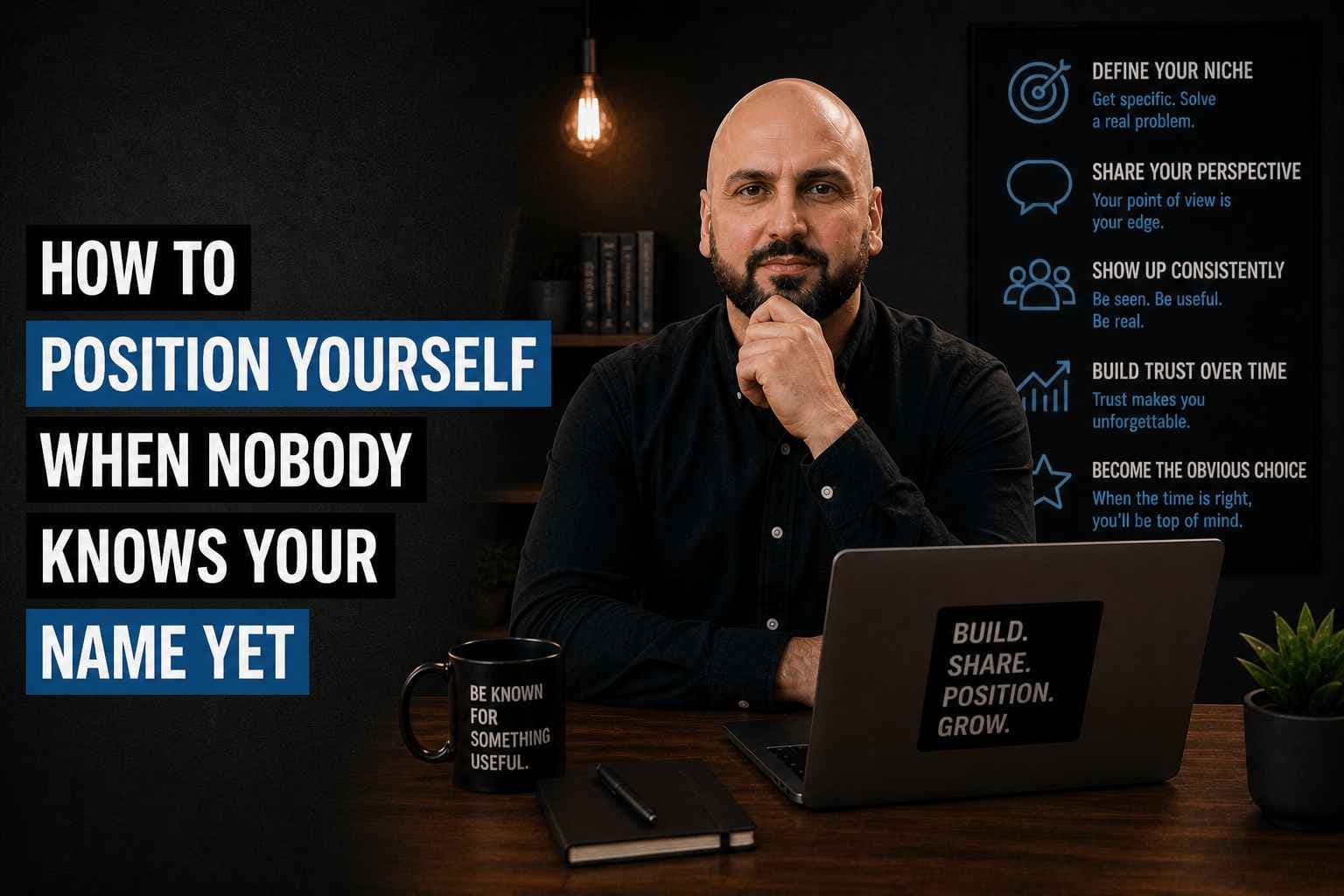
The escape is positioning, not volume. Specificity, proof of work, and borrowed credibility are the three levers available to anyone on day one. A 90-day launch plan turns a generalist into a specialist, then a specialist into a recognized authority. Authority is positioned, not earned.
Key Takeaways
The cold-start paradox is a positioning problem, not a content problem. Volume cannot fix it. Specificity can.
The Guru Ladder progresses Generalist, Specialist, Authority, Guru, Guru's Guru. Each level is a compression milestone in how much expertise the market can extract from your name.
Three positioning levers work on day one: specificity, proof of work via named frameworks, and borrowed credibility from established sources.
Difficult topics build authority faster than easy ones. Hard territory is where competition thins and the algorithm rewards the gap between expectation and delivery.
Mike Ferry built a $50 million real estate coaching empire by positioning knowledge as the product. AJ Kumar learned this at 17 working there as a telephone salesman.
A 90-day plan: Days 1 to 30 stake the claim, Days 31 to 60 borrow and build, Days 61 to 90 create the publishing rhythm.
Here is the paradox every founder hits. You need authority to get attention, and attention to build authority. It feels like showing up to a poker game where everyone has chips and someone forgot to give you yours.
Most "build your personal brand" advice skips this part. It assumes you have an audience, a body of work, a reputation to leverage. It starts at Level 3. Every authority started at Level 1. Unknown. With a point of view and the nerve to share it.
I know because I lived it.
Why Positioning Matters More Than Credibility

When I was 17, I got a job as a telephone salesman for the Mike Ferry Organization. Mike had built a $50 million coaching empire in residential real estate, with tens of thousands of agents in his ecosystem. My job was cold-calling agents and selling them tickets to Mike's live events.
Think about that. A teenager calling professionals who had been closing deals longer than I had been alive. Zero credibility. Zero track record.
What I learned watching Mike operate: people did not buy because of who was calling. They bought because of how the offer was positioned. Mike did not sell event tickets. He sold knowledge, experience, and wisdom packaged so the buyer could not afford to miss it.
The positioning did the heavy lifting. Not the person delivering the pitch. I unpack the full mechanic in my Mike Ferry blueprint.
That lesson rewired my brain. Sales runs on leverage, and leverage comes from positioning. How you present yourself relative to everyone else in the room. Good positioning flips the script. Instead of working harder for small gains, strategic framing creates big wins from smaller efforts.
The thing most people miss: positioning is available to you on day one. You do not need followers. You do not need a book deal. You do not even need a website. You need clarity about where you stand and the discipline to not water it down.
The Cold Start Is A Positioning Problem, Not A Content Problem
When founders tell me "nobody knows who I am yet," they almost always frame it as a content problem. They think they need to post more. Be on more platforms. Create more volume. They produce generic content that sounds like everyone else and wonder why nothing moves.
The issue is positioning, not volume. They skipped the foundation.
Every expert I have worked with, from Kimberly Snyder to the founders running personal media companies today, had to answer one question first. What is the one specific thing I want to be known for, and who specifically do I want to be known by?
That is it. Not "what are the twelve things I could talk about." Not "what is trending this week." One thing. One audience.
In my work I call this the difference between Level 1, the Generalist, and Level 2, the Specialist, on what I call the Guru Ladder. The Guru Ladder maps five levels of expertise compression: Generalist, Specialist, Authority, Guru, and Guru's Guru.
I map all five in GURU, INC. Level 1 is where your advice blends with everyone else's. Level 2 is where you have found your lane and stopped competing with everyone.
Gary Vaynerchuk did not build Wine Library TV by talking about all beverages. He hyper-focused on wine. One category. One audience. That specificity was his positioning, and it made him impossible to ignore in a space of generalists.
Three Levers Build Authority Without An Audience

When you have no audience, no track record, and no platform, you are not powerless. Three positioning levers are available right now.
Lever 1: Specificity Beats Credibility
The narrower your focus, the less your missing track record matters. Say "I help businesses grow" and you compete with a million people who have more proof than you. Say "I help Series A SaaS founders reduce churn in the first 90 days" and you are the only person in the room saying that. Specificity signals expertise before you have proven it at scale.
The human brain equates narrow focus with deep knowledge. A doctor who only treats one condition feels more trustworthy than a general practitioner, even if they graduated from the same school.
Lever 2: Proof Of Work Replaces A Track Record
You do not need a massive portfolio. You need evidence you have done the thinking. A single deep-dive breakdown of how something works in your space. One detailed case study. A framework you built from real experience that organizes a problem nobody else has organized clearly.
This is what I call turning your identity into IP. Your frameworks. Your models. Your way of seeing the problem. That is intellectual property, and it signals authority far more than a follower count ever will.
When I created ROAC, my framework Return on Attention Created, I was not the biggest name in content strategy. ROAC tracks how attention moves through four gates: Register, Retention, Resonate, Reinforce. Having a named, structured system that explained how attention works gave people a reason to pay attention to me. The framework became the proof.
Lever 3: Borrowed Credibility Compounds Fastest
Borrowed credibility means placing yourself in proximity to recognized authority. Collaborations. Guest appearances. Being cited alongside established names. Contributing to platforms that already have trust.
When I was building my agency, working with Neil Patel was not only a business relationship. It was a positioning move. Being associated with a recognized name transferred credibility in ways that would have taken years to build alone. You can do this through podcast guesting, co-created content, or deeply engaging inside an established person's community.
The key: you are not faking credibility. You are borrowing context. You let an existing trust signal vouch for you while you build your own. The same dynamic appears at the entity-graph layer of Google's index, where co-citation with known nodes accelerates entity confidence.
Why Difficult Topics Build Authority Faster Than Easy Ones
This is counterintuitive, so stay with me.
Most people starting from zero pick the easiest, surface-level topics in their space. "5 tips for better productivity." "Why you need a morning routine." Safe. Accessible. Invisible. Ten thousand other people already said the same thing.
Starting with difficult topics, the ones that require real expertise to explain well, is the fastest way up the Guru Ladder. When you tackle a complex problem and make it clear, you signal something powerful. This person knows things I do not. That is the shift from Generalist to Specialist to Authority.
In ROAC terms, you engineer a positive reward prediction error. The viewer's brain expected generic advice and got genuine insight instead. That gap between expectation and delivery is what triggers saves, shares, and follows. It is what makes the algorithm work for you.
The hard topics are where competition thins out. Everyone fights over the easy stuff. The difficult territory is wide open.
A 90-Day Plan To Build Authority From Zero
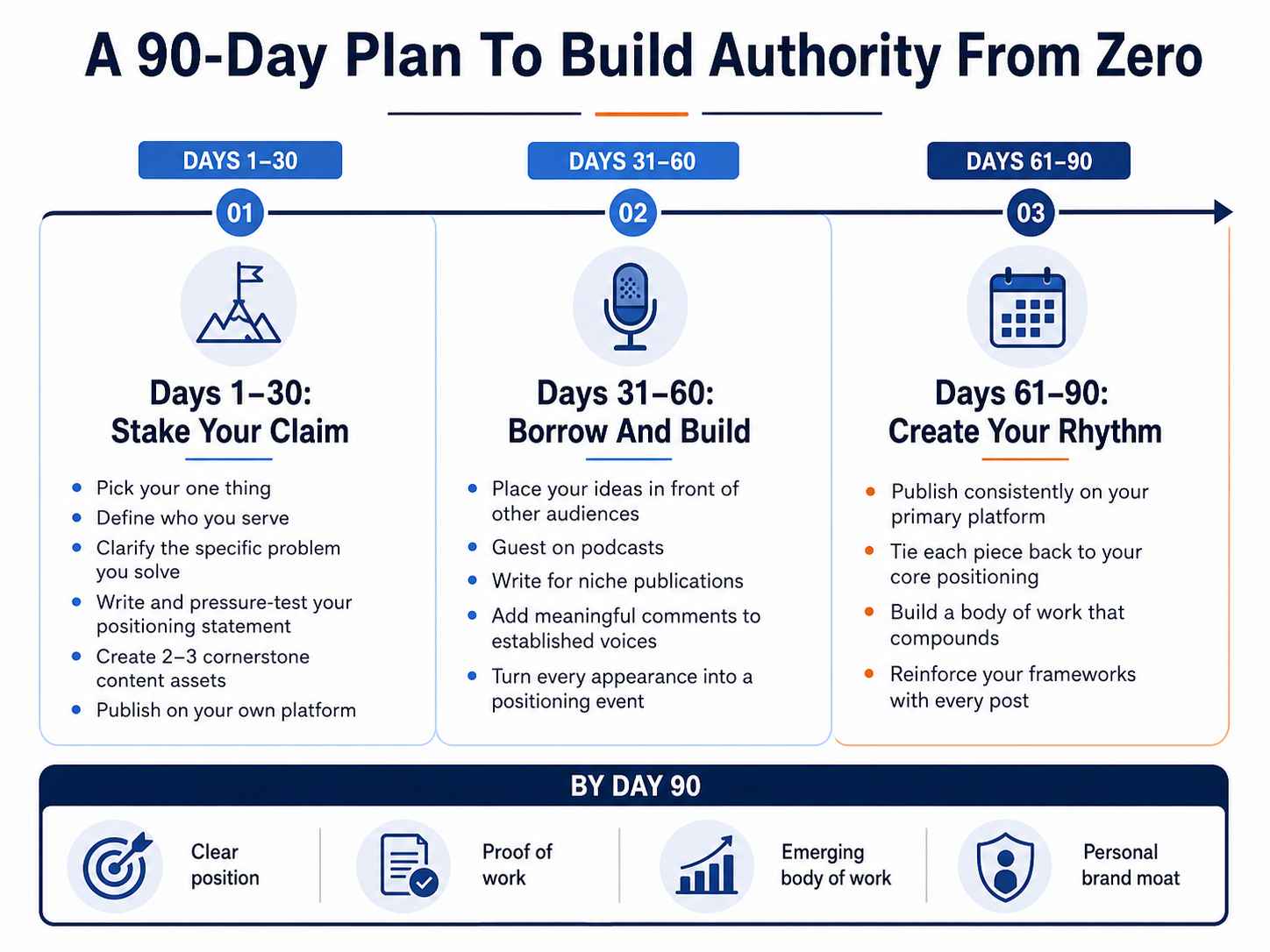
This sequence works when you start from nothing.
Days 1 to 30: Stake Your Claim. Pick your one thing. Define who you serve and what specific problem you solve. Write your positioning statement and pressure-test it. If someone else in your space could say the exact same thing, it is not specific enough.
Then create two or three pieces of cornerstone content. Long-form. Detailed. Opinionated. These are not social posts. These are proof-of-work assets. Put them on your own platform: blog, newsletter, LinkedIn articles.
Days 31 to 60: Borrow And Build. Take your cornerstone ideas and place them in front of other people's audiences. Guest on podcasts. Write for publications in your niche. Comment meaningfully on content from established voices. Not "great post." Substantive additions that showcase your thinking. Every appearance is a positioning event.
Days 61 to 90: Create Your Rhythm. Publish consistently on your primary platform. Everything you create traces back to your core positioning and your original frameworks. You are not creating random content. You are building a body of work that compounds. Each piece reinforces the one before it.
By day 90 you will not be famous. You will have something most people never build. A clear position. Proof you know what you are talking about. An emerging body of work both algorithms and humans can latch onto. That is the foundation of a personal brand moat competitors cannot replicate.
Authority Is Positioned, Not Earned
Here is what I wish someone had told me at 17. Nobody starts as a guru. The people you admire all started where you are. Generalists discovering what made them different. What separated them was not talent or timing. It was the decision to pick a lane, go deep, and let positioning do what no amount of hustle could.
Authority is not given. It is positioned. You can start positioning yourself today, before anyone knows your name.
Frequently Asked Questions
What is the cold-start paradox in personal branding?
The cold-start paradox is the founder bind where authority is needed to attract attention, and attention is needed to build authority. The escape is positioning, not volume. Specificity, proof of work, and borrowed credibility move a founder past the bind without an existing audience.
What is the Guru Ladder?
The Guru Ladder is a five-level model of expertise compression: Generalist, Specialist, Authority, Guru, and Guru's Guru. Each level represents how much value the market can extract from a single mention of your name. Most founders stall at Generalist because they have not chosen a single domain.
How specific does my positioning need to be on day one?
Specific enough that no other expert in your space could say the same sentence about themselves. "I help businesses grow" is too broad. "I help Series A SaaS founders reduce churn in the first 90 days" is specific enough to signal expertise without requiring a long track record.
What is proof of work in a personal brand context?
Proof of work is documented evidence you have done the thinking. A long-form breakdown. A detailed case study. A named framework that organizes a problem clearly. It signals competence faster than a follower count and is the foundation AI systems and search engines use to evaluate authority.
How does borrowed credibility really work?
Borrowed credibility transfers trust from a recognized source to you through proximity. Podcast appearances, collaborations, mentions alongside established names, and meaningful engagement in established communities are the most common mechanisms. The borrowed signal buys time while you build your own.
Why are difficult topics better for new authorities than easy ones?
Easy topics are saturated, so new voices blend in. Difficult topics require real expertise to explain clearly, which means competition thins and the algorithm rewards the rare clear explainer. Tackling hard subjects creates the prediction-error gap that drives saves, shares, and follows.