
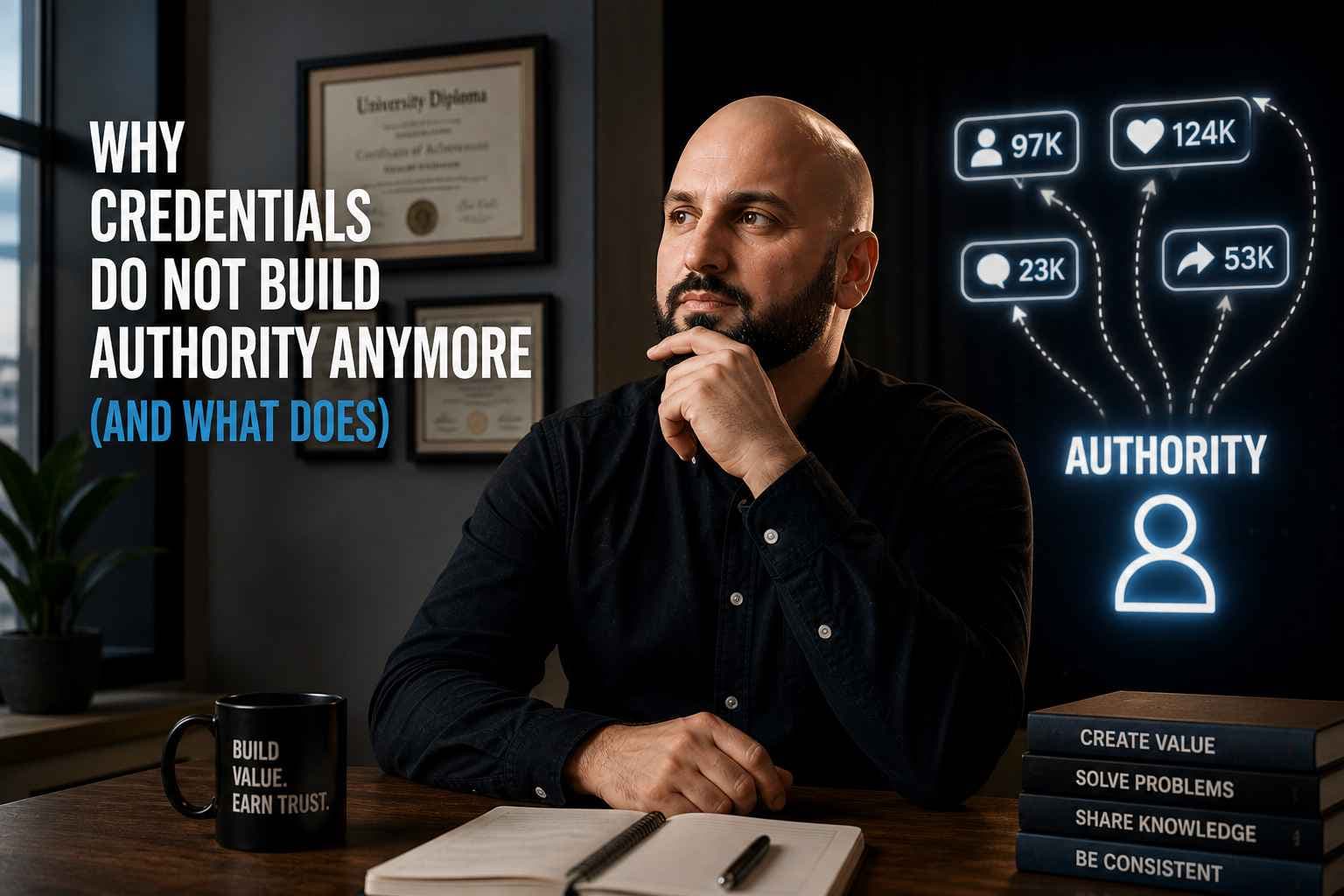
Google's E-E-A-T framework, AI citation systems, and modern audiences all evaluate expertise the same way. Authority is no longer issued. It is demonstrated.
Key Takeaways
Credentials are input signals that describe what someone consumed. Output signals describe what they produced. The market quietly shifted to output around 2018.
Google added the second "E" to E-E-A-T in 2022 to put Experience ahead of Expertise. The order tells you everything you need to know.
Kimberly Snyder went from a $500-per-hour private nutritionist to a multi-million dollar authority brand without ever earning a PhD in nutrition.
Mike Ferry built a $50 million real estate coaching empire by positioning his demonstrated expertise, not by collecting more licenses.
AI citation systems do not check diplomas. They evaluate published depth, entity associations, and topical coherence across a body of work.
Fabricated credentials, from Theranos to Belle Gibson to Liver King, are the strongest evidence that the market was always paying for output, not input.
There is a moment from high school I think about more than I probably should.
My school built a million-dollar pool. I showed up to first-period PE confident. Summers at the local pool. Reps in the bag. I fought through freezing water and made it across. The teacher yelled: "Go to group one. Beginners."
Beginner. Me.
I did not argue. I waited until the teacher turned away, swam under the lane dividers, and joined the advanced group. Nobody noticed. I trained with them the rest of the semester. I kept up.
The teacher had a classification system. One look. One category. An input signal based on surface observation. My swimming was the output signal. The output told a different story.
That input-versus-output distinction is now the defining dynamic of authority in the creator economy.
Why Credentials Lost Their Value In The Creator Economy
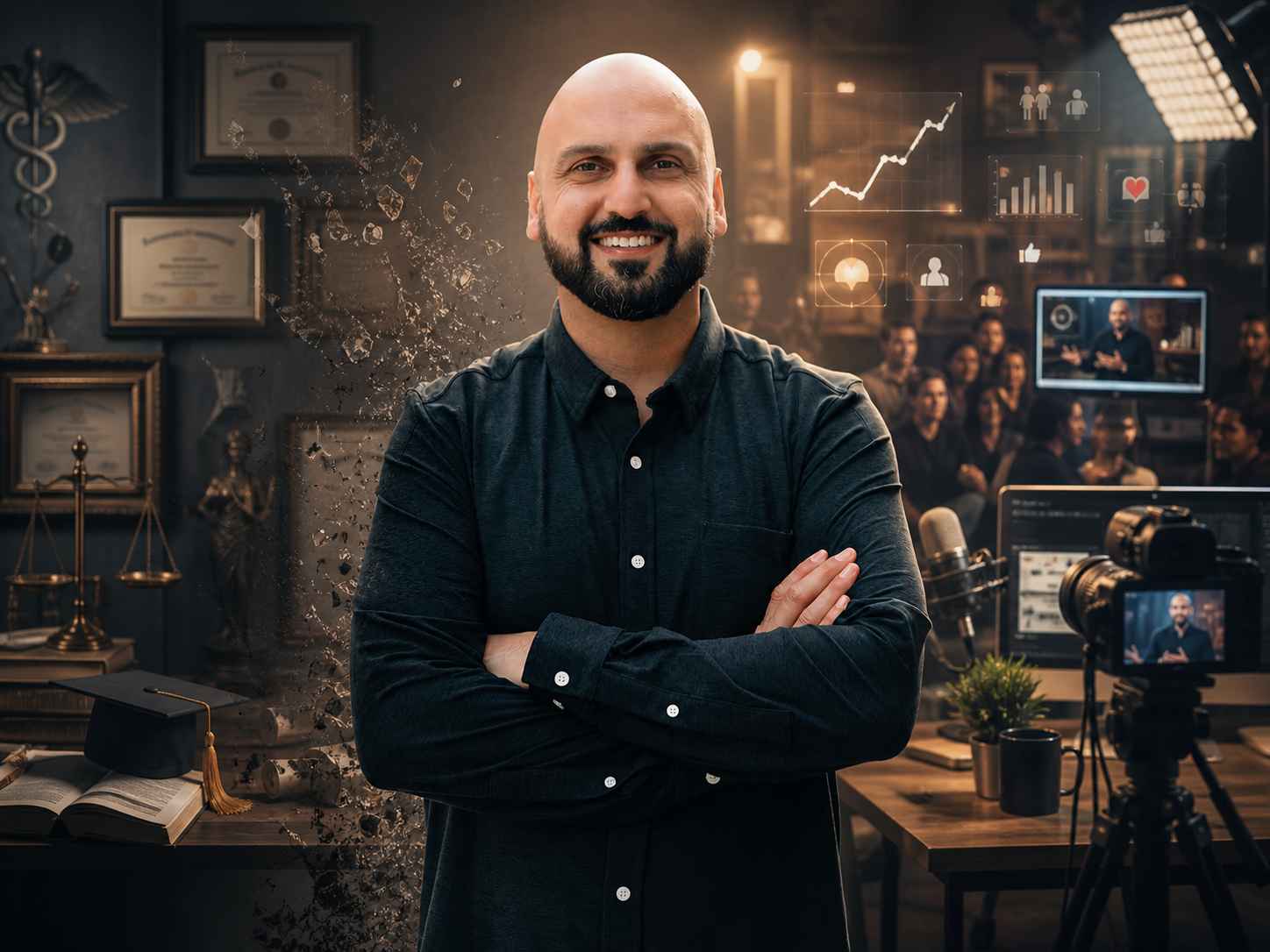
Credentials worked for most of the twentieth century. A medical degree meant someone had survived a brutal filter. A law license meant a passed competency test. An MBA meant institutional vetting. The credential was a compression mechanism. It told you about probable expertise without requiring you to verify it.
Credentials are input signals. They describe what someone consumed. Courses completed. Exams passed. Hours in a classroom. They do not describe what someone produced.
Social media gave every expert a stage. YouTube gave every teacher a classroom. Podcasts gave every thinker a microphone. For the first time in history the market could watch you perform before deciding to trust you. They did not need your résumé because they could check your work.
How A Nutritionist Without A PhD Built A Multi-Million Dollar Brand
When I started working with Kimberly Snyder, she was charging $500 an hour as a private nutritionist for Hollywood celebrities. She had published a book. By every conventional metric, she was successful.
Kimberly did not have a PhD. She was a practitioner who had spent years studying nutrition through direct application, traveling the world learning wellness traditions, and working hands-on with real clients. The credentialed nutritionists in her space had the degrees and were being outperformed.
We built what I call a Digital Concert Hall for Kimberly. A vertically integrated brand ecosystem where every platform reinforced her authority in a single domain. 150,000 email subscribers. Three New York Times bestsellers, one co-authored with Deepak Chopra. Recurring expert on The Today Show. The total: a multi-million dollar personal media company.
Same knowledge she had been sharing in private kitchens. Different structure. She had documented output. They had documented education. The market paid for output.
Why Google's E-E-A-T Prioritizes Experience Over Formal Expertise

Google's quality framework is called E-E-A-T: Experience, Expertise, Authoritativeness, Trustworthiness. Most SEOs treat it as a ranking checklist. It is a trust evaluation system. The order tells you where the world is heading.
Experience comes first. Not Expertise. Not credentials.
Google added the second "E" in 2022. Someone who has done the thing, lived through it, and shown their work is more trustworthy than someone who studied it in a classroom. Not because theory is wrong. Because experience is cheaper to verify.
Every system that processes information solves the same problem: maximum signal with minimum energy. I map the full mechanism in GURU, INC. and in my piece on how the brain, Google, and AI run on the same operating system.
When Google sees deep topical coverage and a track record, verification cost is low. That source wins. When the only signal is a credential in the bio, the system spends more energy auditing. That source loses. Credentials add friction. Demonstrated expertise removes it.
How AI Citation Systems Evaluate Authority Without Checking Credentials
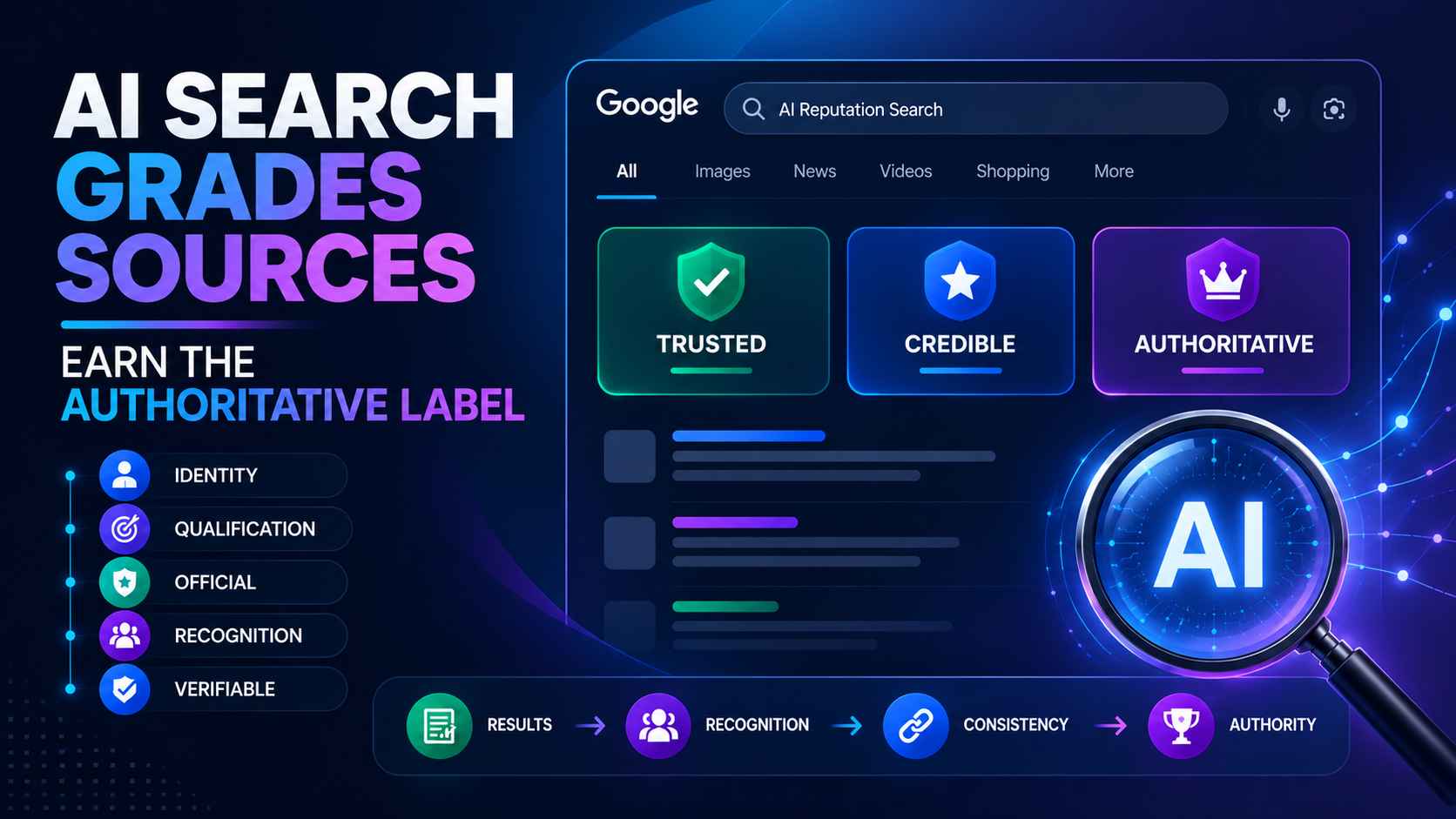
AI citation systems like ChatGPT, Perplexity, and Google's AI Overviews are not checking diplomas. They evaluate published depth, entity associations, topical coherence, and how consistently other trusted sources reference a person.
A language model compresses billions of documents into weighted connections during training. The experts who get cited are the ones whose knowledge shows up as structured, consistent, and deeply interlinked. Named frameworks become retrievable entities. I have written more in my breakdown of how AI decides which video sources to cite.
A PhD who published three papers behind a paywall in 2014 and has not created public content since is invisible. A self-taught practitioner with 200 articles, named frameworks, and citations from other creators is a node in the knowledge graph. The AI does not know which one has the degree. It only sees which one reduced the cost of retrieval.
The Authority Proof Stack: What Replaced Credentials
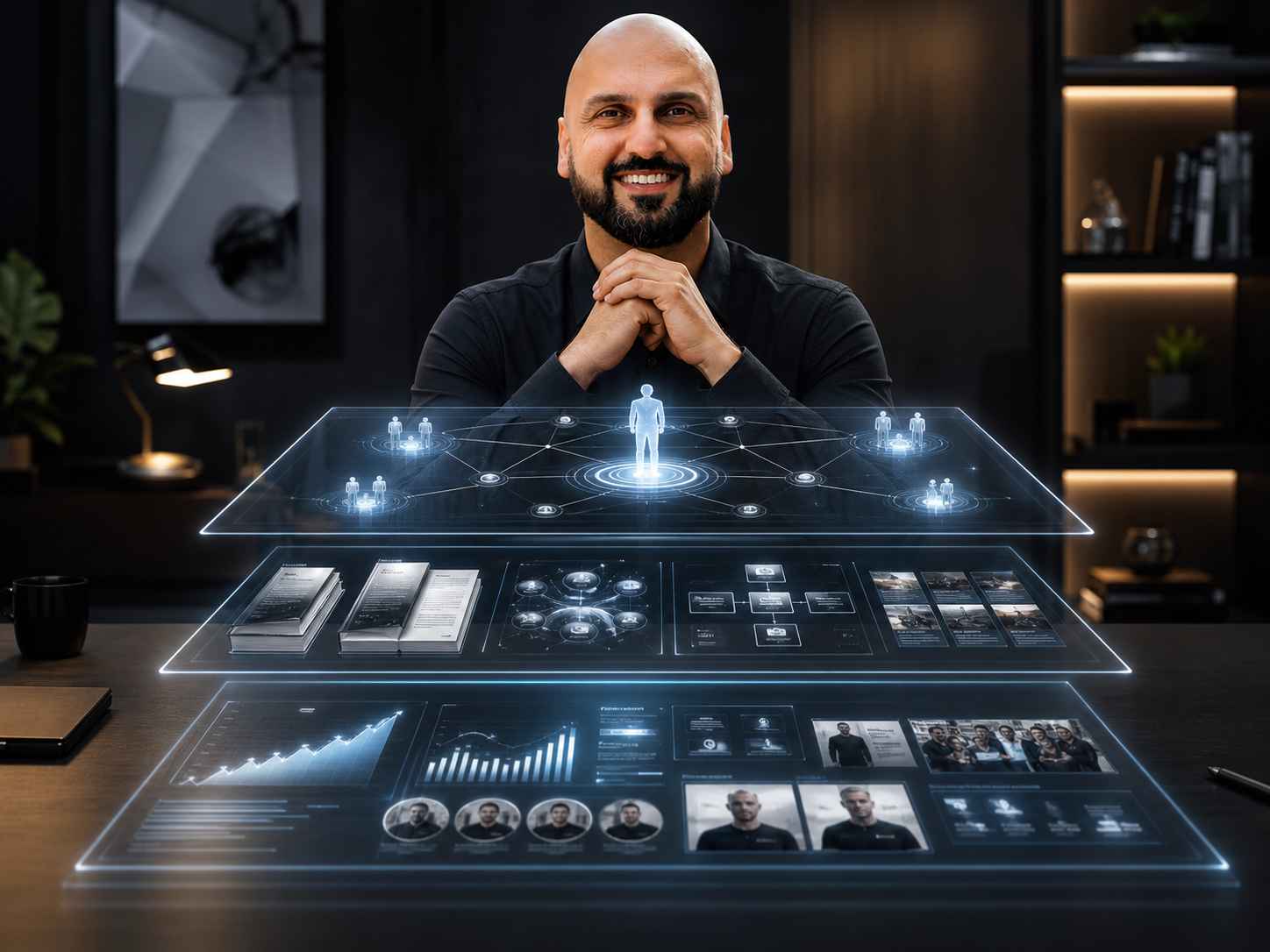
The new credential is a body of documented results the market can verify without asking for your transcript. I call this the Authority Proof Stack. Three layers that build compounding authority in 2026.
Layer 1: Documented Results. Before-and-after transformations. Case studies with real numbers. Client outcomes that speak for themselves. Kimberly Snyder's community sharing their transformations was more powerful than any certification body.
Layer 2: Structured Knowledge. Most experts have the knowledge but it is scattered. Structured knowledge organizes expertise into a coherent body of work with topical depth, interlinked concepts, and named frameworks uniquely associated with you. This is what separates the generalist from the authority.
Layer 3: Positioning Clarity. This is the Mike Ferry lesson. Early in my career I worked as a telephone salesman for the Mike Ferry Organization, selling seminar tickets to real estate agents. Mike was a residential agent who built a $50 million coaching empire. He did not get a more impressive license. He showcased his knowledge so effectively that clients sought him out.
Positioning is not deception. It is clarity. Making what you know visible and retrievable to every system looking for it.
Why Fabricated Credentials Prove Credentials Were Never The Real Signal
Fabricated credentials are the strongest evidence credentials were never the real signal. I call this pattern darketing in GURU, INC. Darketing manipulates authority signals to create trust without substance.
Elizabeth Holmes cosplayed as Steve Jobs. Black turtleneck. Visionary narrative. The technology never worked. The performance was convincing enough that investors, media, and world leaders bought in without questioning the output.
Belle Gibson fabricated the most powerful credential of all: lived experience. She built a wellness empire claiming she had cured her own terminal cancer. She never had cancer. The brand collapsed overnight.
Liver King built a multimillion-dollar brand on the "ancestral lifestyle." Leaked emails revealed thousands of dollars a month in steroids. The visual credential, his own body, was manufactured.
Every one of these stories is about someone who understood the market responds to output and decided to fake the output. If credentials were the real signal, faking them would not work.
Authentic documented results are the one signal almost impossible to fabricate at scale. They compound in ways manufactured credentials never can. They are the foundation of a real personal brand moat.
Why Experts Cling To Credentials Instead Of Building Authority
If documented results and structured knowledge are what build authority, why do so many experts still cling to credentials?
The credential is not about the market. It is about the expert's psychology.
I call this V.O.L.T., the Virus of Limited Thinking. V.O.L.T. is the belief system that convinces you, no matter how much you have accomplished, that you need one more certification before you are allowed to claim authority.
I know the pattern because I lived it. I dropped out of college. I built an agency that worked with Fortune 500 companies. I helped turn Kimberly Snyder into a multi-million dollar brand. I co-ran a company with Neil Patel. There were still moments when some part of my brain whispered that I did not have the "right" credentials to be in the room.
The experts who break through recognize the credential was always a proxy for competence and trust. Both can now be demonstrated directly.
You do not need permission to be an authority. You need a body of work that makes the case for you.
How To Build Authority Without Credentials In 2026
Stop accumulating input signals. Start producing output signals. Every hour on another certification is an hour not spent documenting results.
Document everything. Client results. Process. Frameworks. Point of view. Public. Structured. Deep.
Name your frameworks. A proprietary methodology with a distinct name creates an entity. A node in the knowledge graph uniquely associated with you. Named frameworks make you findable instead of searchable.
Build topical depth, not breadth. The expert who publishes 200 interlinked pieces on one domain is recognized as an authority by every system. The one who publishes 200 scattered pieces across 15 topics is recognized as a generalist.
Let your work be your credential. Show what you have done, not what you studied.
The Infrastructure Of Authority Already Moved Toward Output
This shift is not coming. It already happened. Google reorganized its trust framework around experience. AI systems built citation logic around published depth. Audiences migrated trust from institutional signals to demonstrated results. The infrastructure of authority moved in one direction. Toward output.
The credential was never the thing. It was a stand-in. Now that the market has better ways to measure the thing directly, the stand-in is losing its power.
The teacher told me I was a beginner. I swam with the advanced group anyway. The classification never mattered. The performance always did.
Frequently Asked Questions
Are credentials still useful in regulated fields like medicine or law?
Yes. In any field where the law requires a license to practice, the credential is a legal precondition, not an authority signal. Authority on top of the license is still built through documented results, structured knowledge, and positioning that the market can verify.
What is the Authority Proof Stack?
The Authority Proof Stack is the three-layer model that replaced credentials as the modern trust signal. Layer 1 is documented results. Layer 2 is structured knowledge. Layer 3 is positioning clarity. Together they build authority every system, human or AI, can read.
Why does Google rank E-E-A-T this way?
Google added the second "E" in 2022 to put Experience ahead of Expertise. Experience is cheaper to verify than credentials and harder to fake. The order signals which trust input the system weighs most when evaluating quality.
What is V.O.L.T. in the context of building authority?
V.O.L.T. stands for Virus of Limited Thinking. It is the subconscious belief system that convinces accomplished experts they need one more certification before they are allowed to claim authority. V.O.L.T. is why so many founders keep collecting inputs instead of producing outputs.
How do AI systems decide which experts to cite?
AI systems compress billions of documents into weighted relationships between concepts. They cite experts whose published work shows depth on a topic, consistent entity associations, and references from other trusted sources. Diplomas and degrees are not part of the calculation.