


ROAC stands for Return on Attention Created. The framework answers one question: did the attention a founder earned produce identity, trust, and revenue, or did it produce numbers that look good and change nothing. ROAC is not return on investment, which measures cost against revenue. ROAC is not return on attention, which measures how well content captures interest. ROAC measures what the attention created downstream. I judge attention across three values: identity value, trust value, and leverage value. A founder who measures ROAC stops optimizing for reach and starts building for conversion.
Key Takeaways
ROAC means Return on Attention Created, a framework for measuring whether attention converted.
ROAC is not ROI and not the existing return-on-attention metric. It measures a different thing.
The three components are identity value, trust value, and leverage value.
Vanity metrics count attention. ROAC measures what attention produced.
A founder applies ROAC by judging attention against the three values, not by a formula.
Measuring ROAC changes what a founder builds, from reach-first to revenue-first.
What ROAC Means
ROAC is my framework for measuring whether earned attention produced identity, trust, and revenue. The name stands for Return on Attention Created. The word that matters most is created. Captured attention is not the measure. Created outcomes are the measure.
Most measurement asks how much attention a piece of content earned. ROAC asks a harder question. Did the attention create anything a founder can convert. A post with a million views and no resulting trust scores low on ROAC. A post with ten thousand views that produced three serious inquiries scores high.
The distinction is the whole point. Attention is the input. ROAC measures the output that input created.
Why ROAC Is Not Content ROI, and Not Return on Attention
ROAC sits between two metrics it is often confused with, and it matches neither. The difference is given below.
Return on investment measures revenue against the cost of producing content. ROI is a cost-efficiency calculation. It tells a founder whether the money spent came back, and nothing about what the attention built.
Return on attention measures how well content captures and holds interest at the top of the funnel. ROA is an engagement-quality metric. It tells a founder whether attention was earned, and nothing about whether that attention converted.
ROAC measures the step both of those skip. ROAC asks whether the earned attention created identity, trust, and revenue downstream. The founder authority case needs that step, because authority lives in what attention produces, not in how much arrives or what it cost.
Why Founders Measure Attention Wrong
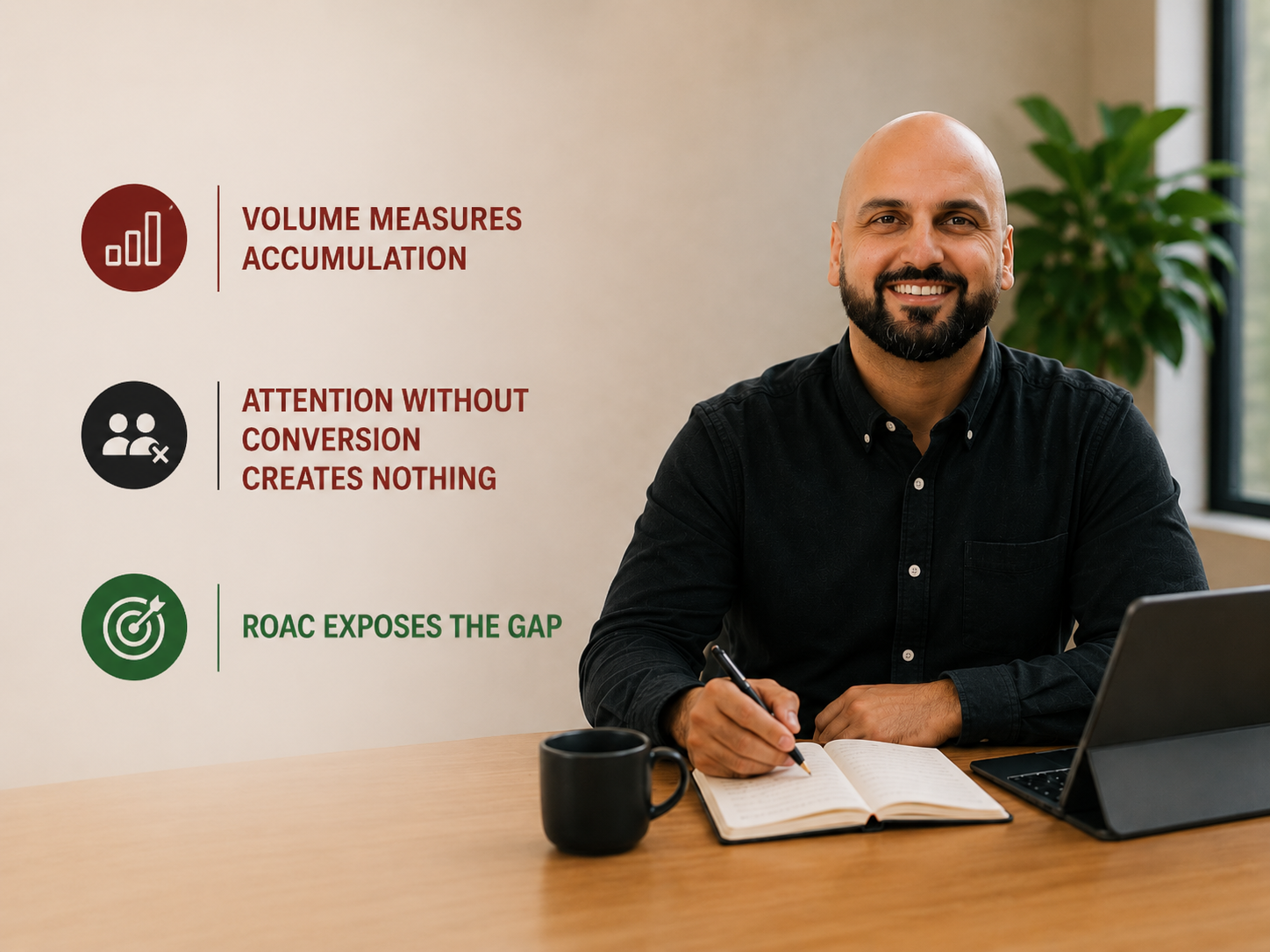
Most founders measure attention by volume, which tells them nothing about revenue. They track followers, impressions, views, and likes. The dashboard climbs. The pipeline does not move. The numbers grow and the business stays the same.
The reason is simple. Volume measures accumulation. Revenue requires conversion. A founder can accumulate millions of views from people who will never buy, never refer, and never remember the name a week later. That attention created nothing, and the metrics never said so.
ROAC exposes the gap. The question changes from how many people saw the content to what the content created in the people who saw it. A founder who asks the second question stops celebrating reach that leads nowhere.
The Three Components of ROAC
ROAC measures attention across three values. The three components are given below.
Identity Value
Identity value measures whether the attention made the founder known for something specific. Attention that leaves no clear association produces no identity value. Attention that fixes the founder in the audience's mind as the authority on one thing produces high identity value. A founder builds identity value when the audience can finish the sentence: this person is the one who understands X.
Trust Value
Trust value measures whether the attention deepened belief in the founder's judgment. Views do not equal trust. A founder earns trust value when the audience moves from watching to believing, from consuming content to acting on it. Trust value is what turns a passive follower into a person who books the call.
Leverage Value
Leverage value measures whether the attention produced compounding returns over time. Attention that expires the day it posts produces no leverage value. Attention that keeps working, attracting inbound interest months later, produces high leverage value. Leverage value is the difference between content that runs once and content that runs for years.
The full framework is defined in GURU, INC., Chapter 10, where I lay out how the three values work together.
How a Founder Applies ROAC
A founder applies ROAC by judging each piece of attention against the three values. ROAC is a framework for judgment, not a single formula. The founder asks three questions of every piece of content that earned attention.
Did it build identity, the association with one clear area of authority. Did it earn trust, the belief that moves a reader toward action. Did it create leverage, the compounding return that keeps working after the post stops trending.
Dr. Ben Lynch built a supplement business on long-form YouTube authority. The attention he earned did not stay on the platform as views. The attention created identity as a trusted expert, trust that converted to purchases, and leverage that compounded as the library grew. That is ROAC working, attention converting into a business, not a follower count.
Why ROAC Changes What a Founder Builds
A founder who measures ROAC builds for conversion, not for reach. The metric changes the content. A founder optimizing for views makes content designed to be seen. A founder optimizing for ROAC makes content designed to build identity, earn trust, and compound.
The shift is the difference between a busy brand and a paying one. The founders who stall optimize attention they never convert. They produce, they grow the numbers, and the revenue never follows, because nothing they measured was tied to revenue.
Fixing the measurement is where clarity on the right next move begins, before another quarter of content gets built against the wrong target. ROAC measures what attention created. A few related questions decide how a founder reads the result.
ROAC Versus Vanity Metrics
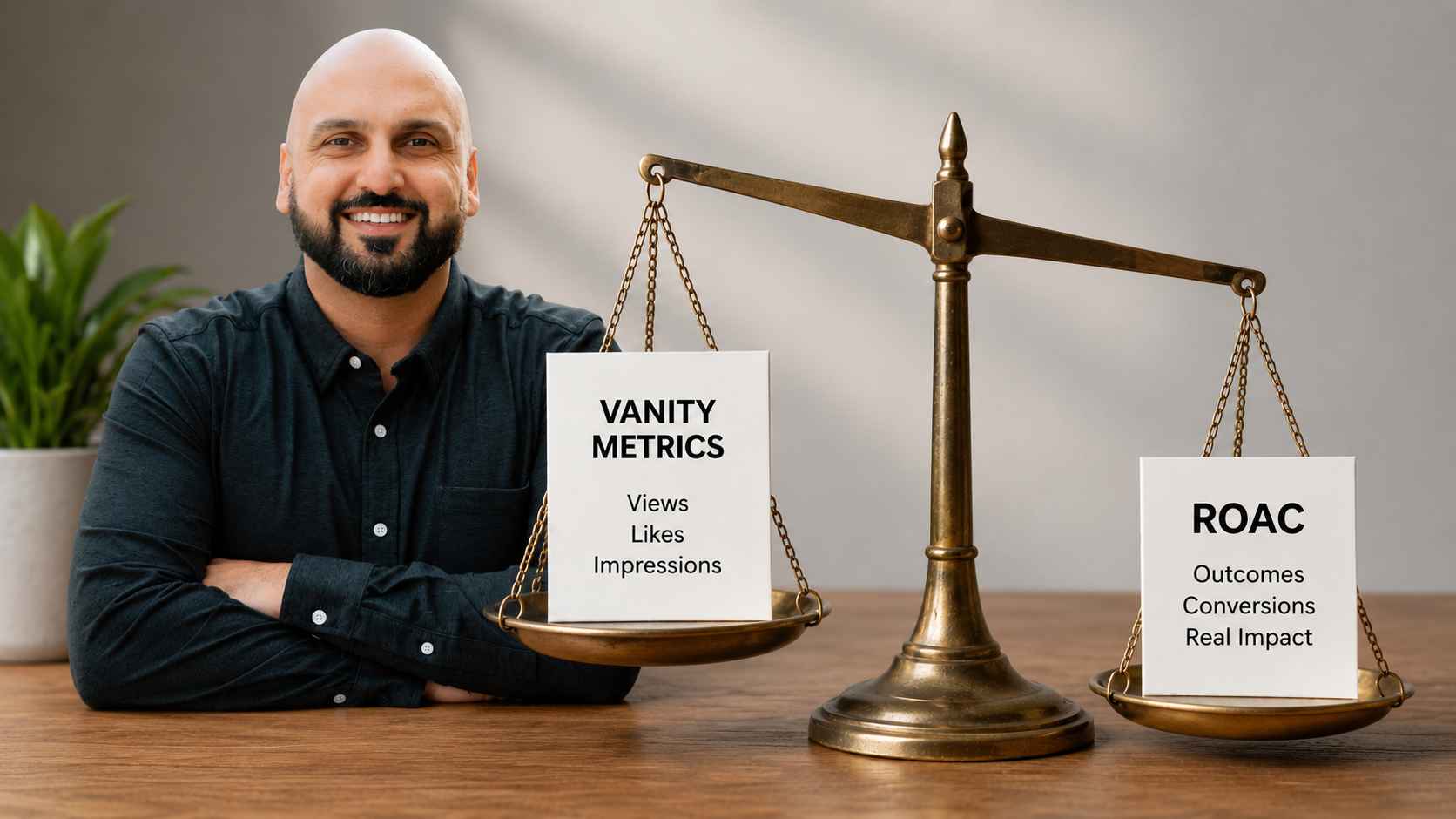
ROAC and vanity metrics measure opposite things. Vanity metrics count how much attention arrived. ROAC measures what that attention produced. One is a tally. The other is an outcome.
A vanity metric rewards the post with a million views. ROAC asks what those million views created. If the answer is nothing the founder can convert, the post failed on the only measure that matters. The market already senses this. The shift away from reach and impressions toward trust and conversion is the same shift ROAC formalizes, with a name and a structure instead of a vague feeling that views stopped meaning anything.
How ROAC Connects to Revenue Systems
ROAC is the measurement that sits in front of every revenue system a founder builds. The revenue systems convert attention into income. ROAC tells the founder whether the attention is worth converting in the first place.
A founder who skips this measurement scales the wrong thing. More attention with no identity, trust, or leverage produces more noise, not more revenue. ROAC qualifies the attention before the revenue systems try to monetize it. The measurement comes first. The monetization follows what the measurement approves.
Common Questions About Measuring Attention
Founders ask the same questions when they first apply ROAC. The most common confusion is treating ROAC as a number. ROAC is a judgment across three values, not a score on a dashboard.
The second confusion is expecting a formula. Attention is context-dependent, so a universal equation would lie more than it helped. The third is impatience. Identity, trust, and leverage compound over months, not days. A founder who judges ROAC after one week measures noise, not the return the attention actually created.
FAQ
What does ROAC stand for?
ROAC stands for Return on Attention Created. The term is distinct from the unrelated acronyms that share the letters, including finance and medical uses. In the founder authority context, ROAC is my framework for measuring whether attention converted.
What is the difference between ROAC and ROI?
ROI measures revenue against the cost of producing content. ROAC measures whether the attention that content earned created identity, trust, and revenue. ROI is a cost calculation. ROAC is an outcome judgment.
Is ROAC the same as return on attention?
No. Return on attention measures how well content captures interest at the top of the funnel. ROAC measures whether that captured attention converted downstream, across identity value, trust value, and leverage value.
How do you measure ROAC?
A founder measures ROAC by judging attention against the three values: identity value, trust value, and leverage value. ROAC is a framework for judgment, not a single formula, because attention is context-dependent.
Why are vanity metrics not enough?
Vanity metrics measure accumulation, not conversion. A founder can earn millions of views that create no identity, no trust, and no revenue. ROAC measures what the attention produced, which is the only result that reaches the business.