
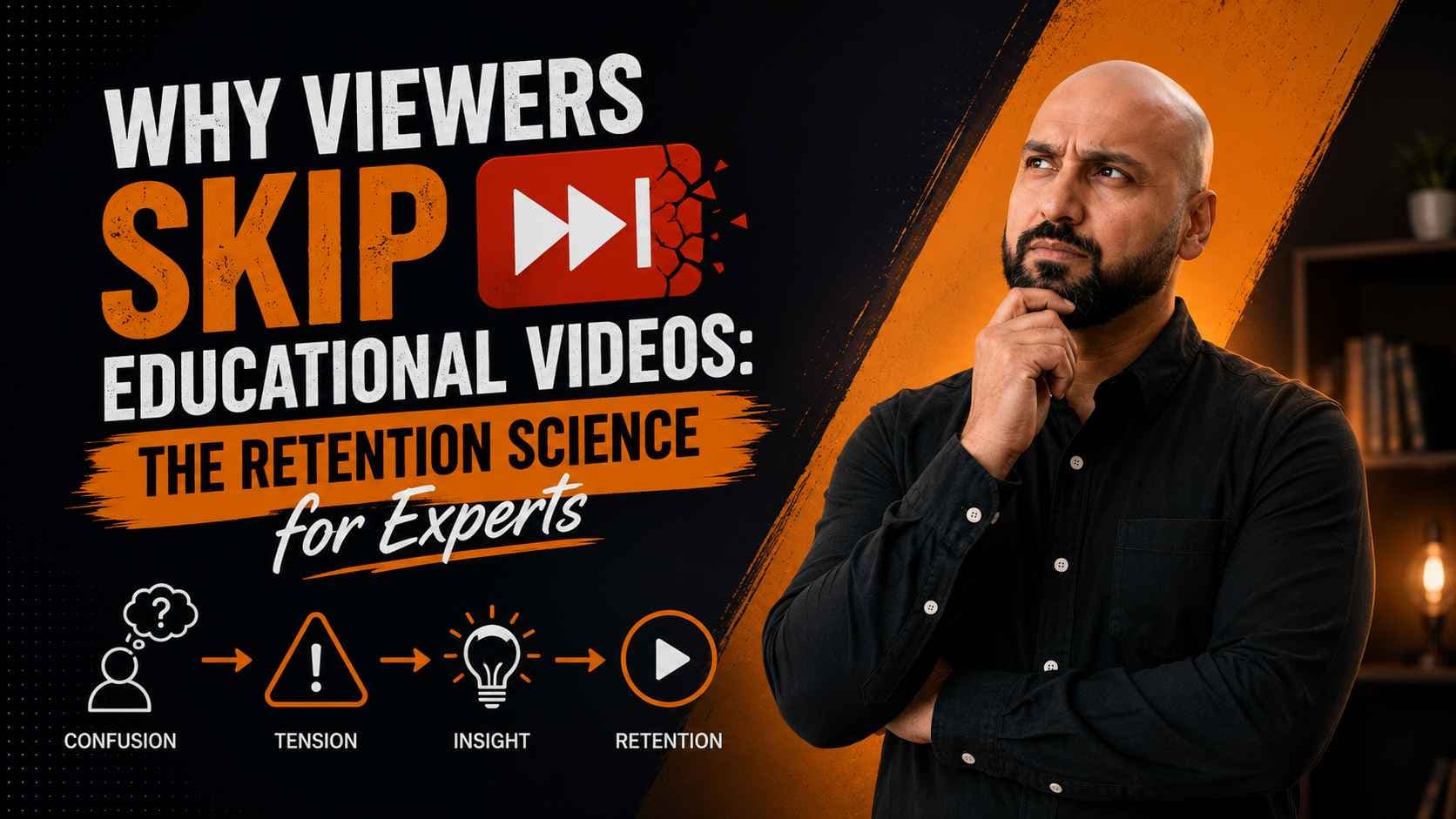
The expert's polish causes the drop-off. The retention science below shows where the first minute fails, and the fix requires zero dumbing down.
Key Takeaways
Clear, concise educational videos raise viewer confidence while producing little learning, per peer-reviewed research by Derek Muller.
Videos that state and refute a common misconception produce the largest learning gains, with effect sizes near 0.8 in Muller's experiments.
The curse of knowledge makes experts overestimate their audience, a bias documented by Camerer, Loewenstein, and Weber in 1989.
YouTube's own analytics define an Intro metric measuring survival past the first 30 seconds, and most abandonment happens early.
Retention is an authority event before it is an algorithm event. Reach shows who arrived. Retention shows who believed.
The fix is productive tension: open with the viewer's wrong assumption, raise the stakes, and make the correction the payoff.
Clear Explanations Feel Easy, and Easy Teaches Nothing

Educational videos lose viewers because a clean explanation produces the feeling of learning without the substance of it. Derek Muller, the physicist behind Veritasium, tested this in peer-reviewed experiments with 364 physics students.
Clear, concise presentations raised viewer confidence and produced almost no learning. Versions that first stated a common misconception, then refuted it, produced the largest learning gains, with effect sizes near 0.8.
The mechanism explains the skip. A polished explanation glides past the viewer's existing beliefs, so the brain invests no effort, registers nothing new, and reaches for the next video.
Viewers rated the clear versions easier and rated themselves smarter after watching. The tests disagreed. Smoothness reads as completion, and completion is permission to leave.
The Curse of Knowledge Makes Experts Misjudge Their Audience
Experts produce those frictionless explanations because expertise hides the audience's starting point. Camerer, Loewenstein, and Weber named the bias in 1989: better-informed people fail to ignore what they know when judging the less informed.
Stanford doctoral research by Elizabeth Newton made it visceral. People tapped famous songs and predicted listeners would name half of them. Listeners named 2.5 percent.
Every founder filming educational content is the tapper. The melody plays perfectly in the expert's head, so the explanation skips the context, the stakes, and the wrong assumption the viewer walked in holding.
I have audited hundreds of founder channels, and the pattern repeats: the smarter the founder, the faster the audience leaves. The knowledge is real. The transmission fails.
The First Minute Decides, and the Platform Says So
Most viewer abandonment happens before the content proves anything. YouTube's own analytics documentation defines an Intro metric: the percentage of the audience still watching after the first 30 seconds, with direct guidance to experiment on those seconds.
The platform's systems favor videos viewers find satisfying, and retention is how satisfaction gets read. Third-party benchmarks put numbers on the wall.
A 2025 report from Retention Rabbit, an AI retention tool that analyzed more than 10,000 videos, found the average video retains 23.7 percent of its audience, with the majority of viewers gone inside the first minute.
An expert who spends that minute on credentials and windup loses the room before the expertise appears. The opening exists to earn the lesson, never to introduce it.
Retention Is an Authority Event Before It Is an Algorithm Event
Retention versus reach is the distinction that decides what educational content builds. Reach counts who arrived. Retention counts who stayed, finished, and absorbed the argument, and only the finishers form the memory that becomes trust.
A skipped video builds nothing regardless of its accuracy, which is why the edutainment content strategy for founders treats entertainment as the delivery system for authority rather than its rival.
The paradox lands hardest on expertise-rich founders. The clarity meant to demonstrate mastery is the property that forfeits the watch, so the founder loses the authority and blames the algorithm.
The algorithm reported the problem. The viewer created it, one early exit at a time, and entertaining content builds founder credibility precisely because emotion and effort keep the viewer present for the argument.
Experts Fix Retention With Tension, Not Simplification

The fix is productive tension, and it requires zero dumbing down. The structure of a high-retention expert video follows Muller's finding directly. The three moves are given below:
Open on the misconception. State the wrong assumption the viewer already holds. Wrongness creates the effort clarity removes.
Raise the stakes. Name what the wrong assumption costs: money, time, position. Stakes convert curiosity into commitment.
Deliver the correction as the payoff. The expertise arrives as the resolution of tension, so the viewer earns it by staying.
Crack Editing, the emotion-first editing methodology covered in the credibility post above, applies the same logic to every cut and caption. Depth then compounds the effect, since long-form YouTube outperforms Shorts for authority once viewers commit past the wall.
Building this structure into a founder's positioning and content system is the work of personal brand consulting for founders: the position supplies the misconceptions worth attacking, and the system turns them into content people finish.
Viewers skip educational videos because clear explanations feel easy, easy feels finished, and finished viewers leave. Experts fix retention by opening on the misconception, raising the stakes, and delivering expertise as the payoff.
The rule compresses to one line: open on what the audience gets wrong, never on what the expert knows. The audience that stays is the audience that trusts.
What Is a Good Audience Retention Rate for Educational Videos
A good retention rate sits above the platform average, which Retention Rabbit's 2025 benchmark placed at 23.7 percent. Educational how-to content leads all niches at 42.1 percent in the same report. Survival past the first minute predicts the rest of the curve.
Do Shorter Videos Fix Low Retention
Shorter videos shrink the failure without fixing it. A weak opening loses viewers at any length. Retention follows tension and payoff structure, never duration alone. A founder with a strong misconception-first opening holds attention across long formats.
Why Does Entertaining Content Outperform Educational Content
Entertaining content wins on effort and emotion: the viewer feels something immediately and stays. Educational content wins when it borrows the same mechanics, opening on tension instead of definitions. The gap is structural, never a verdict on the value of expertise.
Does Confusing Viewers Improve Learning
Productive confusion improves learning when the confusion is designed: a stated misconception the video resolves. Muller's research found these versions felt harder and taught more. Random confusion loses viewers. Engineered tension holds them through the correction.