
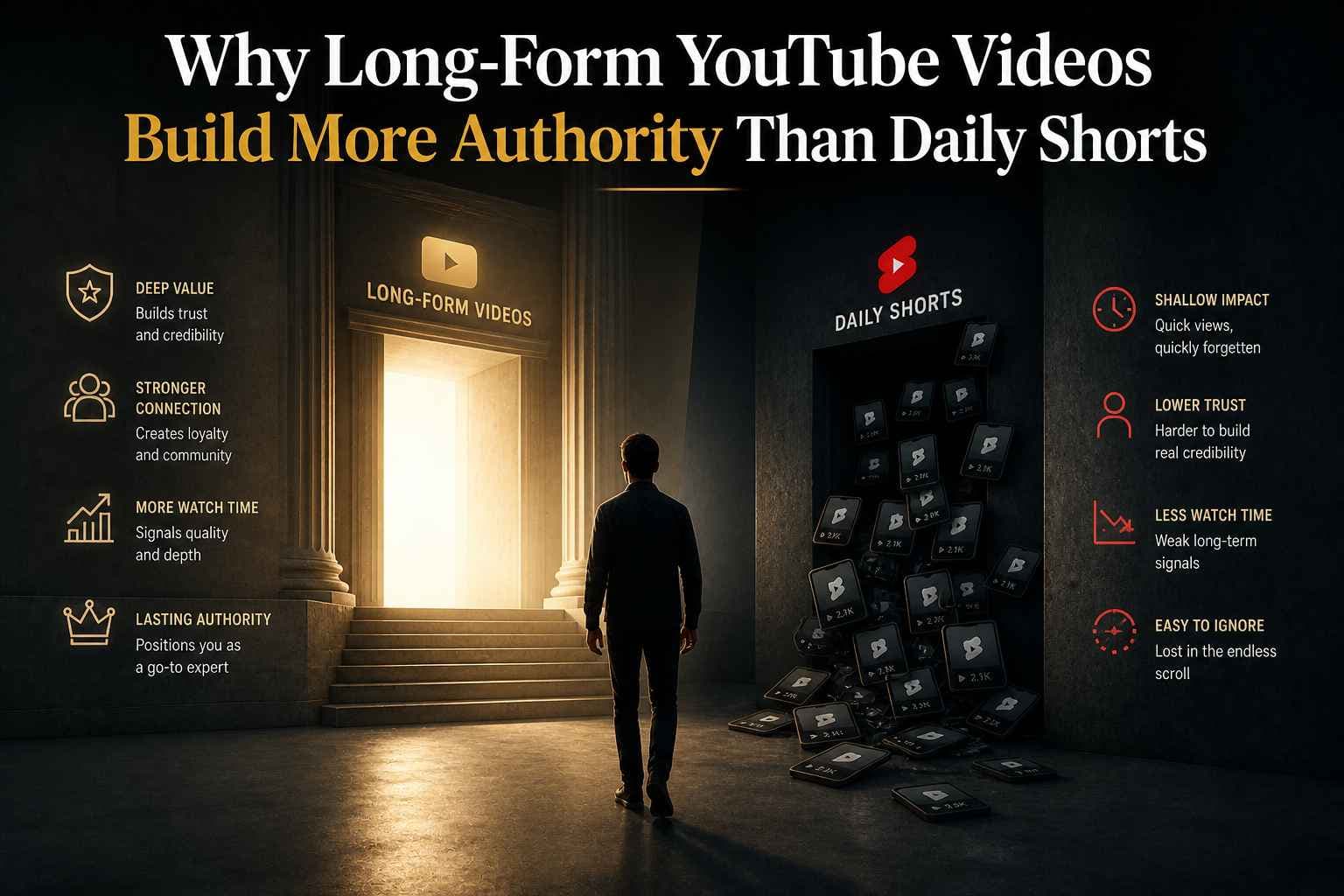
Research on fragmented video viewing shows weaker memory formation, and buyer-behavior research suggests trust forms after roughly 7.5 hours of cumulative content. Founders who want to become the category voice need the format that lets a viewer stay.
Key Takeaways
Shorts move the reach metric. Long-form moves the memory metric. Authority is built on the memory metric, not the reach one.
Fragmented video viewing produced 43 percent recall in one 2026 study. Continuous video produced 66 percent recall from the same content.
Buyer trust in a brand tends to form after roughly 7.5 hours of cumulative content consumption before a serious purchase decision.
Long-form activates mirror neurons and theory of mind in ways that short clips on their own can not fully trigger.
A Signature Series lives inside long-form. Character, format, and voice need sustained runtime to become recognizable.
Shorts still matter inside an authority system as the discovery surface that routes viewers into long-form depth.
Why Reach and Authority Measure Different Things

Reach counts impressions. Authority counts belief. The two metrics move in opposite directions on short-form platforms.
A daily Shorts cadence can pump impressions into the millions inside a quarter. That number looks like growth on a dashboard. It rarely looks like growth on a P&L. Impressions do not close deals. People with a stable mental picture of you do.
Authority is the condition in which a viewer trusts your judgment before they verify your argument. That shortcut forms in the brain after repeated exposure to the same voice making the same kind of decisions.
A 30 second clip is too short to carry a full decision-making pattern. A 12 minute video carries several. The brain needs enough runtime to build a model of the person speaking, not only a model of the topic.
This is the quiet cost of a Shorts-first strategy. It teaches algorithms that you are a content source. It does not teach viewers that you are a category voice.
Reach and authority are different layers inside the same content strategy. Confusing the two is how founders end up with 500,000 Shorts views per month and zero discovery calls.
How Long-Form Activates the Social Brain More Than Shorts Do

Long-form triggers the neural systems the brain uses for in-person interaction. Short clips do not stay on screen long enough to fire them fully.
Mirror neurons activate when the viewer watches you speak, gesture, and reason. The same cells fire as if the viewer were doing the reasoning themselves. That is the neurological basis for empathy, social learning, and trust formation. A 15 second cut can produce a flash of recognition. A 10 minute explanation produces identification.
Theory of mind is the second system long-form activates. The viewer begins to model what you believe, how you think, and how you handle contradictions. That internal model is what people mean when they say they feel they know a creator. Short clips give the brain too few data points to finish the model. Long-form supplies enough signal to complete it.
This is why credentials and demonstrated authority diverge in the creator economy. A credential is a claim. A long-form video is a demonstration of the mind that earned the claim. The second one is the thing audiences end up trusting.
How Fragmented Video Weakens the Memory a Viewer Keeps of You
Fragmented video viewing produces weaker memory than continuous video viewing of the same content. That finding matters because authority lives inside memory.
A 2026 experiment published in npj Science of Learning put 57 students into two groups. One group watched a 10 minute continuous video about a destination. The other watched seven short clips totaling the same 10 minutes with the same core information.
The continuous group answered 66 percent of recall questions correctly. The fragmented group answered 43 percent. Brain imaging showed reduced activation in the claustrum, caudate nucleus, and left middle temporal gyrus for the fragmented group. Those regions handle integration, goal-directed focus, and thematic meaning.
The practical translation is simple. A viewer who consumed a founder through Shorts remembers fewer of that founder's ideas. A viewer who consumed the same founder through long-form remembers more. Remembered ideas are the only ideas that influence future decisions. Forgotten ideas produce no return.
Why Authority Requires the 7.5 Hour Threshold
Buyer trust in a brand tends to form after roughly 7.5 hours of cumulative content consumption. That number appears across buyer-psychology research on content-driven sales cycles.
The number is not mystical. It reflects the amount of runtime the brain requires before handing over a nontrivial purchase decision. Sufficient familiarity with the source has to form first. Repeated exposure lowers perceived risk. Depth of exposure lowers perceived risk faster than breadth.
A viewer can rack up 7.5 hours by watching forty five 12 minute videos. The same viewer racks up 7.5 hours of Shorts by watching roughly 1,800 clips. The long-form path produces a coherent memory of one person. The short-form path produces a blur.
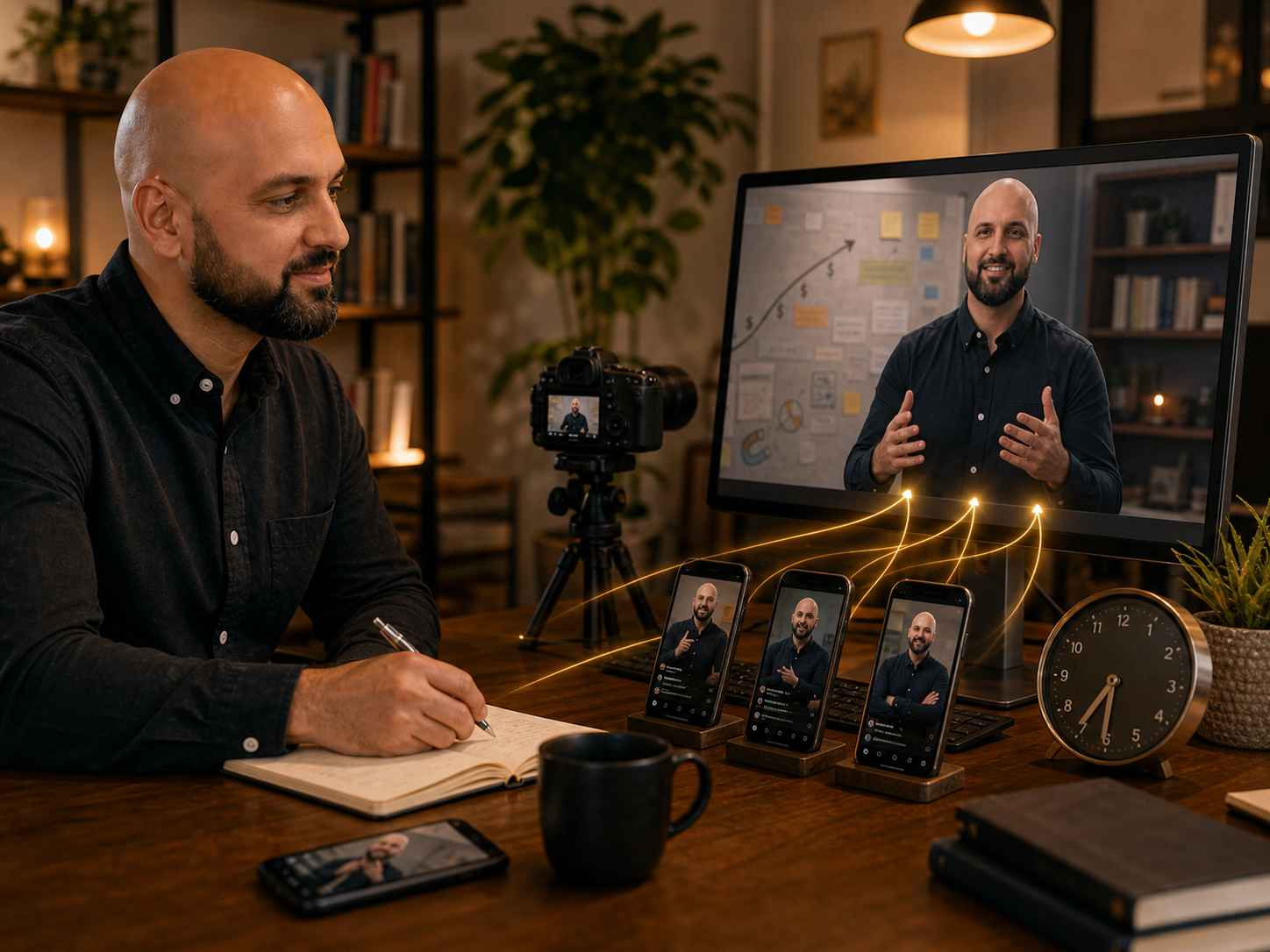
This is why the Personal Media Company is built around long-form anchors with short-form surfacing. Anchors give the brain something to hold. Surfaces route attention toward those anchors.
How Long-Form Becomes the Signature Series Shorts Can Not Be
A Signature Series is a recurring long-form format that becomes synonymous with the creator. Shorts rarely carry this load.
Joe Rogan has a three hour conversation. Ali Abdaal has a weekly essay-video. Chris Williamson has a one hour solo takedown. Each of those formats is a character plus a structure that viewers expect. The expectation is what makes the creator memorable.
Shorts are too compressed to establish a repeatable character or a repeatable structure. A funny 30 second moment is interchangeable. A recurring 40 minute format is not.
The Signature Series functions the way a television show did in a cable era. Viewers knew the host, the rhythm, and the promise. They returned because they trusted the container. Shorts return nothing. They scroll on.
This matters because founders who want to become category voices need a container. Without a container, every post is a fresh introduction. With a container, every post is a new chapter in the same story.
How Long-Form Powers the Reinforce Gate in ROAC
The Reinforce gate is the point at which a viewer stops evaluating each piece from scratch. The brain starts trusting the creator by default. Long-form is the primary fuel for that shift.
The ROAC framework maps four neural gates content passes through before it converts into business outcomes. Register, Retention, Resonate, and Reinforce. The first three are available to both formats. Reinforce belongs to long-form.
Reinforce requires sustained runtime inside one creator's attention environment. Long enough for the brain to rewrite the default from "stranger" to "familiar voice." Short clips almost never deliver that runtime.
Reinforce also unlocks the content formats that fail without prior trust. Opinion pieces, personality-driven videos, long monologues, and direct challenges land only when the audience already trusts the source.
A new creator producing those formats through Shorts usually flops. A creator with a year of long-form behind them can open with the same opinion. The same audience accepts it.
This is the mechanism that turns content into a business asset rather than an entertainment output. Attention that has passed through Reinforce is discounted less by every algorithm and every buyer.
Where Shorts Still Earn a Place Inside the Authority System
Shorts belong inside an authority system as the discovery surface, not the authority surface. They do real work when they are used for what they do best.
Shorts route a new viewer into a long-form anchor. Shorts maintain daily surface area in a feed where the algorithm rewards frequency. Shorts test hook language before the hook is invested in a longer video. Those jobs are legitimate and valuable. I map the full short-form layering inside the four-layer Shorts stack.
The failure mode is treating Shorts as the authority surface itself. When a founder posts fifty Shorts in a month and no long-form, the viewer has no depth to fall into. The funnel is all top. This is also the pattern behind the complaint that YouTube is oversaturated. The surface is oversaturated. The depth layer is largely empty.
The correct relationship is layered. Shorts discover. Long-form converts the discovery into belief. Landing pages convert the belief into revenue. Each layer does its own job. The same per-view logic that drives YouTube as a citation engine applies here. Efficiency is a property of how the layers pass attention to each other, not of any single clip.
How to Build a Long-Form Cadence That Compounds
A long-form cadence compounds when it is built around a fixed format rather than around individual video topics. Format is the engine. Topics are the fuel.
Start with one long-form format you can sustain weekly or biweekly for at least six months. Keep the structure identical across episodes. Same opening beat. Same middle shape. Same closing move.
Variability lives inside the topic, not inside the container. That consistency lets the brain file your work as one memorable entity. Fifteen disconnected videos never become anything besides fifteen disconnected videos.
Layer Shorts on top of the long-form output. Pull the sharpest 30 to 60 seconds of each episode into a vertical clip. Use the long-form as the source of truth and short-form as the discovery trail leading back to it.
Track the metric most creators ignore. Not views. Returning viewers who watched more than one long-form video. That number is the closest available proxy for authority being formed. It is also the number that correlates with discovery calls, signed clients, and book sales.
Reach is a billboard. Long-form is a cathedral. Billboards get glanced at. Cathedrals get lived inside.
Frequently Asked Questions
Are YouTube Shorts useful for any founder trying to build authority?
Yes, but only as a discovery layer, not as the authority layer. Shorts route new viewers toward long-form content where authority forms. Using Shorts alone is similar to running billboards without any store behind them.
How long should a long-form YouTube video be to build authority?
The useful range is 8 to 45 minutes, depending on topic complexity and audience. The rule is not length by itself. The runtime has to be long enough for the viewer to form a stable mental model of the creator.
How often should founders publish long-form YouTube videos?
Once a week is the practical ceiling for most founders. A biweekly cadence held for two years usually outperforms a daily cadence held for three months. Consistency of format matters more than frequency of output.
Why do some Shorts-first creators still seem authoritative?
Those who look authoritative on Shorts almost always have a history. Usually a pre-existing audience from long-form media, or a body of long-form content sitting behind the clips. Shorts carry authority that was built somewhere else. They rarely build it from scratch.
Does this argument apply to LinkedIn and Instagram too?
The mechanism is the same on any platform that allows depth. LinkedIn essays, long Instagram carousels, and multi-minute TikToks all function as long-form inside their own contexts. The required ingredient is runtime with the same voice, not the specific platform.
What is the best way to repurpose long-form into Shorts?
Pull the sharpest 30 to 60 seconds from each long-form video. Publish it as a Short that points back to the source. The clip has to stand alone as an idea and must not feel like a teaser. Teaser cuts underperform standalone cuts in most formats.
How do I know when long-form is building authority?
Track returning viewers who watch more than one long-form video, not raw view counts. Rising returning-viewer rate is the earliest signal that the brain is filing you as a familiar source. Discovery calls, inbound messages, and book sales usually follow that metric by 90 to 180 days.