
The market paid me for all of them and remembered me for none of them. The recognition started the day I narrowed to one argument. This post is the decision process I now run with every multi-skilled founder who sits across my table.
Key Takeaways
Spreading content across five expertise areas produces activity the market cannot file under one name.
A Swiss Army knife is useful everywhere and hired for nothing important. A chef's knife commands the kitchen.
Three filters pick the niche: the market premium, the argument that never tires you, and the attached buyer.
The other four expertises never die. They become supporting proof inside the chosen niche.
A 90-day content test proves the choice before any permanent commitment exists.
Five expertises make a résumé. One niche makes a name.
Why the Multi-Expertise Founder Stays Stuck
The market files people under one association, and five subjects give it nothing to file. A founder posting about leadership on Monday, product on Wednesday, and marketing on Friday reads as active and lands as unmemorable.
Each piece is competent. The pattern argues nothing. The audience scrolls past a name it never learned to attach to a subject.
Here is the metaphor I use across my table. A Swiss Army knife is useful everywhere and hired for nothing important. A chef's knife does one job, and it commands the kitchen. Buyers do not pay a premium for the founder who does many things adequately.
Buyers pay for the one name they recall when a specific problem arrives. The multi-expertise founder fears narrowing means waste. The market experiences the opposite: breadth without a spine reads as no expertise at all.
The Three Filters That Pick the Niche

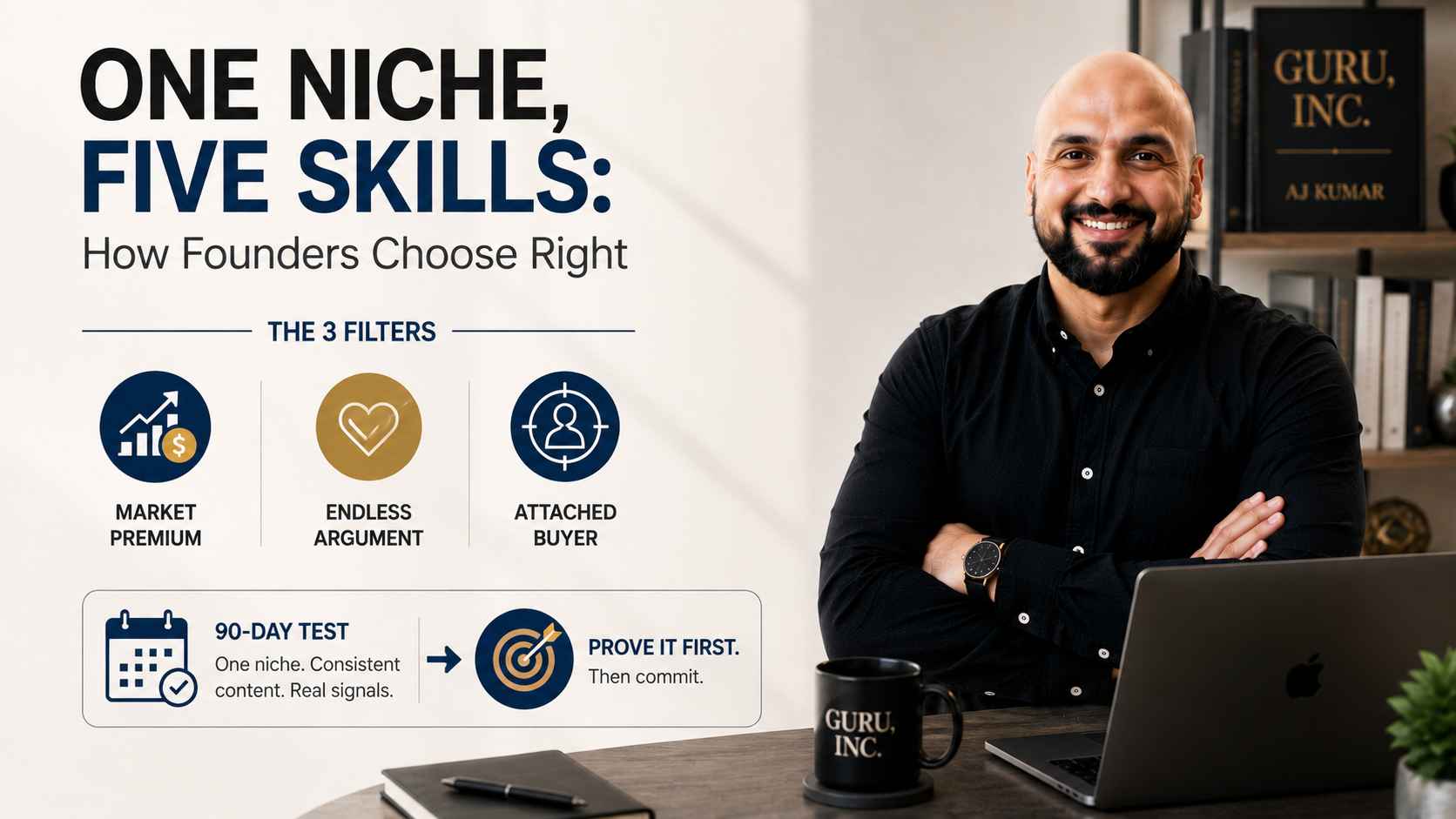
So which of the five wins? Three filters make the choice, and the niche sits where all three overlap. The three filters are given below:
The market premium. Which expertise does the market already pay the most for, with the least resistance? Price signals demand. The skill buyers negotiate hardest against is rarely the one to build a name on.
The endless argument. Which subject do you argue without being asked? Authority takes years of repetition, and repetition runs on genuine conviction. A niche chosen for money alone runs out of things to say by month six.
The attached buyer. Which expertise has a specific person with a specific budget on the other end of it? A niche with no buyer attached is a hobby with a content calendar.
One filter alone misleads. The premium without conviction burns out. The conviction without a buyer stays a passion project. The overlap of all three is the niche, and in my experience most founders know the answer within an hour once the filters are on the table. The refusal was never confusion. The refusal was grief for the four not chosen.
The Other Four Never Die
Choosing one niche does not delete four expertises. It gives them a place to point. The unchosen skills become supporting proof inside the chosen argument: the reason the founder's take is different from every single-skill specialist in the same niche. This is where the fear of waste collapses, because nothing gets wasted. Everything gets aimed.
I ran this play with Kimberly Snyder. She held nutrition, yoga practice, and beauty philosophy, three subjects capable of producing three scattered content streams. The brand chose the intersection instead, and every subject fed one argument. The nutrition expertise led.
The rest became the depth behind it, and the depth is what separated her from every other nutritionist publishing recipes. Positioning work decides what the one argument is. The niche decision decides which expertise carries it and which ones stand behind it.
The 90-Day Test Before Committing

The choice feels permanent, and it is not. Authority takes months to form, which means the first quarter is reversible. I have every founder run the chosen niche for 90 days before treating the decision as settled: one argument, argued consistently, across whatever formats fit.
Then read the signals, the same way ROAC measurement reads any content: is the audience repeating the position back, is inbound referencing it, does the founder still have more to say.
Strong signals on all three confirm the choice. Weak signals after honest execution send the founder back to the filters with real data instead of fear. The test converts an identity crisis into an experiment, and experiments are cheap. What stays expensive is another year of five subjects and no name.
Five Subjects vs One Niche
Attribute | Five-subject founder | One-niche founder |
Market association | None the audience can file | One name, one problem, one call |
Content energy | Split five ways, always thin | Compounding on one argument |
The other skills | Competing for the spotlight | Supporting proof behind the leader |
Buyer response | Interesting, forgettable | Shortlisted when the problem arrives |
Pricing power | Negotiated as a generalist | Anchored to the specialist premium |
The decision also separates this from a different discipline entirely. Saying no to trends filters external noise arriving from the market. The niche decision filters internal abundance, the founder's own genuine skills, and the second filter is harder because everything being declined is real.
Running the filters, making the call, and building the first 90 days around it is exactly where my consulting practice starts with multi-skilled founders. The expertise was never the problem. The unmade decision was.
A founder with five expertise areas chooses one niche through three filters: the premium, the endless argument, and the attached buyer. The other four become the depth behind the choice, and 90 days of signals prove it before anything becomes permanent. Five expertises make a résumé. One niche makes a name.
How Does a Founder Choose a Niche With Multiple Skills
Run three filters: which expertise the market pays a premium for, which argument never tires you, and which has a specific buyer attached. The niche sits where all three overlap, and most founders see it within an hour of honest filtering.
Does Choosing One Niche Waste the Other Expertise Areas
No. The unchosen skills become supporting proof inside the chosen argument, the depth that separates the founder from single-skill specialists in the same niche. Nothing gets deleted. Everything gets aimed at one target.
What If the Chosen Niche Turns Out Wrong
The first quarter is reversible, because authority takes months to form. A 90-day test with honest execution produces real signals: position repetition, inbound references, sustained conviction. Weak signals send the founder back to the filters with data instead of fear.
Is a Narrow Niche Riskier Than Staying Broad
Staying broad carries the larger risk: years of competent content the market never files under a name. A narrow niche concentrates recognition, pricing power, and inbound around one association, and the niche widens naturally after the name is established.