
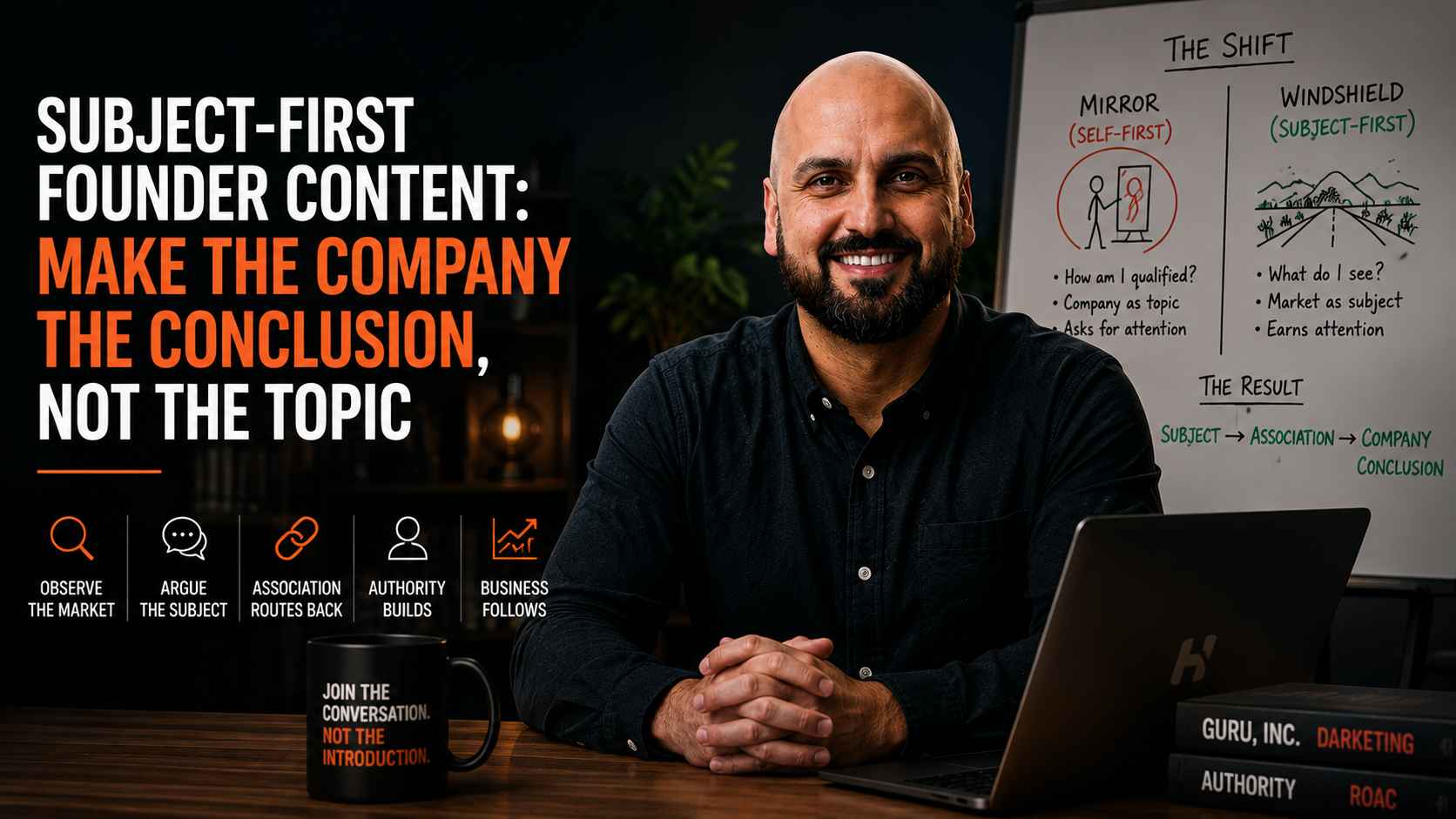
I push every client through the same shift, and it is the single highest-leverage change in founder content: stop making yourself the subject. Start making yourself the lens. The company stops being the topic and becomes the conclusion the audience reaches on its own.
Key Takeaways
Company-first content fails because the audience has no reason to care about the company yet.
The mirror problem: founders write while evaluating themselves instead of observing the market.
Alex Karp runs the reversal: he argues market-level subjects, and the arguments route back to Palantir without a pitch.
A subject earns the founder's attention when the market already argues about it and the company is a natural answer to it.
The founder still appears in subject-first content, as the judgment, never the landscape.
Do not make the company the subject. Make the company the conclusion.
The Mirror Problem
Creating content feels like driving forward while staring into a mirror. Instead of looking out at the world and sharing what you see, you look back at yourself. Am I qualified. Do I know enough. What if I am wrong.
Every post becomes less about helping someone and more about evaluating yourself, and the evaluation never ends because the mirror never runs out of angles.
I know the mirror personally. My early content was about my agency: our services, our wins, our process. Competent posts, professionally made, arguing a subject nobody had a reason to care about yet, which is exactly what makes mirror content exhausting to produce and easy to scroll past. The founder burns energy on self-examination. The market receives a stranger talking about himself.
Why Self-First Content Exhausts the Founder and Bores the Market
The mirror costs twice. The founder pays in anxiety, because every piece doubles as a referendum on their qualifications, and referendums are draining to write. The market pays in irrelevance, because a company description answers a question nobody asked.
The audience is out there arguing about real subjects: their industry's direction, the technology changing their work, the decisions in front of them. A founder staring into the mirror is absent from every one of those conversations.
The creators worth studying spend their attention through the windshield. They observe patterns. They notice what others miss. They share what they see. And the strange arithmetic holds: the less a founder makes himself the subject, the more valuable and authoritative the content becomes.
The Karp Reversal
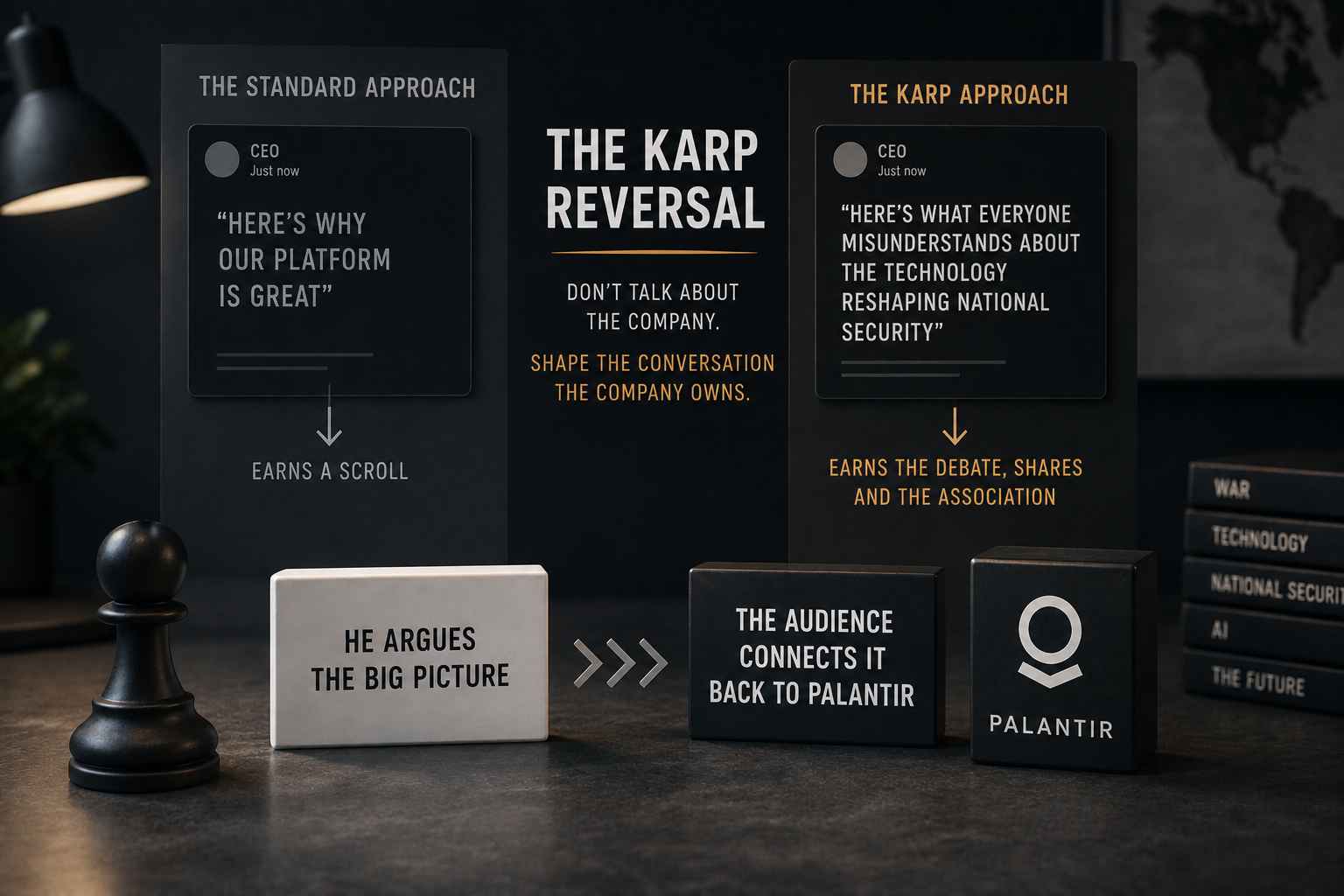
Alex Karp does the reverse of standard founder content, and the reversal is the entire lesson. The Palantir CEO's public commentary is rarely about the product. He argues about war. Technology. National security.
Artificial intelligence. The future of the West. Big, contested, market-level subjects the world already debates, engaged with real conviction and no pitch attached.
The Mechanism in One Sentence
Because he is Palantir's CEO, people connect those arguments back to Palantir on their own. That is the whole mechanism. The audience hears a worldview about security and technology, knows who is speaking, and completes the association without being asked.
The company never needed to be the topic, because the company is the standing answer to every subject he argues. The byline does the routing. The subject does the persuading.
Run the comparison honestly. A CEO posting "here is why our platform is great" earns a scroll. The same CEO arguing "here is what everyone misunderstands about the technology reshaping national security" earns the debate, the shares, and the association, and the association is the asset.
Subjects the Market Already Argues About
So what belongs in the windshield? Subjects that pass two filters, and most candidates fail one of them. The two filters are given below:
The Two Filters for a Subject
The market already argues about it. A subject with a live, ongoing debate carries its own audience. The founder joins a conversation in progress instead of starting one from zero. Industry direction, technology shifts, contested practices, the questions buyers argue about internally: these come with attention pre-attached.
The company is a natural answer to it. The subject sits close enough to the founder's actual work that the association forms without effort. Karp arguing national security routes to Palantir because Palantir lives there. The same arguments from an unrelated CEO route nowhere. Distance kills the mechanism.
The filters work together or not at all. A live debate far from the company builds an audience that never converts. A close subject nobody argues about builds silence.
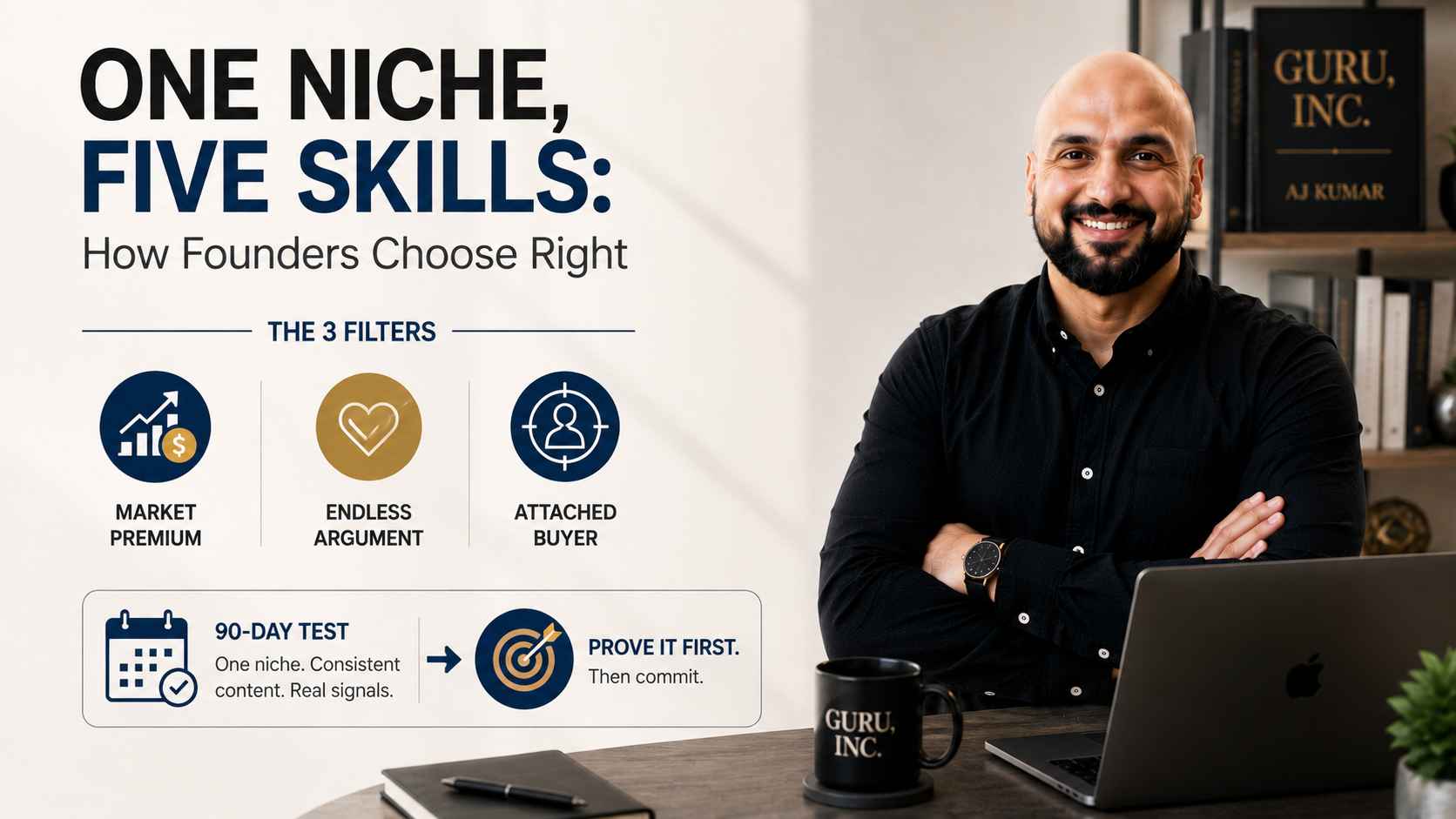
The overlap is the founder's real content territory, and choosing the niche settles which territory the founder owns. Subject-first content settles what the camera points at inside it: the market's arguments, never the founder's brochure.
Windshield Content in Practice

The weekly practice is observation, not self-presentation. What pattern did the market show this week. What is everyone in the industry getting wrong. What decision are buyers agonizing over that has a clearer answer than they think.
The founder's expertise turns those observations into arguments worth reading, and the arguments do the work the company description never did.
This also dissolves the qualification anxiety the mirror manufactures. A founder observing the market needs no permission slip, because the claim is about the subject, not the self. "Am I qualified to talk about myself" is a hard question. "Is this observation about the market true" is a checkable one, and checkable questions are writable ones.
The technical founder who hates writing usually hates the mirror, not the writing, and the windshield fixes what the production tools never fixed.
Where the Founder Still Appears
Subject-first does not mean self-erased. The founder appears in every piece, as the lens: the judgment that selected the subject, the conviction in the argument, the scars behind the specifics. You are the way of seeing, never the landscape.
The audience learns the founder's mind by watching it work on subjects that matter, which builds a deeper association than any self-description, because demonstrated judgment is the one credential nobody skims past.
Self-First vs Subject-First Content
Attribute | Self-first content | Subject-first content |
Topic source | The company, the product, the founder | The market's live arguments |
Opening line | Here is what we do | Here is what everyone gets wrong |
Reader takeaway | A stranger described himself | A judgment worth remembering |
Credibility mechanism | Claimed qualifications | Demonstrated thinking |
Route to the company | The pitch, resisted | The association, completed by the reader |
The Routing Effect
The commercial return of subject-first content arrives through identity, and identity is measurable. Every argued subject deposits the same association: this founder is the one who understands X.
That association is identity value, the first component ROAC measures, and it compounds with every piece that argues instead of advertises. When the buyer's problem finally arrives, the association fires, and the inbound conversation opens with trust the brochure never earned.
The shift from mirror to windshield, picking the subjects, building the arguments, and keeping the company in the conclusion seat, is the content work I run inside my consulting practice with every founder who is tired of describing themselves to an audience that keeps scrolling.
Subject-first content joins the arguments the market already has, argued through the founder's judgment, with the company standing as the natural answer. The mirror asks whether you are qualified. The windshield asks what you see. Do not make the company the subject. Make the company the conclusion.
What Is Subject-First Founder Content
Subject-first content argues market-level subjects the audience already debates, through the founder's judgment, instead of describing the company or the founder. The company benefits through association: the audience connects the arguments back to the business on its own.
Why Does Company-First Content Fail for Founders
The audience has no reason to care about the company yet. A company description answers a question nobody asked, while the market's real arguments carry their own attention. Company-first content asks for interest. Subject-first content joins interest already in motion.
What Subjects Does a Founder Talk About
Subjects that pass two filters: the market already argues about them, and the company is a natural answer to them. The overlap keeps the audience live and the association close. Subjects failing either filter build audiences that never convert or arguments nobody hears.
How Does Subject-First Content Bring Business Back to the Company
Through completed association. Every argued subject deposits the founder as the one who understands that territory, and the byline routes the authority to the company without a pitch. When the buyer's problem arrives, the association fires and the inbound opens with trust already formed.