
Founders avoid entertaining content out of fear for their credibility, and the fear reads the memory science backwards. Twenty years of building authority brands taught me the pattern: entertainment executed with a position multiplies authority instead of spending it.
Key Takeaways
Edutainment blends education and entertainment, and for founders the blend is a retention strategy, not a personality change.
Emotionally engaging material produces stronger memory than neutral material, per published research by Cahill and McGaugh.
Authority-first edutainment entertains in service of a market position. Volume-first entertainment chases reach and compounds nothing.
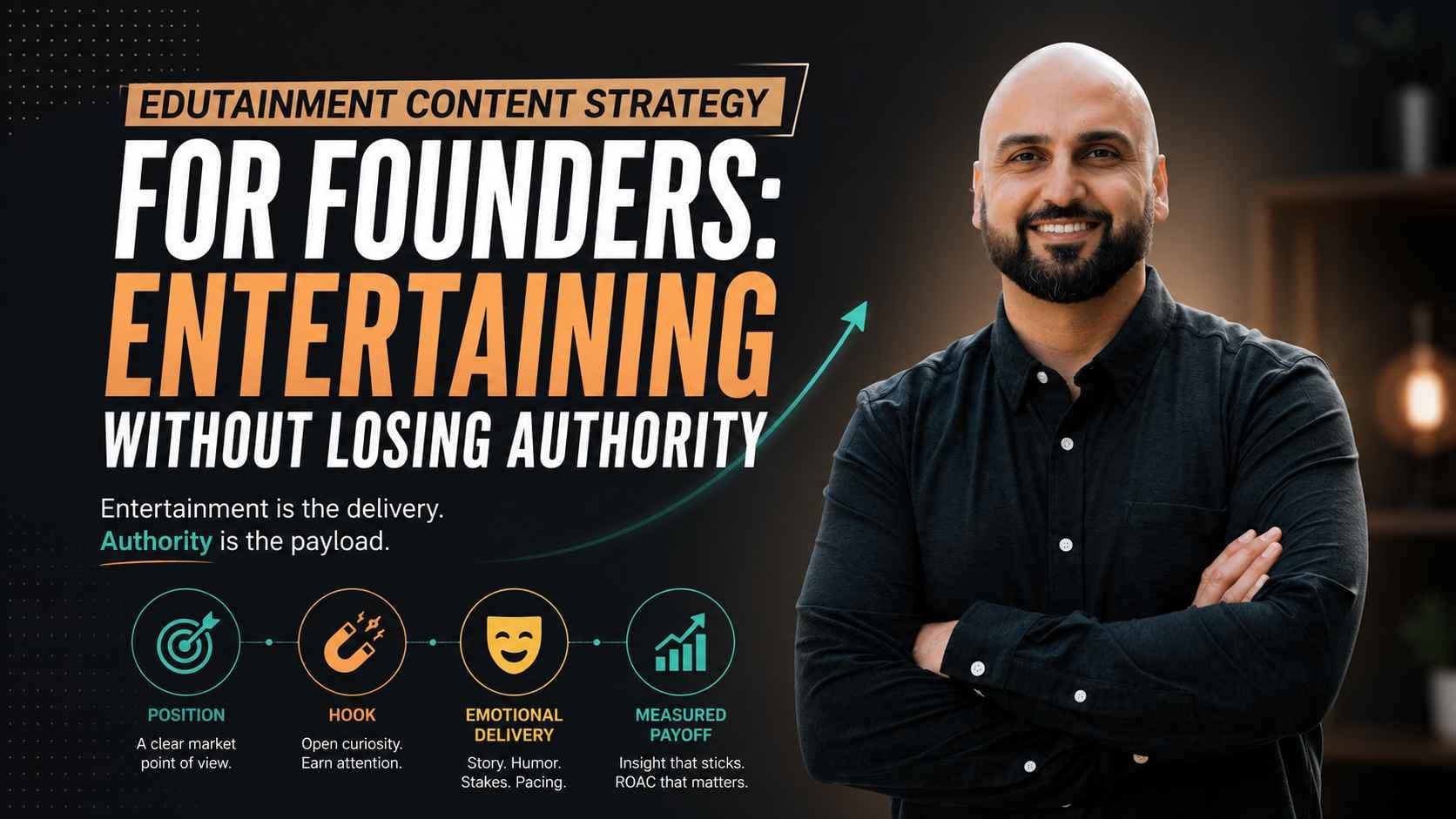
A founder edutainment strategy runs on four components: position, hook, emotional delivery, and measured payoff.
ROAC measures the outcome: the trust and revenue the attention creates, never view counts alone.
Edutainment Converts Founder Expertise Into Content Audiences Finish

Edutainment is content that teaches through entertainment: the lesson carries the value, and the delivery earns the attention. The term covers classrooms, kids programming, and museum exhibits. Founder edutainment is narrower.
A founder uses entertaining delivery, story, humor, pacing, and visual energy, to move real expertise into an audience that scrolls past lectures. The expertise stays intact. The packaging changes.
Most founders treat the two ingredients as rivals. Educational content earns trust and dies in the feed. Entertaining content spreads and sells nothing. Edutainment refuses that trade.
Entertainment is the delivery system, and authority is the payload. A founder who masters the blend stops choosing between being respected and being watched.
The Authority-Loss Fear Reads the Memory Science Backwards
Founders resist edutainment because entertaining feels like a credibility risk, and the research on memory points the other way.
Experiments by Cahill and McGaugh found people remembered emotionally arousing material significantly better than identical material delivered neutrally. Emotion is not decoration on a lesson. Emotion is the mechanism that makes the lesson stick.
The fear confuses entertainment with clowning. A founder performing skits about nothing loses authority. A founder delivering a sharp market position through story and humor multiplies it, because the audience finishes the argument and remembers who made it.
Dry delivery does not protect credibility. Dry delivery hides it. I have audited founder channels for twenty years, and the invisible expert is a far more common failure than the embarrassing one.
Authority-First Edutainment Beats Volume-First Entertainment
Authority-first edutainment entertains in service of a defensible position. Volume-first entertainment chases reach with nothing underneath. The distinction decides everything downstream: topic selection, hooks, formats, and measurement.
A volume-first founder copies trends and rents attention the algorithm repossesses weekly. An authority-first founder builds hooks, open loops, and pattern interrupts around one repeated market judgment, and every entertaining piece deposits into the same account.
NonToxicDad shows the model at scale. Warren Phillips teaches toxin awareness, dense and technical territory, through energetic, emotionally charged delivery, and reaches 30 million monthly viewers. The entertainment never replaced the expertise.
The entertainment is the reason the expertise gets watched. Watched expertise compounds with depth, which is one reason long-form YouTube outperforms Shorts for authority when the goal is trust rather than reach.
The Founder Edutainment Strategy Runs on Four Components

A working edutainment strategy is a system, never a collection of funny posts. The four components of a founder edutainment strategy are given below:
Position. The market judgment every piece argues. Entertainment without a position is noise with good pacing. Alex Karp shows the model at CEO scale: he argues war, technology, and national security, subjects his market already cares about, and Palantir inherits the authority.
Hook. The opening seconds open a curiosity gap the ending closes. Attention gets earned before the lesson begins.
Emotional delivery. Story, humor, stakes, and visual pacing carry the teaching. Retention follows emotion, and completion follows retention.
Measured payoff. Every piece lands one usable insight and routes the attention somewhere owned.
The system runs inside a founder's existing content architecture, never as a separate channel experiment. Measurement closes the loop. View counts flatter and mislead. ROAC, Return on Attention Created, tracks what the attention produces: identity value, trust value, and revenue from people who watched, remembered, and bought.
Founders Start With Delivery Changes, Not a Production Team
Edutainment starts with delivery changes, not with a studio. A founder records the same expertise with stakes stated up front, one story per concept, shorter sentences, and a payoff promised early and delivered late. Production value rises later. Positioning rises first, since entertaining delivery multiplies whatever position exists underneath it, including a position of nothing.
Expertise-rich, visibility-poor founders hold the strongest starting hand in this game: real knowledge, real proof, weak packaging. Personal brand consulting for founders builds the position, the content system, and the measurement that turn that hand into recognized authority. The entertaining part is learnable. The expertise is the part nobody fakes.
Edutainment content strategy converts founder expertise into content audiences finish and remember. Entertainment is the delivery system. Authority is the payload. Founders who entertain in service of a position build trust faster than founders who lecture, and the memory research sides with them.
Does Edutainment Work on LinkedIn for Founders
Edutainment performs on LinkedIn through story-led posts, sharp openings, and concrete stakes rather than skits. The platform rewards professional narrative over comedy. Founders adapt the delivery to the room while the position underneath stays identical.
How Much Entertainment Fits Founder Content
Marketers cite an 80/20 ratio between value and fun, and ratios miss the point. Entertainment is woven through the teaching, never bolted beside it. The correct measure is completion: enough emotional delivery that the audience finishes the lesson.
Is Edutainment the Same as Infotainment
Edutainment teaches through entertainment, and the lesson is the point. Infotainment presents information as entertainment, and the stimulation is the point. Founders build authority through the first. The second produces engaged audiences that learn nothing and buy nothing.
What Makes Edutainment Fail for Experts
Edutainment fails when the entertainment disconnects from the expertise: humor about nothing, trends without a position, and hooks with no payoff. Unrelated entertainment reads as clout-chasing. Related entertainment reads as mastery. The connection decides the credibility outcome.