
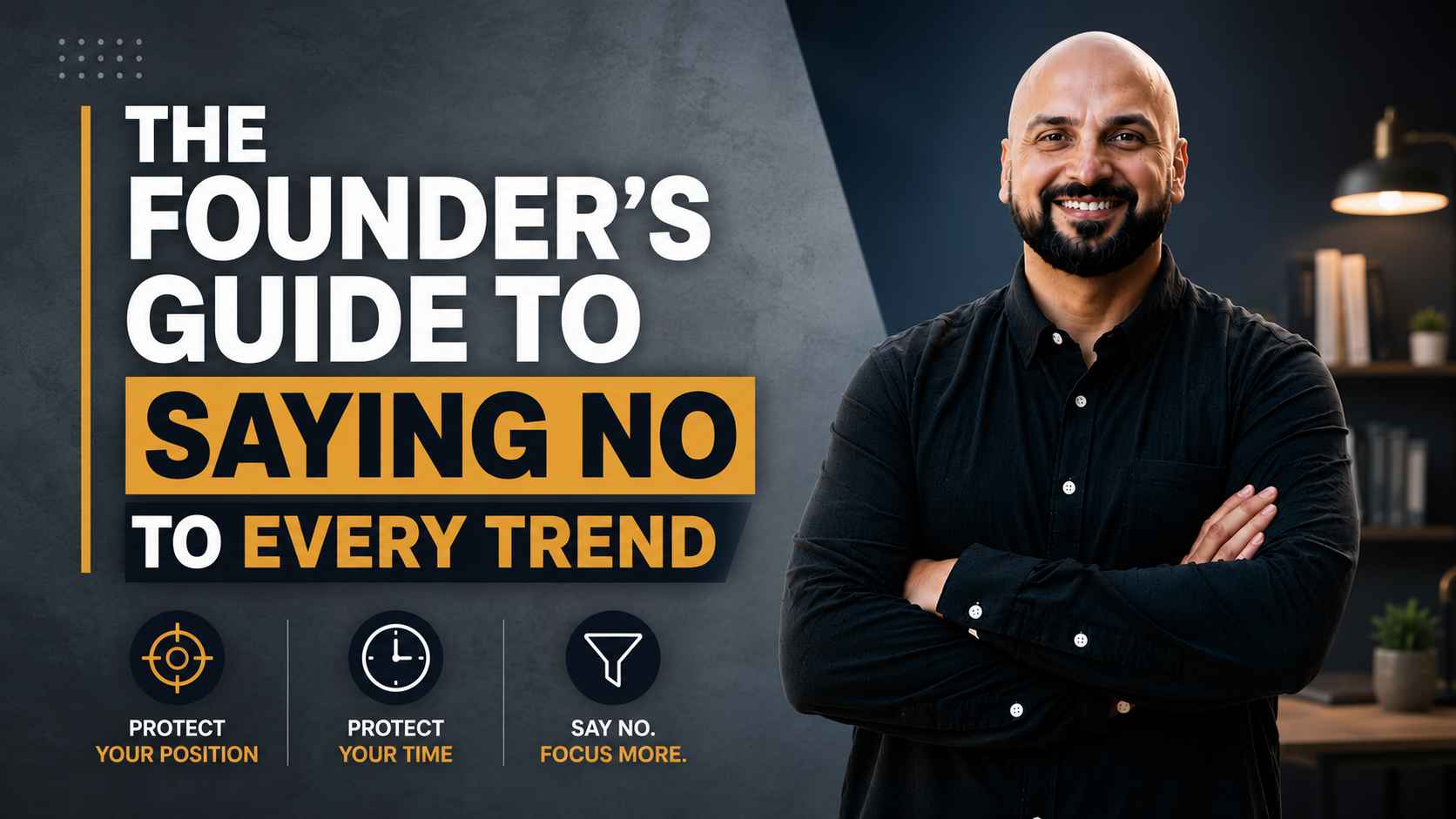
Each one looks free in the moment and costs real attention, production time, and a share of the one position the founder is supposed to be known for. Saying no to most of them is not caution. It is the actual discipline authority content depends on.
Key Takeaways
Every adopted trend carries a real, ongoing cost: attention, production time, and dilution of the founder's position.
A trend earns adoption by passing one filter: does it serve the position, or does it merely look active.
Derek Sivers' Hell Yeah or No heuristic, built for opportunity decisions generally, applies directly to trend adoption.
Writing the no down prevents the same trend pitch from resurfacing every quarter with no memory of why it was declined.
Saying yes to a trend is correct only when the trend and the position are the same thing, not merely adjacent.
Every Trend Arrives With a Real Cost

A new platform, a new content format, a trending audio or structure, none of these arrive free. Each one demands attention to learn, time to produce consistently, and a claim on the founder's name that continues once started.
Content built without a repeated position produces noise regardless of how current the format looks, and every adopted trend that does not serve the position is exactly that noise, dressed as activity.
The founder's product-scope version of this problem is well documented: every feature added is a promise that continues, supported, and explained long after the excitement of shipping it fades.
The content version runs identically. Every platform joined and every format adopted becomes something the audience now expects to see again.
The Filter: Does It Serve the Position

One question decides most trend-adoption decisions before they become a debate. Does the trend serve the position the founder already argues, or does it merely look active and current. A trending format that carries the same repeated argument earns a yes.
A trending format that requires abandoning the argument to fit the format earns a no, regardless of how much reach it promises.
The product-scope discipline that inspired this filter asks three questions of any proposed feature: does it serve the core function, does the team want to maintain it two years from now, and what does building it cost in what does not get built.
The same three questions apply directly to trends. Does the format serve the position. Does the founder want to produce it two years from now, once the trend itself has faded. What does adopting it cost in the content that would have argued the position more directly.
The Hell Yeah or No Heuristic
Derek Sivers built a decision rule for opportunities generally: anything short of genuine enthusiasm gets declined by default, since default yes produces a life scattered across too many half-committed directions. The heuristic was built for investing and general opportunity decisions, and it transfers cleanly to trend adoption.
A trend that produces genuine enthusiasm, one the founder would pursue even without the pressure of relevance, earns consideration. A trend adopted only from fear of missing out earns the default no.
The test filters out the largest category of bad trend decisions: adoption driven by anxiety about looking absent rather than genuine fit with the position. Fear of missing out produces yeses that a position-first filter would have declined immediately.
Write the No Down
A declined trend evaporates from memory unless it gets recorded. A simple running list, one line of reasoning per declined trend, stops the same pitch from resurfacing every quarter as a fresh debate.
Reading old entries months later usually confirms the no was correct, and the record removes the recurring cost of relitigating a decision already made.
This is the same discipline the content calendar trap applies to planning horizons: a fixed position, revisited rarely, and a lightweight system underneath it that prevents every new pressure from becoming a fresh decision made from scratch.
That post covers how far ahead to plan proof and position. This filter covers whether a new platform, format, or tactic earns a place in the plan at all.
When Saying Yes Is Correct
Saying yes to a trend is correct when the trend and the position are the same thing, not merely adjacent to it. A founder whose position concerns a specific platform's culture belongs on that platform regardless of trend cycles.
A founder whose position argues something the trending format happens to illustrate well adopts it because the position demanded it, not because the trend did.
The distinction matters because a blanket no is as costly as a blanket yes. Declining every trend without checking it against the position risks missing the rare case where trend and position genuinely align. The filter exists to make that one case obvious rather than to reject everything by default.
Trend Pressure and the Filter Question
Trend pressure | Filter question | Likely answer |
New platform everyone is joining | Does the position require presence there | No, unless the position is platform-specific |
Trending content format | Does the format carry the same argument | Only if it strengthens the position, not merely reach |
Competitor adopting a new tactic | Does adopting it serve the founder's own position | Rarely, since a competitor's position differs |
Genuine enthusiasm for a new format | Would this get pursued without the trend pressure | Yes, this is the Hell Yeah case |
Every trend a founder considers costs real attention and production time, and most of them fail the one filter that matters: whether they serve the position already being argued. Write the no down, reserve genuine enthusiasm for the rare yes, and let the position decide instead of the fear of missing out.
How Does a Founder Know Which Trends to Adopt
A trend earns adoption only when it serves the existing position rather than merely looking current. Genuine enthusiasm for a format, independent of trend pressure, is a stronger signal than reach potential or competitor activity.
Does Saying No to Trends Mean Ignoring the Market Entirely
No. The filter declines trends that do not serve the position, not awareness of the market generally. A founder still tracks what the market is doing. The decision is whether to adopt it, not whether to notice it.
What Happens When a Founder Adopts Too Many Trends
The position dilutes. Attention and production time spread across formats and platforms that do not reinforce a single argument, and the audience remembers activity without remembering what the founder stands for.
Is It Ever Too Late to Say No to a Trend Already Adopted
No. Retiring a trend that never served the position costs less than continuing to maintain it. The same audit that decides whether to adopt a new trend applies retroactively to ones already running.