
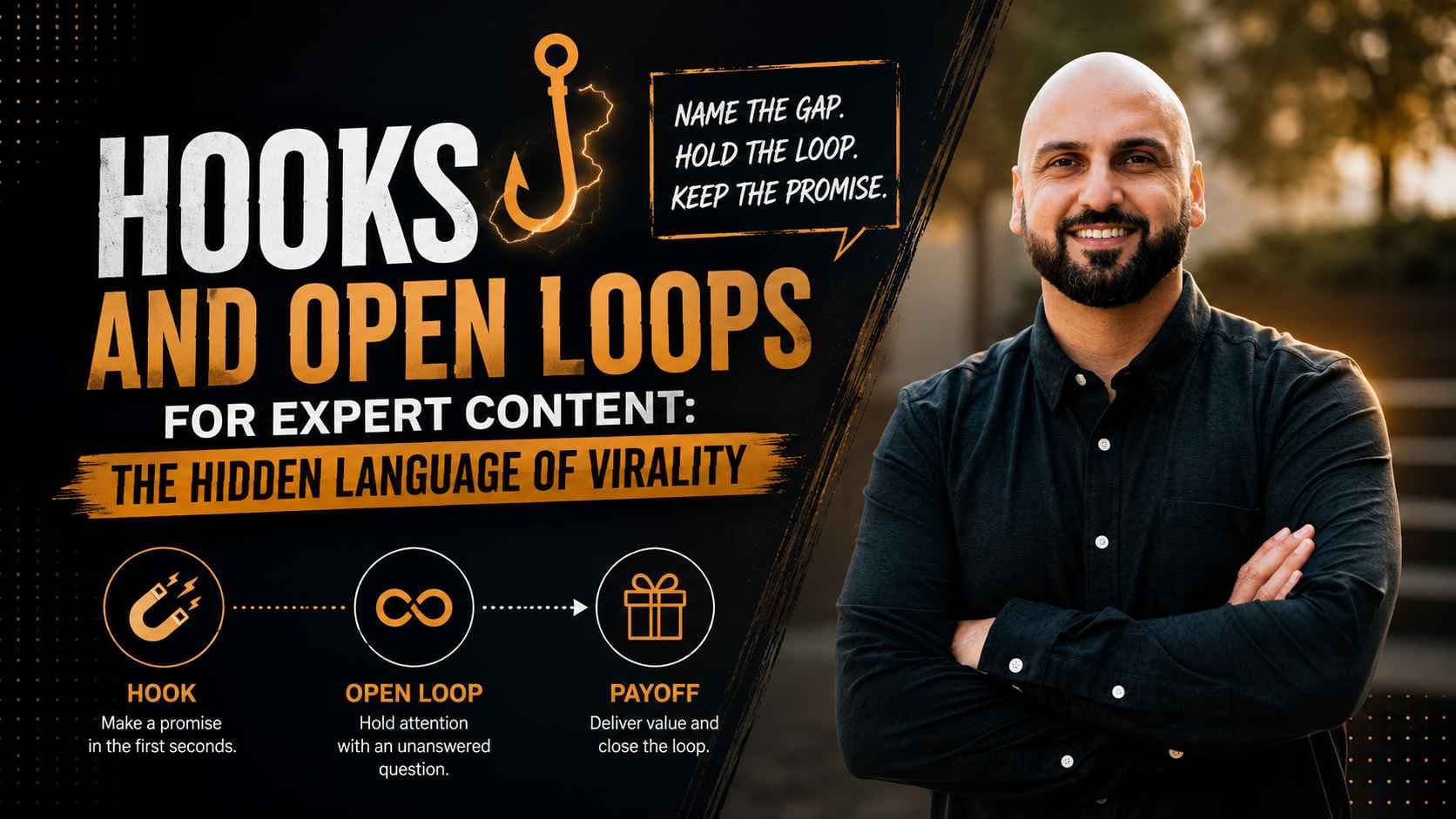
An open loop is the unanswered question that holds attention through the middle. The payoff is the repayment that converts the watch into trust. Experts lose viewers by leading with credentials and context. The structure below reverses that order.
Key Takeaways
A hook is a specific promise delivered in the opening seconds, and platforms measure survival of exactly that window.
Curiosity follows an information gap: attention locks onto a named hole in the viewer's knowledge, per George Loewenstein's research.
Open loops hold attention by delaying resolution, and every opened loop creates a debt the content repays.
Curiosity gaps build trust because the payoff keeps the promise. Clickbait spends trust by breaking it.
Five hook patterns fit expert content: misconception, stakes, result-first, contrarian position, and cost of ignorance.
The Hidden Language of Virality treats these mechanics as emotional architecture rather than tricks.
A Hook Is a Promise That Earns the Opening Seconds

A hook is a specific promise that gives the viewer a reason to stay before the content proves anything. Platforms build their measurement around exactly this window. YouTube's official creator guidance instructs creators to structure the first 15 seconds of a video deliberately, and its analytics track survival past the 30-second mark.
A 2025 benchmark from Retention Rabbit, an AI retention tool, found videos stating a clear value proposition inside 15 seconds held 18 percent higher retention at the one-minute mark.
Experts spend that window on the opposite material: credentials, agendas, and background. The viewer hears throat-clearing and leaves. The promise comes first. The proof earns its place after the promise buys the time to deliver it.
Curiosity Opens When Content Names a Gap in the Viewer's Knowledge
Curiosity is not a mood. Curiosity is a response to a named information gap. George Loewenstein's information-gap research, published in Psychological Bulletin in 1994, located curiosity in attention focused on a gap in knowledge. The finding hands experts a mechanical instruction: a gap pulls attention only after the content names it.
Generic openings name no gap. "Today I want to talk about pricing" opens nothing. "Your pricing page loses the deal before the sales call starts" opens a gap the viewer now owns and wants closed.
I write hooks for founders by locating the distance between what their buyers believe and what the founder knows. That distance is the hook, and every genuine expert holds a warehouse of it.
Open Loops Hold Attention Until the Payoff Closes Them
An open loop is a question the content raises and deliberately delays answering. The hook opens the primary loop. Strong expert content nests smaller loops inside it: a promised example, a withheld number, a mistake teased two sections before its explanation. Attention rides the unresolved question from beat to beat.
Every loop is a debt. Content that opens loops and abandons them trains the audience to distrust the next promise, and distrust compounds faster than trust.
The payoff schedule is the craft: open early, close late, and close every loop before the final frame. A finished viewer with every question answered is the unit of authority this structure produces.
Curiosity Gaps Build Trust and Clickbait Spends It
Curiosity gaps and clickbait share the same opening mechanics and run opposite economics. A curiosity gap makes a promise the payoff keeps. Clickbait makes a promise the content breaks, and every broken promise charges the expert's credibility account.
The watch was never the goal for a founder. The trust behind the watch is, which is why entertaining content builds founder credibility only when the delivery carries real expertise to a real resolution.
The distinction also dissolves the expert's fear of manipulation. Structuring curiosity is not deception. Deception is promising what the content never delivers. A hook makes promises the content keeps.
Clickbait makes promises the content breaks. An expert with genuine answers holds the safest hooks available, since every payoff is already in inventory.
Five Hook Patterns That Fit Expert Content
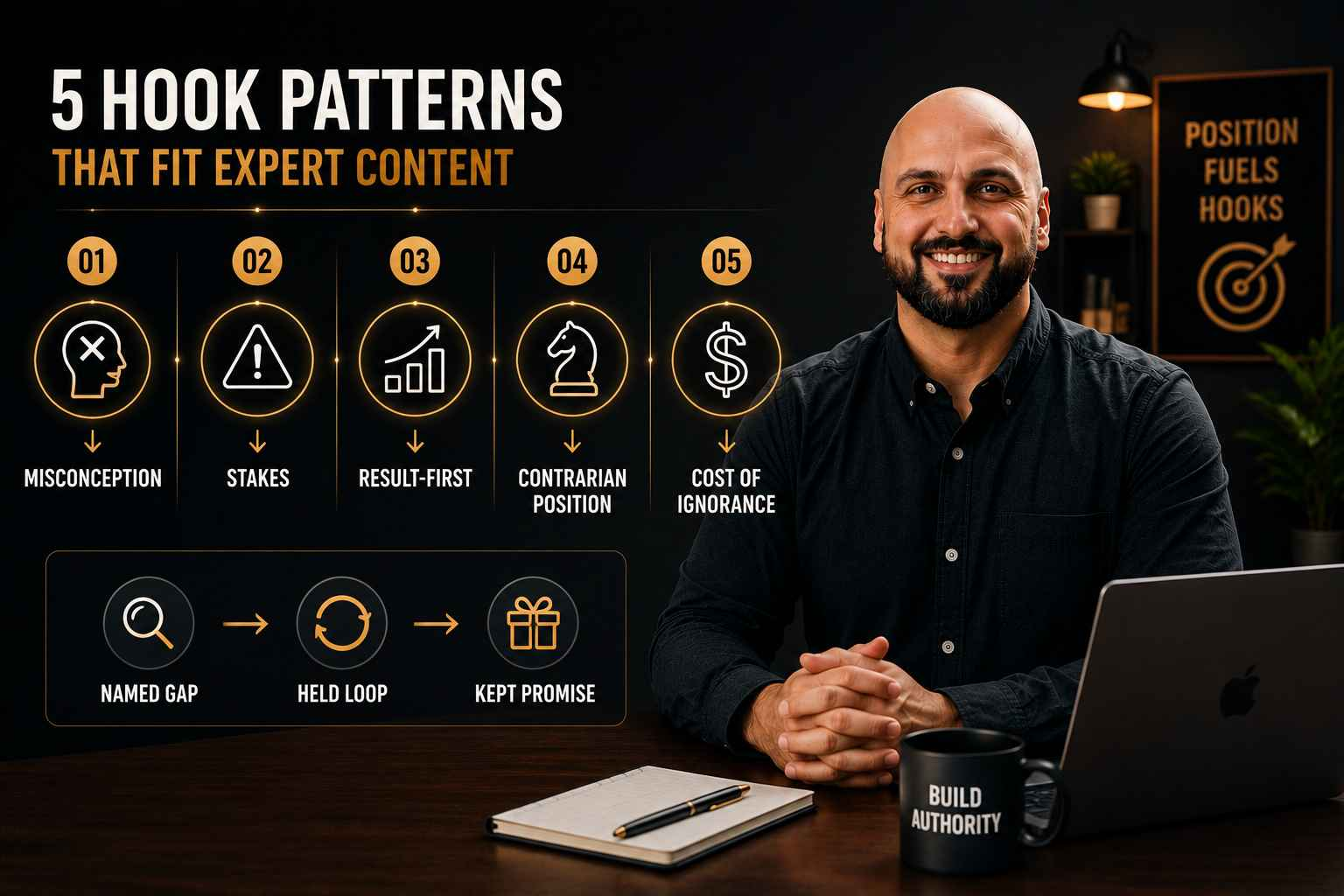
Virality has a grammar, and GURU, INC. names it the Hidden Language of Virality: the recurring emotional patterns beneath content that spreads. Hooks are the first sentence of that language, and expert material supplies five reliable patterns. The five hook patterns for expert content are given below:
The misconception hook. Open on the wrong assumption the audience holds. The pattern drives retention because viewers skip educational videos that confirm what they already believe.
The stakes hook. Name the cost of the problem in the first sentence: money, time, or market position.
The result-first hook. Show the outcome, then rewind to the method. The gap between result and process is the loop.
The contrarian position hook. State the market judgment nobody else defends. Position supplies this pattern, and hooks starve without one.
The cost-of-ignorance hook. Tell the viewer what not knowing this costs them right now.
Every pattern runs on the same engine: a named gap, a held loop, a kept promise. The patterns plug into the edutainment content strategy for founders as its hook component, and building the position that feeds them is the work personal brand consulting for founders delivers before any camera turns on.
Hooks and open loops convert expert content from skipped to finished. A hook names the gap, an open loop holds the attention, and the payoff keeps the promise. Experts who structure curiosity build trust with every completed watch.
Do Hooks Work in Written Content and LinkedIn Posts
Hooks transfer to every format. A first line that names a gap performs the same job as a video's opening seconds. LinkedIn truncates posts after a few lines, which makes the pre-truncation line the entire distribution decision.
What Is the Hidden Language of Virality
The Hidden Language of Virality is a framework from GURU, INC. by AJ Kumar. The framework names the recurring emotional patterns beneath content that spreads, treating virality as a learnable structure rather than luck, timing, or algorithm favor.
How Many Open Loops Fit in One Video
One primary loop carries the piece from hook to payoff. Two or three nested loops hold the middle: a teased example, a withheld number, a promised mistake. Every opened loop closes before the end, since unclosed loops erode trust.
Why Do Expert Hooks Fail
Expert hooks fail through the curse of knowledge: the expert opens with context the audience never requested. Credentials, agendas, and definitions name no gap. A hook fails whenever the first sentence serves the speaker instead of the viewer.