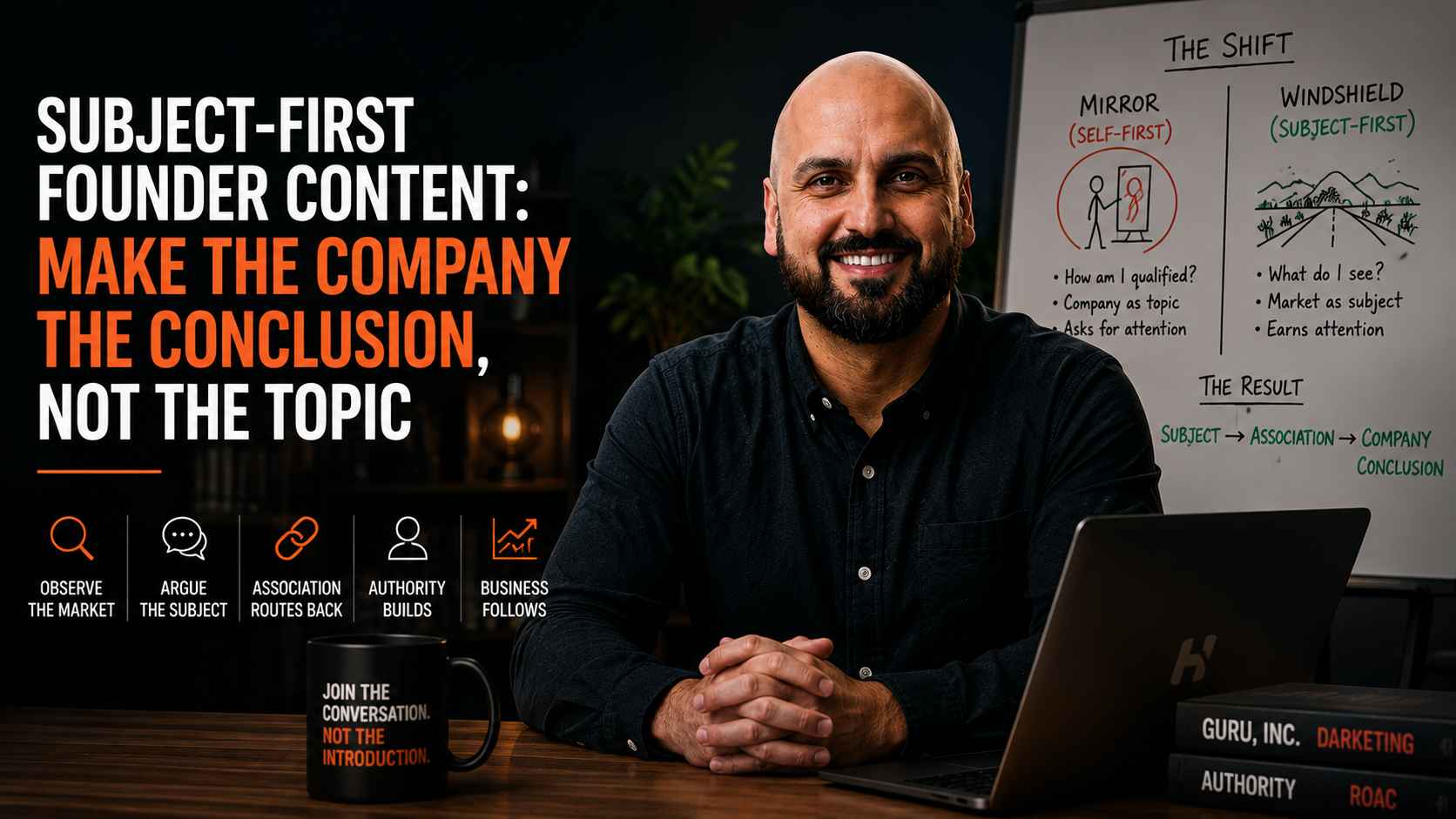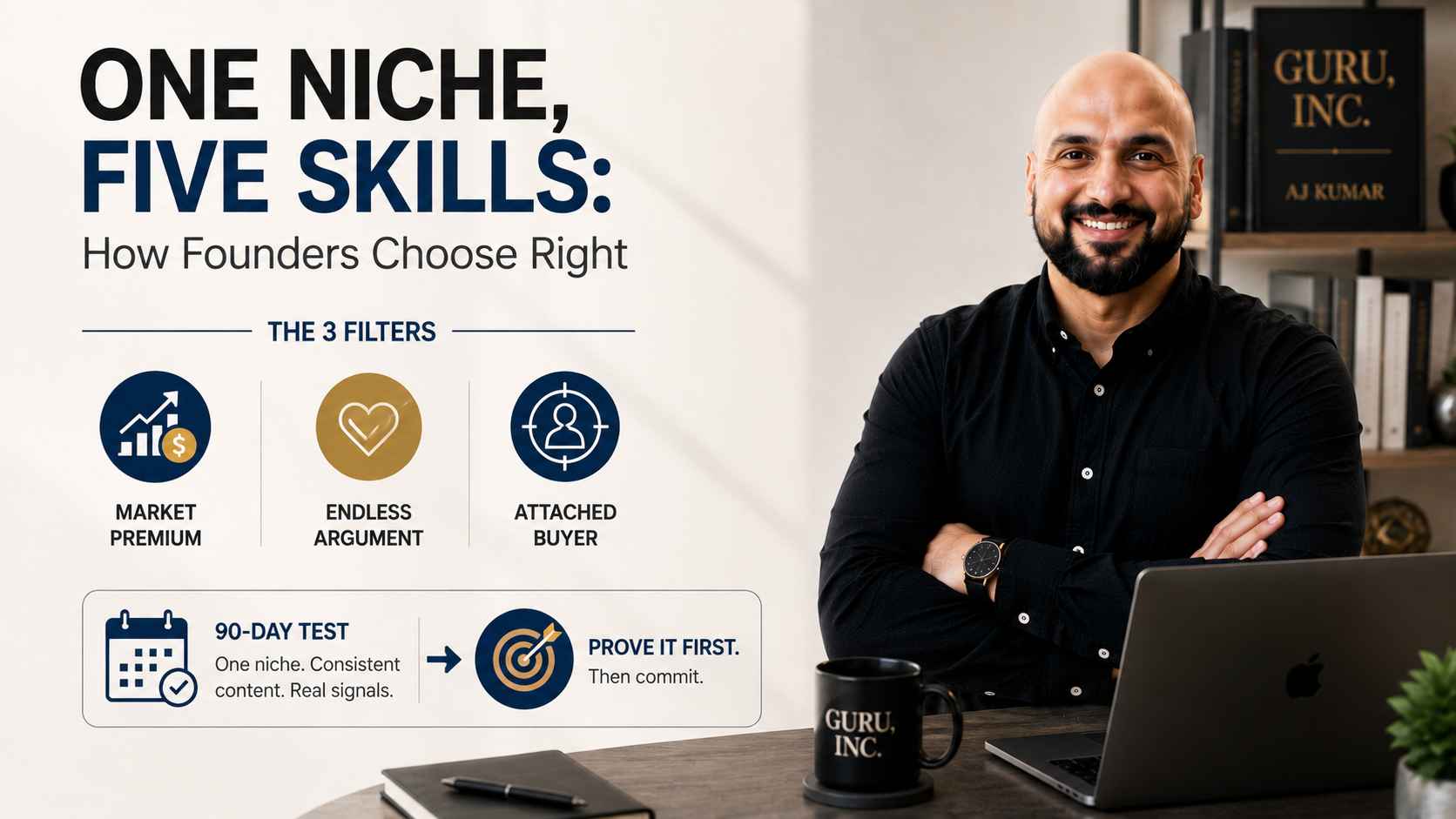

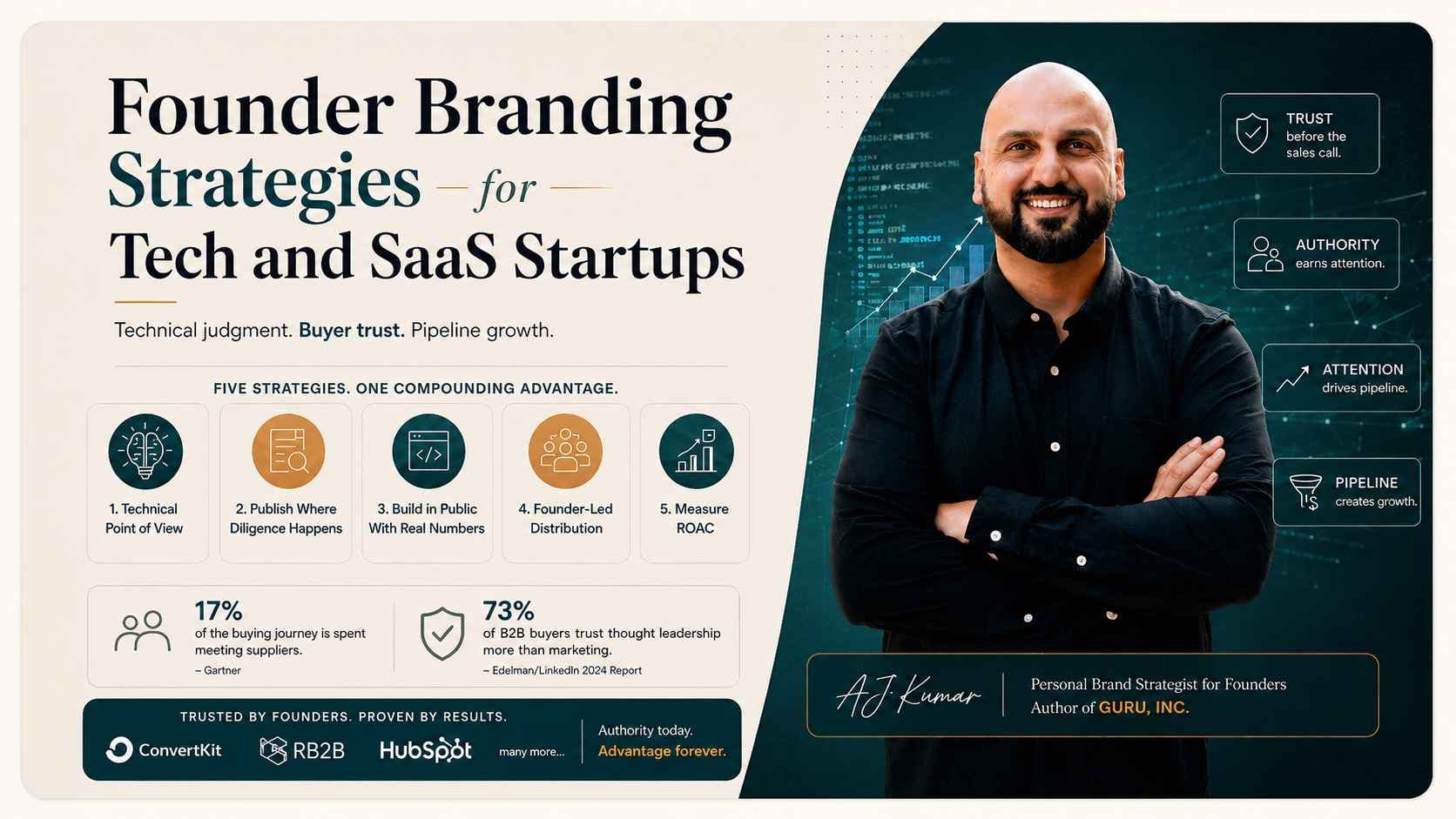
A SaaS founder brand answers that evaluation in advance. AJ Kumar, personal brand strategist for founders and author of GURU, INC., explains the five strategies, the founder-led growth connection, and the three objections technical founders raise.
Key Takeaways
Technical buyers evaluate vendors through self-directed research, and Gartner found buying groups spend roughly 17 percent of the purchase journey meeting potential suppliers.
The 2024 Edelman-LinkedIn B2B Thought Leadership Impact Report found 73 percent of B2B buyers consider thought leadership a more trustworthy basis for judging a company's competencies than traditional marketing materials.
Founder branding and founder-led growth describe the same motion at different depths: one builds the authority, the other harvests the pipeline.
Five strategies fit the vertical: a technical point of view, diligence-channel publishing, building in public, founder-led distribution for product-led motions, and ROAC measurement.
The three standard objections, no time, the product speaks for itself, and engineers distrust self-promotion, each fail against documented buyer behavior.
Authority-first beats volume-first in SaaS more decisively than in any other vertical, since technical audiences punish empty frequency fastest.
A Founder Brand Solves the Trust Problem Technical Buyers Have With Marketing

Technical buyers distrust marketing more than any other B2B audience, and a founder brand is the trust layer that survives their skepticism. Engineers, product leaders, and technical executives filter vendor claims by default.
The same buyers read a founder's technical writing, test the reasoning, and extend trust to the product behind it. The founder becomes the proof the marketing cannot be.
The buying research supports the mechanism. Gartner's research on B2B buying found that buying groups spend roughly 17 percent of the purchase journey meeting with potential suppliers.
The remaining evaluation happens away from sales: in search results, peer communities, and content. A SaaS vendor is being judged for months before the first call, and the founder's public record is the most human evidence available in that window.
Trust research points the same direction. The 2024 Edelman-LinkedIn B2B Thought Leadership Impact Report found 73 percent of B2B buyers consider thought leadership a more trustworthy basis for judging a company's competencies than traditional marketing materials.
A SaaS startup selling an intangible product to a skeptical committee holds exactly one asset that qualifies as thought leadership on day one: the founder's judgment, published.
I have watched technical founders treat that asset as optional while spending six figures on ads their buyers filter out. Most founders build this backwards.
Founder Branding and Founder-Led Growth Describe the Same Motion at Different Depths
Founder branding builds the authority asset, and founder-led growth is the pipeline motion that harvests it. The SaaS world runs on the second vocabulary. Founder-led content, a term popularized by Dave Gerhardt of Exit Five, describes founders producing the company's demand content personally.
Dark social, popularized by Chris Walker, describes the untrackable channels, private Slacks, group chats, and word of mouth, where B2B buying decisions actually form. Both terms describe distribution mechanics.
The mechanics fail without the asset underneath. Founder-led content from a founder with no positioning produces volume, not demand. Authority-first versus volume-first is the dividing line: the volume-first founder posts daily and compounds nothing, while the authority-first founder publishes a defensible point of view and lets dark social carry it.
Frequency is a multiplier on positioning. Multiplying zero produces zero, a math problem I have audited inside more SaaS content calendars than any other failure in twenty years.
The translation matters for a second reason. Founder-led growth language treats the founder brand as a channel. AJ Kumar treats the founder brand as architecture the channel runs on, which is why the strategies below start with positioning and end with measurement, not with a posting schedule.
Five Founder Branding Strategies for Tech and SaaS Startups
Five strategies convert a SaaS founder's technical judgment into commercial authority. The five founder branding strategies for tech and SaaS startups are given below:
Position on a Technical Point of View, Not a Product Pitch
A SaaS founder brand is built on a defensible market judgment, never on product features. Technical audiences reward founders who argue a position: why the category is broken, which architecture wins, what the incumbent gets wrong.
Founder-market fit is the credibility test buyers and investors apply silently, and a published point of view is its public evidence. A founder pitching features is a salesperson. A founder arguing a thesis is a source.
Publish Where Diligence Happens: LinkedIn, Search, and Long-Form
SaaS buyer diligence concentrates on LinkedIn, search results, developer communities, and long-form formats. Durable, searchable content outperforms short-form reach for a committee evaluating a vendor over months. A technical essay ranks and compounds.
A podcast appearance gets cited inside the buying committee. Channel selection follows the buyer's evaluation behavior, and three channels run with depth beat eight channels run on fumes.
Build in Public With Real Numbers
Building in public converts operating transparency into technical credibility. Public examples document the pattern; none of the founders named here are clients, and each publishes the results openly.
Nathan Barry built ConvertKit, now Kit, with public revenue reporting that made the company's growth its own marketing.
Adam Robinson of RB2B publicly attributes the majority of his pipeline to his own LinkedIn content and documents the numbers as he goes. Real numbers are the native language of a technical audience, and transparency is a moat competitors with weaker numbers refuse to copy.
Turn the Founder Into the Distribution Layer of a Product-Led Motion
Product-led growth acquires users, and founder trust converts the accounts the product alone stalls on. A self-serve product reaches individual users. The expansion deal, the security review, and the executive sponsor respond to human authority.
Dharmesh Shah, cofounder of HubSpot, demonstrates the ceiling of the model: one of the largest founder audiences in SaaS functioning as permanent, owned distribution for the company.
The founder brand is the demand engine the product motion plugs into, which is the argument investors underwrite when a founder brand attracts capital as a distribution advantage.
Measure Return on Attention, Not Vanity Metrics
Founder branding in SaaS is measured by ROAC, Return on Attention Created, because the buying journey hides from attribution software. Dark social breaks last-touch attribution by design: the buyer heard the founder on a podcast, discussed the tool in a private Slack, and arrived as a "direct" visit. Impressions and follower counts measure nothing a board cares about.
ROAC tracks what the attention produces: identity value, trust value, and revenue signed by accounts that self-reported the founder's content in the deal. Pipeline that names the founder is the metric. Applause is not.
The Three Objections SaaS Founders Raise, Answered

Three objections appear in nearly every conversation with a technical founder, and each one fails against documented buyer behavior. The three objections are given below:
No time. The objection assumes branding means content production. Positioning plus a capture system turns the founder's existing thinking, sales calls, product decisions, and technical arguments, into publishable material inside hours per week, a system covered in personal branding for founders with no time. Founders spend more weekly time on deals the brand fails to warm.
The product speaks for itself. Products speak only to users already inside them. Gartner's 17 percent figure describes a buying journey that happens before anyone touches the product. A silent founder concedes that entire window to competitors and to whatever the committee's Slack decides unsupervised.
Engineers distrust self-promotion. Correct, and the objection confuses promotion with judgment. Technical audiences punish hype and reward argued positions, working code, and real numbers. Authority-first content is the opposite of self-promotion. The founders technical communities respect most are the ones who publish the most substance.
Each objection protects a comfort, not a strategy. AJ Kumar hears all three from expertise-rich, visibility-poor founders whose pipelines already depend on referrals, which is the exact condition a founder brand exists to fix.
How SaaS Founders Fit the Brand Into the Company System
A SaaS founder brand runs as company infrastructure, not as the founder's side project. The build order is fixed. Positioning comes first: the technical thesis the founder is known for.
The capture and production system comes second, since content architecture for founders is what makes the motion survivable next to a founder's operating load. Distribution and measurement come third, on the diligence channels and the ROAC standard defined above.
The sequencing question is the only one left, and stage answers it. A pre-launch founder builds the thesis in public while building the product. A post-revenue founder earning $30K to $500K per month, growing on referrals while competitors out-publish them, holds the exact profile this system was built for.
Personal brand consulting for founders builds the positioning, the architecture, and the measurement as one engagement, and I built the practice for that founder specifically.
Founder branding for tech and SaaS startups converts technical judgment into buyer trust before the sales conversation exists. Technical buyers research in private, distrust marketing, and extend trust to founders whose thinking is public. Authority-first founders own that window. Volume-first founders decorate it.
What Is Founder-Led Content in SaaS
Founder-led content is demand content produced in the founder's own voice and name rather than the company's. The term, popularized by Dave Gerhardt, describes the distribution motion. The motion performs in proportion to the positioning underneath it.
Does Founder Branding Work for Developer Tools and Technical Products
Developer audiences reward founder branding built on substance: argued positions, working demonstrations, and real numbers. The same audiences punish hype fastest of any market. Technical founders hold a native advantage, since their judgment is the content.
Does a SaaS Founder Brand Belong to the Founder or the Company
The founder owns the brand, and the company rents its benefits: pipeline, talent gravity, and category association. Acquirers price that arrangement during diligence. Founders who document systems and named IP transfer more of the value than founders who remain the system.
How Long Before Founder Branding Affects SaaS Pipeline
Founder branding affects SaaS pipeline in quarters, matching the B2B buying cycle it operates inside. Buyers encounter the founder months before entering the funnel. Self-reported attribution, prospects naming the founder's content on sales calls, appears before dashboards register the source.
How Does Founder Branding Support SaaS Category Creation
Category creation demands a spokesperson who argues the category thesis repeatedly until the market adopts the language. A founder brand supplies that voice with more credibility than any company channel. The category and the founder authority compound together.