
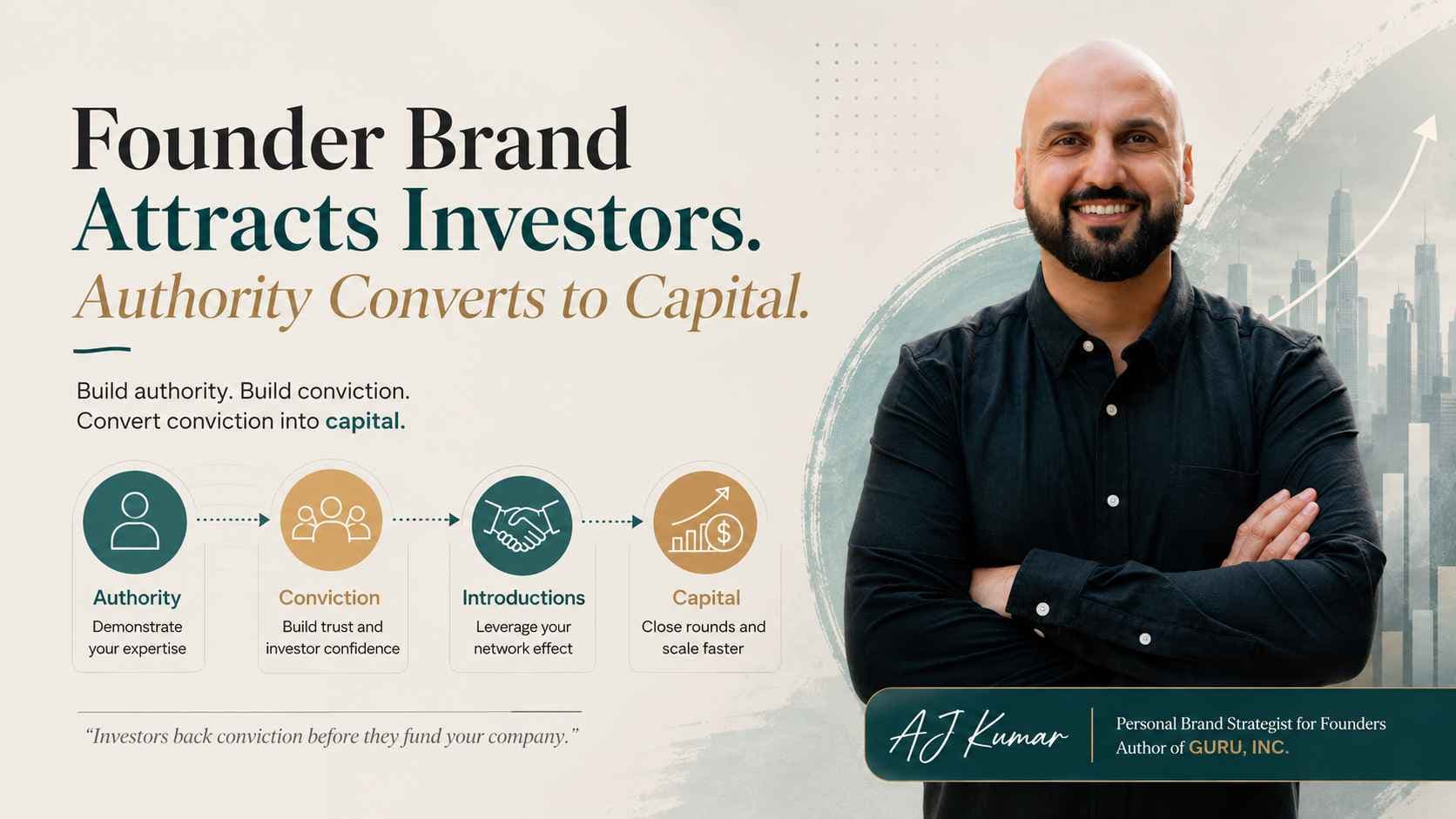
A founder's public authority is the only evidence of judgment an investor reads before a conversation exists. Authority converts to conviction, and conviction converts to capital. AJ Kumar, personal brand strategist for founders and author of GURU, INC., explains the mechanism and its limits.
Key Takeaways
Venture capitalists identify the founding team as the most important factor in investment decisions, ahead of product and market, per research published in the Journal of Financial Economics.
A founder brand functions as pre-loaded due diligence: public evidence of judgment, domain command, and consistency that investors read before any meeting.
Research from Wharton found that founder influence on Twitter correlated with meaningfully larger later funding rounds for consumer startups.
Investor trust responds to demonstrated thinking, not follower counts. Audience without substance registers as risk, not signal.
A distribution advantage built through founder content lowers customer acquisition costs, and investors underwrite that advantage directly.
Founders build the brand before the raise, since conviction assembled in advance beats persuasion attempted in the room.
Investors Underwrite the Founder Before the Business

Venture capitalists rank the founding team as the single most important factor in their investment decisions. Research by Paul Gompers, Steven Kaplan, and colleagues, published in the Journal of Financial Economics in 2020, surveyed more than 850 venture capitalists.
The management team ranked first in deal selection, ahead of the business model, the product, and the market. The finding holds across stages and sectors.
The implication reaches further than most founders realize. An investor deciding on the team is deciding on evidence of judgment, and early-stage companies offer almost no other evidence. Revenue is thin. The product changes quarterly. The team is the constant, and the founder is the team's public face.
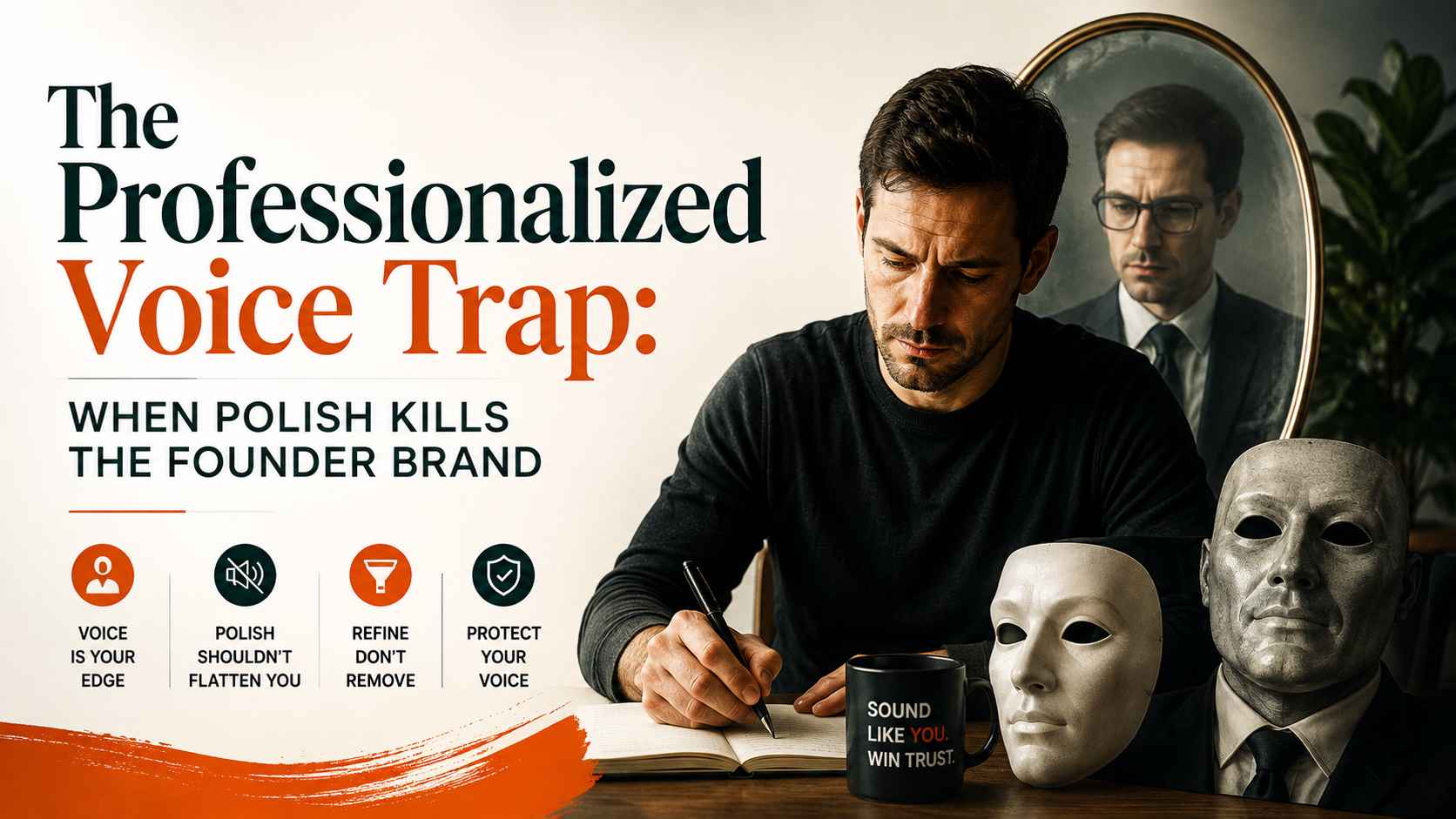
Most founders prepare for that evaluation backwards. They polish the deck for the meeting and leave the public record unmanaged. Investors read the public record first. I have watched founders lose conviction they never knew they were being measured for, in rooms they never entered.
Personal branding for executives covers how leaders build that public record deliberately; for a fundraising founder, the record is the pitch before the pitch.
A Founder Brand Works as Pre-Loaded Due Diligence
A founder brand is due diligence the investor performs without asking permission. An investor who encounters a founder searches the name, reads the writing, watches the interviews, and forms a judgment before replying to the introduction.
The founder's published thinking answers the diligence questions in advance: does this person understand the market, communicate with clarity, attract talent, and hold a defensible point of view. Authority answers those questions. Awareness does not.
The distinction matters because founders confuse the two constantly. Awareness is being seen. Authority is being trusted on a specific subject, and trust is the actual currency of a term sheet. A founder known for volume registers as noise.
A founder known for judgment registers as signal. The evidence supports the mechanism with numbers. A 2017 study by researchers at Wharton, published in Information Systems Research, examined consumer startups and found that founder influence on Twitter correlated with larger subsequent funding: high-influence founders raised meaningfully more in later rounds than comparable founders without that public presence.
Influence in the study meant engagement and network position, not raw follower count. The market prices demonstrated reach and demonstrated thinking, not vanity metrics.
Reputation carries measurable enterprise weight as well. Weber Shandwick's study The CEO Reputation Premium found that global executives attribute 44 percent of a company's market value to the reputation of its chief executive.
Public-company data, applied carefully: the number describes perception at scale, and the mechanism, leader reputation converting to enterprise value, starts operating at the seed stage.
Founder Authority Creates the Warm Introduction Economy
Warm introductions dominate venture deal flow because authority travels through networks before the founder does. Paul Graham's essays and Y Combinator's guidance describe fundraising as momentum-driven: investors move when other credible people already believe.
A founder brand manufactures that pre-existing belief at scale. Every published framework, every cited insight, and every conference conversation seeds the network with the founder's judgment.
A cold deck argues from zero. A warm introduction arrives with borrowed conviction, and a strong founder brand makes every introduction warmer, since the introducer points to a public record instead of a private opinion. The mechanism compounds.
A personal brand functions as a moat, and investors underwrite moats: a founder whose name pulls customers, talent, and press holds an advantage a competitor purchases only with capital.
Distribution is the second half of the same argument. Investors at firms like Andreessen Horowitz have argued publicly for years that distribution advantages decide crowded markets.
A founder running the Personal Media Company Model, programming owned content channels the way a media executive programs a network, walks into the meeting with acquisition costs a paid-only competitor never matches. The brand is not decoration on the business case. The brand is inside the business case.
Audience Without Substance Registers as Investor Risk

Investors discount founder audiences that lack operating substance behind them. The counter-case deserves honest weight. A large following built on hype creates key-person risk, concentration risk, and diligence doubt.
Regulators fined celebrity promoters over undisclosed crypto endorsements, and investors watched influencer-led ventures collapse when the audience proved rented rather than owned. A founder who spends product-building hours chasing virality signals misallocated attention, and sophisticated investors read the signal exactly that way.
The concession sharpens the rule rather than weakening it. Investor trust responds to authority, defined as demonstrated judgment on a specific subject, and punishes awareness manufactured without it. A founder brand built on the operating substance of the company passes diligence.
A founder brand built instead of the company fails it. AJ Kumar draws the same line for clients in every engagement: the brand amplifies proof, and the brand never replaces proof.
How Founders Build Investor-Ready Authority Before the Raise
Investor-ready authority is built before the raise, since conviction assembles slowly and pitches happen fast. The founder who starts publishing during the fundraise is visibly fundraising. The founder who published for two years prior owns a record no six-week sprint replicates. The sequence is the strategy.
The build order follows the same architecture I apply to every founder engagement. Positioning comes first: the specific market judgment this founder is known for, stated sharply enough that an investor repeats it.
Proof comes second: operating results, named insights, and documented thinking that anchor the position. Distribution comes third: consistent long-form content on owned and durable channels where diligence actually happens, which for investors means search results, LinkedIn, and long-form interviews far more than short-form reach.
The return extends past the round. The ROI of personal branding for founders compounds across customers, talent, and press, and the fundraise draws on the same asset. Capital is one more market where authority converts, and the conversion rate rewards founders who built early.
Founders preparing a raise treat the brand as part of the round's infrastructure, alongside the model and the data room. Personal brand consulting for founders builds that infrastructure: positioning, proof architecture, and the public record investors read first.
I built the practice for expertise-rich, visibility-poor founders, and a fundraising founder with that profile is leaving conviction on the table.
A founder brand attracts investors by answering diligence questions before the first meeting. Investors underwrite the team first, and a founder's public authority is the only pre-meeting evidence of judgment. Founders who build authority early convert it into conviction, introductions, and capital.
Do Investors Check a Founder's Online Presence Before Investing
Investors search a founder's name as informal diligence before and after the first meeting. Search results, published writing, interviews, and professional profiles form the pre-meeting evidence of judgment. The public record shapes conviction before any deck opens.
Does a Large Social Media Following Help a Founder Raise Capital
Follower count alone moves few investors. Wharton research found founder influence, measured through engagement and network position, correlated with larger funding rounds. Demonstrated judgment and reach convert to capital. Raw audience without operating substance registers as risk.
When Does a Founder Start Building a Brand Before Fundraising
Authority compounds over quarters, so the build starts at least a year before an intended raise. Positioning lands first, proof and content follow, and the public record matures while the company grows. A brand started mid-raise reads as fundraising theater.
Which Platforms Matter Most for Founder Authority With Investors
Investor diligence concentrates on search results, LinkedIn, long-form interviews, and podcasts. Durable, searchable, long-form content carries more diligence weight than short-form reach. A founder's owned channels and consistent professional record outrank viral moments in an investor evaluation.
Can a Founder Brand Replace Traction in a Fundraise
A founder brand amplifies traction and never replaces it. Investors underwrite operating substance: revenue, retention, and product progress. Authority lowers the cost of belief in real numbers. Authority attached to weak numbers accelerates the no.