

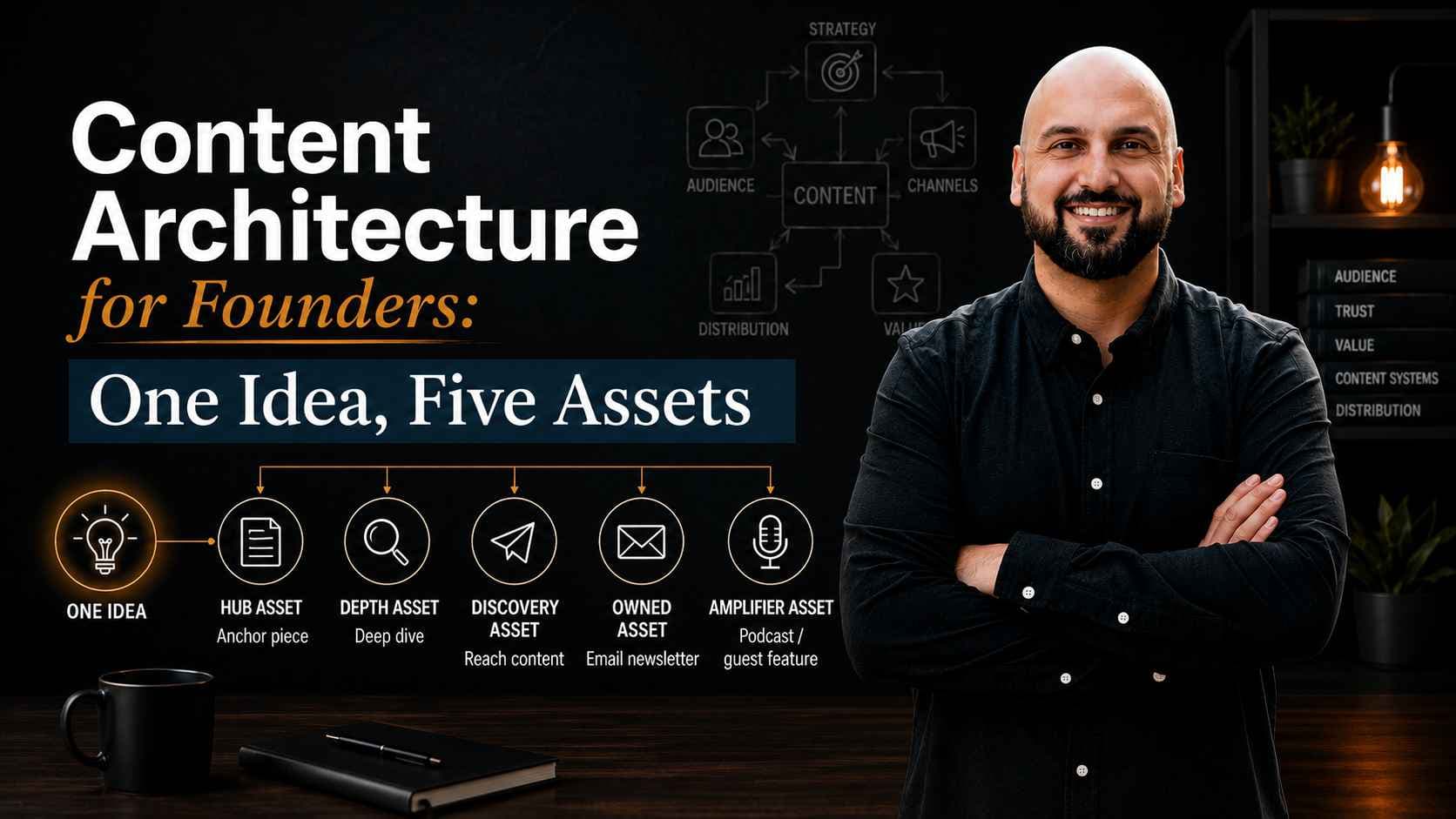
Content architecture for founders means designing one idea to become several assets by intent, not by salvage. The design happens before production, not after. This is the difference between an architect and a contractor.
An architect decides what the building carries before anyone pours concrete. A founder who architects content decides what one idea carries before anyone records, writes, or films. The result is leverage: one unit of thinking, five units of output, each with a job.
Key Takeaways
Content architecture is design, not repurposing. The structure comes first.
One strong idea is the load-bearing decision. A thin idea collapses under five assets.
Each asset serves a different job. Five disconnected posts are not architecture.
The five assets connect into a system. Each one points the audience toward the next.
Architecture produces leverage. The founder turns one idea into compounding output.
Repurposing reformats what already exists. Architecture engineers what gets built.
What Content Architecture Means for a Founder

Content architecture is the practice of designing one idea to become a structure of assets. For a founder, this means deciding in advance what one idea will produce. The design comes first. The production follows.
This term carries a second meaning in software and web design, where content architecture refers to content models, taxonomies, and headless systems. That meaning belongs to information architects and developers. The founder meaning is different.
Here, content architecture is the deliberate design of how one idea becomes many pieces of personal-brand content. The distinction matters because it sets the entire approach. An architect designs. A contractor builds to someone else's design. A founder who architects content makes the design decision first, then builds. The founder who skips the design produces volume and calls it a strategy.
Why Founders Architect Content Instead of Repurposing It
A founder architects content to design leverage in advance, not to salvage it afterward. This is the line that separates architecture from repurposing. Repurposing takes a finished piece and breaks it into smaller formats. Architecture starts with an idea engineered to become many things from the beginning.
The common advice tells founders to record one video, then cut it into clips, captions, and a newsletter. That advice describes salvage. It extracts value from something already made. The work is real, and the future has a place for it, but it is not architecture.
Architecture Is the Blueprint. Repurposing Is the Labor.
An architect decides the structure before construction begins. A contractor executes that structure. Most founders operate only as contractors. They produce a piece, then look for ways to reuse it. A founder who operates as an architect decides what one idea will carry, then produces each asset against that plan. The plan is the leverage. The reuse is just labor.
The One Idea Is the Load-Bearing Decision
A founder's content architecture begins with one idea strong enough to carry five assets. The idea selection is the architecture. Everything downstream depends on it. A thin idea produces five thin posts. A load-bearing idea produces five assets that each stand on their own.
I test an idea before I build on it. A load-bearing idea answers a real question the buyer carries. It holds a point of view a competitor cannot copy. It survives being told five different ways without thinning out. If the idea fails that test, no amount of production saves the assets built on top of it.
This is the part most content advice skips. The advice jumps straight to formats and tools. The architecture decision happens earlier, at the level of the idea itself. The method behind this idea-first design is documented in GURU, INC., where the structure of an authority idea gets defined before any distribution begins.
The Five Assets One Idea Becomes
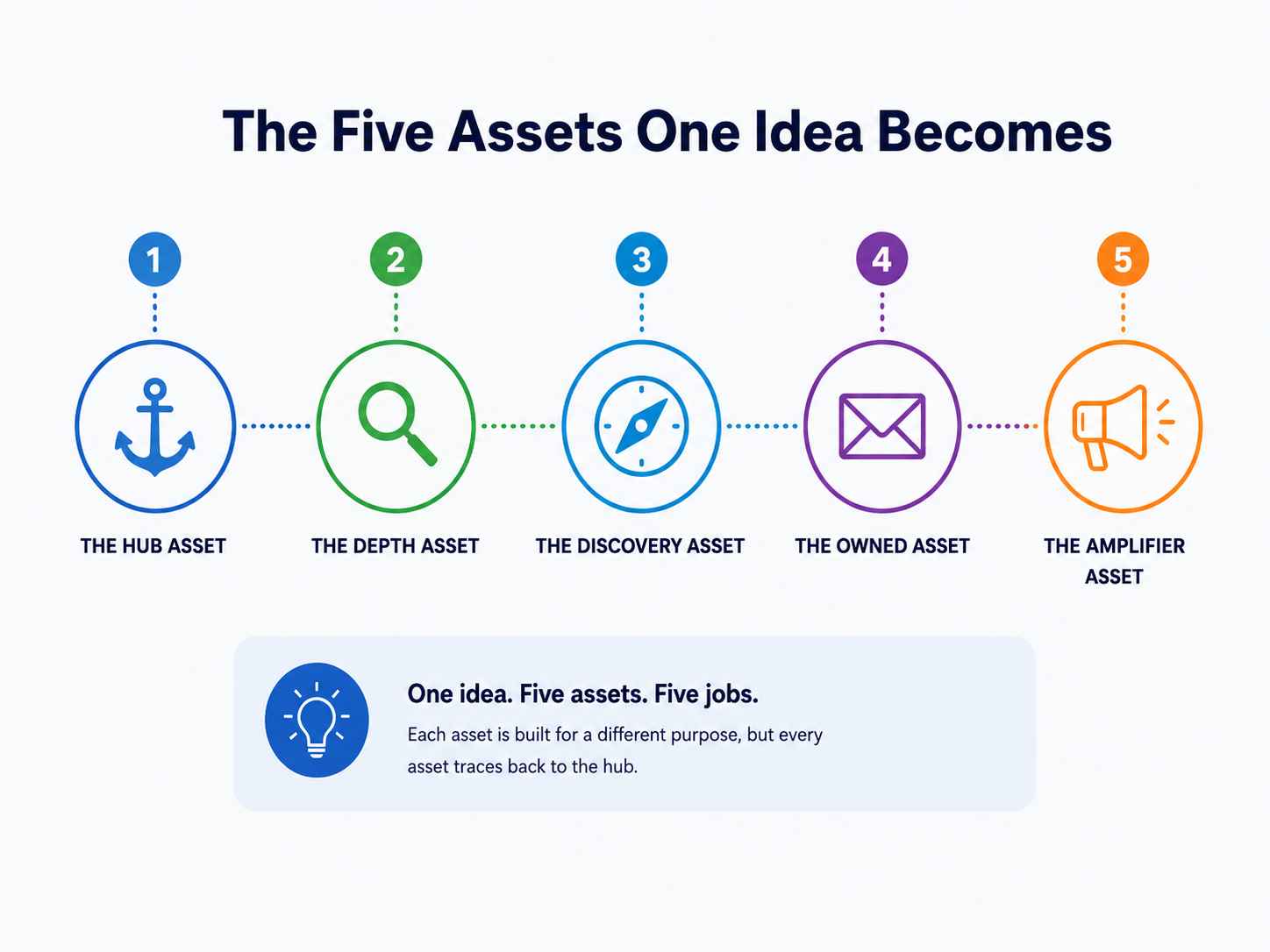
A founder's one idea becomes five assets, each built for a different job. The number is not the point. The structure is the point. Five disconnected posts are not architecture. Five assets designed to do five jobs are architecture. The five assets are given below.
The Hub Asset
The hub asset is the anchor the idea is built as first. This is the deep, long-form piece that holds the full idea in one place. Every other asset traces back to it. A founder builds the hub asset before anything else, because the rest of the structure depends on it.
The Depth Asset
The depth asset develops one part of the idea in detail. The hub holds the whole idea. The depth asset takes a single section and goes further than the hub had room for. This is where a founder proves the expertise the hub only claimed.
The Discovery Asset
The discovery asset carries the idea to people who have not found the founder yet. This is the piece built for reach, designed to be found by a new audience. The discovery asset earns attention and sends it back toward the hub.
The Owned Asset
The owned asset delivers the idea to the audience a founder already controls. This is the email or list-based piece that reaches subscribers directly, with no platform between the founder and the reader. The owned asset deepens trust with people who already chose to listen.
The Amplifier Asset
The amplifier asset is the version of the idea pitched to other channels and audiences. This is the piece shaped for a podcast, a guest feature, or a partner's platform. The amplifier asset carries the idea past the founder's own reach into someone else's.
The order is deliberate. The hub asset comes first, because the architecture decides which asset the others support. A founder who designs this structure once stops asking what to post next. The structure already answers it.
How the Five Assets Connect Into a System
A founder's five assets connect when each one points the audience toward the next. The connection is the architecture. The pieces alone are just content. The links between them are the system.
A pile of repurposed posts has no internal direction. Each piece sits on its own platform and ends there. A designed structure moves the audience. The discovery asset earns attention and sends it toward the hub. The hub builds depth and sends it toward the owned asset. Each handoff is planned. The founder designs the path, not just the stops.
This is why architecture beats volume. Volume produces more stops with no path between them. Architecture produces fewer pieces that pull in one direction.
Why Content Architecture Produces Leverage, Not Volume
A founder builds content architecture to turn one unit of thinking into five units of output. Leverage is the economic claim. The same input produces a multiplied return. Volume asks the founder to think five times. Architecture asks the founder to think once and build five times.
The founders who stall usually have volume and no architecture. They post daily, they stay busy, and the output does not compound, because nothing connects. The fix is rarely more content. The fix is a structure that makes the existing thinking carry more weight.
That structure is where clarity on the right next move begins, before the production load grows any heavier. Architecture is the design. A few questions decide whether the design holds.
Content Architecture Versus Content Repurposing
Content architecture and content repurposing solve different problems. Architecture designs the structure before production. Repurposing reformats content after production. One is the blueprint. The other is the renovation.
The order is the whole distinction. A founder who architects decides what one idea carries, then builds each asset to that decision. A founder who repurposes takes a finished asset and adapts it for another channel. Both have a place.
The architecture comes first, and the repurposing extends what the architecture already built. A founder who only repurposes is renovating a building no one designed.
How Content Architecture Compounds Into Revenue
Content architecture compounds into revenue because a connected system converts better than scattered posts. Five assets pulling in one direction move an audience toward a decision. Five disconnected posts move no one anywhere.
A founder who designs the structure builds a path from attention to trust to action. Attention without a path leaks. The architecture closes the leak. Each asset hands the audience to the next, and the final asset turns interest into a decision.
The work of designing that path is what lets a founder turn that attention into measurable revenue, rather than collecting reach that never converts.
Common Content Architecture Mistakes Founders Make
Founders make four predictable architecture mistakes. The mistakes are listed below. First, they start with a thin idea. A weak idea cannot carry five assets, and the structure sags. Second, they confuse architecture with repurposing.
They produce first and design never. Third, they chase volume. They measure output by count, not by connection. Fourth, they build five disconnected pieces. Five assets with no path between them are not a system, only a pile.
Each mistake traces back to the same root. The founder skipped the design. The architecture decision is the one most founders never make, and it is the one that separates leverage from grind.
Frequently Asked Questions
What is content architecture for founders?
Content architecture for founders is the practice of designing one idea to become a structure of content assets. This is the founder-content meaning, not the website information-architecture meaning used in software and web design.
What is the difference between content architecture and content repurposing?
Content architecture designs the structure before production. Content repurposing reformats content after production. Architecture is the blueprint. Repurposing is the renovation that comes later.
How do you turn one idea into multiple content assets?
A founder turns one idea into multiple assets by designing the idea to carry them from the start. The work happens at the idea stage, not by chopping a finished piece into fragments afterward.
How many assets should one idea become?
The structure decides the number, not a vanity count. A load-bearing idea supports the five connected assets in the architecture. A thin idea supports none, regardless of how many pieces a founder forces from it.
Does content architecture save time?
Yes. Content architecture removes the daily decision of what to post. The structure already answers it, so the founder spends time building the design instead of inventing the next piece.