
None of them supply the one thing that makes the output worth reading: a specific, repeated market position. Fix the format first, and a founder produces polished content about nothing in particular.
Key Takeaways
Hating writing is a real, common obstacle. It is rarely the actual barrier to authority.
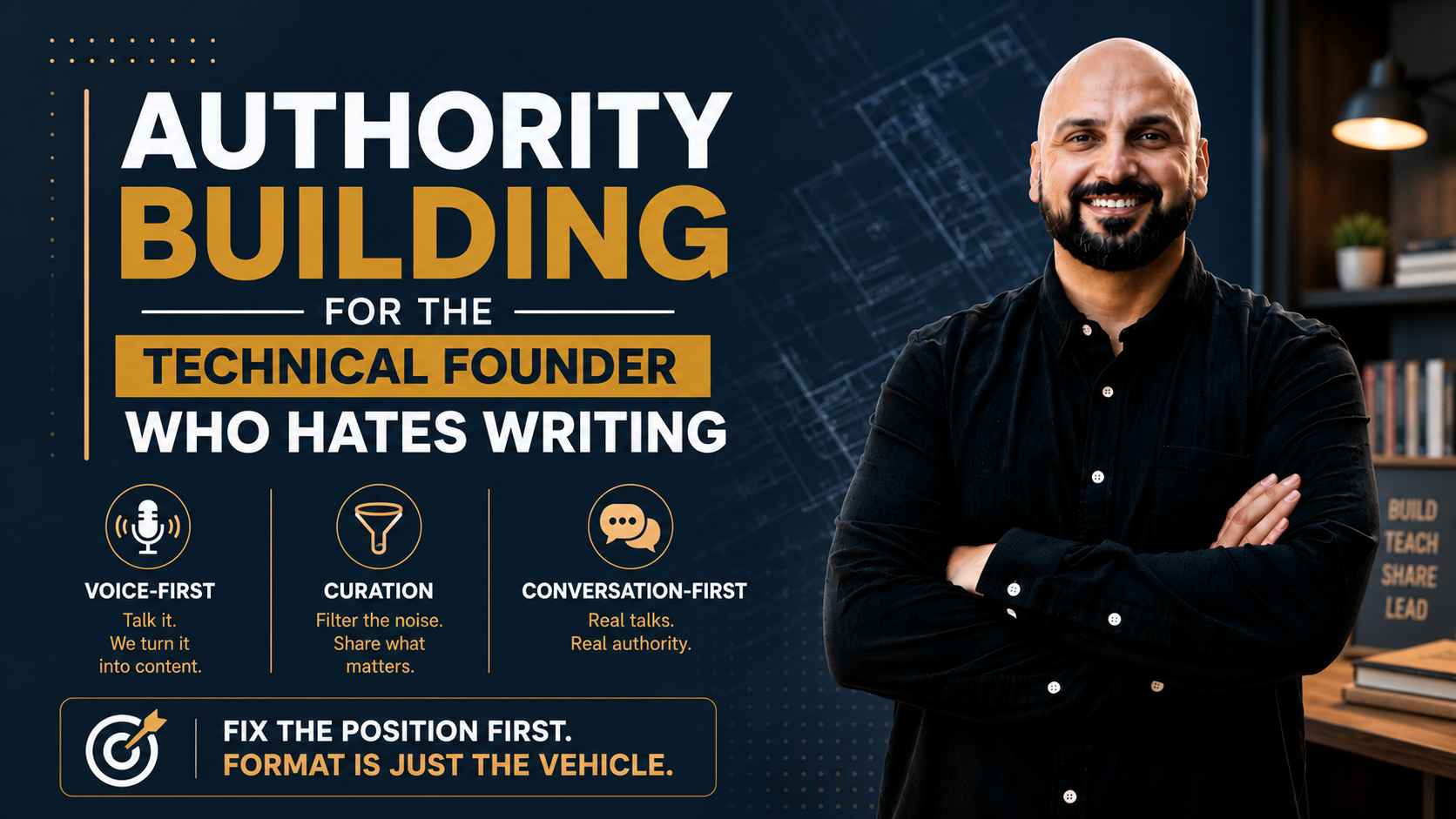
Three production paths remove the writing bottleneck entirely: voice-first, curation, and conversation-first.
Any of the three produces noise without a specific position behind it.
A ghostwriter captures voice. A ghostwriter cannot supply a position that does not exist yet.
The fix order matters: define the position first, then choose whichever format removes the most friction.
The Real Barrier Is Rarely the Writing Itself
Technical founders describe the same block in nearly identical words: no time, no patience for typing, nothing worth saying that has not been said. The complaint sounds like a writing problem. It usually hides a positioning problem instead.
A founder with a sharp, specific market position has an easy time producing content in any format, spoken, written, or filmed. A founder without one struggles regardless of format, because there is no repeated argument for the content to carry.
Authority in industries that distrust marketing covers the vocabulary problem technical founders face with peers. This is a different problem: the production problem, which format removes the friction, and the deeper question underneath it.
Three Production Paths That Skip Traditional Writing
Voice-First: Talk, Then Transcribe

A founder records a short voice memo answering one question or explaining one recent decision. Transcription tools turn the recording into rough text. A light edit shapes it into a post without erasing the founder's natural phrasing. This removes the blank page entirely, since the founder never faces one.
Curation: Become the Trusted Filter
A founder does not need to generate original essays to build authority. Filtering the noise, a new research paper, a regulatory change, a technical debate, and explaining in two sentences why it matters to a specific audience is a legitimate authority format on its own. The founder becomes the filter a busy audience trusts, without writing a single long-form piece.
Conversation-First: Podcasts and Interviews
Talking out loud, with someone else asking the questions, bypasses the writing problem completely. A twenty-minute podcast guest appearance lets a founder articulate a real worldview while someone else handles distribution and editing. The founder speaks. The format does the rest.
Format Without Position Produces Polished Noise
Every one of the three paths above solves the same surface problem: getting words out without traditional writing. None of them solve a different problem entirely: what the words are for. A ghostwriter captures a founder's authentic voice, and authentic voice attached to no specific argument produces content that sounds real and says nothing memorable.
This is the volume-first trap wearing a new outfit. Authority-first content argues one repeated position through whatever format carries it best. Volume-first content, however well produced, however authentic the voice, chases output with nothing underneath. A voice memo about a random technical decision is not the same as a voice memo about the one technical decision that proves the founder's actual point of view.
The One Filter Before Choosing a Format

Before picking voice, curation, or conversation, a founder answers one question: what is the one specific thing I want to be known for. Not a broad category like engineering or SaaS. A specific, arguable position: a stance on solving one category of technical problem, stated clearly enough that peers could repeat it back.
Once that position exists, the format choice becomes simple. Pick whichever removes the most friction, voice for founders who think out loud, curation for founders who read constantly and have opinions about what they read, conversation for founders who do their best thinking with another person in the room. The format is a delivery mechanism. The position is the actual content.
Matching Format to Friction
Production path | Removes | Requires |
Voice-first | The blank page | A position worth talking about on record |
Curation | Original long-form writing | A specific audience and a real point of view on what matters |
Conversation-first | Solo production entirely | A clear worldview to articulate when asked |
Each path fails the same way without the shared requirement: a position. Voice-first without one produces rambling audio. Curation without one produces a link aggregator. Conversation-first without one produces a guest who agrees with everything the host suggests.
Building the Position Before the Production System
A technical founder rarely lacks expertise. What is often missing is the translation from deep technical knowledge into one repeatable, quotable stance. That translation work, defining the position clearly enough that any format can carry it, is where personal brand consulting for founders starts before any production system gets chosen.
A technical founder who hates writing has real, legitimate options: voice, curation, conversation. None of them replace the requirement underneath all three. Define the position first. Choose the format that removes the most friction second. Authority follows the position, not the production method.
Can a Ghostwriter Fix a Technical Founder's Content Problem
A ghostwriter captures voice and removes the writing burden. A ghostwriter cannot invent a position that does not exist. Founders who bring a clear stance to a ghostwriter get strong content. Founders who bring only their expertise often get polished content with nothing memorable inside it.
Is Voice-to-Text Content as Effective as Written Content
Yes, when the underlying position is specific. Transcribed voice memos carry a founder's natural phrasing, which often reads more authentic than heavily edited prose. The format matters less than whether the recording argues something specific.
Do Technical Founders Need to Post Daily to Build Authority
No. One consistent, position-driven piece per week outperforms daily posting with no repeated argument behind it. Frequency matters far less than whether every piece deposits into the same recognizable stance.
What Should a Technical Founder Post About First
The founder's strongest, most specific opinion on solving their category of technical problem. A concrete stance, stated plainly, gives every future format, voice, curation, or conversation, something worth carrying.