
Founder-led content is the only motion that generates original signal. The other three amplify, institutionalize, or echo what the founder produces. This guide explains how to choose.
Key Takeaways
The four content motions (founder-led, team-led, brand-led, community-led) are not equal options. They are four layers of one system.
Only founder-led content generates original signal: the recognition, trust, and POV a market attaches to a face.
Team-led, brand-led, and community-led content are amplifiers. Without a founder source, they produce volume without authority.
Alex Hormozi sold 2.9 million copies of $100M Money Models in 24 hours through founder-led signal alone.
Most company pages get a fraction of the engagement founder accounts get because there is no face for the audience to attach to.
Community-led content is not a strategy you pick. It is the result of the first three layers being executed well.
The Four Ways a Company Can Publish Content
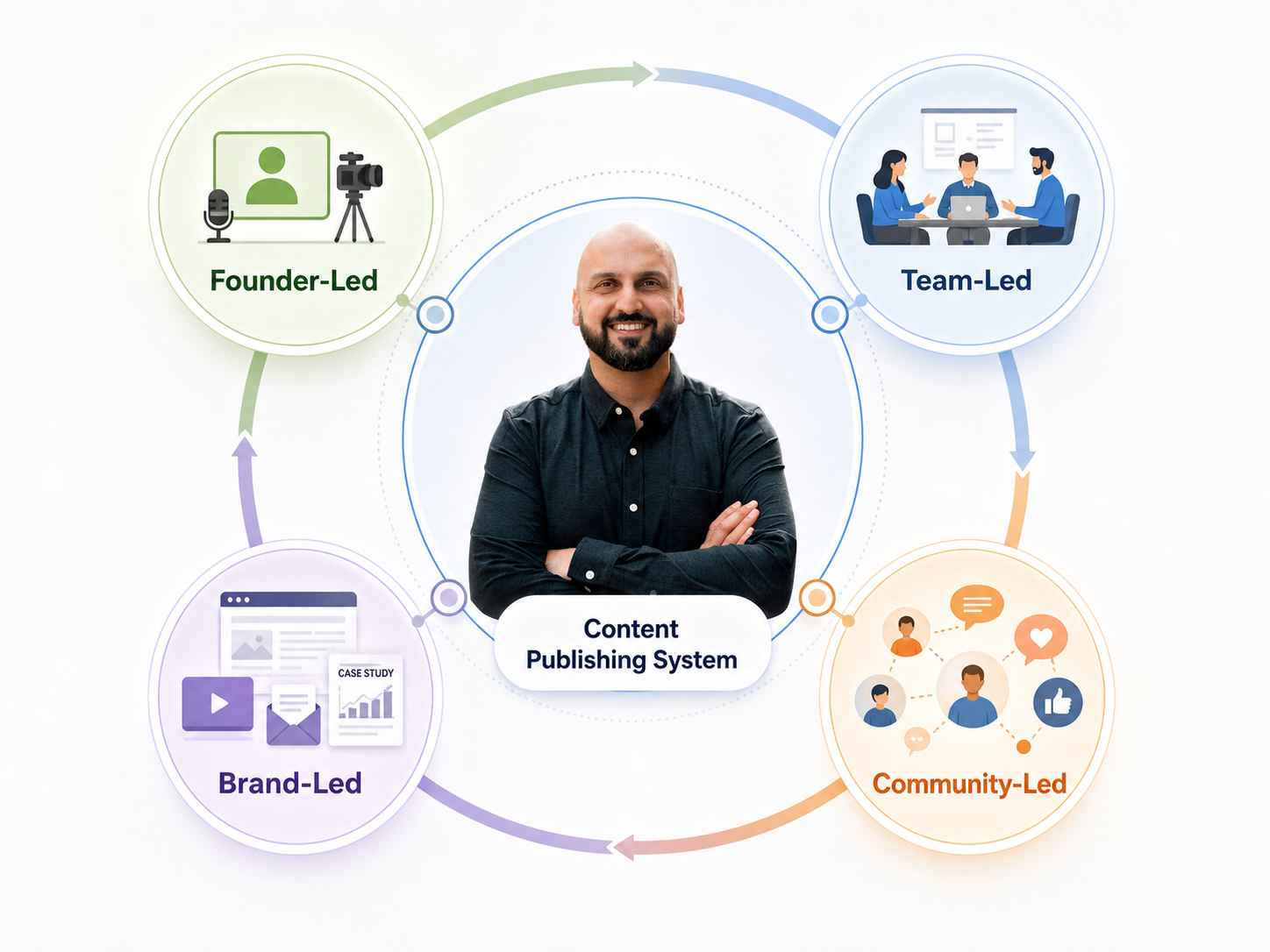
There are four ways a company can publish content. The founder publishes it. The team publishes it. The brand publishes it. The community publishes it. That is the entire taxonomy.
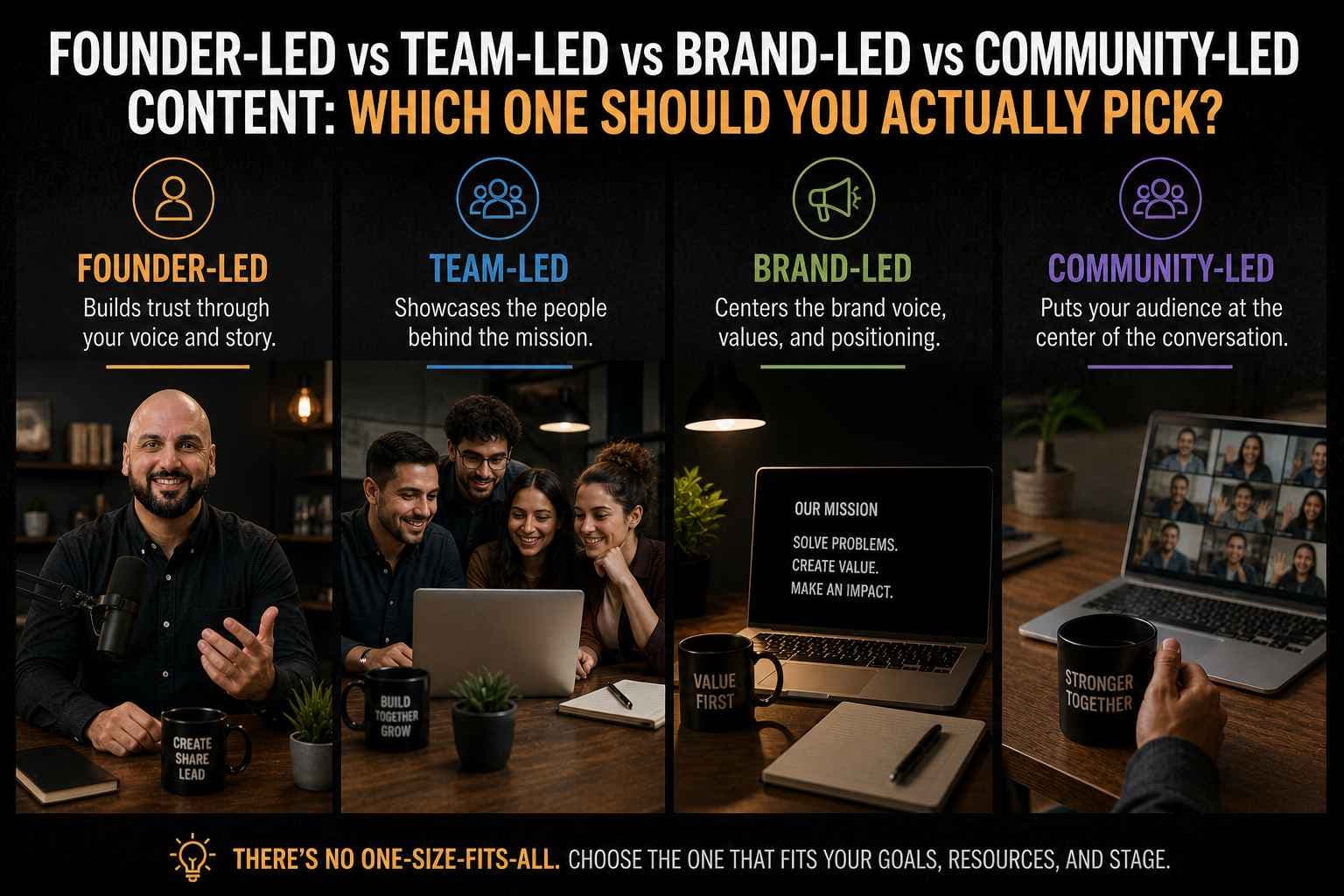
Founder-led means one person carries the voice of the company. Their face. Their POV. Their reputation moves the audience.
Team-led means five or more people inside the company publish across platforms. The output looks like a network. A content factory.
Brand-led means the company itself speaks, through company pages, newsletters, case studies, and videos that carry no individual face.
Community-led means your users publish on your behalf, voluntarily, because the product or idea is worth talking about.
Most strategy advice presents these as four equal options. Pick the one that fits your team, your budget, your stage. Choose wisely.
That advice is wrong. They are not four equal options. They are four layers of a single system, and only one of them generates original signal.
I will walk through each. Then I will explain how to choose.
Founder-Led Content Is the Only Motion That Generates Original Signal
The founder-led motion produces something the other three cannot: original signal.
Original signal is recognition, trust, and a point of view a market can attach to a face. The brain is built to track faces and voices. It is not built to track logos. When a founder shows up consistently with a clear POV, the audience builds a relationship with that person. That relationship transfers to the company. Not the other way around.
Alex Hormozi proves this at scale. He sold 2.9 million copies of $100M Money Models in 24 hours and set a Guinness World Record. The book launched on his face, his frameworks, his voice. Acquisition.com, the holding company behind him, did not sell those copies. Hormozi did. Everything else amplified it. I broke the full mechanic down in my analysis of the Hormozi acquisition empire.
This is the core mechanic. The founder is the only one of the four layers that creates new signal. The other three move signal that already exists.
If your founder is not visible, your content motion has no source.
Team-Led Content Is the Amplification Layer

Team-led content is what happens when five or more people inside the company publish to extend the founder's reach.
Each team member takes a slice of the territory. The product marketer publishes case studies. The head of growth publishes tactical posts. The engineer publishes technical breakdowns. The salesperson publishes industry observations. The output looks like a network with multiple voices reinforcing one POV.
Team-led works only when there is something to amplify. The founder's POV is the gravitational center. The team posts orbit around it, expanding the surface area without changing the core argument.
The bottleneck is not creativity. The bottleneck is editorial alignment. Every team member needs to know the central thesis, the language, and the frameworks. Without that alignment, team-led content fragments. You get five voices that sound like five different companies.
Companies that try to skip the founder layer and start with team-led content end up here. The team posts get published. The metrics look fine. But nothing compounds because there is no centralized signal for the audience to attach to. Volume rises. Authority does not.
Brand-Led Content Is the Institutionalization Layer
Brand-led content is what the company publishes in its own voice, through company pages, newsletters, case studies, blog posts, and videos that carry no individual face.
This is the layer that makes the company's voice feel official. It records what the founder and team have already said. It packages frameworks into ebooks. It turns customer conversations into case studies. It is documentation, not generation.
Brand-led content faces one structural problem. People do not form relationships with companies. They form relationships with people. A company page does not have a face. It does not have a voice. It has a logo and a publishing schedule.
That is why most company pages get a fraction of the engagement that founder accounts get. The audience scrolls past because there is nothing for the brain to attach to. No face. No voice. No POV. The brand needs the founder above it to give it reason to exist. I argue this point in my piece on why brand is the only real moat.
Brand-led content is necessary at scale. Enterprise buyers expect documentation. Auditors expect records. Search engines reward consistent publishing. But brand-led content is not the source of authority. It is the archive of authority created elsewhere.
Community-Led Content Is Not a Strategy You Pick. It Is a Result.
Community-led content is what happens when your users publish on your behalf without being paid to do it.
Most strategy guides list this as the fourth option you can choose. Pick community-led if your product is good enough, or your community is engaged enough, or your network effects are strong enough. The framing makes it sound like a choice.
It is not a choice. Community-led content is a downstream effect of the first three layers being executed well. Users do not generate content for you because you decided to make community-led your strategy. They do it because your founder said something worth quoting, your team built something worth showing, and your brand made something worth referencing.
When the upstream layers are weak, community-led content does not appear. Telling users to post on your behalf does not produce posts. Building a Slack community does not produce content. Running a referral program does not produce content. Those tactics produce activity, not signal.
If your community is not creating content about you on its own, the answer is not better community management. The answer is upstream. You have a founder signal problem.
Which One Should You Pick? Here Is the Decision

The question is not which of the four to pick. The question is in what order to build them.
Start with founder-led. Always. Even if your founder is reluctant. Even if your founder thinks they are not interesting. Even if your founder has imposter syndrome. The founder is the only layer that can create original signal, and the other three layers cannot function without it.
Add team-led second, after the founder has clarity on POV, language, and frameworks. Without that clarity, the team has nothing to align around and the content fragments into noise.
Add brand-led third, after the team is producing reliably. Brand-led content needs source material to package. If the team and founder are not producing, the brand pages produce filler. Filler does not rank, does not resonate, and does not get cited.
Community-led shows up on its own when the first three layers compound. You do not pick it. You earn it.
If you are picking only one because resources are limited, pick founder-led. It is the only one of the four that works without the others.
The Sequence That Works: Founder First, Then Stack
The four motions stack in one direction.
Founder generates signal. Team amplifies it. Brand institutionalizes it. Community echoes it. That sequence is not a preference. It is a requirement. Each layer depends on the layer above it.
I write about this in GURU, INC. through a model I call the Personal Media Company. The model breaks a founder business into five components: programming, distribution, monetization, operations, and measurement. The founder sits at the top of programming. Everything else, including team content and brand pages and community engagement, executes against what the founder produces.
Joel Osteen runs this exact sequence. One sermon per week, delivered live to a 45,000 person venue at Lakewood Church. That sermon becomes the source content for everything else: TV broadcasts, podcasts, social clips, books, courses. The team amplifies it. The brand institutionalizes it. The community quotes it. One source feeds an entire media operation. I broke this down in the Joel Osteen content system.
The founder is the source. The other three are downstream. Build the source first.
The Mistake That Kills Company Content at Scale
The most expensive mistake at the enterprise level is over-corporatization.
As companies grow, the instinct is to make the content more polished, more institutional, more "on brand." Founders pull back from posting because it feels unprofessional. Marketing teams take over. The founder becomes a quarterly all-hands speaker instead of a daily voice. The brand pages publish. The team factory hums. Volume rises. Engagement collapses.
The diagnosis is not bad copywriting or weak distribution. The diagnosis is missing signal at the top of the stack. The founder went silent. The amplification layers kept running, but with nothing to amplify.
Founder-led companies should not evolve from human to corporate. They should evolve from expressive to intentional. The founder gets sharper, more strategic, more deliberate about what they say, but they do not stop saying it. The voice gets refined, not removed. This is the core argument running through everything I publish on personal brand authority.
Pick founder-led first. Stack the rest behind it. That is the order that compounds.
Frequently Asked Questions
What is the difference between founder-led and team-led content?
Founder-led content comes from one person whose face, voice, and POV represent the company. Team-led content comes from five or more employees publishing across platforms to extend reach. The founder generates the signal. The team amplifies it.
Can a B2B company succeed with brand-led content alone?
A company can publish brand-led content without a founder voice and still get search traffic. It will struggle to build authority that compounds. Buyers form relationships with people, not logos, so brand pages without founder signal underperform on every engagement metric.
How often does the founder need to post for founder-led content to work?
Three to five times per week on the primary platform is the working baseline. The cadence matters less than the consistency of POV. Reliable publishing of one clear thesis beats high-frequency publishing of unfocused thoughts.
What if my founder hates being on camera?
Start with written content and audio formats. Newsletter, LinkedIn posts, podcast appearances. Many founders ease into video after their written voice is established. The face matters, but it is not the only entry point.
Is community-led content the same as employee advocacy?
No. Employee advocacy is paid or incentivized internal participation, which is closer to a hybrid of team-led and brand-led. Community-led content comes from external users who post about you because they want to, not because you asked them to.
How do I know if my founder-led content is working?
Track three signals: inbound conversations that reference specific posts, search demand for the founder's name climbing over time, and team alignment around shared language and frameworks. Revenue is the lagging indicator. Conversation density is the leading one.