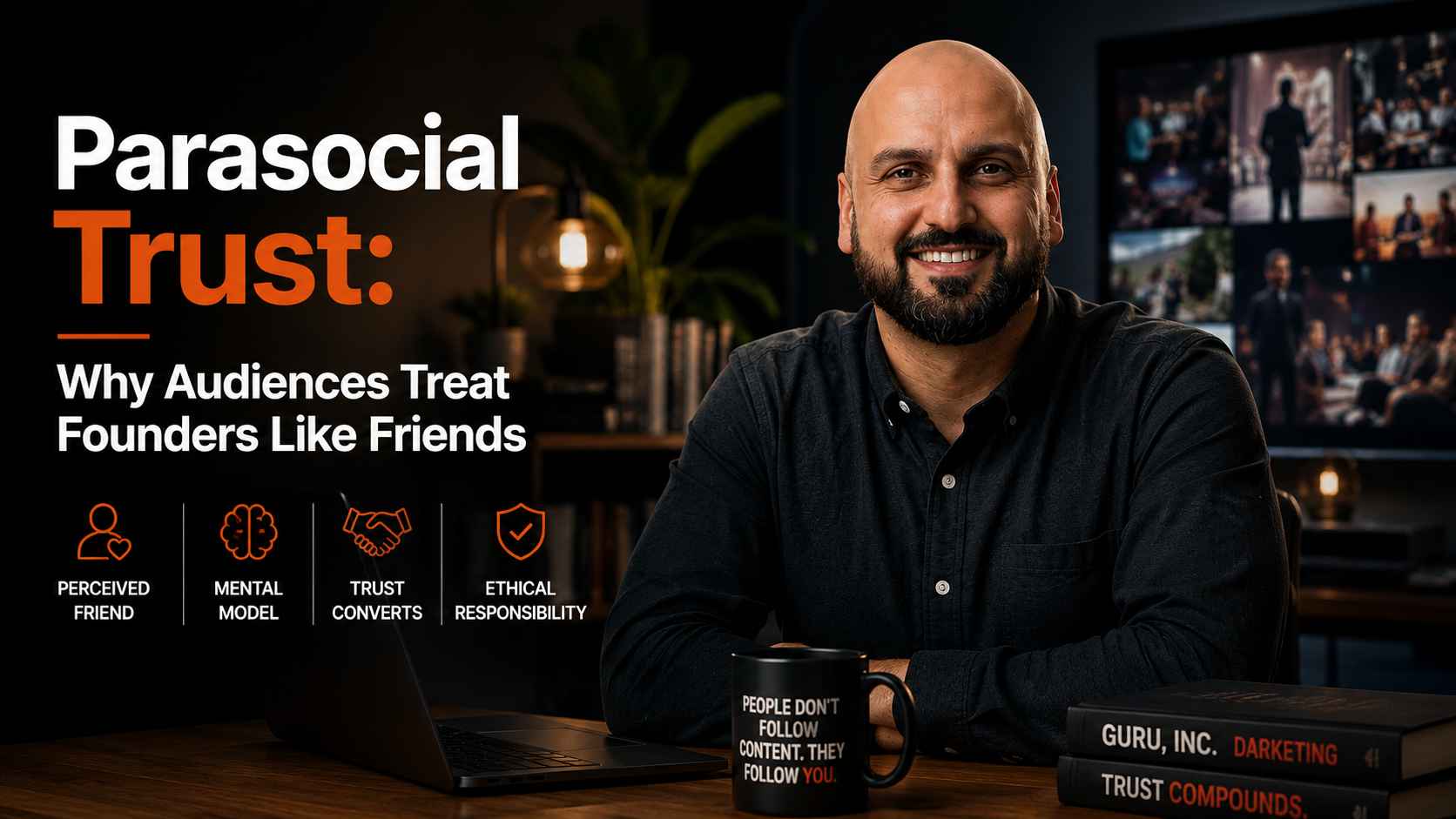

The audience wants to recognize itself in past-you and see a path to where you are now. This guide breaks down the Mirror Test. Three checks (Mirror, Move, Map) turn a chronological backstory into the trust-building front door of a founder's personal media company.
Key Takeaways
The origin story is the front door of your personal media company, not the trophy case in the lobby.
Most founder origin stories fail at the first job: making the audience recognize itself in past-you.
The Mirror Test runs three checks before you write a word: Mirror, Move, Map.
Specificity is the price of identification. Vague pasts trigger nothing. Ugly specifics build trust.
Audiences do not want to admire founders. They want to recognize themselves and see a path forward.
At scale, founders should evolve their origin story from expressive to intentional, not from human to corporate.
The origin story is the front door, not the trophy case.
Every founder gets one shot at their origin story. Most spend it wrong.
The instinct is to walk the audience through a chronological list of accomplishments. The childhood. The struggle. The big break. The wins. By the time the story ends, the audience has met the founder and applauded politely. That is the trophy case approach. It earns admiration and nothing else.
The origin story is not the trophy case. It is the front door of your personal media company. The first room a stranger walks into. What they feel inside that room decides if they stay long enough to buy anything.
I write about this in GURU, INC. through a framework I call ROAC. ROAC stands for Return on Attention Created. It tracks attention through four neurological gates: Register, Retention, Resonate, Reinforce. Origin stories live or die at the Resonate gate. That is the gate where the brain decides, "This person is one of mine."
Trophy cases get registered. They do not resonate.
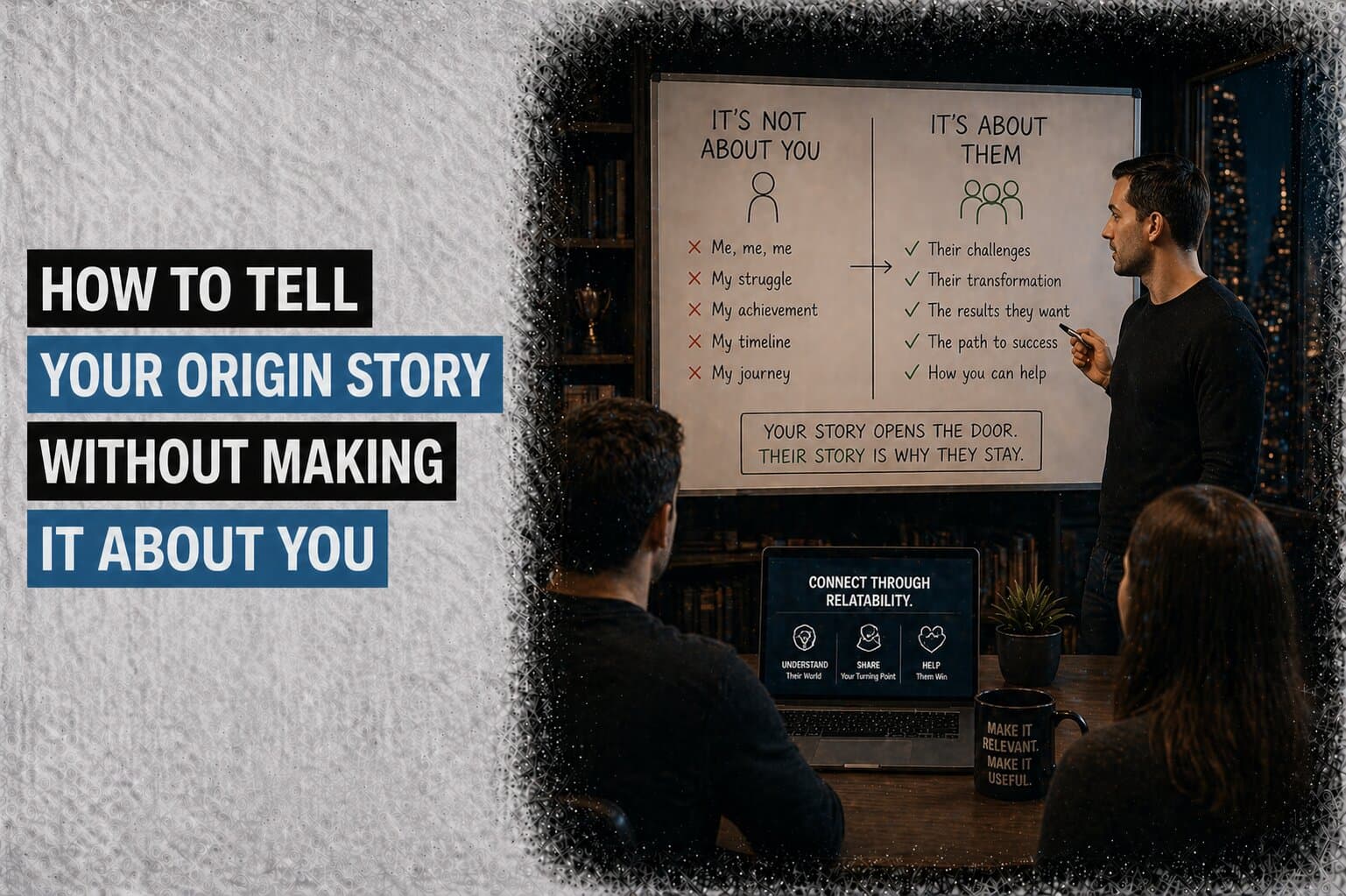
Founders break it by making themselves the hero.
The hero of your origin story is not you. It is the version of you that looks exactly like the audience right now.
Most founders skip this step. They tell the story chronologically with themselves at the center. The audience watches from outside the frame. Nothing fires. The brain is built to pattern-match against the self. If the story does not contain a self-shaped slot for the listener to step into, the story does nothing.
Donald Miller built an entire framework around this in Building a StoryBrand. His thesis is simple: brands fail when they cast themselves as the hero of their own story. The customer is the hero. The brand is the guide. Founders make the same mistake with their origin story.
They cast themselves as the protagonist of their own backstory and wonder why nobody connects. The fix is to demote yourself to guide. The audience is the hero, even in the story about your past.
Look at how Alex Hormozi opens. He does not lead with Acquisition.com or the 2.9 million copies of $100M Money Models he moved in 24 hours. He leads with sleeping in a gym, broke, after walking away from a corporate job. The job his parents wanted him to keep.
That past-Hormozi is the slot. It fits every founder who has felt the gravity of safety they need to walk away from. I break this same pattern down in my post on the Hormozi acquisition empire.
Audiences do not want to admire you. They want to recognize themselves in you. Admiration creates distance. Recognition creates trust.
The Mirror Test runs three checks before you write a word.

Every origin story must pass three checks to function as a mirror.
The Mirror Test is the first thing I run when a founder hands me a draft. It is a heuristic, not a hierarchy. All three checks need to fire for the story to work.
The three checks are:
Mirror. Does past-you look like current-them?
Move. What specific shift did you make?
Map. What path can they trace from where you started to where you are now?
If a story fails Mirror, it reads as a flex. If it fails Move, it reads as vague inspiration. If it fails Map, it reads as a closed door. The reader watches and applauds, then leaves.
When all three fire, the story builds personal brand authority the way nothing else can. The audience identifies with past-you, watches you cross, and sees the path forward. That sequence is the entire job.
Mirror: past-you must look like current-them.
The first job of an origin story is recognition. The reader must see themselves in your past, not in your present.
This is where most founders drift. They describe their past in vague terms ("I was struggling"). Vague pasts trigger nothing. The brain does not pattern-match on abstractions. It pattern-matches on specifics. I cover the neuroscience side of this in the biology of brand building.
Specificity is the price of identification. Name the apartment. Name the job. Name the feeling. The more uncomfortable and unflattering the detail, the stronger the mirror.
Warren Phillips, the founder of NonToxicDad, did not start with "I cared about my family's health." He started with the specific moment one of his children got sick and he could not figure out why. Every parent who has felt that helplessness recognized themselves in past-Warren before he ever taught them anything.
The recognition came first. Then came the audience. He is now over 1 million followers and 30 million monthly views. The mirror is the audience standing across from you, looking at the version of you they are right now.
Move: name the specific shift you made.

The Move is the moment your past-self stopped looking like the audience.
Most founders skip the Move or rush it. They jump from struggle to success in a single sentence. The audience does not learn anything because nothing was earned. A vague Move makes the founder seem either lucky or hidden, and neither one is teachable.
The Move is the part you have earned the right to teach. It is a decision, a reframe, a system, a piece of advice that broke the pattern. Name it. Be specific. Show the mechanism, not the outcome.
I built Kimberly Snyder's brand from a $500-per-hour nutritionist serving celebrity kitchens into a multi-million dollar authority brand. We hit 16 million unique visitors and 150,000 email subscribers. The Move was not "she got famous."
The Move was the decision to stop trading hours for celebrity meals. She packaged her expertise as a personal media company. That is teachable. The growth chart is not. If you cannot describe your Move in one sentence, the audience will not remember it.
Map: turn your past into their path.
The Map is the bridge from your past to their future.
Without a Map, the origin story closes. The audience watches you cross to the other side and stay there. They are still on their side. The story becomes a wall, not a door. They feel inspired for thirty seconds, then nothing changes.
The Map does not have to be a how-to guide. It has to imply a sequence. "From where I was, the way out was X. From where you are, the way out is X applied to your situation."
Joel Osteen, who fills a 45,000-person venue every week for thirty-minute sermons, structures his origin story this way. He talks about his father's death and the weeks he spent terrified to step on stage. The Map is implicit: faith, repetition, showing up before he felt ready.
Every member of the audience can see themselves walking that same path on a smaller scale. I unpack the format mechanics in my post on the Joel Osteen content system. A great Map makes the audience feel the path is shorter than they thought, not longer.
The corporate origin story is why founders lose authority at scale.

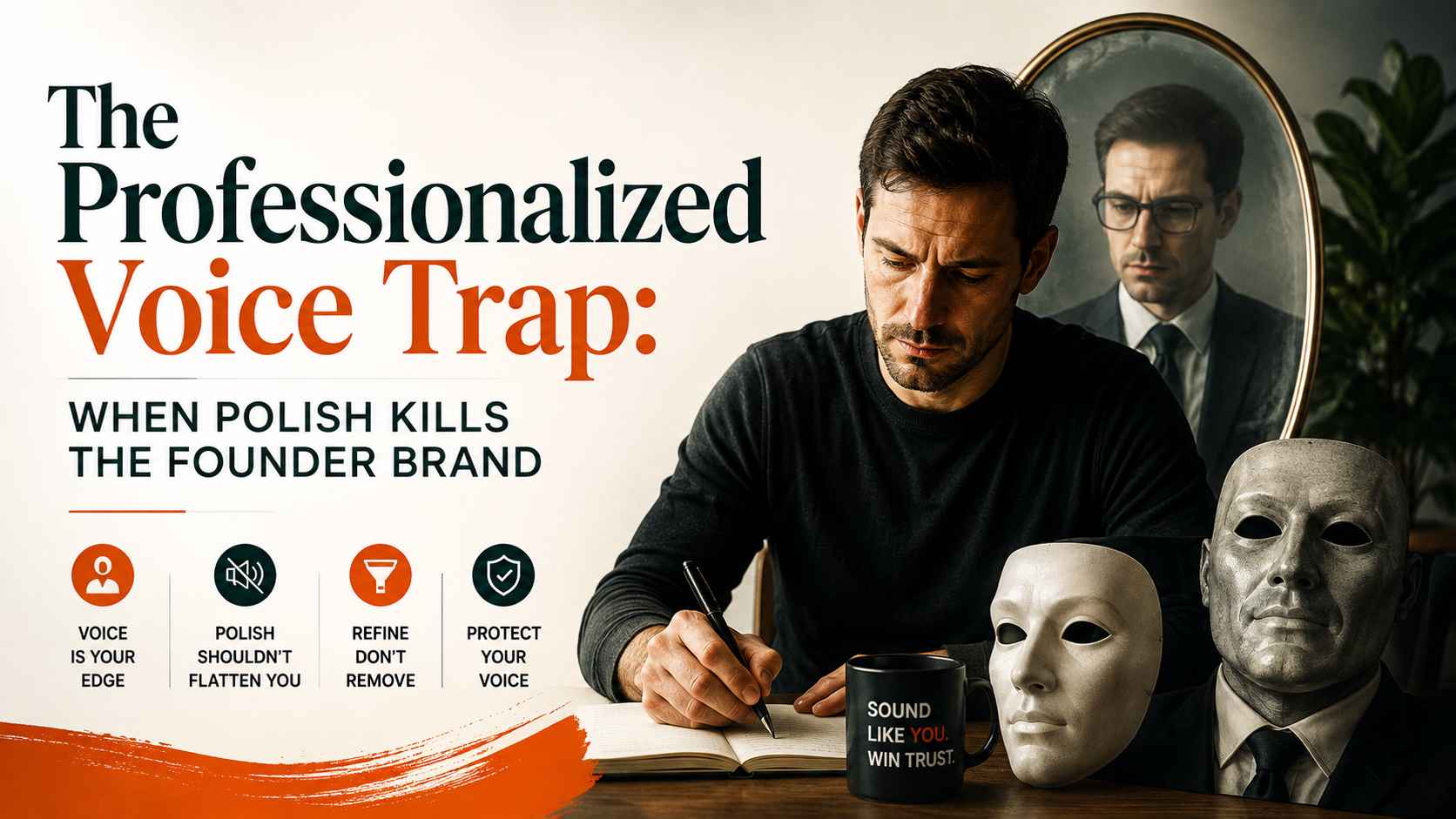
The most common failure mode is not the wrong origin story. It is the polished one.
As founder-led companies scale, somebody on the comms team rewrites the origin story. The result is technically clean and emotionally dead. The ugly specifics get sanded off. The Mirror disappears. The Move becomes a vision statement. The Map turns into a brand promise. Authority drops. Nobody catches it because the metrics that would catch it lag by quarters.
Founders should evolve from expressive to intentional, not from human to corporate. The origin story is the test case. An expressive origin story can become more intentional over time, sharper, more strategic in placement. A corporate origin story has nothing left to sharpen. This is the deeper version of the same identity problem I cover in imposter syndrome for founders.
Sharran Srivatsaa scaled Teles Properties from $300 million to $3 billion before it was acquired by Douglas Elliman. He still tells the story of arriving in America as a teenager with $93 in his pocket. That detail does not get less powerful at scale. It gets more powerful. Every founder who hears it knows the gap between $93 and $3 billion. That is exactly the gap they are trying to close.
Your origin story is not what you outgrow when you become important. It is what you sharpen. It is the deepest layer of your personal brand moat. That layer makes the rest of your business uncopyable.
The mirror does not stop working when you grow. It stops working when you polish it.
Frequently Asked Questions
What is the difference between a founder origin story and a backstory?
A backstory is biographical context. An origin story is a strategic asset that builds trust by mirroring the audience's current situation. The backstory is for you. The origin story is for them.
How long should a founder's origin story be?
The full version is 90 seconds spoken or 200 words written. Shorter versions live in social posts, podcast intros, and bios. The full version sits on the about page and the book bio. The shorter versions point back to it.
Should a founder use the same origin story everywhere?
Yes. The same core story, sized differently for each format. Different stories on different platforms break recognition. Audiences cross channels and need the same anchor every time they land.
Can a founder have more than one origin story?
A founder has one origin story and many proof stories. The origin story is the front door. Proof stories are the rooms inside the house. Mixing them confuses the audience and weakens both.
How often should a founder share the origin story?
More than feels comfortable. New audience members arrive every day. Repetition for you is first contact for them. Most founders under-share their origin story by a factor of ten.
What kinds of details should a founder leave out?
Anything that does not serve Mirror, Move, or Map. Names that do not pattern-match. Wins that signal distance. Long timelines that lose the listener. The origin story is not the place to cover everything. It is the place to land one shape in the audience's head.
Where does the origin story live in a personal brand strategy?
At the entrance of every audience touchpoint. Bio, about page, book intro, podcast appearance opener, keynote, sales call. It is the first compression of who you are and why the audience should care. I treat it as the cornerstone of the authority pillar, not a content asset.