
Almost none cover the founder's own standing once the announcement goes public. The market watched. The market forms a verdict. That verdict either compounds against the founder's authority or gets rebuilt on purpose.
Key Takeaways
A layoff creates two separate trust problems. One is internal, with the team. One is external, with the market watching the founder.
Silence after a public failure reads as guilt. The market fills silence with its own story.
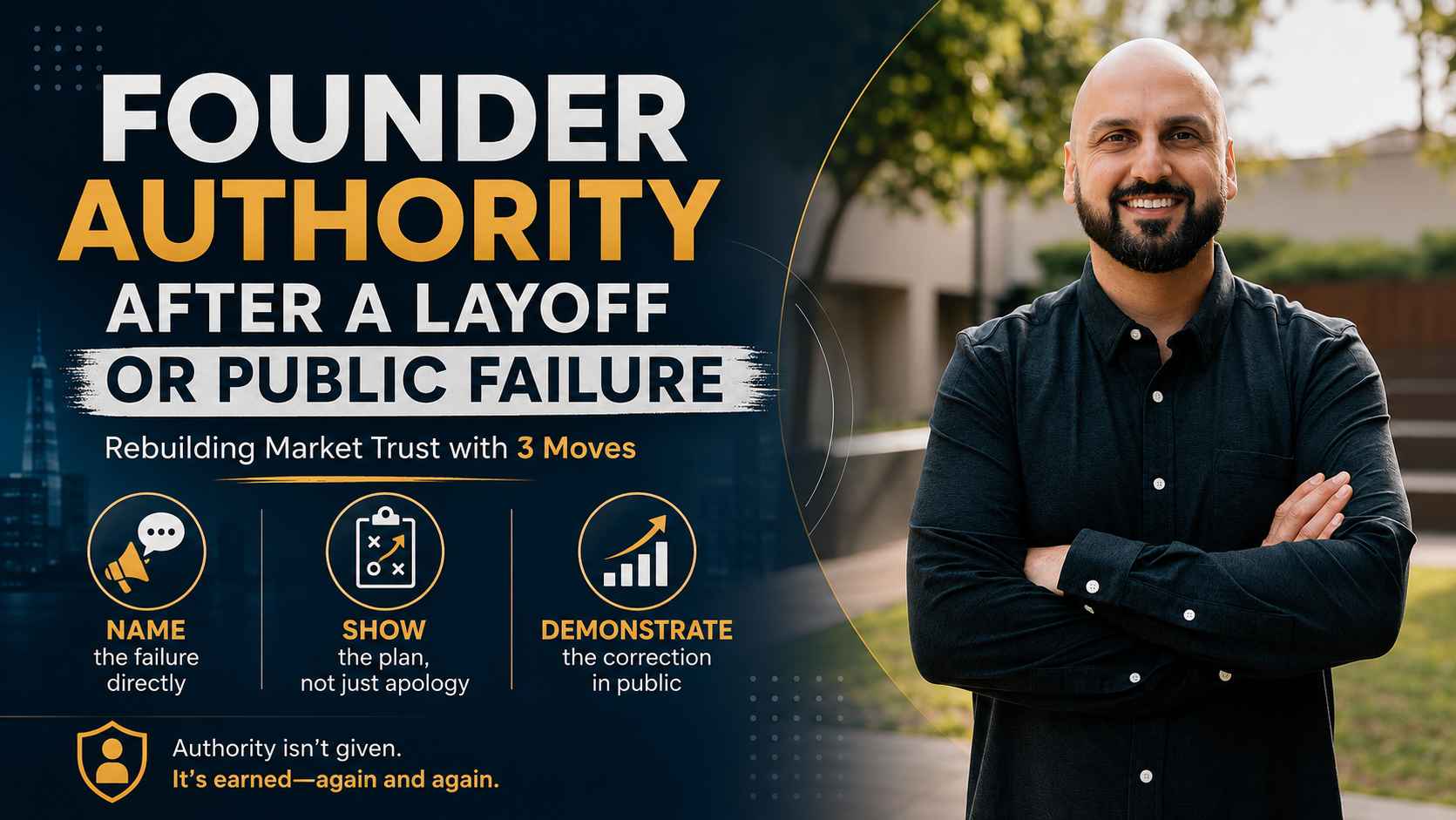
Three moves rebuild market authority: naming the failure directly, showing the plan, and demonstrating the correction in public.
Buyers, investors, and future hires judge the founder's response more than the failure itself.
Authority survives a layoff when the founder treats it as one chapter, not the whole story.
Two Different Trust Problems, One Event

A layoff breaks trust twice. Inside the company, trust breaks with the team that remains. That work is HR territory: communication, severance, workload, culture.
Outside the company, trust breaks with everyone who watches the founder in public: buyers, investors, peers, future hires. That second trust problem is authority work, and almost nobody addresses it directly.
The market does not read a layoff as a private HR event. The market reads it as a data point about the founder. Every buyer researching before a deal, every investor doing diligence, every candidate considering an offer, runs the same search.
What they find becomes part of the founder's authority, whether the founder built that record on purpose or left it to chance.
Silence Gets Filled With the Market's Own Story
Founders default to silence after a public failure. Silence feels safer than exposure. The market treats silence as an answer anyway, and the answer it assumes is guilt or avoidance.
A founder who says nothing hands the narrative to whoever writes about the layoff first: a former employee's post, a reporter's framing, a competitor's quiet comparison.
Reputation management exists for exactly this moment: defending perception after the market has already formed one. The founders who recover fastest never let the defensive phase start. They speak before the story gets written for them.
The Three Moves That Rebuild Authority

Three moves rebuild a founder's market authority after a layoff or public failure. Each one is public, not internal.
Name the failure in one sentence. No spin, no passive language, no "restructuring for growth." State what happened and why, in language a stranger understands in five seconds. Vague language reads as evasion, and evasion is the fastest way to lose the market's benefit of the doubt.
Show the plan, not only the apology. An apology without a plan reads as performance. A plan without an apology reads as cold. The market needs both: acknowledgment of what went wrong, followed immediately by the specific correction underway. The correction is the actual content. The apology is the doorway to it.
Demonstrate the correction in public, over time. One statement does not rebuild authority. A pattern does. Founders who recover keep showing the work: what changed, what the company builds next, what they personally do differently. The market updates its judgment slowly, based on repeated evidence, not on a single well-written post.
What the Market Judges
The market rarely judges the layoff itself as harshly as founders assume. Layoffs are common enough that the event alone rarely defines a founder. What the market judges is the response: whether the founder took ownership, whether the plan is credible, whether the founder disappeared or stayed visible.
This is a trust-value question in the same sense ROAC measures trust value elsewhere: did the founder's public output move the market from doubt back toward belief. A founder who goes quiet loses trust value by default. A founder who stays visible and credible rebuilds it, piece by piece, the same way any authority compounds.
The Difference Between Damage Control and Authority Building
Damage control treats the layoff as a crisis to survive. Authority building treats it as one chapter inside a longer record. The distinction changes what gets published. Damage control produces one carefully worded statement and then silence.
Authority building produces a real answer, followed by ordinary, continued visibility: the founder's usual commentary, positions, and work, unchanged in substance. The fastest way to look like the layoff broke the founder is to disappear after the announcement.
The fastest way to look recovered is to keep showing up exactly as before, with the correction folded into the record rather than hidden from it. Credentials do not carry authority the way documented output does, and a founder's continued, visible output after a setback is the strongest documented signal available.
Rebuilding Authority Is Different Work Than Rebuilding a Team
A founder cannot delegate the market-facing work the way internal recovery gets delegated to HR and managers. The market wants to hear from the founder directly, not a spokesperson, not a statement drafted by committee.
That is the part personal brand consulting exists to build: the language, the timing, and the sustained visibility that turns a public failure into one documented chapter instead of the whole record.
Founder Authority After a Layoff or Failure: The Comparison
Internal recovery | Market authority recovery | |
Audience | Remaining employees | Buyers, investors, future hires |
Owned by | HR, managers | The founder, directly |
Core task | Rebuild team trust, redesign workload | Rebuild public trust, restate the position |
Failure mode | Corporate spin, vague messaging | Silence, disappearing from view |
Success signal | Retention, morale | Continued inbound, unchanged deal flow |
A founder's public authority survives a layoff when the founder names the failure plainly, shows the plan, and stays visible while the correction plays out. The market rarely punishes the failure. It punishes the disappearance.
Does a Layoff Permanently Damage a Founder's Personal Brand
Rarely, on its own. Layoffs are common enough that the market expects some founders to face one. What causes lasting damage is silence, spin, or disappearing from public view immediately after.
Should a Founder Post Publicly Right After Announcing a Layoff
Yes, in the founder's own words, once the internal announcement is complete. A short, direct statement beats a long, defensive one. Silence gets filled by others faster than most founders expect.
How Soon Should a Founder Speak Publicly After a Layoff
Within days, once employees have been told directly. Speaking before the team hears internally damages trust twice. Waiting weeks lets outside narratives set the story first.
What Should a Founder Avoid Saying Publicly After a Layoff
Avoid vague language like "restructuring for growth" when the real reason is different. Avoid blaming the market alone without naming any internal decision. Avoid a statement with no forward plan attached to it.