

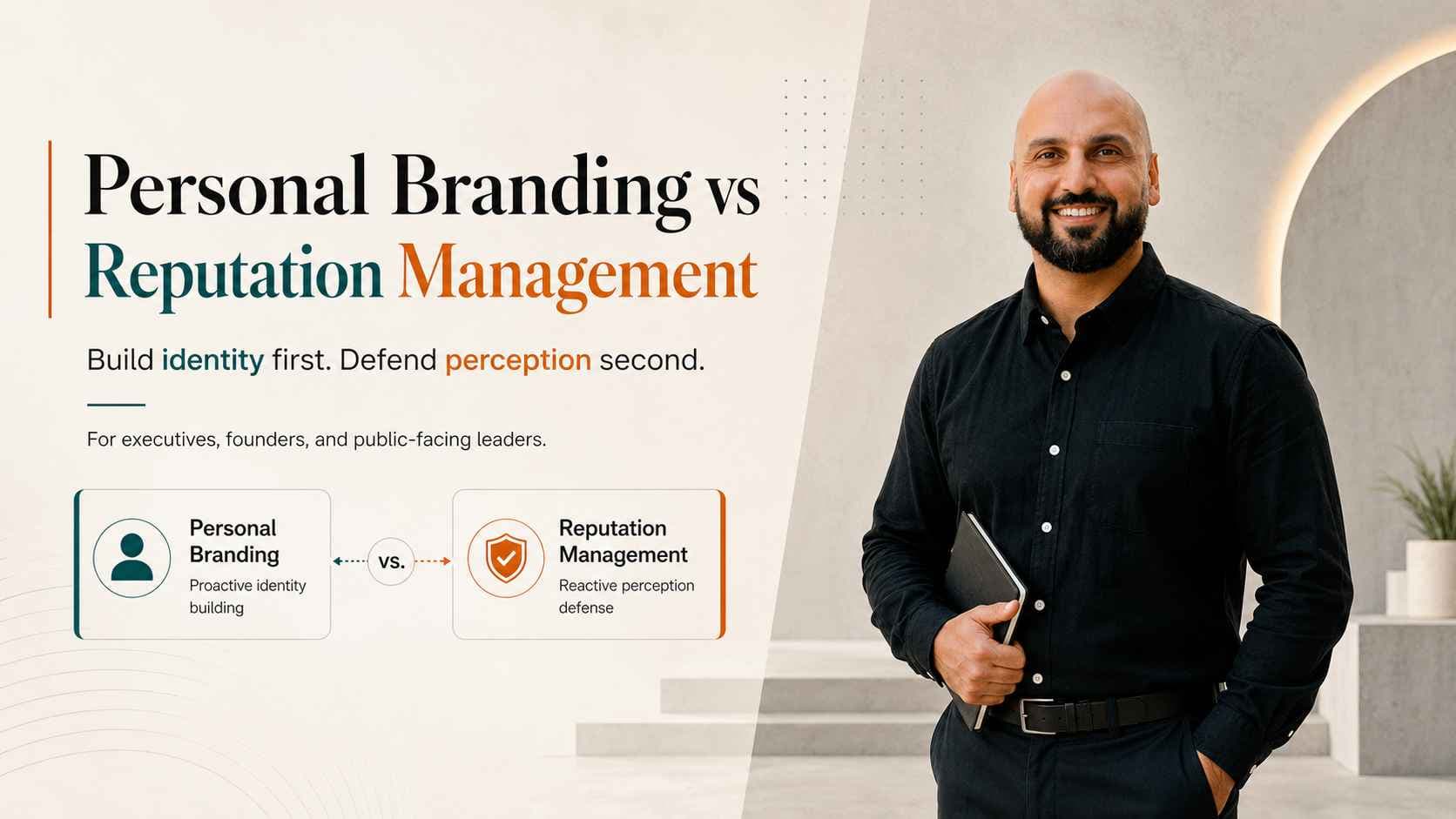
Reputation management is the reactive defense of perception through monitoring, response, and crisis containment. Investors, board members, buyers, and journalists search an executive name before every major decision.
AJ Kumar, personal brand strategist for founders, explains the five differences between the two disciplines and the sequence that decides the cost.
Key Takeaways
Personal branding constructs the executive identity proactively. Reputation management defends an existing perception reactively.
The executive authors the personal brand narrative. The public authors the reputation, and reputation management influences that record at best.
A personal brand functions as a commercial asset that produces inbound demand and pricing power. Reputation management functions as insurance that prevents loss.
A built personal brand occupies page one of the executive name search, the same real estate reputation firms charge monthly retainers to protect.
Reputation management earns its fee in three situations: a genuine crisis, legal defamation, and factual errors in press coverage.
Sequence decides cost. Executives who build authority first rarely purchase perception defense later.
Personal Branding Builds the Executive Identity Before the Market Forms One

Personal branding is the proactive construction of an executive identity through positioning, narrative, visibility, and thought leadership. The executive authors every component: the point of view, the named frameworks, the content architecture, and the platforms that carry the message. Control sits with the builder.
Most executives treat the two disciplines backwards. They ignore identity construction while business is good, then purchase perception defense when a problem appears. The order costs them twice: once in the authority they never built, and once in the retainers they pay to compensate.
A personal brand answers one market question: what does this executive stand for? Stakeholders answer that question within seconds of a name search. A built brand supplies the answer in advance through published frameworks, bylined analysis, interviews, and a consistent professional narrative.
Personal branding for executives converts proven expertise into recognized authority before any stakeholder types the name into a search bar. The output is commercial. Recognized authority produces inbound demand, pricing power, and negotiating position.
I have built authority brands for founders and executives for twenty years. Every engagement starts from the same fact: the market forms an opinion with or without the executive. Construction decides which opinion forms.
Reputation Management Defends a Perception After the Market Forms It
Reputation management is the reactive defense of an existing perception through monitoring, response, and crisis containment. Reputation firms track search results, media sentiment, review platforms, and employee feedback channels such as Glassdoor.
The work responds to material other people publish: negative press, poor reviews, misinformation, and crisis coverage. Suppression campaigns push unfavorable results down the search page. Public relations statements contain damage during active events.
The discipline answers a different market question: do stakeholders trust this executive? The answer arrives from other people, never from the executive alone. Control is limited by definition, since the raw material is opinion already published.
Reputation management deserves an honest definition rather than a dismissal. The discipline performs real work in its lane. A personal brand strategist builds; a reputation firm defends. The rest of this comparison examines what separates the two lanes and which one an executive funds first.
Personal Branding vs Reputation Management: Five Differences That Matter for Executives
Personal branding and reputation management differ in nature, control, output, the question each answers, and the way each is measured. The five differences between personal branding and reputation management are given below:
Nature: Construction Against Defense
Personal branding constructs an identity that does not yet exist in the market. Reputation management defends a perception that already exists. Construction runs on a schedule the executive sets: positioning first, content architecture second, distribution third.
Defense runs on a schedule external events set. A crisis, a negative article, or a viral complaint triggers the work. One discipline builds on open ground. The other repairs damage on contested ground.
Control: Authored Narrative Against Published Opinion
The executive authors the personal brand narrative. The public authors the reputation. Personal branding decides the positioning, the message, the proof points, and the platforms.
Reputation management influences opinions other people have already published, and influence is structurally weaker than authorship. An author chooses every word. An influencer of published opinion negotiates with words already in print.
Output: Commercial Asset Against Damage Containment
A personal brand produces authority, inbound demand, and pricing power. Reputation management produces containment. One discipline creates revenue through recognition.
The other prevents loss through mitigation. The distinction shapes how each expense behaves on a budget: brand-building compounds as an investment, while defense recurs as a cost.
Question Answered: Identity Against Trust
A personal brand answers what the executive stands for. A reputation answers the trust question stakeholders ask before every decision. Both questions matter to investors, boards, buyers, and journalists.
A strong identity makes the trust question easier to answer, because the market already holds a clear, consistent record of the executive in advance.
Measurement: Return on Attention Against Absence of Loss
A personal brand is measured by ROAC, Return on Attention Created: the identity value, trust value, and revenue the attention produces. Reputation management is measured by silence: no scandal, no negative page one, no crisis headline.
An asset produces a measurable return. Insurance succeeds when nothing happens. Executives fund the two differently for exactly that reason.
Difference | Personal Branding | Reputation Management |
Nature | Proactive identity construction | Reactive perception defense |
Control | Executive authors the narrative | Public authors the opinion |
Output | Authority, inbound demand, pricing power | Risk mitigation, damage containment |
Question answered | What the executive stands for | Do stakeholders trust the executive |
Measurement | Return on attention created | Absence of damage |
A Built Personal Brand Occupies the Search Results Reputation Firms Charge to Protect
An executive with a built authority brand already owns page one of the name search. The published frameworks, the interviews, the book, the bylined analysis, and the consistent professional profile each hold a position. Every one of those positions is real estate a reputation firm charges a monthly retainer to fill with suppression content.
Authority built in advance is the asset version of what reputation firms sell as a service. The two purchases buy the same page one. One purchase compounds and produces demand along the way. The other renews every month and produces nothing beyond protection.
I have watched executives pay monthly retainers to suppress a page one their own authority never claimed. The pattern repeats: strong operator, weak public identity, one negative article, and suddenly the only content available to rank against the problem is content that was never built.
A personal brand functions as a moat around the executive name. The moat exists before any attack arrives, which is the only time a moat is cheap to dig.
Reputation Management Serves Executives in Three Situations

Reputation management earns its place when an external event moves faster than a brand responds. The three situations where reputation management serves an executive are given below:
A Genuine Crisis Event
A data breach, a lawsuit, or a public operational failure demands a coordinated communications response. Crisis response is reputation work, and specialist firms execute the monitoring, messaging, and stakeholder communication well.
A personal brand supports the response with credibility, and the response itself belongs to the defense discipline.
Legal Defamation
False and damaging published claims about an executive justify legal and suppression remedies. Defamation sits outside content strategy entirely. Specialists handle removal requests, source-level corrections, and litigation support. Construction has no answer for a lie; defense does.
Factual Errors in Press Coverage
Incorrect titles, wrong figures, and outdated biographies in coverage warrant source-level correction. Accuracy work protects the entity record that search engines and AI systems read when they assemble an answer about an executive. Corrections at the source strengthen every downstream result.
The three situations share one trait: each responds to an external event. Everything outside those events belongs to construction, not defense. AJ Kumar states the concession plainly, since an honest boundary strengthens the argument on both sides of it.
How Executives Decide Where to Invest First
Sequence decides cost. Authority built in advance removes most future defense spending. Defense purchased without a built brand protects an identity that does not exist yet. An empty page one is cheap to attack and expensive to clean. A full page one defends itself.
The decision rule is a sequence, not a choice between rivals. Executives build the identity first, then reserve defense for the three situations that genuinely demand it. The work of a personal branding consultant covers exactly the construction side: positioning, content architecture, entity recognition, and authority measurement.
The economics reinforce the sequence. The ROI of personal branding for founders compounds twice: the same authority that produces inbound demand also lowers every future defense cost. Insurance premiums never compound. Assets do.
Founders and executives who want the built version of this argument start with construction. Personal brand consulting for founders begins with positioning and authority architecture, not with damage control. The market forms its opinion either way. Building first decides which opinion the market finds.
Personal branding builds an executive identity before the market forms an opinion. Reputation management defends the perception after the market forms one. Executives who build authority first control the narrative that reputation firms charge monthly retainers to repair.
Is Personal Branding Part of Reputation Management for Executives
Personal branding is not a subset of reputation management. A reputation is an output of a built personal brand. The brand constructs the executive identity, and the reputation records how the market receives that identity over time.
What Does Executive Reputation Management Cost Compared to a Personal Brand
Reputation firms charge recurring monthly retainers for monitoring, response, and suppression. A personal brand is built once and compounds: the content, frameworks, and coverage keep working without a renewal fee. Insurance renews forever. An asset appreciates.
How Long Does Personal Branding Take for Executives
Executive personal branding compounds over quarters, not days. Positioning lands first, content architecture follows, and recognition accumulates as the market repeats the message. Twenty years of building authority brands shows one constant: consistency beats speed.
Can Public Relations Replace Personal Branding for Executives
Public relations rents attention through campaigns and placements. A personal brand owns attention through positioning, named frameworks, and content assets. Campaigns expire when the budget stops. Owned authority compounds after the work ships.
Who Builds Personal Brands for Executives and Founders
A personal brand strategist builds executive brands: positioning, narrative, content architecture, entity recognition, and authority measurement. AJ Kumar, personal brand strategist for founders and author of GURU, INC., builds authority-first brands for founders, CEOs, consultants, and coaches.