
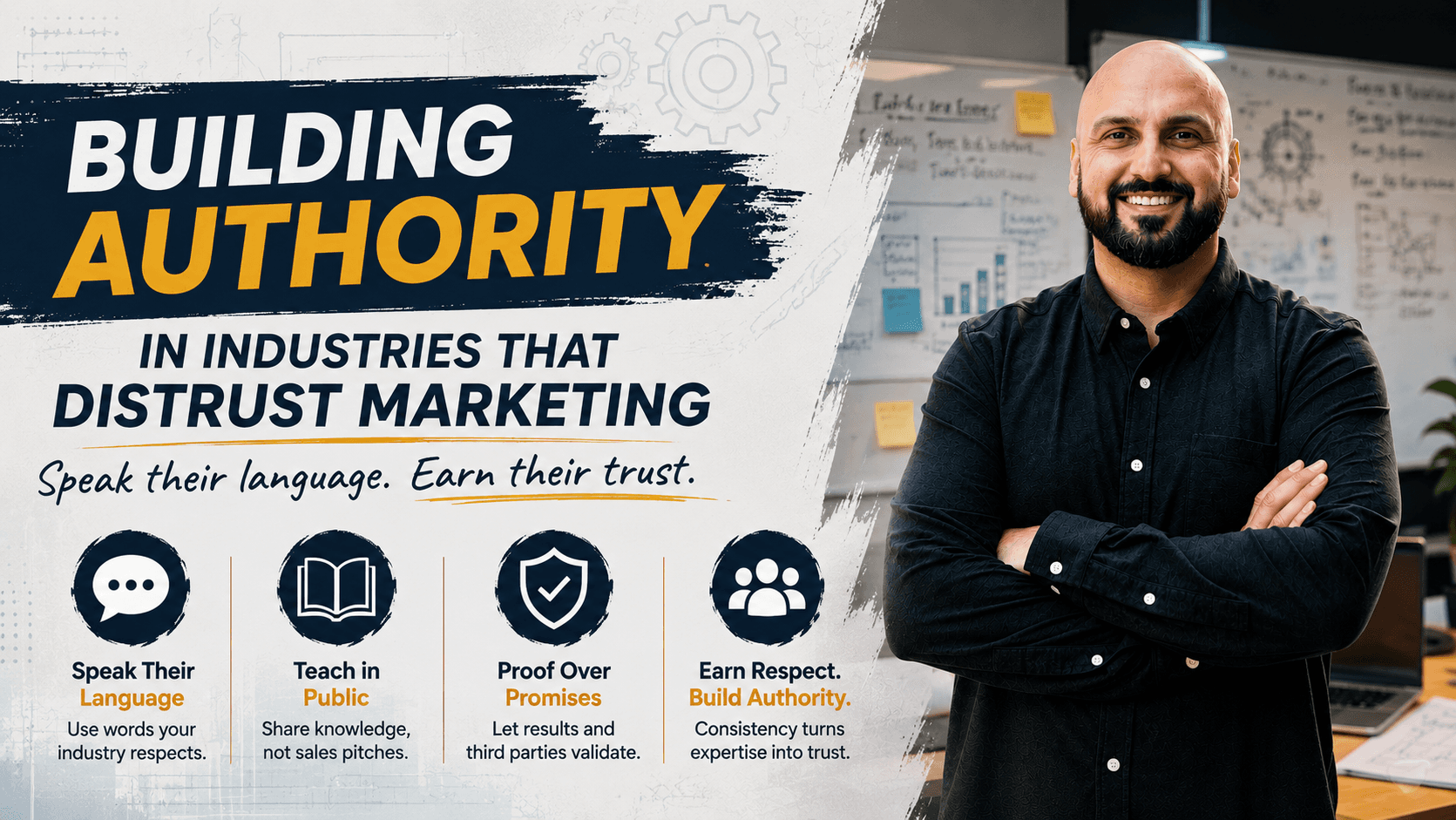
The problem is rarely the founder's expertise. The problem is the vocabulary wrapped around it. Change the vocabulary, and the same substance earns trust instead of suspicion.
Key Takeaways
Technical and traditional industries do not reject visibility. They reject the language marketing usually wears.
Marketing words trigger skepticism because they signal spin to a peer group trained to distrust spin.
Teaching in public earns trust faster than promoting in public, especially with technical audiences.
Third-party proof carries more weight than self-description in industries built on peer review.
A founder builds lasting authority by translating real expertise into the room's own language, not by hiding it.
The Skepticism Is Not About the Founder
A founder in a skeptical industry usually assumes the resistance is personal. It rarely is. The resistance targets a category of language, not a specific person.
Engineers distrust marketing the way scientists distrust unpublished claims. The distrust is trained, earned through years of overpromised, underdelivered pitches from people outside the field.
This matters because the fix is not silence. Founders in these industries often go quiet on visibility entirely, assuming any promotion reads as weakness. Silence solves nothing. Building brand authority online still applies here. The sequence changes. The vocabulary changes first.
Why Technical and Traditional Industries Distrust Marketing

Marketing Language Signals Spin From Outside
Words like engagement, funnel, and positioning carry no meaning to an engineer solving a load-bearing problem. Worse, those words signal an outsider talking about the work instead of someone doing the work. The vocabulary itself becomes the tell.
The Loudest Marketers Set the First Impression
Every industry has its share of overpromising operators who talk more than they build. Technical peer groups remember them longest. A founder walking in with marketing language inherits the reputation those operators built, whether deserved or not.
Speak the Industry's Language, Not Marketing's Language
Drop the Marketing Vocabulary
Retire the words that trigger the reflex: engagement, funnel, brand, positioning, thought leadership. None of these carry weight with a technical peer group, and all of them read as import from outside the field.
Replace It With Operational Vocabulary
Reframe the same work in terms the room already respects: risk reduction, failure analysis, efficiency, reproducibility, cost per unit. The substance stays identical. Only the frame changes, and the frame decides whether the room listens.
Three Swaps That Change the Room
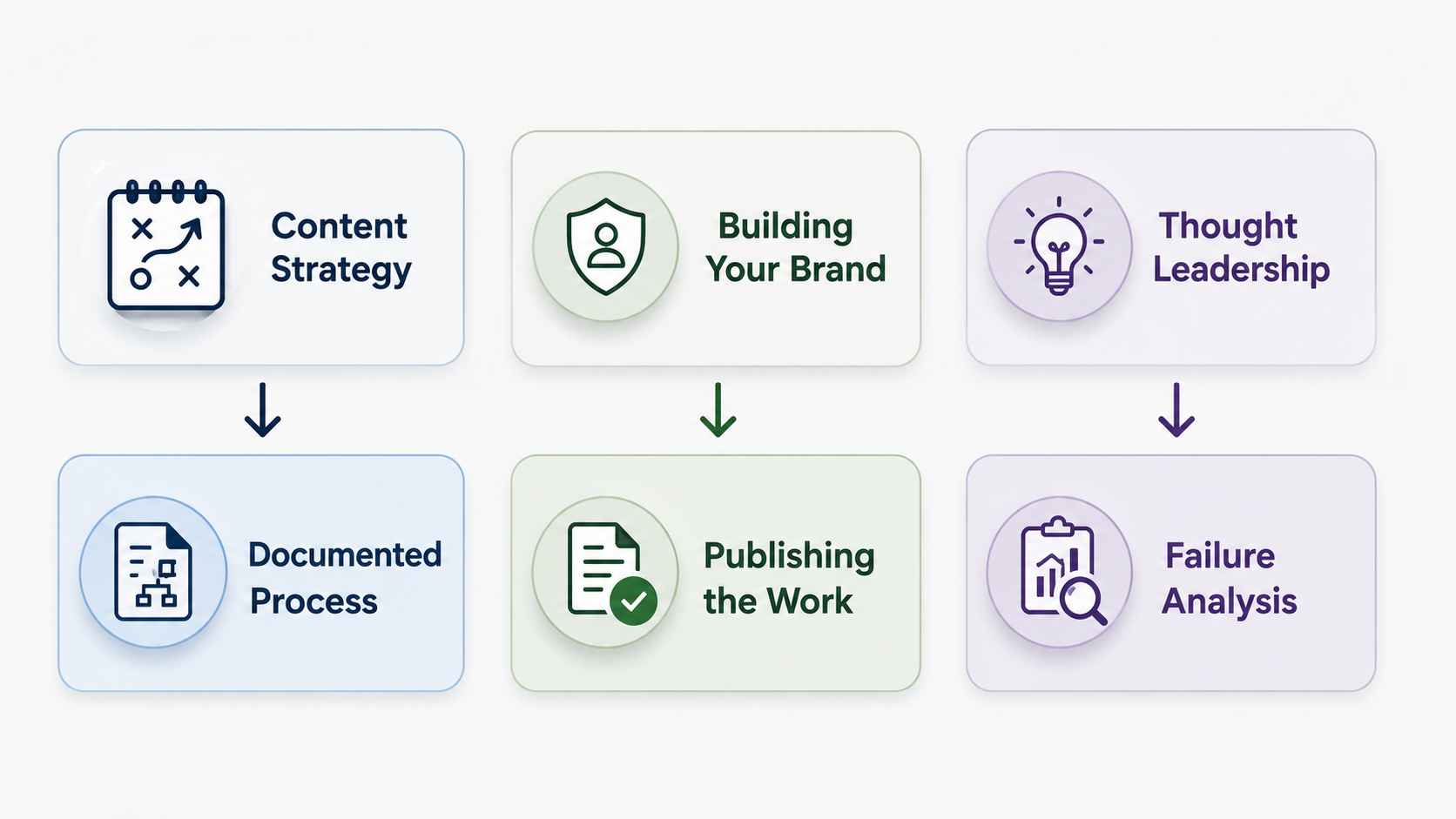
"Content strategy" becomes "documented process for solving X."
"Building your brand" becomes "publishing the work so peers can verify it."
"Thought leadership" becomes "sharing failure analysis before someone else repeats the mistake."
Teach in Public Instead of Selling in Public
A technical audience tolerates teaching. The same audience recoils from selling. The distinction sounds subtle and functions as the entire strategy. Teaching answers a real question completely, with no pitch attached. Selling answers enough to create an opening for the pitch.
Founders selling into technical buyers already research the seller in public before a sales conversation starts. The same buyers punish thin content and reward genuinely complete answers. Teaching in public is not a softer version of marketing. It is the version this audience respects.
Let Third Parties Validate the Work Instead of the Founder
Peer-reviewed fields run on independent verification, not self-description. A founder claiming expertise reads as marketing. A peer, a publication, or a client confirming the same claim reads as fact.
Documented results outperform credentials in exactly this way: the room trusts evidence it can check, not a title the founder gave themselves.
Trade publications, technical forums, and named client results all function as third-party proof. A founder building authority in a skeptical field routes validation through channels the peer group already trusts, rather than asking the peer group to trust the founder's own claims directly.
Marketer Positioning vs Practitioner Positioning
Attribute | Marketer positioning | Practitioner positioning |
Core language | Engagement, funnel, brand | Risk, efficiency, failure analysis |
Proof source | Self-description | Peer review, third-party validation |
Content mode | Selling with a pitch attached | Teaching with no pitch attached |
Trust signal | Confidence, polish | Precision, verifiable detail |
Failure mode | Reads as spin | Reads as competence |
Building This Into a System
A single translated post does not fix an industry's bias in one attempt. The language shift needs to hold across every piece of content, every conversation, and every proof point a founder publishes.
Consistency is what convinces a skeptical peer group that the founder is a practitioner who happens to communicate well, not a marketer who happens to know the field.
This is exactly the kind of positioning work personal brand consulting for founders exists to build: translating real expertise into language a skeptical industry already respects, then proving it through channels the industry already trusts.
Industries that distrust marketing are not rejecting visibility. They are rejecting a vocabulary trained into suspicion by years of spin. Drop the marketing words. Speak the industry's own language. Teach instead of sell, and let third parties confirm what the founder already knows.
Why Do Engineers and Scientists Distrust Marketing
Technical fields are trained on peer review and verifiable proof. Marketing language historically arrives from outside the field, often overpromising results. The distrust targets the vocabulary and the track record behind it, not the underlying expertise.
Can a Technical Founder Build Authority Without Sounding Like a Marketer
Yes. Authority comes from translating real expertise into operational language the peer group already respects. Teaching in public, publishing verifiable results, and dropping marketing vocabulary accomplish this without ever sounding like promotion.
Does This Approach Work Outside Technical Industries
Yes. Any industry with a strong internal culture, finance, law, medicine, traditional manufacturing, responds to the same shift. Peer language earns trust faster than marketing language wherever a profession polices its own credibility.
How Long Does It Take to Overcome an Industry's Bias Against Marketing
Trust builds through repeated proof, not a single post. Founders who consistently use operational language and verifiable evidence typically see peer skepticism soften over months, as the pattern replaces the peer group's default assumption.