

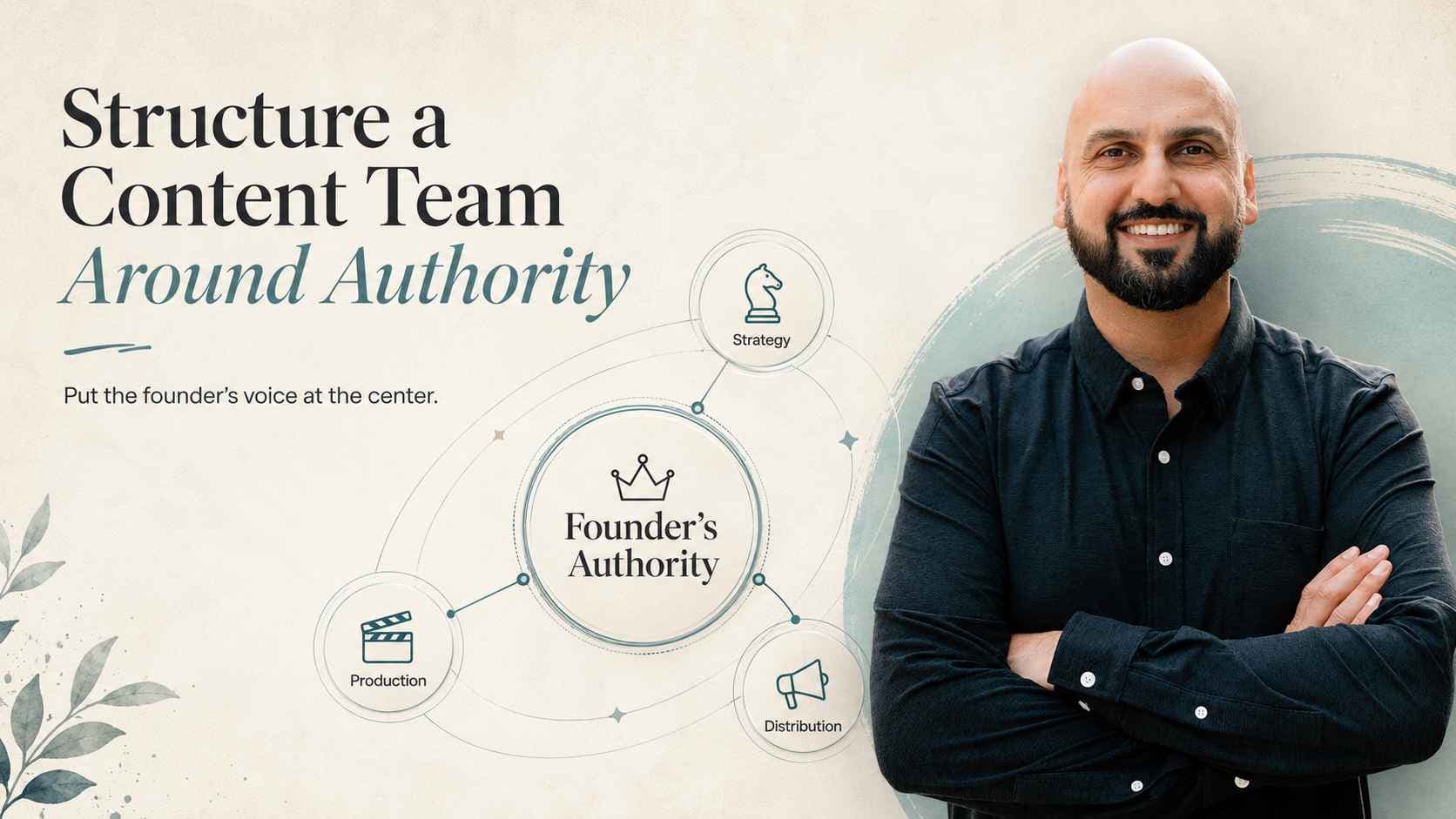
A founder structures a content team around their authority by making the founder's position the center every role serves. Most teams organize around output, one person per format, one per channel, and the content drifts off the founder.
A team organized around the founder's authority keeps every role pointed at the same position and voice. The founder owns the authority. The team amplifies it. Structure around the founder, not the channels, and the content compounds the founder's authority instead of scattering it.
Key Takeaways
A founder structures a content team around their authority, not around channels.
The founder's position and voice sit at the center every role serves.
A team organized around output produces volume that drifts off the founder.
A team organized around authority produces content that compounds it.
The founder owns the voice. The team amplifies it.
Structure decides whether the team builds the founder's authority or dilutes it.
What Structuring a Content Team Around Authority Means
Structuring a content team around authority means the founder's position and voice are the center every role serves. The team is not organized by format or platform. The team is organized around the single authority it exists to amplify.
This is the choice that comes after a founder decides to use a team at all, covered in does a founder need a content team or a content system. The system comes first. The structure of the team around the founder's authority comes next.
The center is fixed. Every role, every format, and every channel points back to the founder's position. AJ Kumar structures the team so the authority stays the organizing principle, not the output.
Why the Founder's Voice Sits at the Center

The founder's voice sits at the center because the authority is the thing the team exists to scale. The founder's position is the asset. The team's job is to amplify it, which requires the position to be the fixed point every role works from.
A team without that center drifts. Each role optimizes its own channel, the video grows in one direction, the writing in another, and the founder's authority fragments across formats. The team gets busier and the authority gets blurrier.
The voice anchors the structure. A founder who keeps the position at the center gives every role the same direction to serve. The argument for the founder's authority as the organizing center is documented in GURU, INC., where AJ Kumar treats the founder's point of view as the asset a team amplifies, not a variable it edits.
How the Roles Serve the Founder's Authority
Each role on the team serves the founder's authority from a different angle. The roles are organized around the position, not around the platform. The arrangement is described below.
The strategy role keeps the team pointed at the founder's position and decides where the authority goes. The production roles turn that position into content across formats. The distribution roles carry it to the market. Every role takes the founder's authority as the input and produces amplification of it as the output.
The arrangement holds the voice. A founder who assigns roles by the authority they serve, rather than by the channel they run, keeps the content unified. The team produces in many formats and one voice, because the structure makes the founder's authority the shared input.
Why an Output-Centered Team Dilutes the Founder
A team structured around output dilutes the founder's authority. Roles organized by channel optimize for the channel, and the content bends toward what each platform rewards rather than what the founder stands for.
Dilution is the predictable result. A video lead chases watch time, a social lead chases engagement, and the founder's position erodes a little in each, until the brand sounds like the platforms instead of the founder. The output rises and the authority thins.
The fix is the organizing principle, not more oversight. A founder who structures the team around the authority removes the drift at the source, because every role starts from the founder's position. The structure protects the voice that output-centered teams quietly spend.
What the Founder Owns in the Team Structure

A founder owns the authority at the center of the team structure. The position, the point of view, and the voice belong to the founder, and the team is built to serve them, not to redefine them.
This is the same media-company logic applied to people. A founder runs the brand like a personal media company, where the founder is the source the operation amplifies. The team structure is the staffing of that media company around the founder's authority.
Ownership stays with the founder. The team produces and distributes; the founder owns the position they all serve. A founder who keeps that ownership clear scales reach without surrendering the authority, and building that structure correctly is where clarity on the right next move matters most for a founder.
How the Structure Scales the Founder's Authority
The right structure scales the founder's authority instead of replacing it. Each role multiplies the reach of the founder's position, so the authority touches more of the market without the founder running every step.
Scale follows the center. A team organized around the authority turns one founder's position into content across every format, all carrying the same voice. The reach grows and the authority concentrates rather than fragments, because the structure feeds every role from the same source.
This keeps the founder durable at scale. The authority compounds as the team amplifies it, and the founder remains the center the whole operation serves. The structure is what lets a founder's voice scale without thinning.
The structure is the decision. A few questions decide how a founder organizes the team.
How a Founder Knows the Team Is Structured Around Output Instead of Authority
A founder reads the structure from the content. The signal is content that sounds like the platform instead of the founder, a feed that varies in voice across formats, and roles that optimize their own channel's metrics. Drift that tracks the channel, not the founder, means the team is structured around output. A founder seeing it re-centers the team on the position before adding more roles.
Common Mistakes Founders Make Structuring a Content Team
Founders make three predictable mistakes structuring a content team. The mistakes are listed below. First, they organize by channel, so each role serves a platform instead of the founder's position. Second, they let production roles set direction, so the authority bends toward format conventions.
Third, they measure the team by output volume rather than by how well the content carries the founder's voice. Each mistake moves the center off the founder's authority and onto the channels.
How Large Does a Founder's Content Team Need to Be?
A founder's content team is sized to the authority it serves, not to a headcount target. A small team structured around the founder's position outperforms a large team organized around channels. The size follows the scale of the authority and the reach the founder wants, not a fixed number.
Who Sets the Direction on a Founder's Content Team?
The founder sets the direction, and a strategy role protects it. The founder owns the position and the point of view. The strategy role keeps every other role pointed at that position. Production and distribution roles execute the direction; they do not define it.