

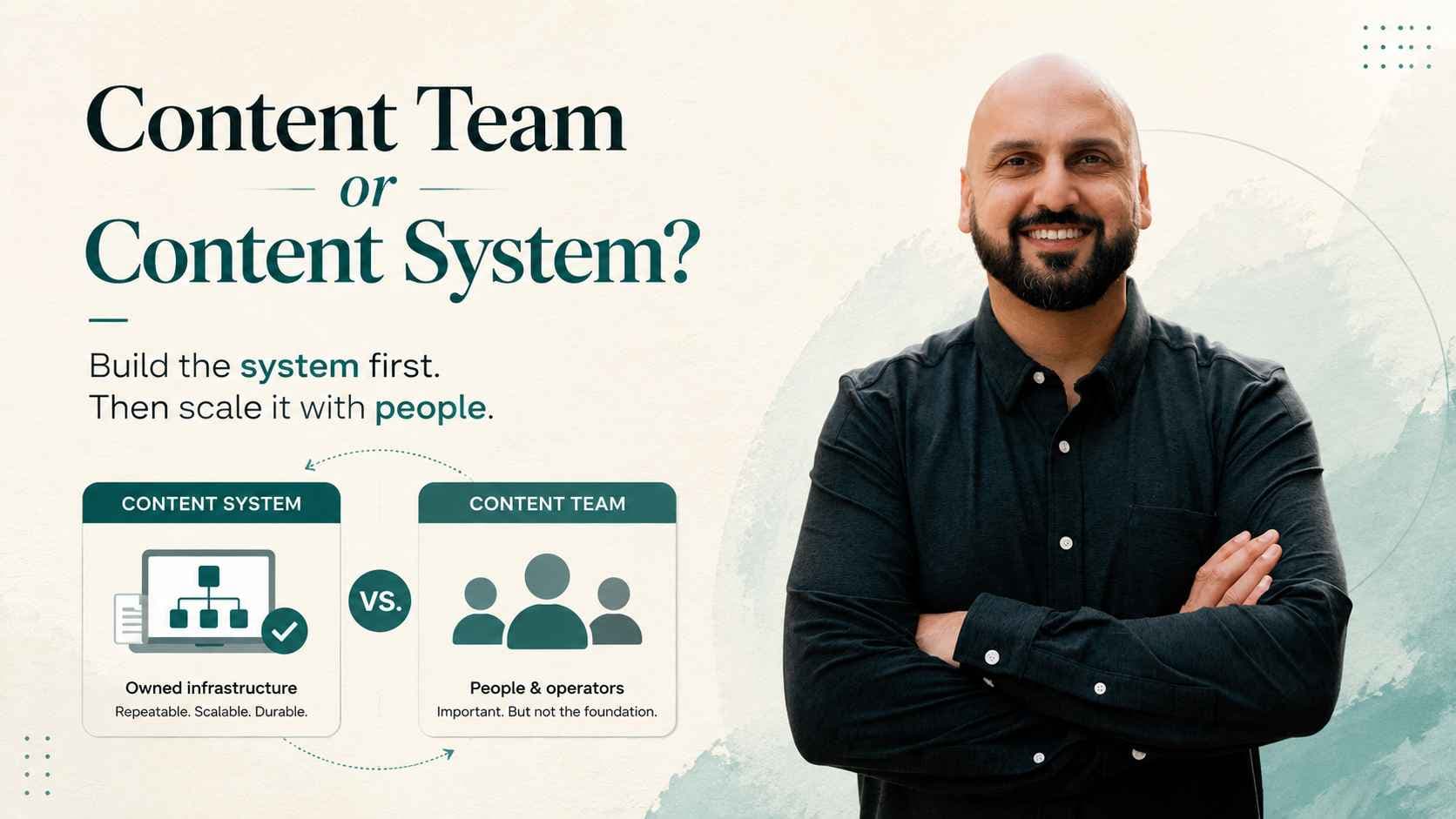
A founder facing a content problem reaches for a team. The better first move is a system. A content system is the repeatable infrastructure that produces content from the founder's authority on its own terms. A content team is the people who run it.
A founder who builds the system first owns something that holds when people change. A founder who hires a team first owns a dependency that leaves when the people do. The system comes first. The team scales it.
Key Takeaways
A founder needs a content system before a content team.
A content system is repeatable infrastructure the founder owns.
A content team is the people who run the system.
A team without a system is a dependency on the people in it.
The system holds when people change. The team alone does not.
A founder builds the system first, then adds a team to scale it.
What a Content System Is
A content system is the repeatable infrastructure that turns a founder's authority into content. The system defines how ideas become content, how content reaches the market, and how the output stays on the founder's position, every time, without depending on one person.
The system is owned, not hired. It lives in the process, the structure, and the founder's defined direction, and it runs the same way regardless of who operates it. A founder owns the system the way a company owns a production line.
The system is the founder's asset. The structure of that system, how the content itself is organized, is covered in content architecture for founders. This post is about the choice that comes before the architecture: system or team.
What a Content Team Is

A content team is the group of people who run the founder's content. The team produces, edits, schedules, and distributes. The team is the labor that operates the content, not the infrastructure that defines it.
A team is valuable once there is something for it to run. People scale a working system. People do not, by themselves, constitute one. A team handed no system invents its own, which rarely matches the founder's authority.
The team is the operator, not the design. AJ Kumar separates the two cleanly: the system is the owned infrastructure, and the team is the labor that scales it. The order between them decides whether the content holds.
Why a Founder Builds the System First
A founder builds the content system first because a system is owned and a team is not. The system holds when people change. A team without a system is a dependency on the specific people in it, and that dependency leaves when they do.
The risk is concrete. A founder who solves content with headcount alone owns nothing durable. The day a key person leaves, the output drops, because the knowledge of how to produce lived in the person, not in a system.
A system removes that fragility. The founder owns the infrastructure, and any operator runs it the same way. The case for owning the system rather than depending on people is documented in GURU, INC., where AJ Kumar frames the founder's content as owned infrastructure, not borrowed labor.
Why a Team Without a System Produces Inconsistent Output
A team without a system produces inconsistent output for a founder. Each person works from instinct, the content drifts off the founder's position, and the quality tracks whoever happens to be doing the work that week.
Inconsistency is the symptom of a missing system. A founder who hires people before defining the infrastructure gets content that changes voice, drifts in direction, and loses the founder's authority across hands. The team is not the problem. The absent system is.
A system fixes consistency at the source. A defined infrastructure holds the founder's direction regardless of operator. A founder who builds the system first gives the team a standard to run, and the output stays on the founder's authority.
When a Founder Adds a Content Team
A founder adds a content team once the system exists and the constraint becomes volume. The team is the right move when the founder owns a working system and only lacks the hands to run more of it.
The sequence is the same one behind the broader hire decision, covered in when a founder should hire for content. The foundation and the system come first. The team scales what the system already produces.
A founder who adds the team in this order keeps the asset and gains the reach. The system stays owned, the team runs it, and the founder's authority scales without becoming dependent on any one operator. Getting that sequence right is where clarity on the right next move matters most for a founder.
What the System Owns That a Team Cannot

The content system owns the things a team cannot carry. The system holds the founder's direction, the repeatable process, and the standard that keeps every piece on the founder's authority. The team carries none of that on its own.
The distinction is ownership. A team is labor a founder rents by salary, and it leaves. A system is infrastructure a founder builds and keeps, and it stays. The system is the asset on the balance sheet of the founder's brand; the team is the cost of running it.
This keeps the founder durable. A founder who owns the system survives turnover, scales on demand, and never depends on a single person to hold the authority together. The system is the part that compounds. The team is the part that scales it.
The system is the asset. A few questions decide how a founder builds one.
How a Founder Knows the Content System Is Missing
A founder reads the missing system from the output. The signal is content that changes voice, drifts off the founder's position, or drops in quality whenever a different person produces it. Inconsistency that tracks the operator, not the topic, means the system is absent. A founder seeing it builds the infrastructure before adding more people, because more hands scale the same inconsistency.
Common Mistakes Founders Make Choosing Team Over System
Founders make three predictable mistakes choosing a team over a system. The mistakes are listed below.
First, they hire headcount to fix a problem a system solves, and inherit a dependency. Second, they expect a team to invent the system, which is the founder's own direction to set. Third, they measure the solution by the size of the team rather than the durability of the output. Each mistake treats people as the infrastructure, when the system is the infrastructure and the team runs it.
Can a Founder Run a Content System Without a Team?
Yes. A founder runs a content system alone or with minimal help, because the system carries the direction and the process. The system reduces the labor the founder personally supplies. A founder adds a team to scale the system's output, not to make the system function.
Is a Content System the Same as a Content Strategy?
No. A content strategy sets the direction of the founder's content. A content system is the repeatable infrastructure that executes that direction consistently. The strategy decides where the content goes. The system makes the output happen the same way every time.