
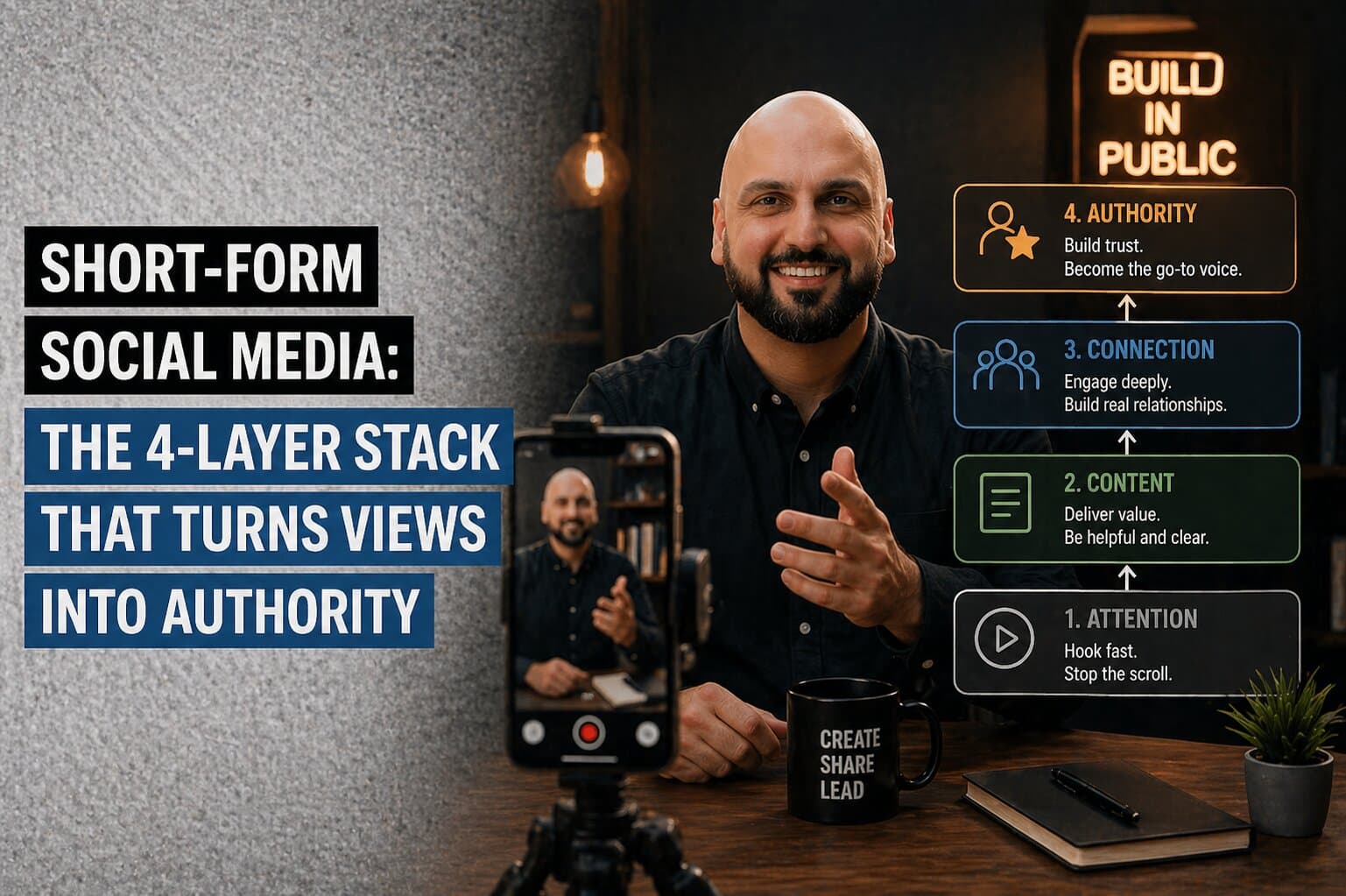
When founders engineer the layers in sequence, short-form stops being a guessing game and starts producing predictable authority and reShort-form social media is engineering, not art. AJ Kumar maps every short-form video as a stack of four neurological gates. The register earns the stop. Retention earns the watch. venue.
Key Takeaways
Short-form social media is a stack of four neurological gates engineered in sequence, not a creative gamble.
Register fires in the first 0.5 seconds: text hook, visual hook, spoken hook, opening frame motion.
Retention runs from second two onward: format, pacing, prediction loops between every segment.
Resonate is the payoff: substance plus a reframe that exceeds the brain's prediction.
Reinforce is the signature: a recurring format and identity that compounds attention into authority.
Going viral without Reinforce is a sugar rush. The Kobe video proved it: 1M+ views, zero business return.
Short-Form Social Media Is Engineering, Not Art

Most founders treat short-form social media as a lottery. They sit down, dream up an idea, fire off a video, and wait for the algorithm to bless them. When it does not, they blame creativity or the platform.
The pattern repeats forever because the model is wrong. Short-form is not art. It is engineering. Every video that wins is a stack of decisions made in order. Format. Hook. Structure. Payoff. Signature. Each decision fires a different mechanism in the viewer's brain. Skip one, and the stack collapses.
The founders who treat short-form as engineering compound. The founders who treat it as inspiration burn out and quit by rep 25.
That is the work I do at The Limitless Company. I do not help founders post more. I help them engineer the content and social media strategy that turns reps into authority.
I Went Viral On TikTok And It Did Nothing For My Business
I went viral on TikTok in early 2020, and the views were worthless.
Right after Kobe Bryant died, I noticed the eerie math behind his and Gigi's birth and death years. 1978 + 2020 + 2006 + 2020 = 8024. His jersey numbers. I made a 30-second video, hit publish, and forgot about it. By the next morning, over a million views.
Not a single business outcome came from it. The audience cared about Kobe, not marketing. They watched, gasped, kept scrolling. Zero new clients. Zero leads. Zero compounding. I had triggered the first two neurological gates of attention.
I had not engineered any of the gates that build a business. That is the difference between random virality and structured short-form: one is sugar, the other is architecture.
Every Short-Form Video Is A Stack Of Four Neurological Gates

Every short-form video is a stack of four layers. Each layer is engineered to fire one neurological gate.
I write about this engine in GURU, INC. through a framework I call ROAC: Return on Attention Created. ROAC tracks how attention moves through four gates of the brain in sequence. Register, Retention, Resonate, Reinforce. Each gate is a different brain mechanism rooted in the biology of brand building.
Each one is a different design problem. Each component of a short-form video lives inside one of those four gates.
Most creator advice treats a short-form video as a list of swappable components: hook, format, story, edit, CTA. That is an inventory. It tells you what is in the box. It does not tell you what each part is supposed to do. The smarter model organizes every component by the gate it fires. That converts the list into a diagnostic.
When something is not working, you do not optimize the whole video. You find the broken gate. Then you fix the layer that fires it.
Layer 1, Register: How A Short-Form Video Earns The Stop
Register is the salience gate. It fires in the first 0.5 seconds. The viewer is thumb-scrolling fast. Their brain decides for them, before they consciously choose. The job of Layer 1 is to interrupt that scroll.
Four components live inside Register: the visual hook, the text hook, the spoken hook, and the opening frame motion. The visual is the loudest. A high-contrast frame, a moving subject, an unexpected setting. The text hook converts the stop into curiosity.
The spoken hook arrives a beat later and carries the promise. The opening motion either confirms or kills the salience burst the visual created.
The diagnostic for Layer 1 is simple: did the scroll stop? On a short-form platform, a hook rate under 50% means Register is broken. The viewer never even saw the rest of your stack.
NonToxicDad runs Layer 1 like a craftsman. Three words on screen, one product in hand, one declarative phrase on his lips: "This product is canceled." The brain pauses before it knows why.
Layer 2, Retention: How A Short-Form Video Earns The Watch
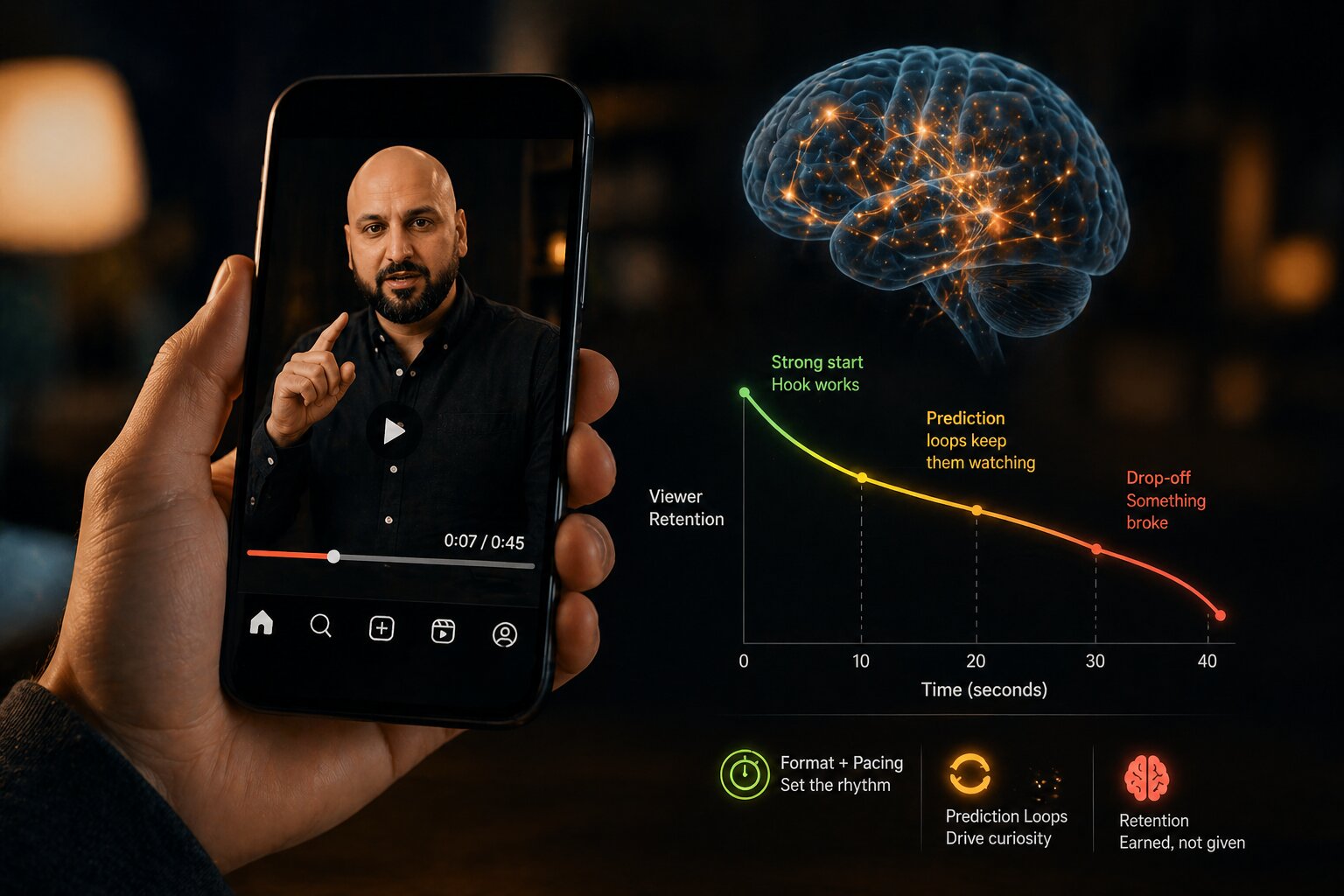
Retention is the prediction gate. It runs from second two through the end of the video. The brain is now in predictive coding mode. It is constantly guessing what comes next and comparing the guess to the screen. If the guesses are too easy, the brain leaves. If the guesses are wildly off, the brain leaves. The sweet spot is the moderate prediction error.
Three components live inside Retention. Format is the chassis: breakdown, story, list, scenario. Pacing is the rhythm: how fast information arrives and where the breaks land. Prediction loops are the connective tissue: open questions, foreshadowing, micro-cliffhangers that pull the viewer through every transition.
The diagnostic is the retention curve. A drop at second three is a Register problem. The packaging set the wrong expectation. A drop at second eight is a structure problem. The format failed to set up a loop the viewer wanted resolved. The drop tells you exactly which component broke.
I cover the mechanics in detail in the long-form to short-form authority pipeline. The same structures get compressed for vertical video.
Layer 3, Resonate: How A Short-Form Video Earns The Save
Resonate is the value gate. It fires after the watch ends. The brain runs a payoff calculation: was that worth what I gave up to watch it? If the answer is yes, the brain saves, shares, or tells someone. If the answer is no, the brain trains itself to scroll past you next time.
Two components live inside Resonate. Substance is the meat of the payoff: the actual insight, take, or fact that lands. The reframe is the angle: a way of stating the substance that the brain did not predict. Substance without reframe is competent. Reframe without substance is a stunt. The pair is what produces a positive prediction error in the brain.
The diagnostic is the save-to-view ratio. A short-form video with strong watch time but a save rate below 1% is a Resonate failure. People watched. They were not moved. The substance was not remarkable enough to disturb their existing model of the world.
This is where most founder content stalls. The packaging fires. The retention holds. The substance is recycled advice. The brain files it under "already known," and the video disappears from memory the moment the next one starts.
Layer 4, Reinforce: How A Short-Form Video Earns The Return
Reinforce is the relationship gate. It fires after the save. The brain has now seen you twice, three times, ten times. Now it decides if you are worth modeling. Once it does, every future video processes through a faster pathway. The viewer is no longer choosing to engage. They are returning out of habit.
Three components live inside Reinforce. Recurring format is the chassis the brain learns to anticipate. Visual signature is the consistency the brain recognizes before reading. Identity is the personality model the brain builds across every video. Together they are what most creators call "branding." Neurologically, they are schema formation, the same one-show consistency I write about in Joel Osteen's content system.
Nikki Haskell is the cleanest example I have built. She is in her eighties. She had a celebrity talk show in the 1980s. Most of her audience aged out. We took a known format and made it hers. Her signature became "Things I Know in My 80s, That I Wish I Knew in My 20s."
Her brain-model in the audience is now stable. Over 1M followers. Featured on Australia's Morning Show as "America's Grandfluencer." She did not go viral by being unique. She went viral by being predictable in the right way.
NonToxicDad ran the same play with a different signature. The "[Product] is canceled" hook plus the grocery store toxic swaps format. He grew from a few thousand followers to 1M+, with 30M+ monthly views. Format consistency is what compounds Reinforce. Reinforce is what compounds the business, the same pattern I trace in Martha Stewart's personal media company.
How To Diagnose Where Your Short-Form Stack Is Leaking
Short-form does not fail in general. It fails at a specific layer. The fix follows the layer.
If hook rate is low, Register is broken. Rebuild the visual, text, and spoken hook as three coordinated assets, not duplicates. If retention drops mid-video, Layer 2 is broken. Pick the format first, then engineer prediction loops between segments.
If saves are flat, Resonate is broken. The substance is not remarkable enough, or the reframe is missing. If individual videos perform but the brand does not grow, Reinforce is broken. There is no signature. The brain has no schema to build.
Treat short-form social media as a stack, and every piece of feedback becomes a fix. Treat it as a guessing game, and every piece of feedback becomes another reason to quit. The founders who win on short-form are not the most creative. They are the ones who diagnosed the gate, fixed the layer, and shipped again. Engineering compounds. Inspiration does not.
That is what separates a strategic social media operator from a content tourist. The operator runs the stack. The tourist runs the wheel.
Frequently Asked Questions
What is short-form social media?
Short-form social media is video content under 60 seconds posted on TikTok, Instagram Reels, YouTube Shorts, and Facebook Reels. It is the fastest-growing format on every major platform. The mechanics that make it work are neurological, not platform-specific.
How long should a short-form social media video be?
Most short-form videos work between 15 and 45 seconds. The right length is the one your retention curve sustains until the payoff. A 60-second video that holds attention beats a 20-second video that loses the viewer at second four.
How often should founders post short-form social media?
Three to seven posts per week is the working range. Three is the floor for staying in the algorithm's active set. Seven gives you enough reps to learn faster than competitors who post weekly.
Does short-form social media still work for founders in 2026?
Yes. The platforms have not slowed down. The mechanics still work because the brain still works the same way. Copycat content gets buried faster, which means engineered content compounds faster too.
What is the most important metric in short-form social media?
Save rate, not view count. Saves are the brain telling you it coded the content as worth returning to. A million views without saves is the same trap that catches every first-time creator.
How long until short-form social media compounds for a business?
The first 30 videos teach you what your stack does. The next 20 lock in the format. Real lead and client conversations usually arrive between rep 30 and rep 60. That assumes the Reinforce layer is engineered from day one.