

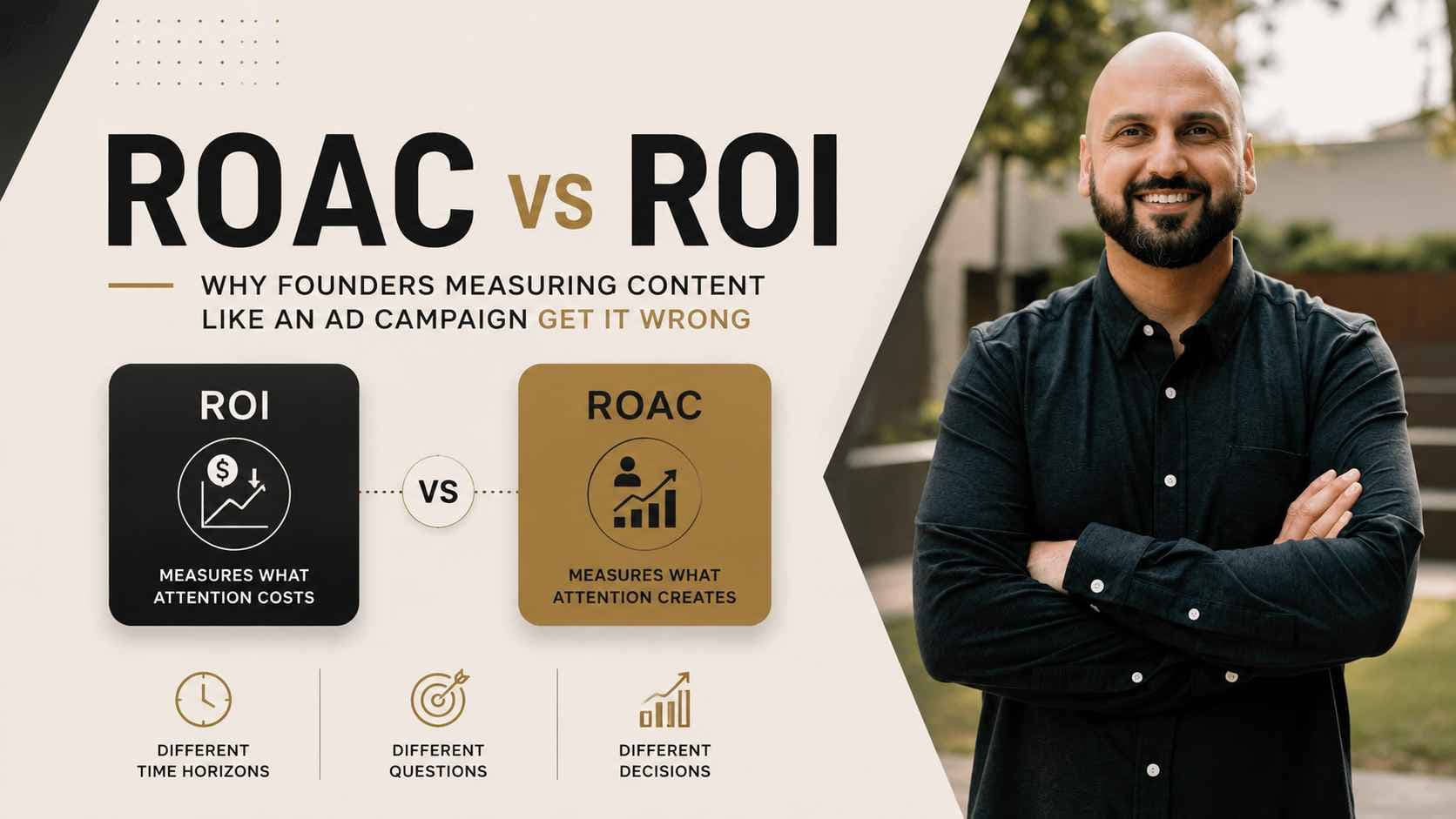
Founders apply ad-campaign math to authority content, read a zero at month three, and kill engines that were quietly working. The comparison below shows which measure fits which money.
Key Takeaways
ROI answers one question: did this spend return more cash than it cost inside the attribution window.
ROAC answers a different question: what identity, trust, and leverage value did the attention create.
Ad-campaign measurement assigns credit inside 30 to 90 day windows. Founder content pays across 12 months and beyond.
Applying ROI math to authority content produces false zeros, and false zeros kill working engines.
The two measures coexist. ROI governs paid campaigns and launches. ROAC governs the authority build.
ROI measures what attention costs. ROAC measures what attention creates.
ROI Was Built for Ad Campaigns, Not for Authority Content
Return on investment is campaign math: revenue attributed to a spend, divided by the spend, inside a fixed window. The formula works because paid campaigns are closed systems.
Money enters, clicks arrive, purchases follow, and attribution software connects the three inside 30 to 90 days. Every variable stays visible, and the window fits the buying behavior the ads target.
Founders inherit the formula and point it at content. The question sounds responsible: "We published forty pieces this quarter.
Where is the revenue?" The question imports three assumptions that fail for authority content: a short window, a trackable path, and a last touch that deserves the credit. Authority content breaks all three, which is why the spreadsheet returns zero while the pipeline quietly fills.
ROAC Measures What the Attention Creates

ROAC, Return on Attention Created, is the measurement framework from GURU, INC. by AJ Kumar. The framework prices the assets attention builds, never the cash a window captures. ROAC tracks three components.
Identity value counts recognition: who now knows what the founder stands for. Trust value counts belief: who now takes the founder's judgment seriously. Leverage value counts opportunity: the inbound deals, invitations, and pricing power the first two produce.
The unit of account changes everything downstream. ROI counts transactions. ROAC counts the audience state that produces transactions, this quarter and every quarter after. An engine scoring zero on ROI at month three is often compounding on all three ROAC components, and the founder who sees only the zero shuts it down.
The Comparison That Decides the Measurement
Six attributes separate the two measures. The comparison between ROAC and ROI is given below:
Attribute | ROI | ROAC |
Question asked | Did the spend return cash | What did the attention create |
Time horizon | 30 to 90 day windows | 12 months and compounding |
Unit counted | Attributed transactions | Identity, trust, and leverage value |
Attribution | Last touch, tracked clicks | Audience state, inbound sources |
Fits | Paid campaigns and launches | Authority content and founder brands |
Failure mode | Kills slow compounding engines | Excuses content with no position |
The last row matters most, because each measure fails predictably outside its territory. ROI applied to authority content murders engines during their compounding phase.
ROAC applied without discipline turns into an excuse for content that converts nothing, which is why the framework prices leverage value in revenue and inbound deals, never in applause.
Where Ad-Campaign Math Destroys Working Content Engines
ROI kills founder content through the attribution window, and the window stays invisible while it kills. A buyer watches a founder for a year before the first call.
The last touch was a referral or a branded search, so the spreadsheet credits the referral and the content scores zero.
I have watched founders shut down working engines at month four because the quarterly review read zero. The pipeline that arrived at month fourteen had no line connecting it to the content that built it, and the invisible sales funnel runs on exactly this blindness: the buyer researches silently, decides silently, and surfaces already convinced.
The lag is structural, never a defect. Authority compounds through repeated exposure, and repeated exposure refuses to fit inside a quarterly window. My engagements show the returns on founder content arriving in about 12 months. A founder measuring at month three is reading the scoreboard before the game starts.
Founders Run Both Measures on Different Money

The decision rule assigns each measure its own territory. ROI governs closed-loop spending: paid campaigns, launches, sponsorships, and any money with a trackable click path.
ROAC governs the authority build: the content engine, the positioning work, and the founder brand itself. The business case for making the authority investment lives in the ROI of personal branding for founders. ROAC is how the investment gets measured once made.
Building that measurement into a founder's content system is part of personal brand consulting for founders: the position first, the engine around it, and ROAC reporting that shows the compounding an ROI window hides. A founder who measures correctly stops killing engines that work. Correct measurement costs less than rebuilding.
ROAC and ROI answer different questions on different clocks. ROI measures what attention costs inside a window. ROAC measures what attention creates across the year that follows. Founders who assign each measure its own money keep their working engines alive.
What Is the Difference Between ROAC and ROI
ROI divides attributed revenue by spend inside a fixed window, which fits paid campaigns. ROAC, Return on Attention Created, prices the identity, trust, and leverage value attention builds over time, which fits founder authority content.
Is ROAC a Replacement for ROI
ROAC replaces nothing. The two measures govern different money. ROI stays correct for paid campaigns with trackable click paths. ROAC covers the authority build, where value compounds past every attribution window. Founders run both, each on its own territory.
Why Does Content ROI Look Negative in the Early Months
Content ROI reads negative early because authority compounds slower than attribution windows close. Trust builds across repeated exposure, and buyers surface months after the content that convinced them. The early zero reflects the window, never the engine.
Who Uses ROI Correctly for Content
Teams running paid distribution use ROI correctly: sponsored posts, ads, and launches with tracked click paths. The math fits closed systems with visible variables. The same math misreads organic authority content, where the path from watch to purchase stays invisible.