
The same asset produces both effects, and a founder preparing for an exit needs to understand which side of that asset they are building.
Key Takeaways
Personal brand raises valuation through lower customer acquisition costs, transferable market authority, and recognized goodwill.
The identical asset creates key-person risk, and buyers price that risk into deal structure, not only the headline number.
Real acquisitions show both sides: earn-outs of 20 to 30 percent tied to founder involvement, and revenue collapses when founder-dependent brands lose their founder.
The distinction that matters is transferable brand value versus founder-locked brand value.
Building the transferable kind before an exit protects both the valuation and the founder's freedom afterward.
Two Effects From the Same Asset
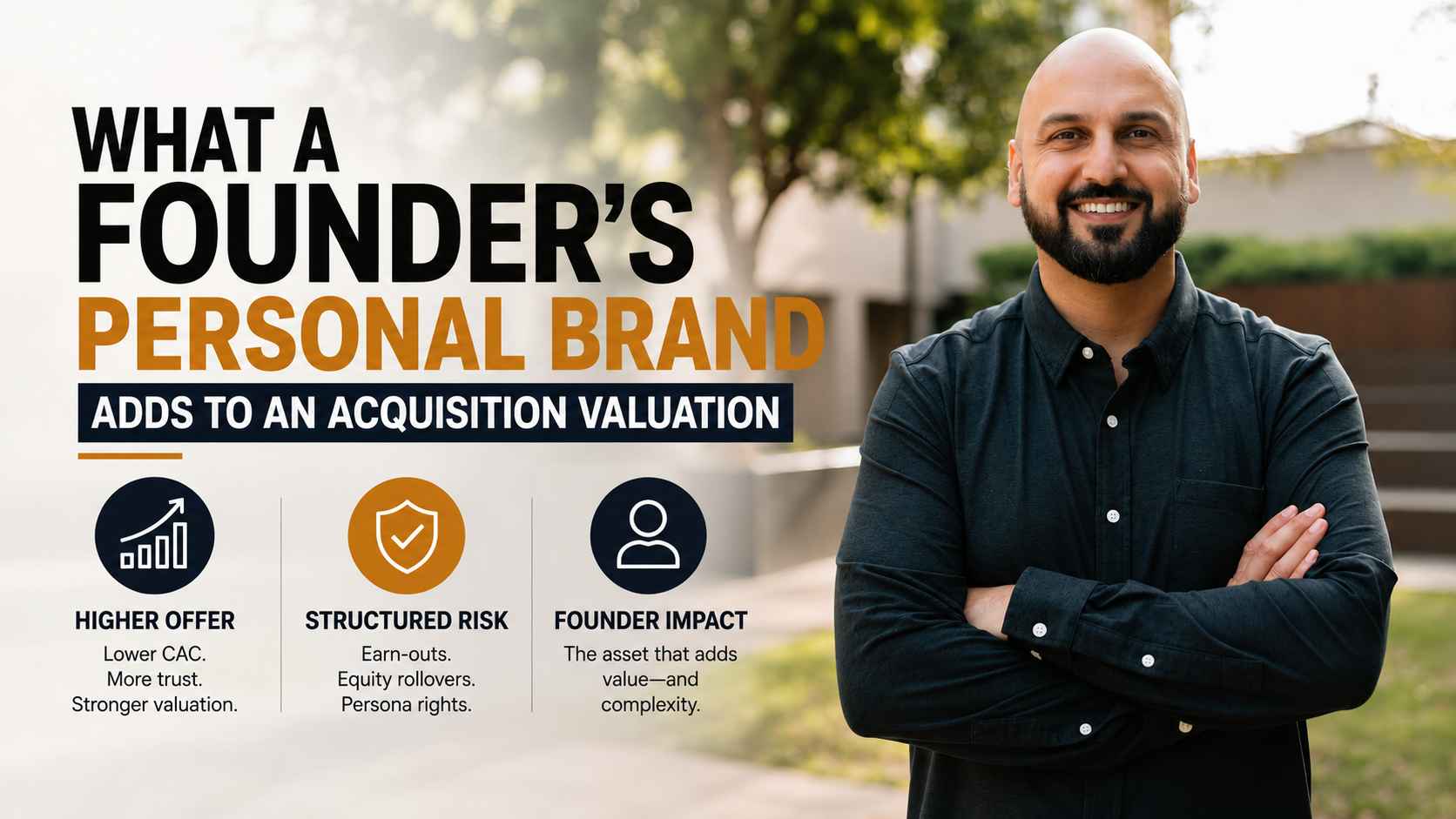
A founder's public authority does two things simultaneously as a company approaches acquisition. It raises the price a buyer offers, since organic trust lowers customer acquisition costs and signals category leadership rather than generic competition.
It also raises the buyer's concern, since a business whose performance depends on one person's continued presence carries real risk if that person leaves after the sale closes.
Buyers do not ignore either effect. They pay for the first and structure the deal around the second, which is why a strong personal brand rarely produces a simple higher number and nothing else. It produces a higher number attached to conditions.
What Raises the Valuation

A founder's personal brand raises valuation through the same mechanisms ROAC measures elsewhere. Identity value, being recognized as the category authority rather than one competitor among many, lets a buyer underwrite premium positioning instead of commodity pricing.
Trust value lowers the customer acquisition cost baked into the buyer's cash flow model, since inbound demand costs less to convert than paid acquisition.
Leverage value, the compounding recognition that keeps producing inbound after the founder's active involvement decreases, is the closest thing to pure transferable goodwill a personal brand creates.
Buyers underwriting an acquisition build these into the cash flow projections the offer rests on. A founder who shows inbound volume, conversion rates, and acquisition costs tied to the brand gives the buyer real numbers to price rather than a story to discount.
What the Buyer Prices as Risk Instead
The identical brand becomes a liability the moment a buyer asks what happens if the founder leaves. Founder-led brands can decline quickly when the founder's involvement ends or the founder's public standing changes.
Logan Paul's Prime Energy is a documented example: the brand's UK sales reached £112 million in 2023 and declined 70 percent the following year, illustrating exactly the dependency buyers structure deals to protect against.
How Buyers Structure Around the Risk
Buyers rarely walk away from a founder-led brand over this risk. They structure the deal to manage it instead. Earn-outs condition part of the purchase price on post-closing performance, keeping the founder financially tied to results after the sale.
George Clooney's sale of Casamigos included an earn-out period extending as long as ten years. Hailey Bieber's sale of Rhode included an earn-out accounting for roughly 20 percent of the deal.
Equity rollovers work similarly, requiring the founder to keep a stake rather than exit with cash immediately, aligning incentives without the litigation risk earn-outs sometimes create once operational control shifts.
Persona rights add a second layer specific to founder-led brands. Where the brand depends on the founder's name, image, or story, buyers negotiate explicit licenses covering how that persona gets used after the sale and what happens to those rights when the agreement ends.
Keurig Dr Pepper's investment in Nutrabolt paired a minority stake with a long-term commercial relationship, letting a buyer gain exposure to a founder-led business without a full acquisition until the dependency question resolves over time.
Transferable Value vs Founder-Locked Value
The real distinction to track long before any acquisition conversation starts is whether the brand's value transfers to the company or stays locked to the person. Attention rented from a platform belongs to the platform, and authority built into owned systems belongs to the founder: the same logic applies at exit.
A founder whose authority lives in personal charisma and unrepeatable presence has built value a buyer only accesses by keeping the founder locked in through earn-outs and persona licenses. A founder whose authority lives in documented systems, a content library, and an owned audience has built value that transfers with the sale.
Neither structure is wrong. A founder planning to stay fully engaged for years after a sale can build the personal, presence-dependent kind without penalty. A founder wanting a clean exit needs the transferable kind built well before negotiations start, since it cannot be assembled retroactively during due diligence.
Transferable vs Founder-Locked Brand Value
Attribute | Transferable brand value | Founder-locked brand value |
Source | Documented systems, owned audience, content library | Personal charisma, unrepeatable presence |
Buyer's structure | Straightforward acquisition, lighter earn-out | Extended earn-out, persona license, equity rollover |
Post-sale founder freedom | High, obligations end near closing | Low, tied to multi-year performance and licensing terms |
Risk to buyer | Lower, value survives founder's departure | Higher, value depends on continued founder involvement |
Building Toward the Exit You Want

The work of shifting authority from founder-locked to transferable starts years before a sale, not during it. Attracting investors runs on the same underlying trust a later acquisition depends on, though the diligence questions differ: investors ask whether the founder can build the company, and acquirers ask whether the company survives without the founder.
Building the systems, documentation, and owned audience that answer the second question is part of what personal brand consulting for founders prepares a founder for well ahead of any exit conversation.
A founder's personal brand raises the offer and raises the buyer's caution in the same motion. The valuation gain is real. The deal structure that follows depends entirely on whether the brand's value transfers to the company or stays locked to the person who built it.
Does a Strong Personal Brand Always Increase Acquisition Value
It increases the headline valuation while also introducing key-person risk that shapes deal structure. The net effect is usually positive, though the value often arrives attached to earn-outs or persona licensing rather than a clean, unconditional price.
What Is an Earn-Out and Why Do Founder-Led Deals Use Them
An earn-out conditions part of the purchase price on performance after the sale closes, keeping the founder financially invested in results. Founder-led brands use earn-outs more often than typical acquisitions because buyer and founder incentives need explicit alignment when brand value depends on continued involvement.
What Are Persona Rights in an Acquisition
Persona rights cover a buyer's license to use the founder's name, image, likeness, or story after the sale, along with restrictions on how the founder can use that same persona outside the business. Deals resting heavily on founder identity typically require a separate persona rights agreement beyond standard employment terms.
How Does a Founder Reduce Key-Person Risk Before Selling
Building documented systems, an owned audience independent of any single platform, and a content library that carries the position without daily founder involvement all reduce key-person risk. The goal is authority that survives the founder's reduced presence, assembled years before due diligence begins.