
The post grounds the mechanism in two peer-reviewed studies (Damasio's somatic marker hypothesis and Zajonc's mere exposure effect), uses Alex Hormozi's Acquisition.com as a public proof point, and maps the four vertical-integration layers (Creation, Distribution, Monetization, Community) that compound into an invisible funnel.
Key Takeaways
Acquisition.com sold 2.9 million copies of $100M Money Models at $29 in 24 hours, breaking the Guinness record for fastest-selling nonfiction book.
Damasio's somatic marker hypothesis (Philosophical Transactions B, 1996) shows decisions are embodied before they are rationalized.
Zajonc's mere exposure research (Journal of Personality and Social Psychology, 1968) shows repetition produces preference without cognitive processing.
The Personal Media Company has four vertical layers: Creation, Distribution, Monetization, Community. The sales page is downstream of all four.
Authority compounding produces the trust the sales page is supposed to manufacture, weeks or months before any pricing conversation.
The Jensen Huang register builds the same invisible funnel as the Elon register, with quieter content and slower cadence.
The Sales Page Is the Surface, Not the Mechanism

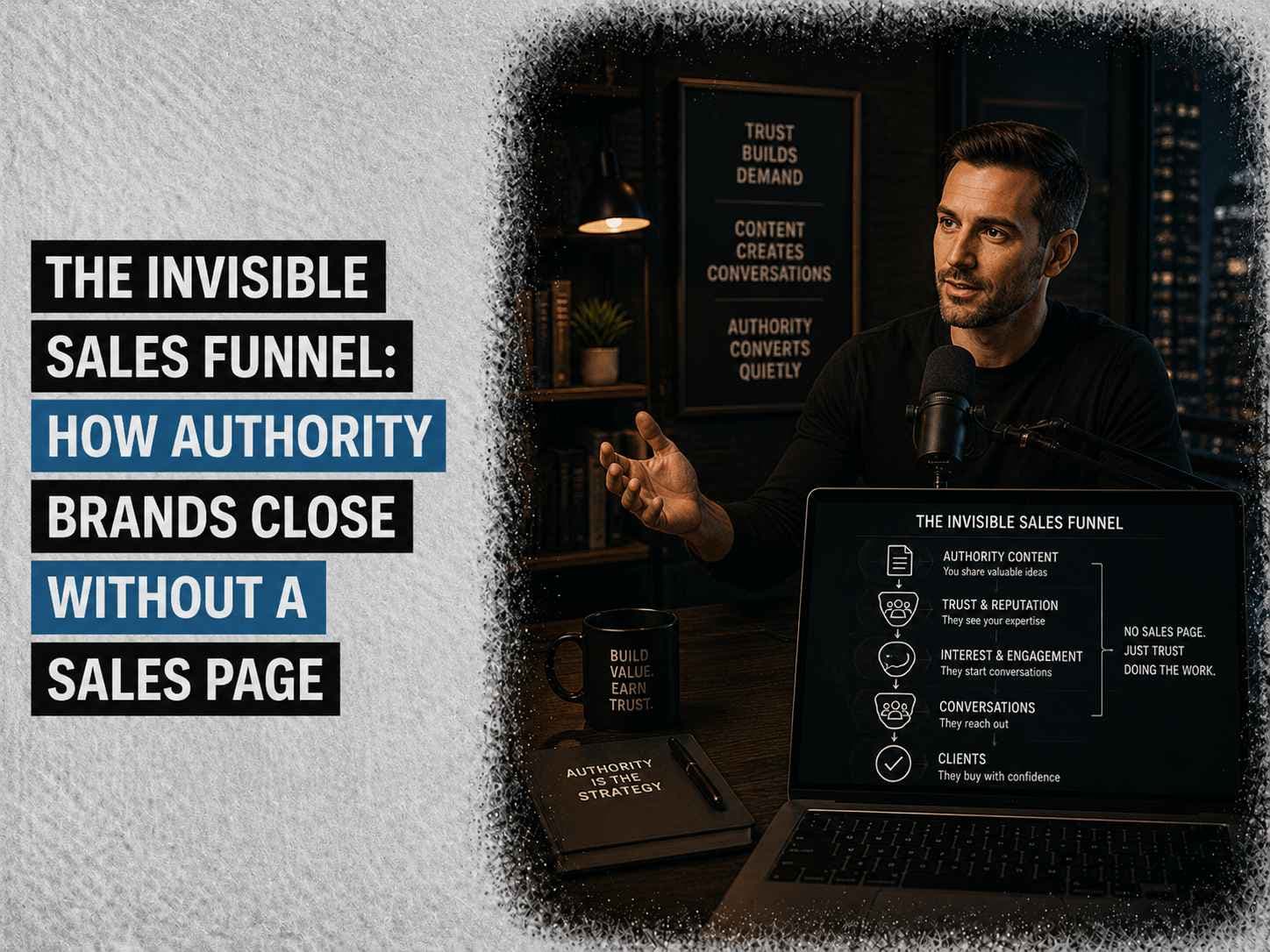
Most founders iterate on a piece of real estate that does not produce the trust it claims to produce. They rewrite headlines. They split-test CTAs. They debate the placement of testimonials. They behave as if the sales page is the thing that closes the deal. It is not. The sales page is the place where someone documents a decision that has already happened somewhere else.
Authority brands know where the decision really happens. It happens in the audience's body. In their inbox. In their browser tabs. In their mental model of the founder, over weeks and months of consumption. By the time the prospect lands on the sales page, the page is reading a verdict back to them. It is not producing one.
This is why authority brands look like they sell without selling. They are not skipping the sales process. They have moved the entire process upstream of the page. The page survives as a formality. Everything important happened before the prospect arrived.
Acquisition.com Sold 2.9 Million $29 Books in 24 Hours Without a VSL
When Alex Hormozi launched $100M Money Models in August 2025, the book moved 2.9 million copies in 24 hours. The launch broke the Guinness World Record for fastest-selling nonfiction book. There was no video sales letter. There was no nine-email drip sequence.
There was no manufactured scarcity. There was a brand that had already produced enough proof, enough free playbook, enough framework density. The audience treated the book launch as a small request from a known authority.
Hormozi's brand architecture operates on five layers: Proof Before Personality, Frameworks Over Feelings, Generosity as Strategy, Media as Infrastructure, Operator Leverage. None of those layers live on a sales page. All of them live in the years of content that came before the book launch. There was no VSL. There was no drip sequence. There was a brand that had already done the work.
The lesson is not that Hormozi got lucky. The lesson is that the invisible funnel makes the visible one optional.
The Personal Media Company Is the Invisible Funnel

GURU, INC. is built around a framework I call the Personal Media Company Model. The model is simple. A PMC is the vertically integrated entity a founder builds around their identity. It manufactures confidence across every stakeholder group whose belief moves the business. It is not a marketing function. It is the asset that makes the product sellable. The sales page is downstream of the PMC, not the other way around.
Running a marketing agency years ago, I sat next to someone at a conference and mentioned a blog post I had written. I shared it, she hired the agency, and the contract ran more than a year at $3,000 per month. One tangible piece of writing produced tens of thousands of dollars from one conversation. That blog post was not a sales page. It was the invisible funnel doing what the sales page would have to do otherwise.
That same pattern repeats at every scale. A video. A framework. A book. A keynote. The PMC produces tangible artifacts the founder can hand to a stranger, and the artifact carries the proof.
The Decision Happens in the Body Before It Reaches the Brain
Antonio Damasio formalized this in 1996 with the somatic marker hypothesis. The paper appeared in the Philosophical Transactions of the Royal Society B. The hypothesis describes how emotional and bodily signals guide rapid decisions before the conscious mind catches up.
Those signals are processed in the ventromedial prefrontal cortex and the amygdala. Damasio's Iowa Gambling Task experiments showed something striking. Control subjects developed skin-conductance responses anticipating bad decisions seconds before they could articulate why. The body knew. The brain rationalized.
This is what happens to a buyer who has consumed a founder's work for months before a sales conversation. The somatic markers have already fired. Trust has accumulated in the same neural circuits that fire when we recognize a friend. By the time the prospect lands on a discovery call, they are not weighing options. The discovery call is the rationalization. The decision happened in the body weeks earlier.
A sales page asks the prefrontal cortex to make a decision. The prefrontal cortex is the second responder. The first responder already left the room. This is the biology of brand building at work.
Mere Exposure Builds the Trust the Sales Page Is Supposed to Build
Robert Zajonc demonstrated the mere exposure effect in 1968 in the Journal of Personality and Social Psychology. The finding has been replicated across six decades. Repeated exposure to a stimulus produces affective preference without conscious cognitive processing. The audience does not need to be persuaded. They need to be familiar. Familiarity is the persuasion.
Zajonc later proposed the affective primacy hypothesis. Affective reactions can be elicited with minimal stimulus input. Neuroscience research on the underlying circuit shows two effects. The amygdala becomes less reactive to repeated stimuli. The prefrontal cortex signals acceptance.
The body decides the founder is safe long before the mind decides the offer is good. The audience is not waiting to be convinced. They are waiting to recognize a face they have already seen.
A sales page is one exposure. A PMC is thousands. The authority signals that compound across Google, YouTube, and AI are what produce mere-exposure-grade familiarity at scale. The sales page can not catch up.
The Invisible Funnel Compounds Across Four Layers

A Personal Media Company is vertically integrated across Creation, Distribution, Monetization, and Community. Creation is the IP layer: frameworks, stories, named concepts, books. Distribution is the channel layer: owned email, podcasts, social platforms, earned press.
Monetization is the revenue layer: products, speaking, licensing, consulting. Community is the relationship layer: an audience that exists on owned infrastructure, not rented platforms. Each layer feeds the next.
I see this in real time with GURU, INC. The book led to a Florida speaking engagement at a social media conference, the Distribution layer in action. The Florida talk produced a conversation with a senior person at a hundreds-of-millions enterprise company, which led to their founder. That deal is in motion, and the same connection opened an adjacent enterprise relationship that converted. One book. Four layers. Multiple deals.
The sales page approach can not produce this. A sales page is one transaction at a time. A PMC produces a brand moat that keeps producing transactions. The founder can stop thinking about the original asset and the asset keeps working.
The Elon Register Is Not the Only Register
Most founders who resist building a PMC are resisting one specific version of it. The loud, frequent, spectacle-driven personality brand. They picture Elon Musk. They opt out. They assume the only alternative to a sales funnel is a high-decibel personality machine. That is not the work they want to do.
The Jensen Huang register exists. Quiet. Selective. Deep. Two keynotes a year. One annual letter. A handful of carefully chosen interviews. The substance is the surface. Jensen built the same invisible funnel Elon built, in a completely different key. Nvidia's narrative multiple shows the math holds. Martha Stewart ran the same playbook for thirty years in yet another register. You do not have to be loud. You have to be intentional.
The Sales Page Is the Receipt, Not the Sale
Most founders build the sales page first, then try to drive traffic to it, then wonder why the conversion rate is low. The order is wrong. Build the invisible funnel first. Build one named framework. Publish one essay you can hand to a stranger. Record one conversation that lives forever. Repeat until the artifacts compound into a body of work strangers can find on their own.
The sales page becomes the receipt that documents what already closed. The conversion math improves not because the page got better, but because the prospect arrived already decided. Founders who build the kind of consulting work that closes inside the broader economics of authority share one trait.
They do not have better sales pages than their competitors. They have a personal media company sitting upstream of the page. The PMC does the work the page was never able to do alone.
Frequently Asked Questions
Can you really sell high-ticket consulting without any sales page at all?
Yes, when the audience arrives with enough prior context to qualify themselves. The page becomes optional once the personal media company has produced the trust. Most founders still keep a minimal page as a destination, but the page no longer carries the conversion weight.
What is the minimum content footprint to act as an invisible funnel?
One named framework, one published essay or video that explains it, and one destination where the framework lives in full. That is enough to start. The footprint grows with use; what matters is that something exists for a stranger to find or be handed.
How long does it take for a personal media company to start generating clients?
The first inbound conversations usually surface inside 90 days of consistent publishing. Compounding authority that produces enterprise-level conversations typically takes 12 to 24 months. The early period feels slow because the somatic markers in the audience are still forming.
Do I still need a website if my content does the selling?
Yes, but as a destination, not a funnel. The website is where strangers verify what they already suspect. Schema, named frameworks, and indexable content make the site act as a trust receipt, which is a different job than acting as a conversion machine.
What is the difference between a personal brand and a personal media company?
A personal brand is the perception. A personal media company is the production system that creates and maintains the perception across owned distribution. Brands break when the founder stops posting. PMCs keep working because they are infrastructure, not effort.