


The scorecard below holds nine KPIs, three per value, each one chosen because it predicts revenue. One review cycle replaces the dashboard.
Key Takeaways
Founder brand KPIs answer to revenue, never to the feed. A KPI earns its place by forecasting pipeline.
The scorecard organizes nine KPIs under the three ROAC values: identity, trust, and leverage.
Identity KPIs test whether the market knows the founder for one specific thing.
Trust KPIs test whether the audience acts on the founder's judgment.
Leverage KPIs test whether the attention compounds without new spend.
Do not track what flatters. Track what forecasts.
Founder Brand KPIs Answer to Revenue, Not to the Feed
A founder scorecard exists to forecast revenue, and most founder reporting forecasts nothing. The monthly review reads the same everywhere: "Followers up 12 percent, engagement up 8, impressions doubled."
Every number describes the feed. None describes the business, and the full case against that dashboard lives in ROAC versus vanity metrics.
The gap exists because KPI literature covers companies, not founders. Startup scorecards track burn, churn, and CAC while the founder brand, the asset producing inbound demand, runs unmeasured or runs on applause.
Revenue-linked KPIs versus vanity dashboards is the split this page resolves: nine signals, each with a defined revenue connection, reviewed on a fixed cadence.
The Scorecard Structure: Three Values, Nine KPIs

The scorecard I run inside every engagement organizes nine KPIs under ROAC, Return on Attention Created, the framework from GURU, INC. by AJ Kumar. The structure follows the framework's logic.
Identity value, trust value, and leverage value are the three outcomes attention creates, so every KPI maps to one value, and every value maps to revenue through a defined path: identity drives selection, trust drives conversion, leverage drives compounding inbound.
The mapping is the discipline. A proposed KPI that fits no value measures noise, however precise the number looks. Three KPIs per value keeps the scorecard readable in one sitting, which is the difference between a scorecard and a second dashboard.
Identity KPIs: Is the Founder Known for One Thing
Identity KPIs test whether the attention fixed the founder in the market's mind as the authority on one subject. The three identity KPIs are given below:
Branded search trend. Searches for the founder's name and name-plus-topic, read from Search Console. Rising branded search means the market is looking for the person, not discovering them by accident.
Position repetition rate. How often audience members repeat the founder's argument in their own words: comments, replies, posts. Repetition is identity value speaking out loud.
Introduction accuracy. How hosts, buyers, and referrers introduce the founder. An accurate introduction means the market memorized the positioning. A vague one means the positioning never landed.
Trust KPIs: Is the Audience Acting on the Judgment
Trust KPIs test the move from consuming to acting, because belief without action funds nothing. The three trust KPIs are given below:
Inbound conversations with intent. Calls booked, messages citing specific content, replies asking commercial questions. Counted monthly, with the citing piece logged.
Content-attributed pipeline. Deals whose first touch traces to the founder's content, captured from sales notes in the buyer's own words. The single strongest number on the scorecard.
Owned-list action rate. Email subscribers gained plus reply and click behavior. Owned access acting is trust the algorithm never mediates.
Leverage KPIs: Is the Attention Compounding
Leverage KPIs test whether the attention keeps working after the posting stops. The three leverage KPIs are given below:
Aged-content inbound. Inquiries citing pieces older than 90 days. Attention that expires on posting scores zero here regardless of its launch numbers.
Evergreen view share. The share of this month's views arriving on the back library rather than the newest posts. A rising share means the library became an asset.
Unprompted citations. Third parties referencing, quoting, or listing the founder without outreach. Compounding recognition arrives uninvited.
Running the Scorecard: Cadence and the Revenue Anchor
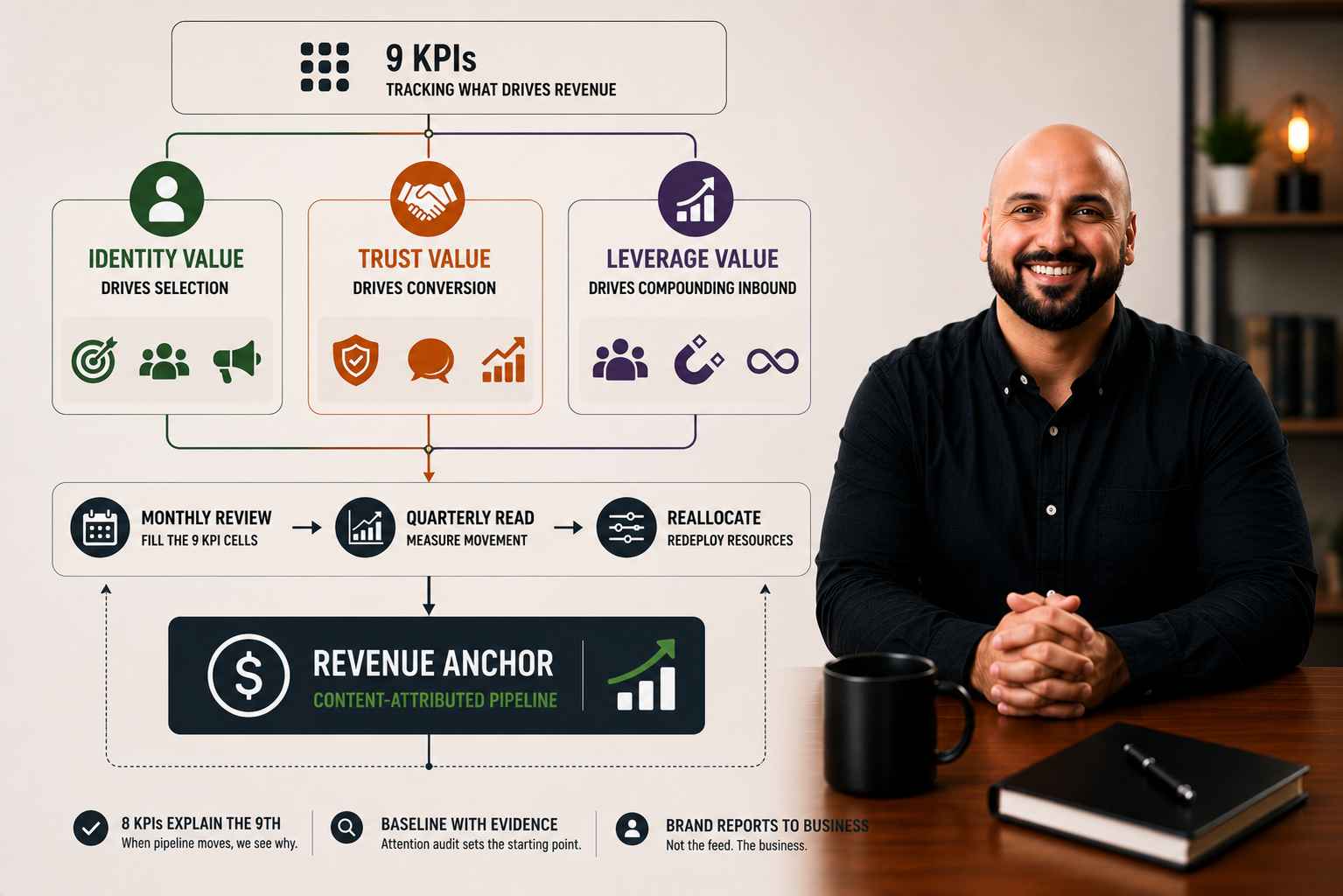
The scorecard runs monthly, reads quarterly, and anchors to one number: content-attributed pipeline. The monthly review fills the nine cells. The quarterly read looks for movement and feeds the reallocation decision, the same rhythm defined in how to measure ROAC.
Eight KPIs explain the ninth: when attributed pipeline moves, the identity and leverage columns show why, and when it stalls, they show where.
Setting the baseline takes one diagnostic pass, which is the job of the attention audit: score the existing library, fill the scorecard for the first time, and plan the next quarter against evidence.
Installing the scorecard, the cadence, and the reporting inside a founder's operation is part of personal brand consulting for founders, and it is usually the first time the founder's brand reports to the business instead of to the feed.
Personal brand KPIs track the three values attention creates, identity, trust, and leverage, anchored to content-attributed pipeline and reviewed monthly. Nine signals replace the dashboard, and each one forecasts revenue. Do not track what flatters. Track what forecasts.
How Many KPIs Belong on a Founder Scorecard
Nine, three per ROAC value, plus the pipeline anchor. A longer list recreates the dashboard problem the scorecard exists to solve. Fewer than three per value leaves a blind spot in identity, trust, or leverage.
Which Personal Brand KPI Matters Most
Content-attributed pipeline matters most, because it connects the brand directly to revenue in the buyer's own words. Every other KPI on the scorecard exists to explain, predict, or grow that single number.
How Do Founders Track Branded Search
Founders track branded search in Google Search Console: queries containing the name and name-plus-topic combinations, read as a monthly trend. Autocomplete suggestions on the name add a qualitative signal of what the market associates with it.
Are Impressions Ever a Useful KPI
Impressions work as context inside the leverage read, where the evergreen view share needs a denominator. Impressions fail as a standalone KPI because the number reports the algorithm's distribution decisions, never the audience's belief or the business's pipeline.