
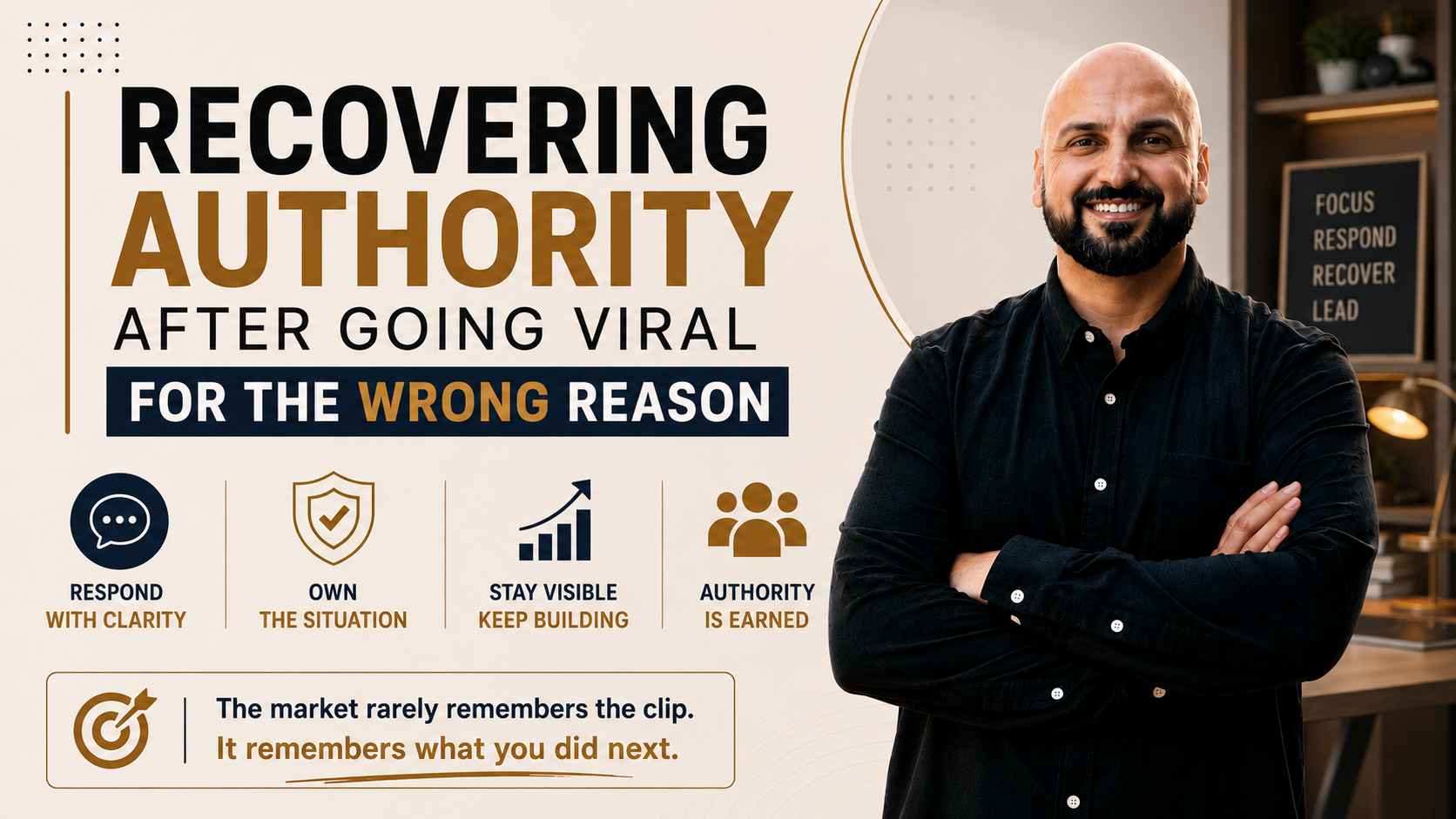
A bad clip, a misread comment, a controversial opinion that spread past the room it was meant for. The moment itself fades fast. What the market remembers is what the founder did next.
Key Takeaways
The market judges the response to a viral moment more closely than the moment itself.
Going dark reads as guilt. Staying visible with a clear answer reads as ownership.
Founders confuse two different situations: a genuine misstep and a misunderstanding. Each needs a different response.
Rebuilding authority happens through continued, ordinary output, not one polished statement.
This is founder authority work, separate from corporate crisis PR and separate from personal safety response.
What This Post Is and Is Not About
This covers a founder's public authority after a viral controversy tied to something they said or did. It does not cover corporate crisis communications for a company-wide incident, and it does not cover personal safety response for private individuals facing harassment or doxxing.
Those are real situations with their own playbooks. This post stays on one question: how a founder's market authority survives a viral moment and what rebuilds it afterward.
The Market Judges the Response, Not the Moment

Most viral controversies fade within days. What outlasts the moment is the founder's own reaction, saved, screenshotted, and referenced long after the original clip stops circulating. A founder who responds well often ends up with more trust than before. A founder who mishandles the response turns a small moment into a defining one.
This is the same pattern covered in reputation management for executives: perception forms fast, and the response is the actual content the market evaluates. A viral moment simply compresses the timeline. The founder has hours, not months, to show the market who they are.
Two Different Situations, Two Different Responses
The Genuine Misstep
A founder said or did something wrong. The clip is accurate. The context does not save it. This calls for direct ownership: name what happened, name why it was wrong, and name the change going forward. No hedging, no blaming the clip's framing.
The Misunderstanding
A comment gets clipped out of context, or an opinion gets flattened into something the founder never said. This calls for a calm, factual correction, not a defensive one. State what was said or meant, once, clearly, and stop. Repeating the correction across every platform reads as arguing. One clear statement, placed where people are looking, does more work than a dozen defensive replies.
Confusing the two is the most common mistake. A founder who over-explains a genuine misstep sounds like they are making excuses. A founder who apologizes for a misunderstanding they did not create looks like they have something to hide.
Going Dark Is the Costliest Response
Founders instinctively want to disappear after a viral moment. Deleting posts, going silent, waiting for it to pass. Silence does not make the moment pass faster. It hands the narrative to whoever is still talking, and virality guarantees someone is still talking.
A founder who stays visible, posting the usual work, answering the direct question once, keeping the account active, signals steadiness. A founder who vanishes signals guilt, whether or not any exists. The instinct to hide is understandable. It is also the response the market punishes hardest.
Rebuilding Happens Through Output, Not a Single Statement

One well-written response does not rebuild authority on its own. Authority rebuilds the same way it built the first time: through consistent, visible work that the market can watch and judge over weeks. The response opens the door. What comes after walks through it.
This is a trust value question in the same sense ROAC measures trust elsewhere. A single statement moves the needle once. Continued, ordinary output, unchanged in substance from before the moment, is what convinces the market the founder is stable. The viral moment becomes one clip in a long record instead of the whole record.
The Comparison: What Recovers Authority and What Does Not
Response | Effect on authority |
Direct ownership, once, in plain language | Rebuilds trust fastest |
Over-explaining a genuine misstep | Reads as excuse-making |
Silence or deleting the account | Reads as guilt |
Repeated defensive corrections | Reads as arguing |
Continued visible output after the response | Signals stability over time |
One polished statement with no follow-through | Fades without rebuilding anything |
Recovering Founder Authority After Virality
A viral moment tests a founder's authority for a matter of days. The recovery tests it for months. Name the situation correctly, misstep or misunderstanding, respond once in plain language, and stay visible while the record rebuilds itself through ordinary, continued work. The market rarely remembers the clip as clearly as it remembers what the founder did after.
Should a Founder Delete Content That Went Viral for the Wrong Reason
Rarely. Deleting content often reads as an admission with nothing else attached. Leaving it visible alongside a direct response shows the founder addressed it rather than hid it.
How Fast Should a Founder Respond to a Viral Backlash
Within the first day, once the situation is understood clearly. Waiting too long lets outside narratives set first. Responding within minutes, before the full context is clear, often produces a worse statement than a same-day response would.
Does Every Viral Moment Require a Public Statement
No. A minor, fast-fading moment sometimes resolves on its own. A moment tied to a genuine misstep, a misquote gaining real traction, or a controversy affecting business relationships usually needs a direct, public response.
How Long Does It Take to Rebuild Authority After a Viral Controversy
Visible recovery signals often appear within weeks: steady engagement, continued inbound, unchanged tone in public replies. Full authority recovery follows the same pattern as building it the first time, compounding over months through consistent, visible work.