
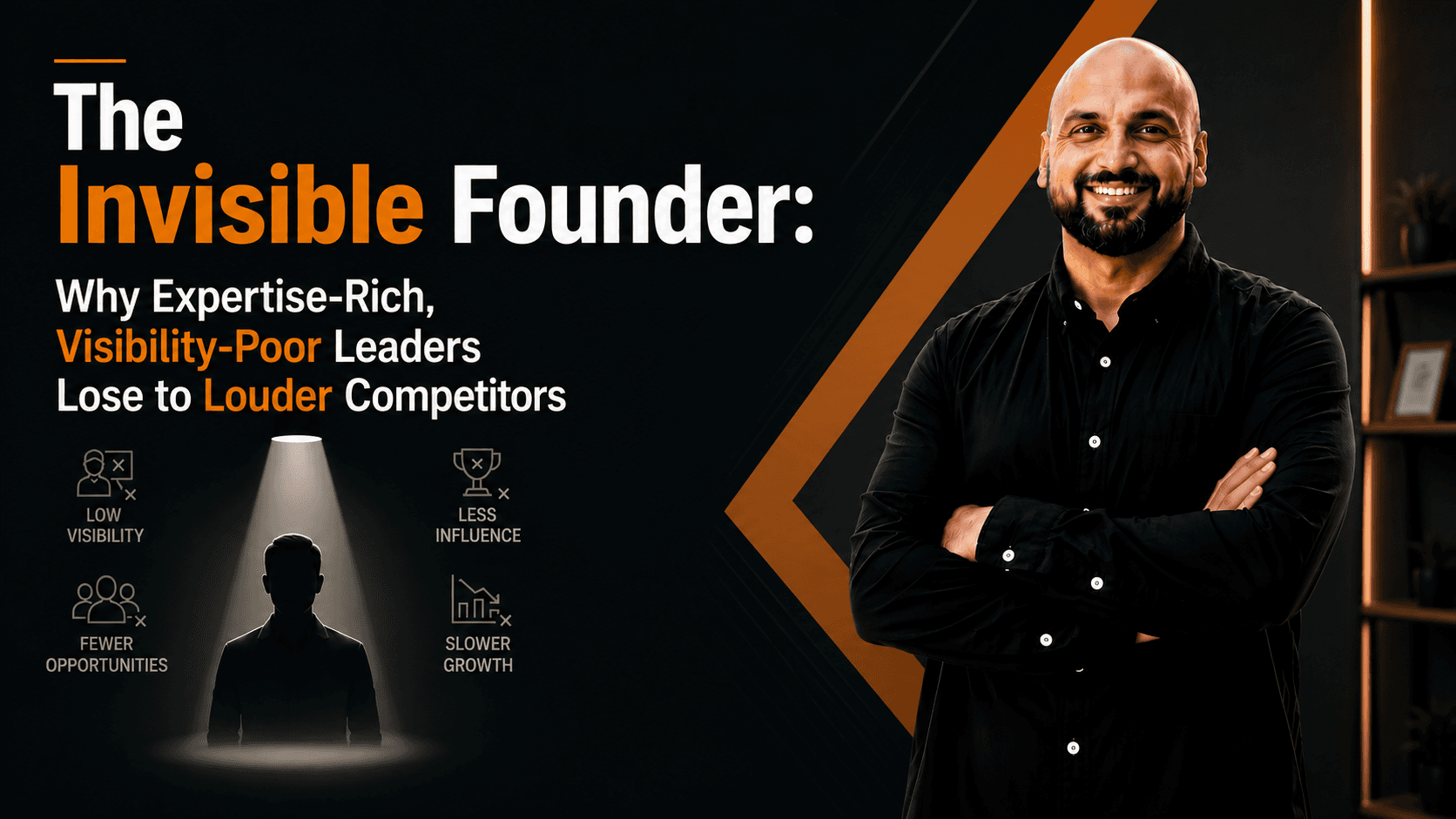
The gap between how good a founder is and how known a founder is has a cost, and the cost never appears on any report. This page itemizes the bill and names the repair.
Key Takeaways
The visibility gap is the distance between a founder's share of competence and share of mind, and markets buy from memory.
Invisibility's costs are silent: the inquiries never sent, referrals never made, and premium pricing never available.
Three sentences keep capable founders invisible, and every one of them sounds like integrity while functioning as a ceiling.
Louder is never the repair. Volume without position is the opposite ditch, and it builds nothing either.
The repair has three moves: one position, public-shaped proof, and a presence system run like a media operation.
Invisible excellence loses to visible competence. Visible excellence loses to nobody.
The Visibility Gap Is a Market Measurement Error
Markets do not buy the best option. Markets buy the best option they remember, and the two lists rarely match. A founder holds a share of competence: how good the work is against the field. The market assigns a share of mind: how often the founder's name surfaces when the problem does. The visibility gap is the distance between the two shares, and revenue follows the second one.
Being the best versus being seen is the split every expertise-rich founder eventually meets. The work compounds privately: better delivery, deeper judgment, stronger results. The recognition compounds publicly or not at all. A founder who invests only in the first share becomes the industry's best-kept secret, and secrets do not receive inquiries.
The Silent Ledger: What Invisibility Costs Without a Receipt

Invisibility feels free because its losses never generate a record. The lost deal appears in no CRM, because the inquiry was never sent. The buyer researched the space, found three visible names, and shortlisted them; the invisible founder lost a race nobody told them was running.
The invisible sales funnel runs on silent research and silent decisions, and a founder with no presence never enters it.
The ledger runs longer than deals. Referrals route to the name the referrer remembers. Talent chooses the founder they have heard of. Podcasts, panels, and press invite the visible.
Pricing anchors to perceived standing, so the invisible founder wins work through discounts the visible competitor never offers. Every line item shares one property: the founder never sees the loss, so the problem reads as a slow market instead of a missing presence.
The Sentences That Keep Founders Invisible
Three sentences hold the ceiling in place, and each one sounds like a principle. "My work speaks for itself." Work speaks only to the people already in the room, and the room holds a dozen people. "Self-promotion is for people without substance."
Publishing judgment is not promotion; silence is not substance. "Our clients know us, and that is enough." Retention is not demand, and a referral-only pipeline is a pipeline one relationship deep.
GURU, INC. names this pattern the Virus of Limited Thinking, VOLT: the internal objections that keep capable founders small while sounding like integrity.
I have heard all three sentences from founders running eight-figure operations, delivered with pride, while their least-qualified competitor booked the keynote, the coverage, and the deal.
Louder Is Not the Fix, and the Fear of Noise Is Half the Problem

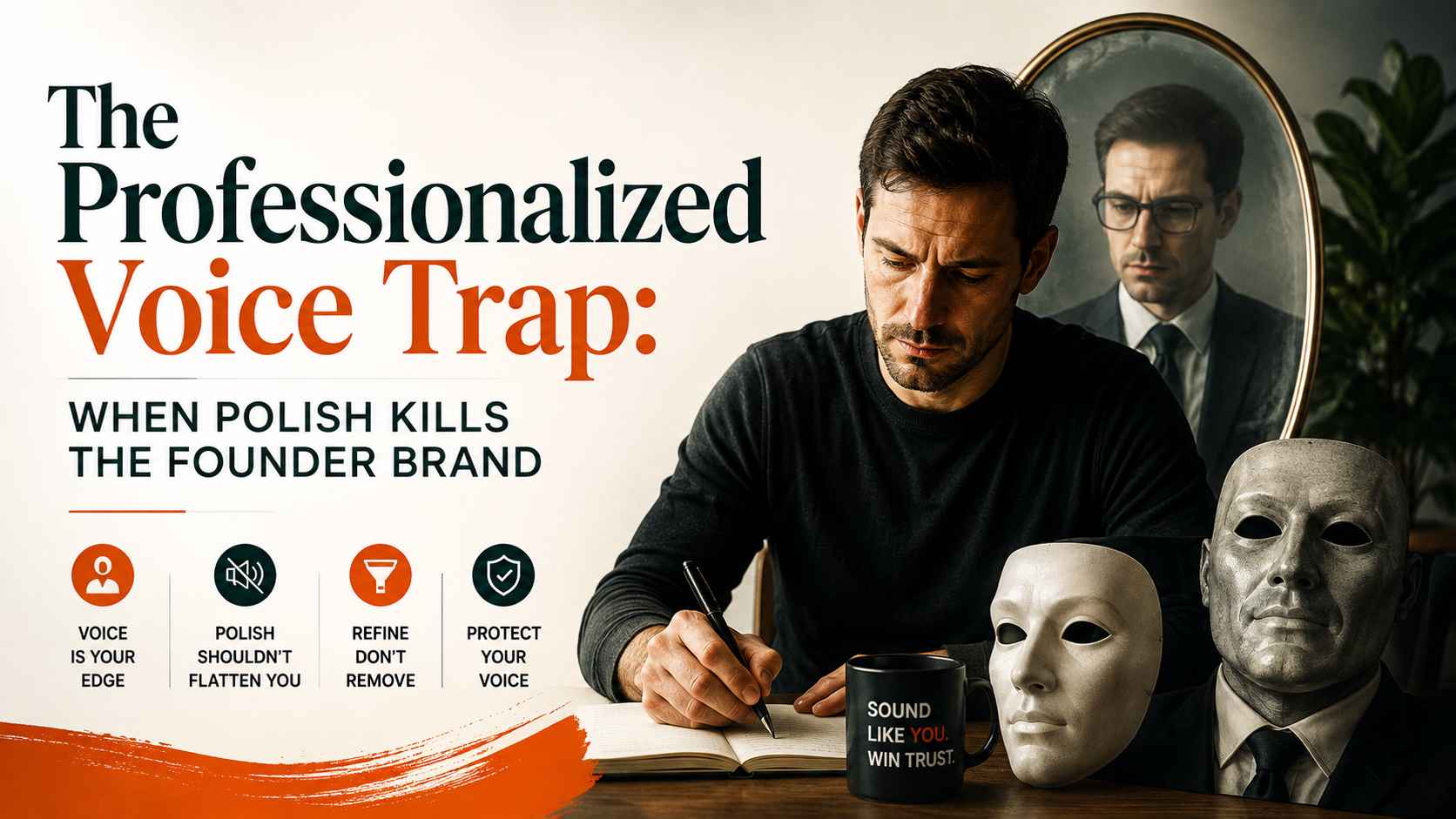
Invisible founders resist visibility because they picture the only alternative as noise. The picture is not wrong about the noise. Volume-first founders flood every channel with content that argues nothing, and more content with no authority is the opposite ditch: fully visible, entirely forgettable. The invisible founder looks at that ditch and chooses silence, which is trading one failure for a quieter one.
Authority-first visibility is the road between the ditches. The output is smaller and pointed: one market position argued repeatedly, evidence attached, in the rooms where the buyers already are.
Visibility built this way reads as judgment, not promotion, because every appearance deposits into the same argument. The founders who fear looking like marketers are the founders best equipped to avoid it: they own the substance the noise-makers fake.
The Repair: From Invisible Operator to Recognized Authority
The repair has three moves, and the order is fixed.
First, the position: the one market judgment the founder defends better than anyone, stated in a sentence the audience repeats.
Second, the proof: private results reshaped into public evidence, patterns, numbers, and named outcomes where permission exists.
Third, the presence system: the founder operating like a media company rather than an occasional poster, which is the architecture the Personal Media Company Model defines: programming, distribution, and measurement running on a schedule the founder controls.
Expertise-rich, visibility-poor founders are the exact persona personal brand consulting for founders was built for: the substance already exists, the results already exist, and the engagement builds the visible architecture around them. The invisible founder's advantage is real, because presence is easier to add to expertise than expertise is to add to presence.
The invisible founder loses to louder competitors because markets buy from memory, and the losses never generate receipts. The repair is authority-first visibility: one position, public proof, and a media-grade presence system. Invisible excellence loses to visible competence. Visible excellence loses to nobody.
Why Do Less Qualified Competitors Win More Deals
Buyers shortlist from memory and research from visibility, so the founder with presence enters every silent race while the invisible expert enters none. Competence decides performance after the win. Share of mind decides who gets the chance to perform.
Is Self-Promotion Unprofessional for Founders
Publishing judgment differs from promotion. A founder arguing a market position with evidence performs the same act as publishing research: visible expertise. Promotion sells the person. Authority-first content demonstrates the thinking, and buyers experience it as help, never as an ad.
How Long Does Closing the Visibility Gap Take
Recognition signals move within the first months: rising branded search, more accurate introductions, audience members repeating the position. Revenue attribution follows near the one-year mark across my engagements, because trust compounds through repeated exposure before buyers act.
What Separates Visibility From Noise
Position separates them. Visibility with one repeated argument compounds into recognition, since every appearance deposits into the same account. Noise is presence without a position: high output, zero association, and an audience that scrolls past a name it never learned.