
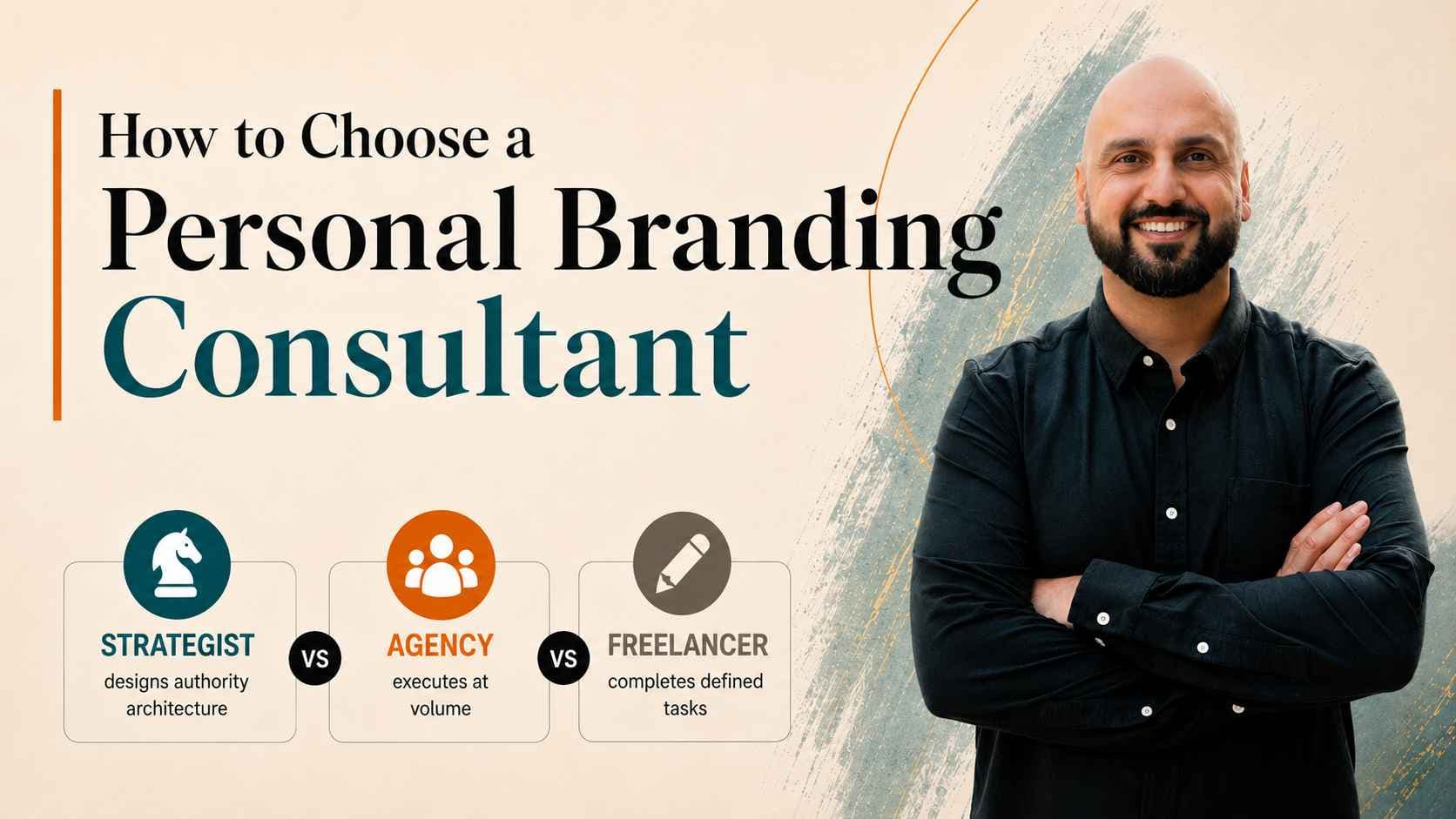
The three models sell different deliverables under the same job title, and scope ambiguity costs founders real money. AJ Kumar, personal brand strategist for founders and cofounder of Single Grain, compares the three models from inside both sides of the market.
Key Takeaways
A personal branding strategist sells positioning and authority architecture with direct senior attention throughout the engagement.
A personal branding agency sells team execution at volume, and quality depends on which people are assigned to the account.
A freelancer sells defined task output at the lowest cost, and the buyer supplies the strategy and the management.
Ownership separates the models. A strategist engagement leaves owned architecture. An agency retainer leaves rented capability. A freelance project leaves deliverables without a system.
Five criteria decide the fit: verified client results, the provider's own brand, scope clarity, cost structure fit, and chemistry on the discovery call.
Revenue stage matches the model. Expertise-rich, visibility-poor founders gain the most from the strategist model.
A Personal Branding Strategist Designs the Authority Architecture

A personal branding strategist designs the positioning, named frameworks, content architecture, and measurement systems that convert founder expertise into recognized authority.
The strategist works as the architect. The blueprint comes first: the market position the brand claims, the point of view that separates it, and the proof that carries the claim. Production follows the blueprint, never the reverse.
GURU Brand Strategy, the positioning architecture I apply across every engagement, starts at exactly that blueprint level. Positioning decisions made in week one govern every piece of content shipped in year three.
The work a personal branding consultant performs covers that definitional ground in full. Selection between provider types is a separate decision, and the differences are structural.
The strategist model carries an honest limitation. The founder stays engaged, since the brand voice is the founder's own. A founder who wants zero involvement beyond an invoice mismatches this model. Senior attention flows both directions in a strategist engagement, and the results depend on it.
A Personal Branding Agency Executes at Volume Through a Team
A personal branding agency bundles strategists, writers, designers, and account managers into one engagement that executes at volume. The agency is the construction crew.
The team produces across platforms simultaneously, manages the calendar, and removes production from the founder's plate. Enterprises and executives who require coordinated multi-platform rollouts buy exactly that capability, and the agency model serves them well.
I speak about the model from the inside. I cofounded Single Grain in 2011 and grew the agency past $2 million in revenue with more than 70 clients, including Salesforce, Sony, and Airbnb. The agency model executes brilliantly at volume.
The same model routes senior attention across dozens of accounts at once. A founder brand runs on senior attention that refuses to be shared, and that conflict is structural, not a staffing accident.
The assigned-team question decides agency quality. The pitch meeting features the senior strategist. The delivery calendar often features the junior team. Founders ask which specific people perform the work before signing, since the invoice amount reveals nothing about the answer.
A Freelancer Executes Defined Tasks Without Owning the Strategy
A freelancer completes defined tasks: a bio rewrite, a profile design, a content batch, a single page. The freelancer is the skilled tradesman. The model wins on speed and cost, and a founder with a locked strategy buys capable hands without agency overhead. Direct access to the person doing the work is a genuine advantage of the model.
The structural gap is the system. Deliverables arrive on schedule, and the strategy behind the deliverables stays wherever the buyer left it. A founder hiring freelance execution supplies the positioning, the priorities, and the management.
Strategy vacuums produce busy calendars and flat authority, a pattern I have audited more times than any other in twenty years of this work.
Agency vs Freelancer vs Strategist: Seven Differences That Decide the Fit
The three provider models differ across seven attributes that decide the fit for a founder. The seven differences between an agency, a freelancer, and a strategist are given below:
Attribute | Strategist | Agency | Freelancer |
Sells | Positioning and authority architecture | Team execution at volume | Defined task output |
Senior attention | Direct and constant | Depends on the assigned team | Direct but narrow |
Cost structure | Project fee or advisory retainer | Highest monthly retainer | Lowest, hourly or per task |
Buyer's role | Decision partner | Approver | Manager and strategist |
Failure mode | Execution gap when the founder stalls | Junior team behind a senior pitch | Strategy vacuum |
After the engagement | Owned architecture that compounds | Rented capability that expires | Deliverables without a system |
Best for | Expertise-rich, visibility-poor founders | Enterprises running multi-platform volume | Founders with a locked strategy buying hands |
The failure-mode row deserves attention, since providers never volunteer it. Each model fails in a predictable direction. The strategist model stalls when the founder disengages. The agency model degrades when senior talent moves to larger accounts. The freelance model drifts when nobody owns the strategy.
The after-the-engagement row is the row the market hides. Two of the three models leave the founder with nothing that keeps working. One leaves an asset. The next section examines that difference, because AJ Kumar treats it as the deciding question of the entire comparison.
The best-for row ends the false debate. No model is universally superior. Each model wins a defined buyer, and the founder's job is recognizing which buyer they are.
The One Question That Separates the Three Models: Who Owns the Strategy After the Engagement
Ownership separates the three models more sharply than price. An agency retainer is rented capability. The content stops when the invoice stops, and the strategic thinking leaves with the team.
Dependency is the quiet product of the rental model. A freelance project leaves finished deliverables and no system connecting them. A strategist engagement leaves owned architecture: the positioning, the named frameworks, and the content systems keep producing after the work ships.
Rented capability expires. Owned architecture compounds. The ROI of personal branding for founders compounds precisely because the founder owns the asset producing the return. A founder comparing quotes compares monthly costs.
A founder comparing outcomes compares what remains in month thirteen. I have watched the second comparison reverse the first one in almost every serious evaluation.
Five Criteria for Choosing a Personal Branding Consultant

Five criteria separate a credible personal branding consultant from an expensive mistake. The five criteria are given below:
Verified Client Results
A credible provider shows named outcomes with specific numbers, not adjectives. A portfolio of polished visuals proves design capacity. Named clients with measurable authority outcomes prove branding capacity. The two are different products. Founders ask for the outcome behind the prettiest sample in the portfolio.
The Provider's Own Brand
A personal branding provider's own name search is the least fakeable sample in the portfolio. A provider selling founder authority demonstrates founder authority: clear positioning, a consistent point of view, and a page one they built for themselves. A weak provider brand predicts a weak client outcome.
Scope Clarity Before Signature
Strategy-only and done-for-you engagements are sold under the same job title, and the contract names which one arrives. Scope ambiguity is the single most expensive confusion in this market. Founders confirm in writing what is produced, what is advised, and what stays on the founder's plate.
Cost Structure Fit
A founder pays architecture prices only for architecture. Task pricing attached to strategy promises signals a mismatch, and strategy pricing attached to task deliverables signals the same mismatch in reverse. The deliverable defines the fair structure. Founders match the price format to the thing purchased.
Chemistry on the Discovery Call
A strong discovery call interrogates the founder's market before presenting any package. A provider who asks probing questions about positioning, buyers, and proof is designing. A provider who opens with a standard package is selling inventory. Founders read the difference within fifteen minutes.
Red Flags That Signal Wasted Spend in Any Model
Four red flags predict wasted spend regardless of the provider model. The four red flags are given below:
Guaranteed results inside 60 days. Authority accumulates on repetition and trust, and no credible provider compresses that timeline on demand. Darketing, the dark side of influence I document in GURU, INC., runs on exactly these promises.
Vague deliverables. A proposal without named outputs produces a dispute, not a brand.
A portfolio without named outcomes. Anonymous success stories carry the evidentiary weight of no success stories.
Selling defense to a founder without an asset. Some providers pitch monitoring and cleanup to founders who own nothing worth defending yet, inverting the honest sequence of authority building against reputation defense. Construction precedes protection.
Each flag shares one root: the provider profits from founder confusion about what is being purchased. Clarity is the founder's cheapest protection, and AJ Kumar treats a provider's resistance to clarity as a verdict in itself.
How Founders Match the Model to Their Revenue Stage
Revenue stage predicts the right provider model more reliably than budget alone. An early founder with a locked strategy and a short task list buys freelance hands and moves fast. An enterprise executive requiring coordinated volume across five platforms buys agency execution and pays for the crew.
A founder earning $30K to $500K per month, whose expertise outruns their visibility and whose growth still depends on referrals, faces an architecture problem, not a production problem.
Architecture problems route to the architect. The criteria above produce that answer on their own for that specific founder: senior attention, owned assets, scope clarity, and a provider whose own brand proves the method.
Personal brand consulting for founders starts at the blueprint, and I built the practice for exactly that founder after running the volume model at Single Grain for years.
A personal branding strategist designs the authority architecture a founder owns. An agency rents a team that executes at volume. A freelancer completes defined tasks. Founders choose by one question: who owns the strategy after the engagement ends.
How Much Does a Personal Branding Consultant Cost
Personal branding consultants price through three structures: hourly rates for task work, project fees for defined architecture, and retainers for ongoing advisory or execution. The structure reveals the engagement model before the number does. Founders match the pricing structure to the deliverable purchased.
Is a Personal Brand Coach the Same as a Personal Branding Consultant
A personal brand coach guides self-discovery through questions and exercises. A consultant recommends direction. A strategist designs and builds the authority architecture. Founders wanting guided reflection hire a coach. Founders wanting a built, owned brand engage a strategist.
How Long Does a Personal Branding Engagement Run
Personal branding engagements run in quarters, not weeks. Positioning lands first, content architecture follows, and market recognition accumulates as the message repeats. Authority compounds on consistency, and no provider model compresses the trust timeline meaningfully.
Can a Freelancer Build Founder Authority Alone
Execution without architecture produces content, not authority. A freelancer delivers assets that perform inside a strategy someone else designed. Founder authority demands positioning, named frameworks, and measurement before production. Volume without that structure creates awareness without authority.
What Questions Does a Founder Ask on a Discovery Call
The five discovery call questions are given below: which deliverables appear in the contract, which specific people perform the work, which past clients show named outcomes, which assets the founder owns at the end, and what happens when execution stalls.