

AJ Kumar traces how a series of real experiences, from learning SEO under Neil Patel to a moment of sudden clarity in a Berkeley restaurant, shaped a four-layer understanding of what the digital world actually is, and why founders who learn to see it this way build something fundamentally different from everyone else.
Key Takeaways:
Benjamin Franklin did not invent electricity. He discovered it. The digital world follows the same pattern; it was always there, waiting for instruments sensitive enough to reveal it.
The digital world operates in four stacked layers: technical infrastructure (the hood of the car), connective tissue (platforms and algorithms), the surface (social feeds and search results), and authority brands (the voices people trust)
Most founders operate only on the surface layer, reacting to what is visible without understanding the architecture beneath
The shift from monochronic seeing (one platform, one post, one campaign) to polychronic seeing (all of it at once) is the single most important perceptual shift a founder can make
The digital world mirrors the natural world. A forest is a network, not a collection of trees. A digital presence works the same way.
Neil Patel taught AJ the infrastructure. Vishen Lakhiani showed the vision. Roy Cammarano provided the framework. Berkeley was where it all connected.
The Digital World Was Not Invented. It Was Discovered.
Benjamin Franklin did not invent electricity in 1752. He flew a kite in a thunderstorm and proved that lightning was electricity. It had been crackling through clouds for billions of years before he gave it a name.
Isaac Newton did not invent gravity. He observed an apple fall and named a law that had been operating invisibly since the beginning of time.
Steve Jobs did not invent the Internet. He saw that people were beginning to live digitally and built instruments, the Mac, the iPhone, the App Store, sensitive enough to let billions of people inhabit it.
These three men did not look at the world and see what everyone else saw. They saw the invisible architecture underneath. The laws operating beneath the surface. The forces that had always been there, waiting for someone perceptive enough to recognize them.
That is exactly the kind of seeing that the digital world requires. And it is exactly what most founders, creators, and experts have never been taught.
What Neil Patel Taught Me About the Hood of the Car
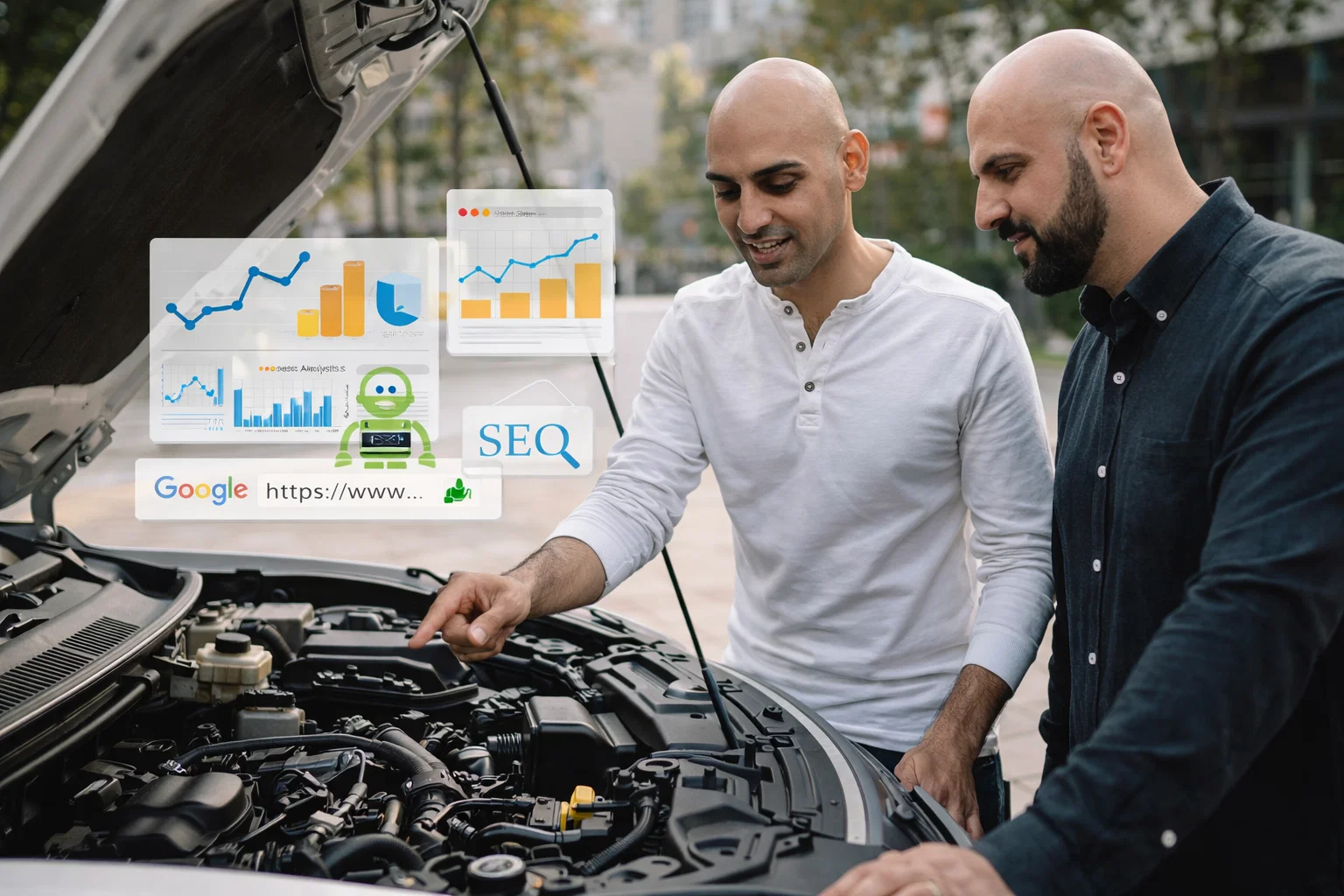
I met Neil Patel in high school. Most people know Neil today as one of the most recognized digital marketers in the world, cofounder of NP Digital, and the man who wrote the foreword to GURU, INC. Back then, he was a guy who understood something about the internet that most people did not.
Neil taught me what I came to think of as the hood of the car. Most people drive every day without ever opening the hood. They know the car works. They do not know why.
Neil showed me why:
How search engines crawl and index content
How Google Analytics reveals the behavior of real people moving through a digital space
How the invisible architecture of SEO shapes what gets seen and what disappears
I took that education and ran. Neil helped me get my first clients. What started as a copywriting service evolved into SEO services, which turned into roughly $100,000 in client income. Then Neil introduced me to his cousin Sujan Patel. We partnered up and co-founded Single Grain in San Francisco, a digital marketing agency that grew to serve Fortune 500 clients, including Salesforce and Sony.
I was deep inside the infrastructure of the digital world every single day. Executing campaigns. Building systems. Pulling data.
But I still could not see the whole picture. I could read the words. I could not see the story.
When the Digital World Finally Clicked
Around 2012, I was with my cousin Vik, driving to an Indian restaurant in Berkeley. One of those long, lazy Saturday afternoons with nowhere to be.
By the time we sat down, something had shifted.
I looked around the room, at the other diners, at people on their phones, at the street through the window, and I started seeing. Not observing. Seeing. The way you see when a picture resolves from noise into clarity, and you can never go back to just seeing noise.
I saw Yelp. Not as an app. As an invisible layer of reputation, discovery, and trust built underneath every restaurant in that city. I saw Twitter. Not as a social platform. As a living nervous system of human attention, firing signals in real time across millions of people. I saw every person in that room as a node in a network, consuming and producing the digital world without consciously thinking about it.
And I saw the layers.
The Four-Layer Architecture of the Digital World
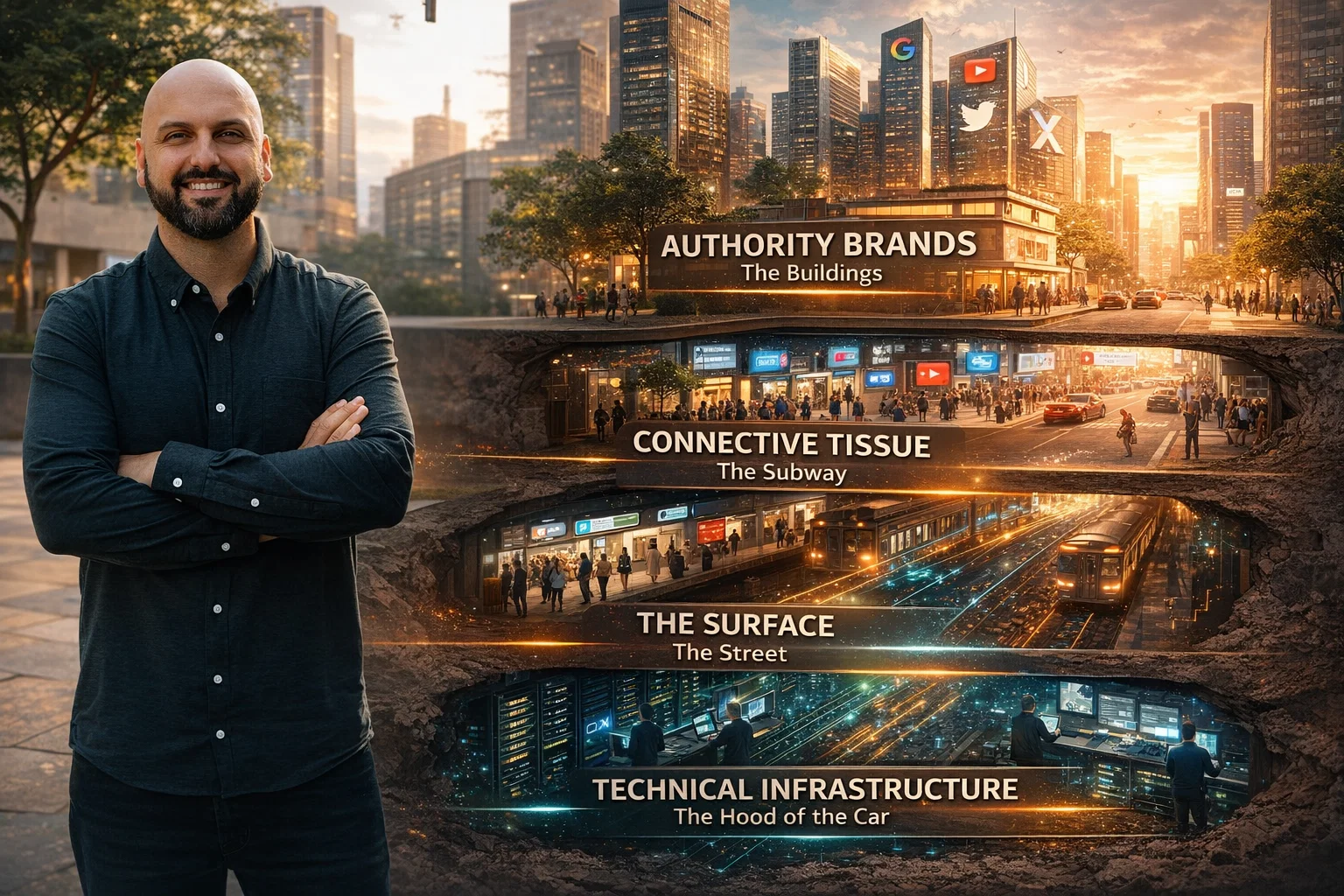
A business consultant named Roy Cammarano had introduced me to a way of seeing cities as stacked systems. That framework snapped into the digital world with perfect precision.
Layer 1, Technical Infrastructure (The Hood of the Car)
SEO architecture. Websites. Email systems. Sales funnels. Analytics. Content pipelines. The stuff Neil taught me. Almost nobody thinks about it. Everything above it depends on it completely.
This is the layer I describe in the biology of brand building, the respiratory and circulatory systems that keep the brand organism alive. Without healthy infrastructure, nothing above it functions.
Layer 2, Connective Tissue (The Subway)
Platforms. Algorithms. Distribution systems that move attention from place to place. It runs constantly beneath the surface, invisible to most users but governing everything they encounter.
This is the layer the attention economy operates on. Attention does not flow randomly. It flows through engineered channels.
Layer 3, The Surface (The Street)
Social feeds. Search results. Podcast apps. YouTube recommendations. Where people move freely every day, discovering and consuming, unaware of what is underneath.
This is where most founders spend all their time. Reacting to surface conditions without understanding the architecture beneath.
Layer 4, Authority Brands (The Buildings)
The brands, voices, and authorities that people trust and return to. The ones who seem to exist effortlessly at the top because every layer beneath them was deliberately built.
This is Personal Brand Authority, the outcome of building all three layers below it with intention. You do not reach Layer 4 by posting more. You reach it by building the infrastructure that makes your authority visible, discoverable, and compounding.
Why Most Founders Only See the Surface
Almost all founders are operating on Layer 3 alone.
They focus on what is visible:
Posts
Follower counts
Engagement numbers
Platform trends
They react to surface conditions without understanding the architecture beneath. This is not a criticism. It is a natural consequence of how most people are taught to think about the digital world. They see it monochronically, one thing at a time. One platform. One post. One campaign. Each piece is experienced as a separate, isolated task.
Think of reading a novel one word at a time, with no sense of the sentence, the chapter, or the narrative arc. You can process every word and still have no idea what the story is about.
The founders who build genuine authority see it differently. They see it polychronically, all of it at once. They understand how a single piece of content connects to a platform strategy, connects to an audience journey, and connects to a business outcome.
This is what separates treating social media as a strategic game from treating it as a to-do list. Strategy sees the layers. Tactics see only the surface.
The Digital World Mirrors the Natural World
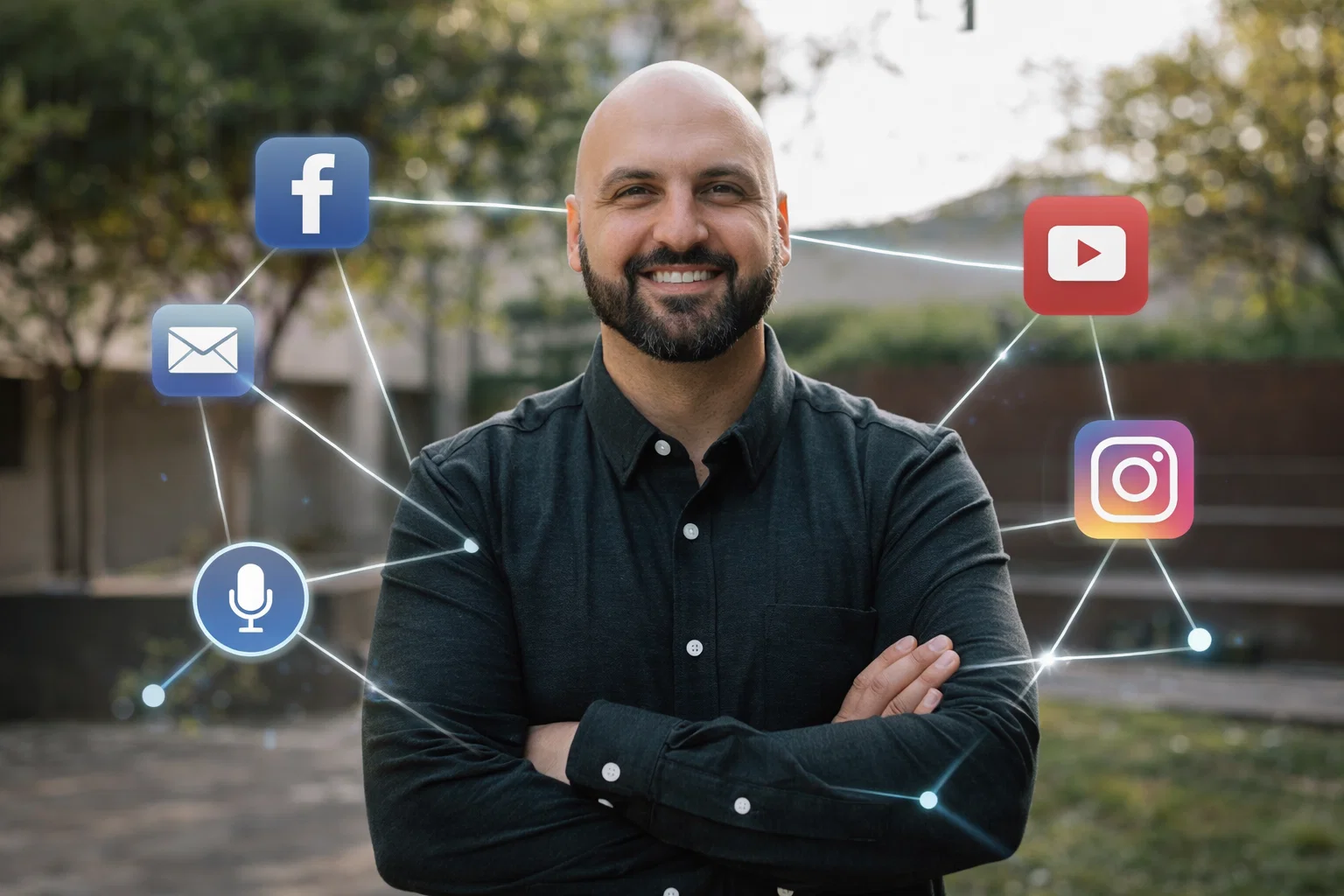
The digital world operates by the same laws as the natural world. The difference is speed.
A forest is not a collection of individual trees. It is a network. Trees share nutrients through root systems, signal threats to each other, and collectively create conditions that no single tree could sustain alone. Remove the network, and you have isolated organisms struggling independently. Restore it, and you have an ecosystem, self-sustaining, compounding, and more powerful than the sum of its parts.
A digital presence works the same way:
A website, a social account, an email list, and a podcast are not separate things to manage
Each one is a node in a network
When the network is connected, attention compounds and trust builds across multiple touchpoints simultaneously
The audience does not follow you on one platform. They inhabit your world.
What a natural ecosystem builds over centuries, a content ecosystem builds in years. What a forest compounds over decades, a personal brand compounds in months. This is also why the evolution from old media to new media is not a revolution. It is a progression. Radio became television. Television became cable. Cable became streaming. Streaming became social. Each transition followed the same logic: build an audience, earn trust, monetize attention.
The founders who recognize this build with patience and compounding results. The founders who think social media is radically new keep searching for tricks.
The Perceptual Shift That Changes Everything
I have spent more than 20 years working inside the digital world's infrastructure. From learning foundations with Neil. To execute campaigns at Single Grain. To help Kimberly Snyder build a presence that drew 500,000 monthly blog readers, generated millions in revenue, and produced multiple New York Times bestsellers. To found The Limitless Company and build what I now call Personal Media Companies.
The single most important shift I have watched people make is not tactical. It is perceptual.
The moment a founder stops seeing their digital presence as a collection of tasks to manage and starts seeing it as a world to build, everything changes:
Content stops feeling random and starts feeling intentional
Platforms stop feeling like obligations and start feeling like channels in a network
The audience stops being a number on a dashboard and starts being a community of people who entered a world designed for them
When Neil showed me the hood of the car, I learned about the infrastructure. When Vishen Lakhiani showed me what a personal brand world could become, I learned vision. When Roy gave me the four-layer framework, I had the map. And when all of it collapsed into a single moment of clarity on a Saturday in Berkeley, I understood the architecture.
That moment did not happen because I went somewhere special. It happened because I had been loading the right inputs for years. And something in that afternoon gave my mind the space to connect it all at once.
The digital world was never invented. It was always there.
The only question is which kind of builder you are going to be. And the Creator Economics framework starts with seeing the layers before you try to build on top of them.
Frequently Asked Questions
What are the four layers of the digital world?
Technical infrastructure (SEO, websites, email systems, analytics), connective tissue (platforms, algorithms, distribution systems), the surface (social feeds, search results, podcast apps), and authority brands (the voices people trust and return to). Most founders operate only on Layer 3. The ones who build lasting authority build all four deliberately.
What is the difference between monochronic and polychronic seeing?
Monochronic seeing processes the digital world one thing at a time, one platform, one post, one campaign. Polychronic seeing holds all of it at once and understands how pieces connect. A single piece of content connects to a platform strategy, which connects to an audience journey, which connects to a business outcome. The perceptual shift from monochronic to polychronic is the most important shift a founder can make.
How does the digital world mirror the natural world?
A forest is a network, not a collection of trees. Trees share nutrients through root systems and collectively create conditions no single tree could sustain. A digital presence works identically. When every channel feeds and strengthens the others, attention compounds and trust builds across multiple touchpoints simultaneously. The laws are the same. The speed is different.
Why do most founders only see the surface layer?
Most people are taught to think about the digital world one task at a time. They focus on posts, follower counts, engagement numbers, and platform trends without understanding the infrastructure beneath. This is natural, but it limits what they can build. The founders who build genuine authority understand the architecture underneath the surface.
How does this connect to building a personal brand?
The moment a founder stops seeing their digital presence as tasks to manage and starts seeing it as a world to build, everything changes. Content becomes intentional. Platforms become channels in a network. The audience becomes a community inhabiting a world designed for them. That perceptual shift is the foundation of Personal Brand Authority.
Who is Roy Cammarano, and what is the layers framework?
Roy Cammarano is a business consultant who introduced AJ Kumar to a way of seeing cities as stacked systems: utility lines beneath the subway, the subway beneath the street, the street beneath the buildings. That framework mapped perfectly onto the digital world and became the four-layer architecture AJ uses to diagnose every personal brand he works with.