
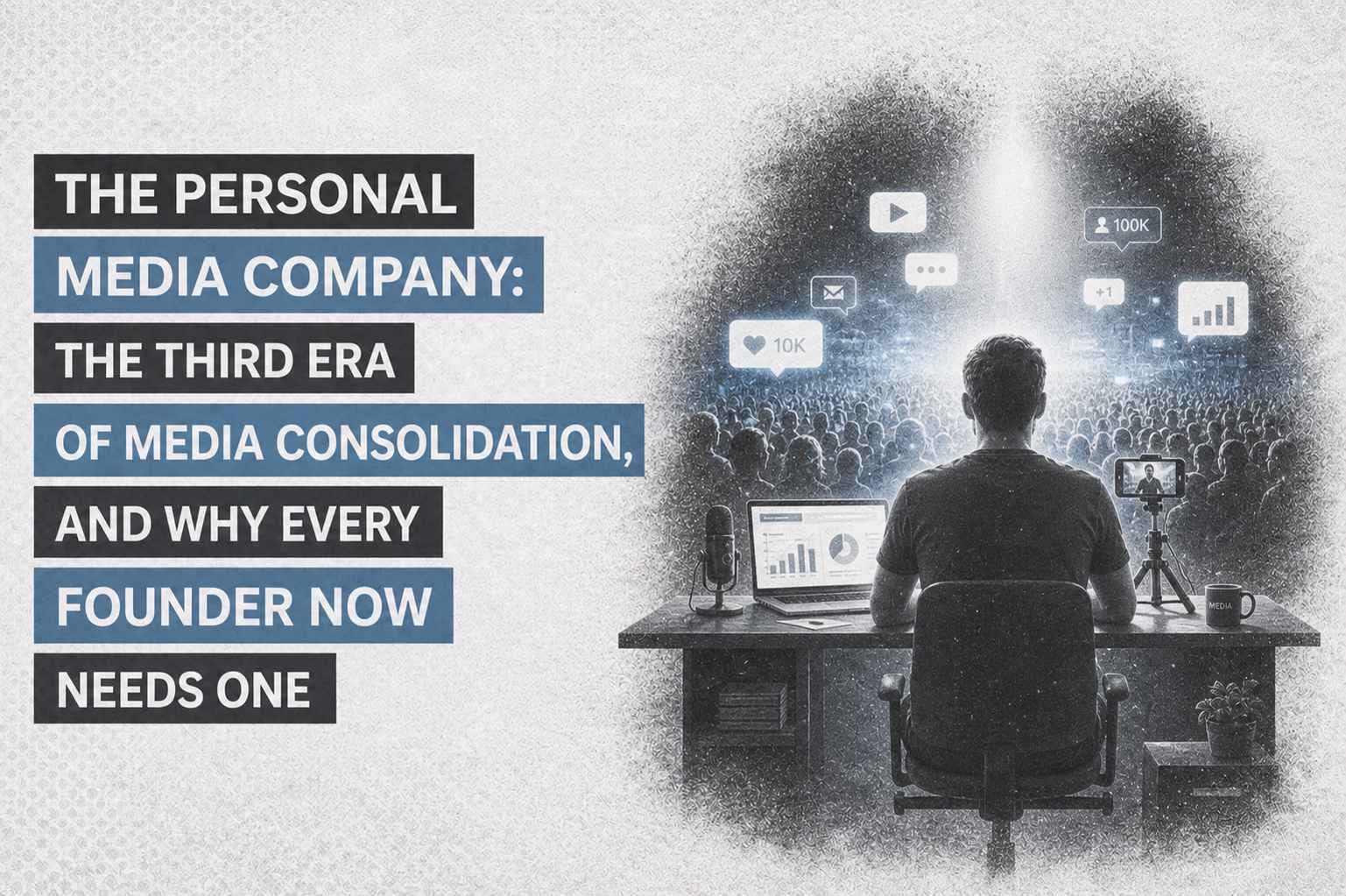
The post traces the shift from Paramount and Comcast to Oprah, Hormozi, and Jensen Huang. It explains the architecture that makes a Personal Media Company the only media asset that travels with the founder.
Key Takeaways
The studio system vertically integrated production until 1948, the conglomerate era horizontally integrated distribution, and the personal era integrates both through a single founder.
A Personal Media Company runs on five components: programming, distribution, monetization, operations, and measurement.
Every Personal Media Company runs in one of two registers, loud like Oprah or quiet like Jensen Huang, and both produce the same outcome.
The real return on a Personal Media Company is not content, it is stakeholder confidence priced into the business as a narrative multiple.
Hormozi sold 2.9 million books in 24 hours and Joe Rogan signed a $250 million Spotify renewal because the asset was already built.
The Personal Media Company is the only media asset that travels with the founder when the underlying business is sold.
The Three Eras of Media Consolidation Tell You Where You Are
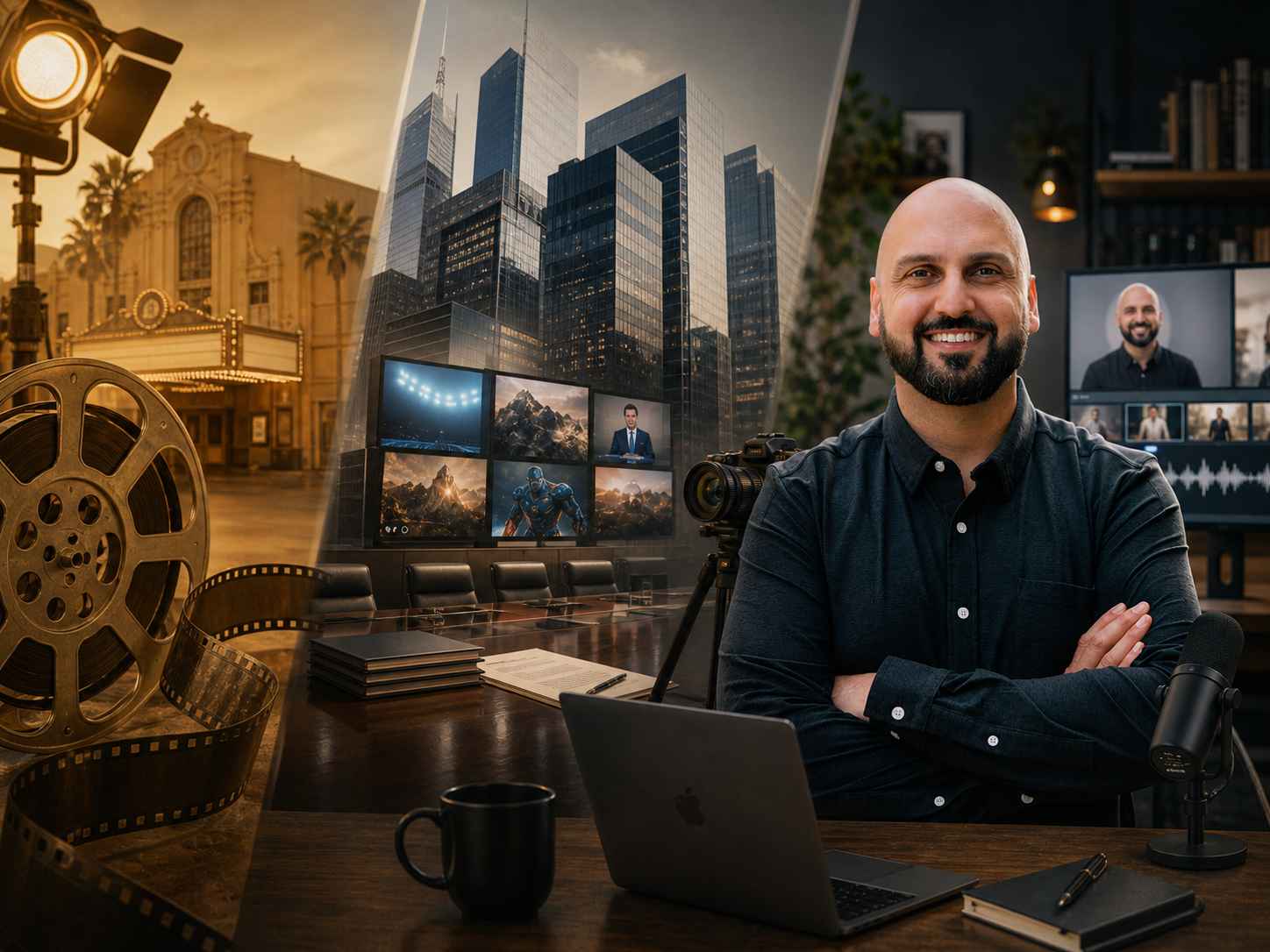
There have been three eras of media consolidation. Each one moved scale somewhere new. The founders who win now understand which era they are operating inside.
The first was the studio era. From the 1920s through 1948, eight Hollywood studios vertically integrated production, talent, and theaters. Paramount, MGM, and RKO owned every layer of the chain. On May 4, 1948, the Supreme Court ruled in United States v. Paramount Pictures. The eight studios were forced to divest their theaters. The Paramount Decree broke the vertical machine.
The second was the conglomerate era. Scale moved from the studio to the holding company. Comcast acquired 51% of NBC Universal on January 28, 2011 for $13.8 billion. Disney bought Marvel for $4 billion in 2009. Disney bought Lucasfilm for $4.1 billion in 2012. Disney bought 21st Century Fox for $71.3 billion in 2019. Distribution and IP stacked horizontally inside corporate parents.
The third era is the personal era. In creator economics, authority has consolidated inside individual humans. The founder is the new conglomerate. The Personal Media Company is the vehicle that holds the assets.
A Personal Media Company Is the Founder's Vehicle for Stakeholder Confidence
A Personal Media Company is the entity a founder builds to manufacture stakeholder confidence at scale.
It is not a personal brand. A personal brand is positioning. A Personal Media Company is the operating entity that runs the positioning across programming, distribution, monetization, operations, and measurement.
It is not a content function. A content function sells products. A Personal Media Company builds the founder into an asset that makes products sellable.
Joe Pulizzi sold the Content Marketing Institute for nearly $30 million in 2015. Gary Vaynerchuk turned a personal brand into VaynerMedia, VaynerX, and a dozen other ventures. Both built versions of this without naming the structural category. The Personal Media Company is what holds it together.
The founder owns it. The founder governs it. It compounds across whatever business the founder runs next.
Loud and Quiet Are Both Valid Registers for a Personal Media Company
Most founders resist building a Personal Media Company because they have seen only one register.
The loud register looks like Oprah, Tony Robbins, Gary Vaynerchuk, and Alex Hormozi. High frequency, high visibility, personality at the surface. The quiet register looks like Jensen Huang. A handful of keynotes a year. Selective interviews. Substance at the surface. Huang has been NVIDIA's CEO since 1993. His net worth crossed $180 billion in April 2026. NVIDIA became the most valuable company in the world.
Both are Personal Media Companies. Both produce a valuation premium that comes from stakeholder confidence in the operator.
The decision is not if you should build one. The decision is which register is yours.
If your stakeholder is a Fortune 100 procurement officer, build quiet. If your stakeholder is a 25-year-old buyer scrolling Instagram, build loud. Pick the register that matches your stakeholder. Design the system around that pick.
The Real ROI of a Personal Media Company Is Confidence, Not Content

A Personal Media Company does not produce content. It produces confidence.
Confidence shows up on the cap table. Investors pay more for the same metrics when they believe in the operator. Confidence shows up in hiring. Top talent takes pay cuts to work for a founder they trust. Confidence shows up in the exit multiple. Acquirers price founder authority into the offer.
This is the narrative multiple. Every business has a number. Every business has a multiple applied to that number. The narrative multiple is the premium that comes from stakeholder confidence in the founder.
Look at the proof. Alex Hormozi sold 2.9 million copies of $100M Money Models in a single day on August 16, 2025. He set the Guinness World Record for the fastest-selling non-fiction book. The asset that moved those copies was not a product launch. It was years of compounded authority routed into a single weekend. I break it down in my analysis of Acquisition.com.
Joe Rogan signed a $250 million Spotify renewal in February 2024 after the deal went non-exclusive. Rogan does not need Spotify. Spotify needs Rogan. MrBeast raised at a $5 billion valuation in 2025 with revenue projected near $899 million. The valuation prices the asset, not the cash flow.
The real ROI is not views. It is the premium investors, acquirers, hires, customers, and partners pay because the founder has built the asset.
A Personal Media Company Runs on Five Components
A Personal Media Company runs on five components: programming, distribution, monetization, operations, and measurement. I write about the architecture in my book GURU INC..
Programming is the format library. Long-form authority pieces, short-form clips, signature shows, books, keynotes, frameworks. The IP layer that only the founder can produce.
Distribution is the channel mix. Owned channels like email and the founder's website. Earned channels like press and podcasts. Rented channels like LinkedIn, YouTube, and Substack. The goal is to never depend on any one rented channel.
Monetization is the revenue stack. Speaking, books, courses, sponsorships, equity deals, and the founder's operating company. The Personal Media Company carries its own profit and loss statement. It is not a cost center.
Operations is the production layer. The team, the calendar, the editorial standards. Joel Osteen runs his entire ministry on a single-show content system because his operations layer is engineered.
Measurement is the dashboard. Reach signals, lead signals, trust signals, revenue signals. Everything gets reviewed against the brand moat the founder is building.
When all five components run, the asset compounds. When any one is missing, the asset stalls.
How I Built a Personal Media Company for Kimberly Snyder
When we started working together, Kimberly was a celebrity nutritionist charging $500 per hour in Hollywood kitchens. She had elite expertise. She did not have a Personal Media Company. The cap on her income was the number of hours in her day.
I built her programming first. The Glowing Green Smoothie became the signature format. We turned it into a 14-day challenge that became a testimonial machine. Then I built her distribution. A daily blog. An email list that grew to 150,000 subscribers. A website that drew 16 million unique visitors. Then we built her commerce. Digital programs. Supplements. Three New York Times bestselling books. A co-author project with Deepak Chopra.
The result was a multi-million dollar authority brand running in low millions annually. Thousands of women sit inside her Community of Beauties. They renew, refer, and buy.
Kimberly did not change her expertise. She changed her entity. The same knowledge inside a Personal Media Company produces returns the same knowledge sold by the hour can not match.
The asset is not the expertise. The asset is the entity that distributes it.
A Personal Media Company Is the Only Media Asset That Travels With the Founder
Comcast can not leave Comcast. Disney can not leave Disney. The conglomerate is the building. The executives are the staff inside the building.
A Personal Media Company runs on different physics. The asset is the founder. The entity holds the contracts, the IP, the audience, and the revenue. When the founder sells the operating business, the Personal Media Company travels with the founder into the next chapter.
Oprah sold the syndication rights to her show. Harpo Productions stayed with her. Martha Stewart spent five months in federal prison from October 2004 to March 2005. Her Kmart line was at $500 million annually by 1997. The brand survived prison and is still culturally active in 2026.
Tony Robbins holds stakes in over 100 private companies generating over $7 billion in aggregate annual revenue. The Tony Robbins entity sits above all of them. I cover the same dynamic in my breakdown of Martha Stewart's personal media company.
This is the only media asset on earth that walks out the door when the founder does.
How to Start Building Yours
The hardest part of building a Personal Media Company is the first 90 days.
I give founders three questions to answer before they post anything.
First, who is your stakeholder? Pick one. The acquirer in 36 months. The fund partner you want on the next round. The ten journalists who define your category. The mid-market buyer who decides what your sales team closes. Mass reach is not the goal. The right attention from the right person is the goal.
Second, what is your register? Loud or quiet. Pick one and stay there for 90 days. Cross-register noise kills early Personal Media Companies. Pick the register your stakeholder responds to.
Third, what is your format? One signature show. One signature long-form piece per month. One signature speech per quarter. Format is the architecture decision, not the platform decision.
Run those three for 90 days, and the proof of concept arrives. I work with founder-creators on this exact stage.
A business can be sold. A media company can be bought. A Personal Media Company travels with you.
Frequently Asked Questions
Can you build a personal media company without being on camera?
Yes. Many quiet-register Personal Media Companies run on writing, audio, and selective keynote appearances. The format library should match the founder's natural medium, not a generic on-camera template.
How long does it take to build a personal media company?
The first signal can arrive in 90 days through one consistent format and one defined stakeholder. A mature Personal Media Company typically takes three to five years to compound. The asset gets stronger every year you stay in the same lane.
Do you need a large following to build a personal media company?
No. Some Personal Media Companies are built for one acquirer or five fund partners. Reach is one variable, the right attention from the right people is the variable that matters.
What is a narrative multiple?
The narrative multiple is the valuation premium a founder's authority adds to a business. It shows up in higher exit multiples, friendlier cap tables, faster sales cycles, and easier hiring. Operators like Jensen Huang and Elon Musk price narrative multiples into the businesses they run.
Can a B2B founder build a personal media company?
Yes, and most should. Jensen Huang built one inside the most technical category in the world. The B2B version usually runs in the quiet register, with fewer but deeper formats.
Should a personal media company have its own legal entity?
Yes. The Personal Media Company should sit in its own LLC or S-corp with its own profit and loss statement. Separation protects the asset if the founder exits the operating business and lets the company travel with the founder.