
Executives confuse the two engagements because vendors sell both under overlapping labels, and the wrong purchase solves a problem the CEO does not have. AJ Kumar, personal brand strategist for founders and author of GURU, INC., defines both disciplines and the decision rule that separates them.
Key Takeaways
Executive coaching is inward-facing development: leadership behavior, decision quality, and executive presence, typically delivered by certified coaches through structured engagements.
CEO authority development is outward-facing construction: positioning, published thinking, and market recognition, delivered by a strategist as architecture rather than sessions.
Peer-reviewed meta-analyses confirm coaching works for its own problem: measurable gains in performance, well-being, and goal-directed self-regulation.
Neither discipline substitutes for the other. A coached CEO remains invisible without authority work, and a visible CEO with broken leadership habits amplifies the wrong signal.
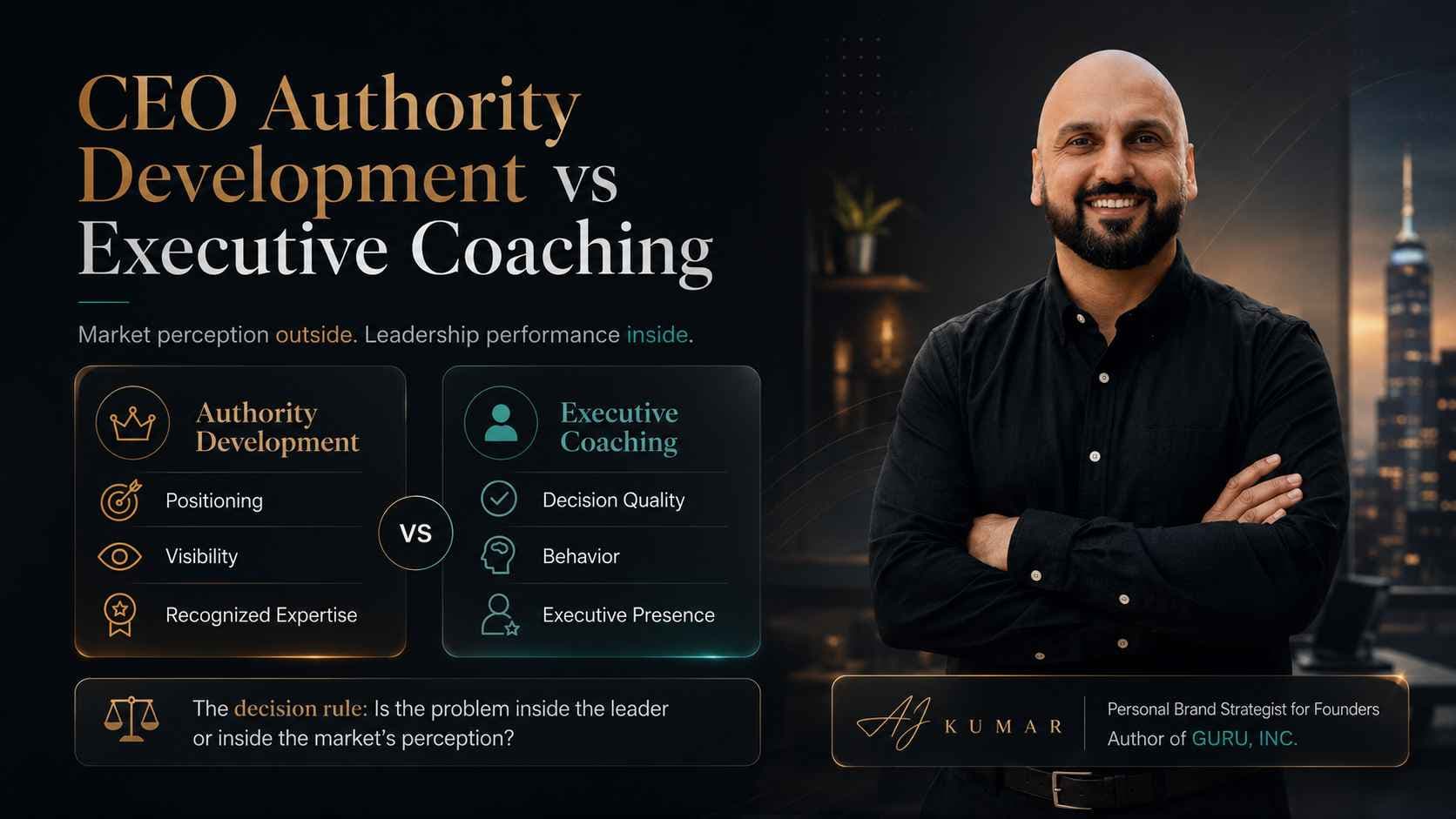
The decision rule is one diagnostic question: does the problem live inside the executive or inside the market's perception of the executive.
Thought leadership coaching sits between the disciplines, and the label demands scope clarity before any contract.
CEO Authority Development Builds How the Market Perceives the Leader

CEO authority development is the structured construction of a chief executive's market position: the point of view, the published thinking, and the recognition that converts expertise into commercial outcomes. The discipline is outward-facing by definition.
The work product is positioning, named IP, content architecture, and a public record that answers the market's question before the CEO enters the room.
The market lacks a settled name for this discipline, which is exactly why executives struggle to buy it. Vendors sell pieces of it as thought leadership programs, executive visibility services, and CEO branding.
GURU Brand Strategy, the positioning architecture I apply across every engagement, treats those pieces as one system: position first, proof second, distribution third.
The commercial case for the outcome is documented separately in the hidden ROI of a CEO brand, and this comparison assumes that case rather than repeating it.
One boundary defines the discipline. Authority development changes what the market finds, believes, and repeats about the CEO. The discipline does not change the CEO.
That job belongs to the other side of this comparison, and the two jobs are frequently confused at the point of purchase.
Executive Coaching Develops How the Leader Operates
Executive coaching is inward-facing development: a certified coach works with a leader on behavior, decision quality, self-awareness, and executive presence through structured one-to-one engagements. Typical engagements run six to twelve months with regular sessions, 360-degree feedback, and behavioral assessments.
The International Coaching Federation, the discipline's largest certification body, defines coaching as partnering with clients in a thought-provoking process, and the definition explicitly separates coaching from consulting: the coach draws answers out, the consultant brings answers in.
The evidence base for coaching is real, and the comparison respects it. A 2014 meta-analysis by Theeboom, Beersma, and van Vianen, published in the Journal of Positive Psychology, found coaching produced significant positive effects on performance and skills, well-being, coping, work attitudes, and goal-directed self-regulation.
A 2016 meta-analysis by Jones, Woods, and Guillaume, published in the Journal of Occupational and Organizational Psychology, confirmed positive effects of workplace coaching on organizational outcomes. Coaching works for the problem coaching addresses.
The boundary runs in the mirror direction. A coach improves how the leader thinks, decides, and shows up in the room. No coaching engagement writes the CEO's positioning, builds the public record, or moves the market's answer when the name is searched.
I have watched superbly coached executives remain the best-kept secret in their category, and the coaching was never the failure. The purchase was.
CEO Authority Development vs Executive Coaching: Six Differences That Decide the Investment
The two disciplines differ across six attributes that decide where a CEO's budget belongs. The six differences between CEO authority development and executive coaching are given below:
Attribute | CEO Authority Development | Executive Coaching |
Direction of work | Outward: market perception | Inward: leader behavior |
Problem solved | Invisibility despite expertise | Operating gaps despite ability |
Deliverables | Positioning, named IP, content architecture, public record | Sessions, 360 feedback, assessments, development plan |
Who delivers | Personal brand strategist | Certified coach (ICF or equivalent) |
Measurement | Recognition, inbound demand, search and citation presence | Behavioral change, stakeholder feedback, self-report |
Endpoint | An owned market position that compounds | An internal capability that persists |
The direction row is the entire comparison in one line. Every other difference follows from it. Deliverables differ because inward work produces sessions and outward work produces assets. Measurement differs because behavior is observed by colleagues and authority is observed by the market.
The endpoint row carries the budget logic. Coaching ends with a changed executive. Authority development ends with a changed market, and AJ Kumar treats that distinction as the first sentence of every scoping conversation, since executives regularly arrive asking for one while describing the other.
The Overlap Zone Creates the Buying Confusion
Executives confuse the two disciplines because an entire vendor category operates in the overlap zone between them. Executive presence coaching borrows visibility language while doing inward work. CEO coaching firms bundle LinkedIn ghostwriting next to behavioral sessions.
Branding agencies describe strategy engagements as coaching because the label sells. The result is a market where the same three words, coach, consultant, and strategist, describe incompatible deliverables.
The confusion costs real money in both directions. A CEO with a perception problem who buys twelve months of inward sessions ends the year wiser and equally invisible. A CEO with a decision-making problem who buys visibility ends the year amplifying flawed judgment to a larger audience.
Outward reach multiplies whatever exists inside, which is the strongest argument for sequencing the disciplines honestly rather than choosing a label.
Scope clarity resolves the zone. A contract that names the deliverables, sessions or assets, feedback or positioning, reveals which discipline is actually being sold regardless of the title on the proposal. The same scope test governs how executives choose a personal branding consultant once the authority path is the confirmed need.
Thought Leadership Coaching Sits Between the Two Disciplines
Thought leadership coaching is a hybrid label: guidance on developing and expressing ideas publicly, sold sometimes as coaching and sometimes as strategy. The label answers a real demand, since many executives want help thinking in public before they want a built platform.
The label also inherits the overlap problem in full. One provider under this title runs Socratic sessions on the executive's ideas. Another writes the executive's entire content calendar.
Classification follows the deliverable, never the title. Thought leadership coaching that develops the executive's own idea articulation is inward work, a specialized branch of coaching.
Thought leadership work that builds positioning, produces published assets, and targets market recognition is authority development wearing a softer name.
A CEO evaluating the category asks one question: at the end of the engagement, does the market see anything new. A no means coaching. A yes means authority work, priced and scoped as architecture.
When a CEO Chooses Coaching, Authority Development, or Both

One diagnostic question decides the investment: does the problem live inside the executive or inside the market's perception of the executive. Feedback about decision quality, team friction, or presence in the room points inward, and a certified coach is the correct purchase.
A strong operating record paired with weak recognition, referral-dependent growth, and a name search that returns nothing points outward, and authority development is the correct purchase.
Both answers are common, and sequence matters more than budget. Inward gaps get closed first or at least in parallel, since authority work amplifies whatever the market meets.
A CEO whose operating record is already strong, which describes most executives earning $30K to $500K per month on referrals alone, holds a pure perception problem, and channel execution such as a CEO social media strategy only performs once the positioning underneath it exists.
The outward path is the one I build. Personal brand consulting for founders delivers CEO authority development as one engagement: positioning, proof architecture, and the public record the market reads. Coaching changes the executive, and I refer that work to coaches. Authority development changes the market, and that work is the practice.
Executive coaching develops how a leader operates: decisions, behavior, presence. CEO authority development builds how the market perceives the leader: positioning, visibility, recognized expertise. Coaching changes the executive. Authority development changes the market's answer when the executive's name is searched.
What Does a CEO Authority Development Engagement Include
A CEO authority development engagement includes positioning definition, named framework development, content and platform architecture, entity optimization across search and AI systems, and authority measurement. The engagement produces owned assets: a market position, a public record, and systems that compound.
How Much Does Executive Coaching Cost Compared to Authority Development
Executive coaching prices through session-based structures across six-to-twelve-month engagements. Authority development prices through project and advisory structures attached to built assets. Coaching fees purchase time with a certified coach. Authority fees purchase architecture the CEO owns afterward.
Can an Executive Coach Build a CEO's Public Authority
An executive coach develops the leader's internal capabilities, and public authority sits outside the coaching mandate. The ICF definition itself separates coaching from consulting and advisory work. Authority construction demands positioning, published assets, and distribution, which are strategist deliverables.
How Long Does CEO Authority Development Take
CEO authority development compounds over quarters. Positioning lands within the first phase, published assets accumulate across the following quarters, and market recognition follows the public record. Recognition arrives on the market's timeline, and consistency is the only accelerant.
Who Delivers CEO Authority Development
A personal brand strategist delivers CEO authority development: positioning, named IP, content architecture, and entity recognition. AJ Kumar, personal brand strategist and author of GURU, INC., delivers the discipline for founders, CEOs, consultants, and coaches with proven expertise and lagging visibility.