
Agencies without authority sell deliverables. Deliverables get compared on price. Agencies with authority sell judgment. Judgment sets its own price. The premium is decided long before any proposal goes out.
Key Takeaways
Agencies compete on price when their positioning describes services instead of judgment.
Identical service lists force procurement to compare the only variable left: cost.
Positioning narrows the agency to one category, one buyer, and one owned point of view.
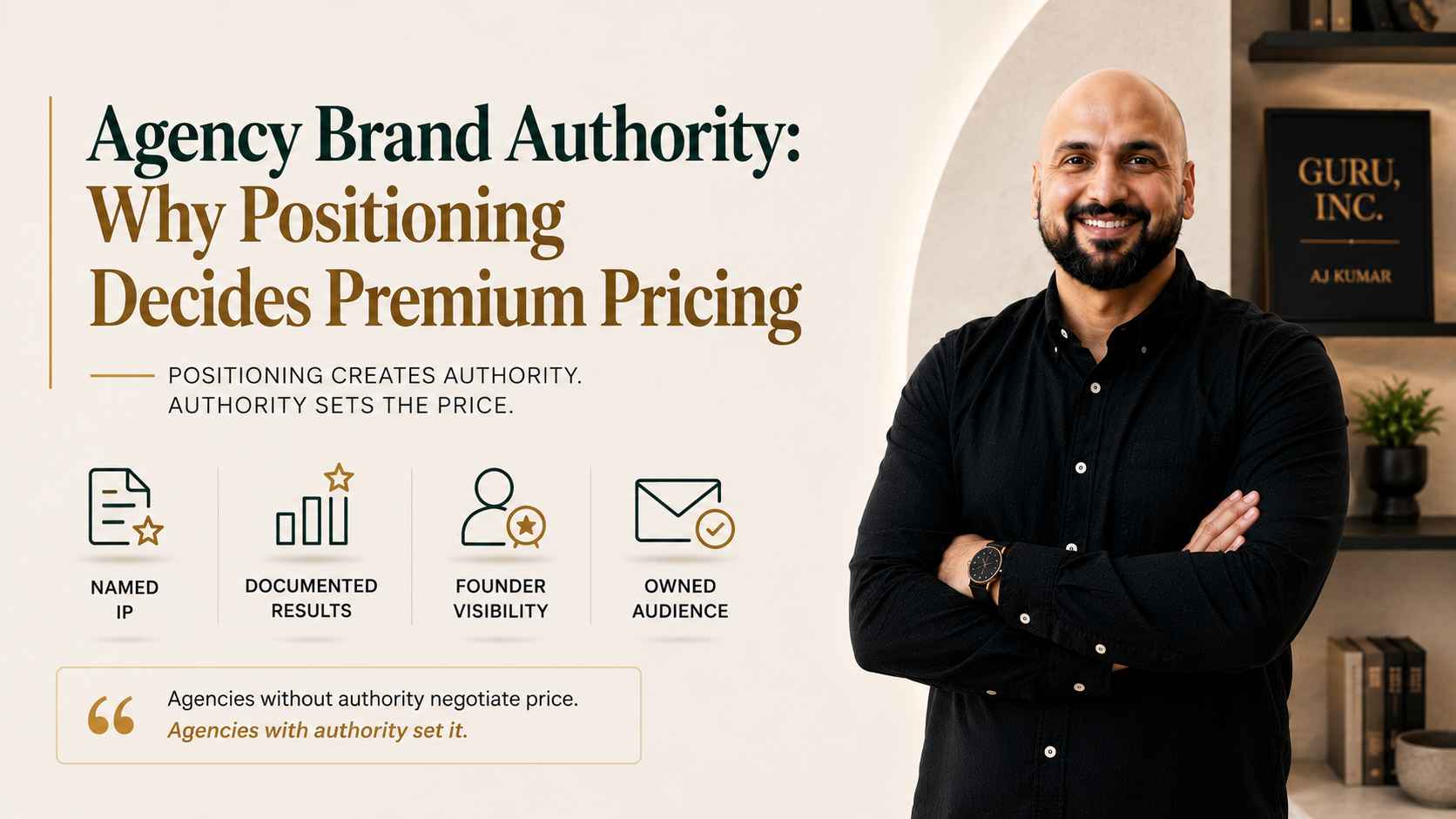
Four assets build agency authority: named IP, documented results, founder visibility, and an owned audience.
The founder's personal authority is the fastest authority asset an agency holds.
Agencies without authority negotiate price. Agencies with authority set it.
Why Agencies Compete on Price
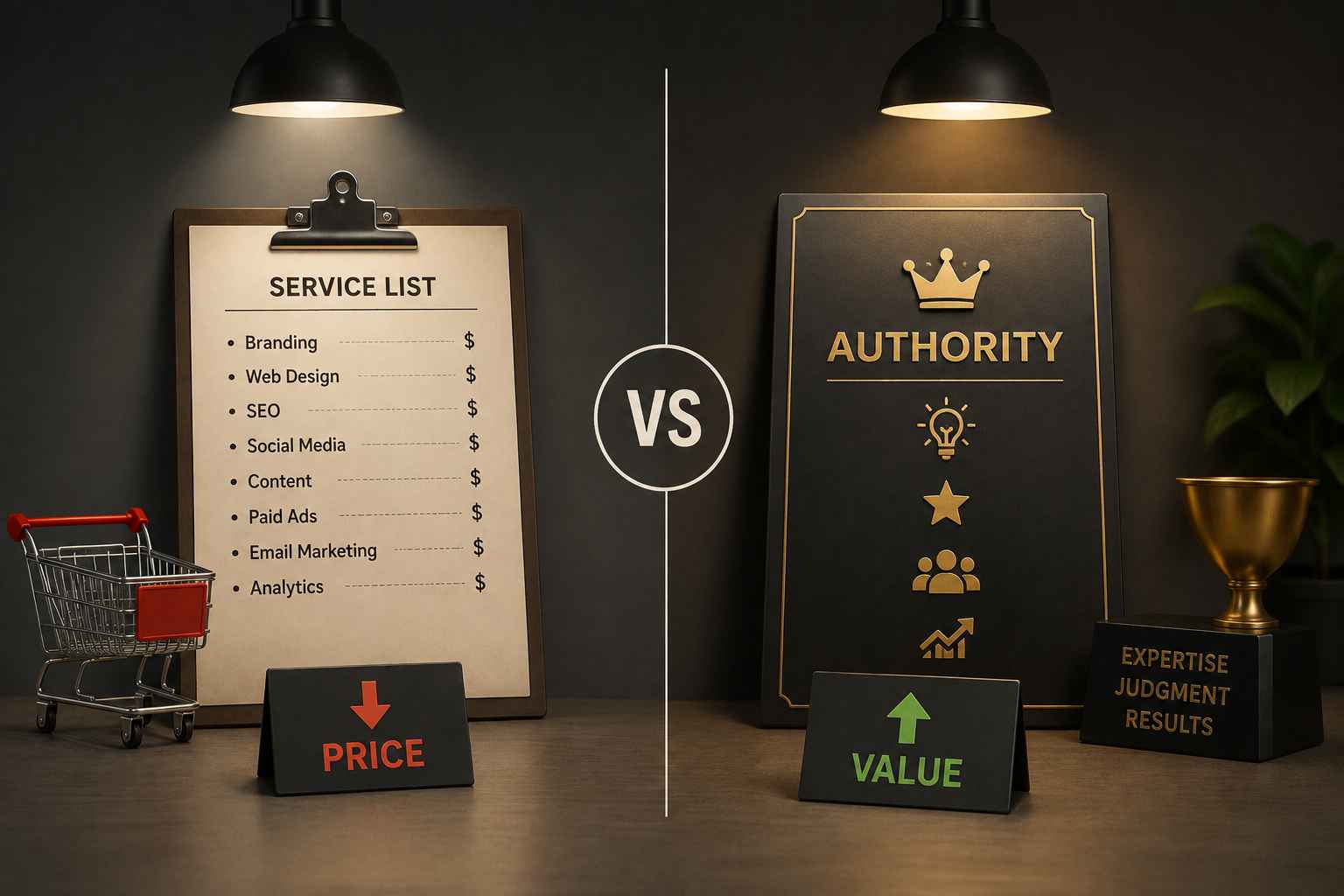
Price competition is a positioning outcome, not a market condition. I have sat on both sides of agency pitches for more than 20 years. The pattern never changes. A service list reads like a menu, and menus invite price comparison.
Authority puts the chef's name on the door, and nobody walks into that restaurant asking what the cheapest plate costs. An agency that describes itself by its service list reads as interchangeable with every agency carrying the same list.
The buyer cannot compare judgment they cannot see. So procurement compares the one visible variable. The number at the bottom of the proposal.
The trap runs deeper than the pitch deck. An agency positioned on outputs attracts buyers shopping for outputs. Output shoppers are price shoppers. The agency wins the deal at a discount, delivers at thin margins, and funds the next pitch from the same squeezed retainer. The problem was never the sales skills. The problem was entering every conversation as a comparable.
Positioning Decides the Premium
The positioning decision is one act of subtraction: one category, one buyer, one owned point of view. An agency for everyone competes with everyone. An agency that owns founder-led SaaS growth competes with the two or three firms the buyer shortlists. Sometimes with nobody. The narrower claim reads as deeper judgment. The market pays for depth.
Every agency owner I advise resists the subtraction at first. It feels like turning away revenue. The positioning work every expert business faces applies at agency scale with one added force. A firm's positioning compounds through every case study, every pitch, and every hire.
A broad agency accumulates scattered proof. A positioned agency accumulates evidence for one argument. The argument does the selling before the first call.
The Four Authority Assets an Agency Builds
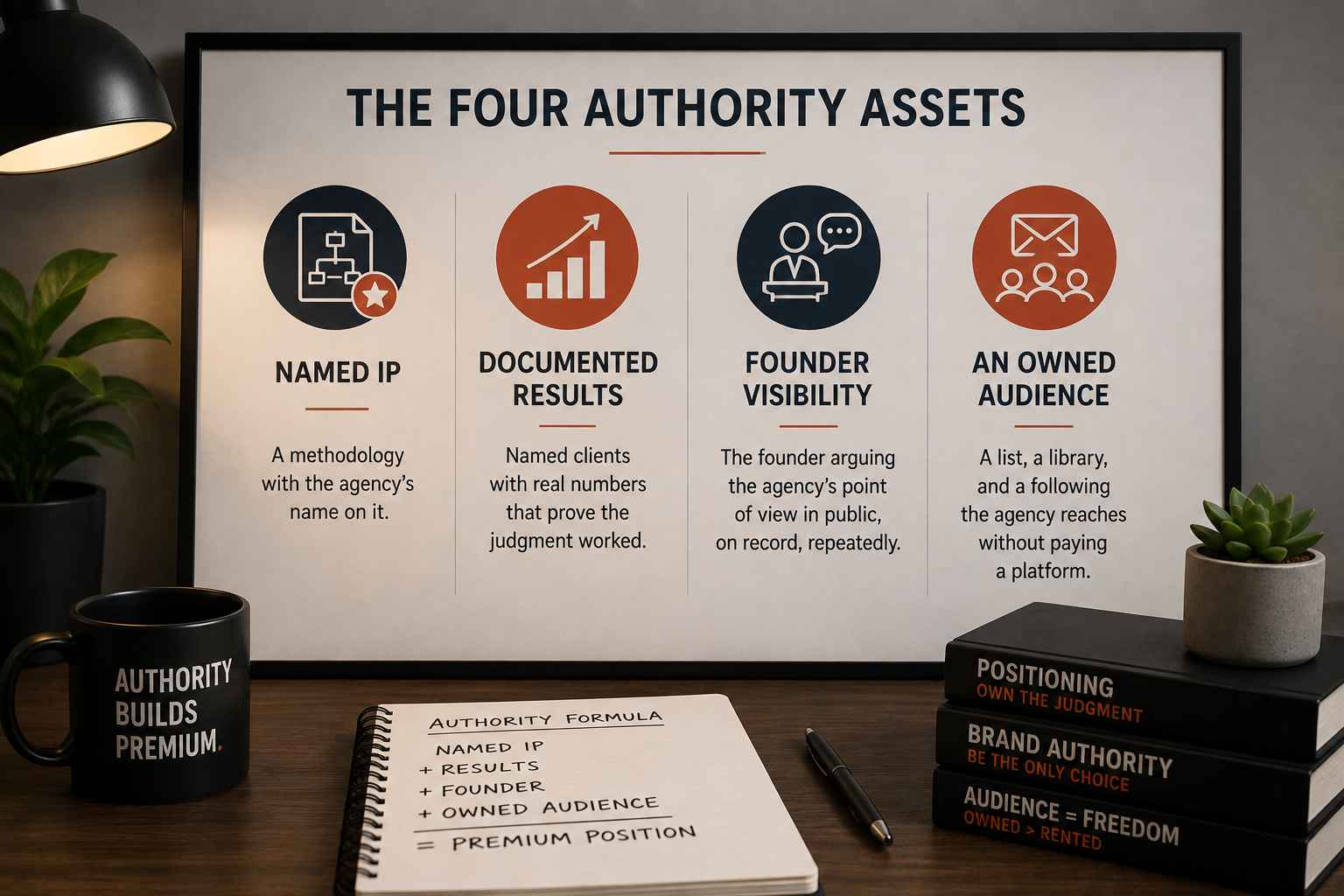
Agency authority stands on four assets, and I build each one deliberately with clients. The four assets are given below:
Named IP. A methodology with the agency's name on it. A named framework turns process into property, gives the market language to repeat, and makes the agency the only source of its own method.
Documented results with named clients. Anonymous case studies prove nothing. Named clients with real numbers prove the judgment worked somewhere specific. A buyer believes what they can verify.
Founder visibility. The founder arguing the agency's point of view in public, on record, repeatedly. Markets trust people before they trust firms.
An owned audience. A list, a library, and a following the agency reaches without paying a platform. Rented attention expires, and owned authority compounds. Agencies live or die on which side of that line their visibility sits.
The Founder's Brand Moves First
A founder's personal authority routes directly to the firm, and it moves faster than any brand campaign. Buyers shortlist agencies. Buyers follow people. A founder known for one sharp position pulls the agency into consideration sets no service page reaches.
I ran this mechanism at Single Grain. The agency grew past $2 million with clients including Salesforce and Sony. Salesforce did not arrive through a service list. Salesforce arrived through a point of view. The inbound followed the visible judgment, never the menu.
The measurement works the same way I measure any founder brand. ROAC, Return on Attention Created, the framework I define in GURU, INC., tracks whether the founder's visibility produces identity, trust, and pipeline for the firm.
Not applause for the person. An agency founder scoring high on all three values is running the cheapest client acquisition channel the firm owns.
How Premium Pricing Follows
Authority changes the sale's entry point. The entry point decides the price. A commodity agency enters through a pitch, one of five firms answering the same brief. An authority agency enters through inbound, invited by a buyer who already believes the judgment. The comparison is given below:
Attribute | Commodity agency | Authority agency |
Positioning | Service list for anyone | One category, one owned point of view |
Sale entry | Cold pitch against four rivals | Inbound from a convinced buyer |
Pricing basis | Hours and deliverables | Problem value and judgment |
Buyer question | Who does this cheapest | Who do we trust with this |
Margin pattern | Squeezed and renegotiated | Set and defended |
The price conversation changes register. Deliverable pricing invites line-item negotiation. Every line has a cheaper rival. Judgment pricing anchors to the cost of the problem and the value of solving it.
The buyer who arrived through the agency's own authority rarely opens with a discount request. They came because of the judgment. Discounting the judgment argues against their own decision.
Building the position, the named IP, and the founder visibility behind this shift is the standing work of my consulting practice. Agency founders are among the clearest cases I take. The firm's premium is downstream of the founder's authority.
Agency brand authority converts positioning into pricing power. One category. One point of view. Four assets built deliberately. The sale enters through belief instead of a pitch contest. Agencies without authority negotiate price. Agencies with authority set it.
How does an agency build brand authority?
An agency builds authority through four assets: a named methodology, documented results with named clients, a visible founder arguing one point of view, and an owned audience reached without paid distribution. Positioning narrows the claim first. The assets prove it afterward.
Why do agencies struggle to charge premium prices?
Agencies positioned on service lists read as interchangeable, so buyers compare price, the only visible difference. Premium pricing follows differentiated judgment. Judgment only becomes visible through positioning, named IP, and a founder on record.
Does niching down limit agency growth?
Narrow positioning shrinks the addressable list and grows the win rate, the pricing, and the referral clarity. Broad agencies chase everyone and anchor low. Positioned agencies attract fewer, better-fit buyers who arrive already convinced. Margin lives there.
Should the agency brand or the founder brand lead?
The founder brand moves first, because markets trust people faster than firms. The agency brand inherits the authority through named IP and documented results, until the firm carries recognition on its own. Founder first. Firm forever.