
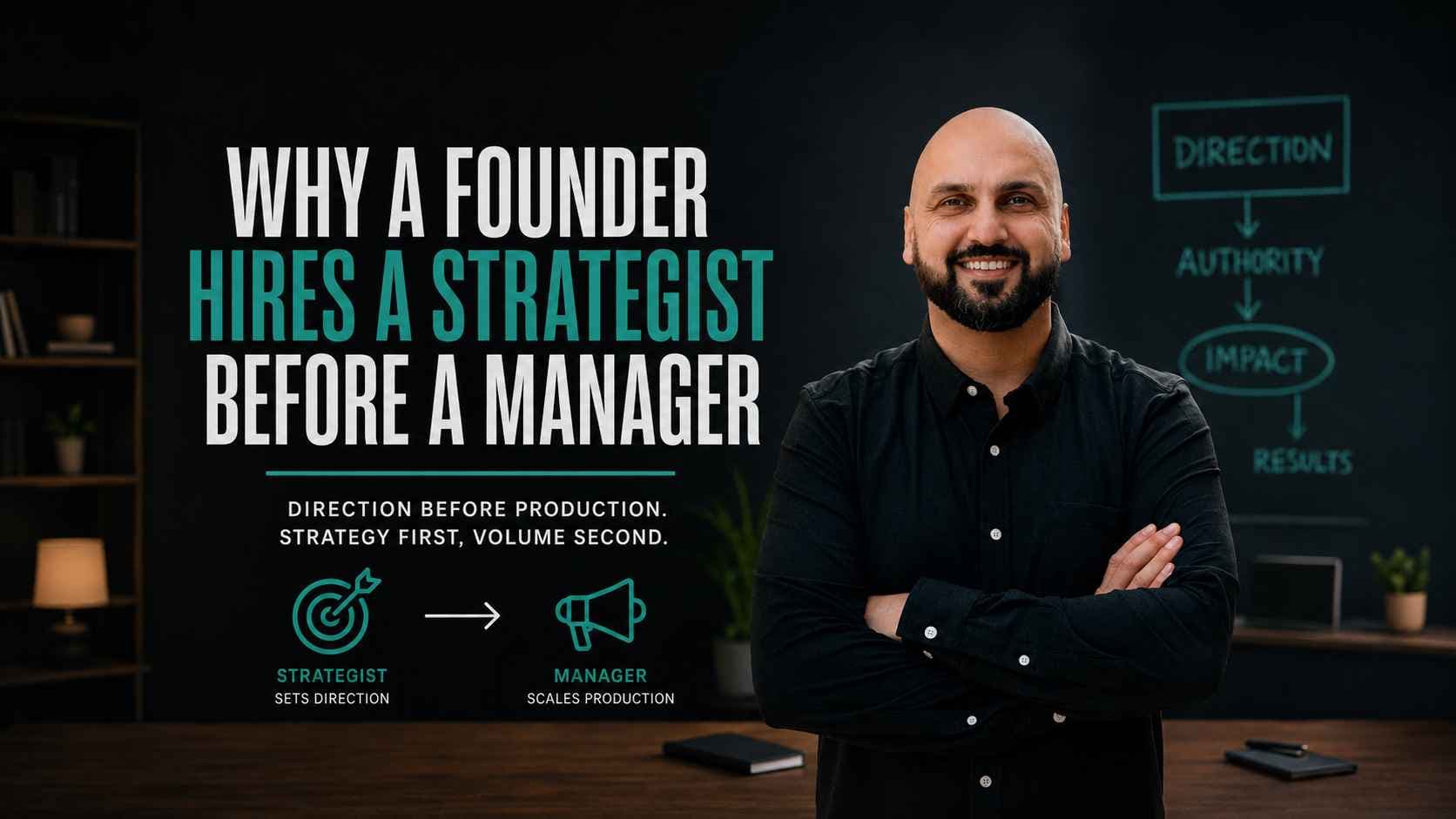
A founder hires a strategist before a social media manager because the two roles do different jobs in a fixed order. A strategist sets where the founder's authority goes. A manager moves volume in that direction. Direction comes first, because production scales whatever direction exists, including none.
A founder who hires the manager first fills the calendar and moves nothing. A founder who hires the strategist first gives every later hire a direction to scale. The order matters more than the titles.
Key Takeaways
A founder hires a strategist before a social media manager. The order is the point.
A strategist sets the direction of the founder's authority.
A social media manager scales production in that direction.
Direction comes first, because production scales whatever exists, including none.
A founder who hires the manager first produces volume with no direction.
The manager hire is right after the direction is set, not before.
Why a Founder Hires the Strategist First
A founder hires the strategist first because direction has to exist before production scales it. A strategist sets where the founder's authority points. A social media manager scales output along that direction.
The order is not interchangeable. Production amplifies whatever direction is in place. A founder with a strategist has a direction worth scaling. A founder with only a manager scales whatever the manager guesses, which is rarely the founder's authority.
Direction is the founder's scarce asset. The strategist protects it and sharpens it before any volume is added. AJ Kumar places the strategist first, because the founder's authority needs a direction before it needs reach.
What a Strategist Sets That a Manager Cannot

A strategist sets the direction a manager cannot set alone. The strategist defines where the founder's authority goes, what it argues, and how it reaches the market. The manager executes inside that frame.
The two roles are genuinely different work, and the full distinction is covered in a strategist versus a social media manager. The short version for the hiring order is simple. The strategist owns direction. The manager owns volume.
A manager hired without a strategist invents the direction by default. The result is content that reflects the manager's instinct, not the founder's authority. The strategist removes that gap by setting the direction first, so the manager scales the right thing.
Why Production Without Direction Returns Nothing
Production without direction returns nothing for a founder. A social media manager hired first fills the calendar and ships volume, and the volume scales an absence. The posts grow and the authority does not.
Volume is not the constraint for most founders. Direction is. A founder producing daily content with no clear position competes with every other voice saying the same thing. The output rises and the return stays flat.
The strategist fixes the constraint that volume cannot. A clear direction makes each piece of content compound toward the founder's authority. The argument for setting direction before scaling output is documented in GURU, INC., where AJ Kumar treats authority as a direction the founder sets, not an output a team guesses.
When a Founder Is Ready for the Social Media Manager
A founder is ready for the social media manager once the strategist has set the direction and the constraint becomes volume. The manager hire is right when the founder knows where the authority points and only lacks the hands to do more.
Readiness follows the sequence. A founder with a clear direction, a working content system, and proven results is ready to scale production. The manager takes that direction and multiplies its reach.
This is the same sequence behind the earlier hire decision, covered in when a founder should hire for content. The foundation comes first, the strategist sets the direction, and the manager scales it. Getting that order right is where clarity on the right next move matters most for a founder.
What Each Role Owns in the Sequence
Each role owns a different stage of the founder's content. The two ownership lines are given below.
The strategist owns direction: the position, the point of view, and where the authority goes. The manager owns production: the calendar, the formats, and the volume that carries the direction to the market. The founder owns the authority itself, the source both roles serve.
The sequence keeps the ownership clean. A founder who hires in order gets a strategist setting direction, then a manager scaling it, with the founder's voice at the center throughout. A founder who hires out of order blurs the lines and scales confusion.
Why the Order Matters More Than the Titles

The hiring order matters more than the titles a founder uses. A strategist by any name comes first, because the direction-setting work comes first. A production hire by any name comes second.
Titles vary across companies. The function does not. The work of setting the founder's direction precedes the work of scaling its reach, regardless of what either role is called. A founder who fixes on titles misses the sequence.
I have watched founders hire the manager first and wonder why the content moved nothing. The answer was the order. The production was real, the direction was absent, and volume scaled an empty frame. The founders who hired the strategist first gave every later hire a direction to scale.
The order is the decision. A few questions decide how a founder fills the roles.
How a Founder Knows It Is Time for the Strategist
A founder reads the timing from one signal. The signal is the gap between effort and return. A founder posting consistently with no clear position, no compounding authority, and no inbound demand has a direction problem, not a volume problem.
That gap is the strategist's work. A founder facing it is ready for the strategist, because more production scales the same gap rather than closing it.
Common Mistakes Founders Make With the First Content Hire
Founders make three predictable mistakes with the first content hire. The mistakes are listed below.
First, they hire the manager first and scale output before direction exists. Second, they treat the two roles as one hire and expect a single person to set direction and run production at volume.
Third, they fix on titles instead of the sequence, so the order depends on a job posting rather than the founder's actual constraint. Each mistake reverses the order direction-before-production requires.
Can One Person Be Both Strategist and Social Media Manager?
One person can hold both roles at a small scale, but the functions stay distinct. The direction-setting work still comes before the production work. A founder who combines them watches the production demands crowd out the strategy, which is the part that sets the return.
Does a Founder Always Need a Social Media Manager?
No. A founder needs direction first, always. A founder needs a social media manager only after the direction is set and the constraint becomes volume. A founder with a clear direction and limited reach benefits from a manager. A founder without direction benefits from a strategist instead.