
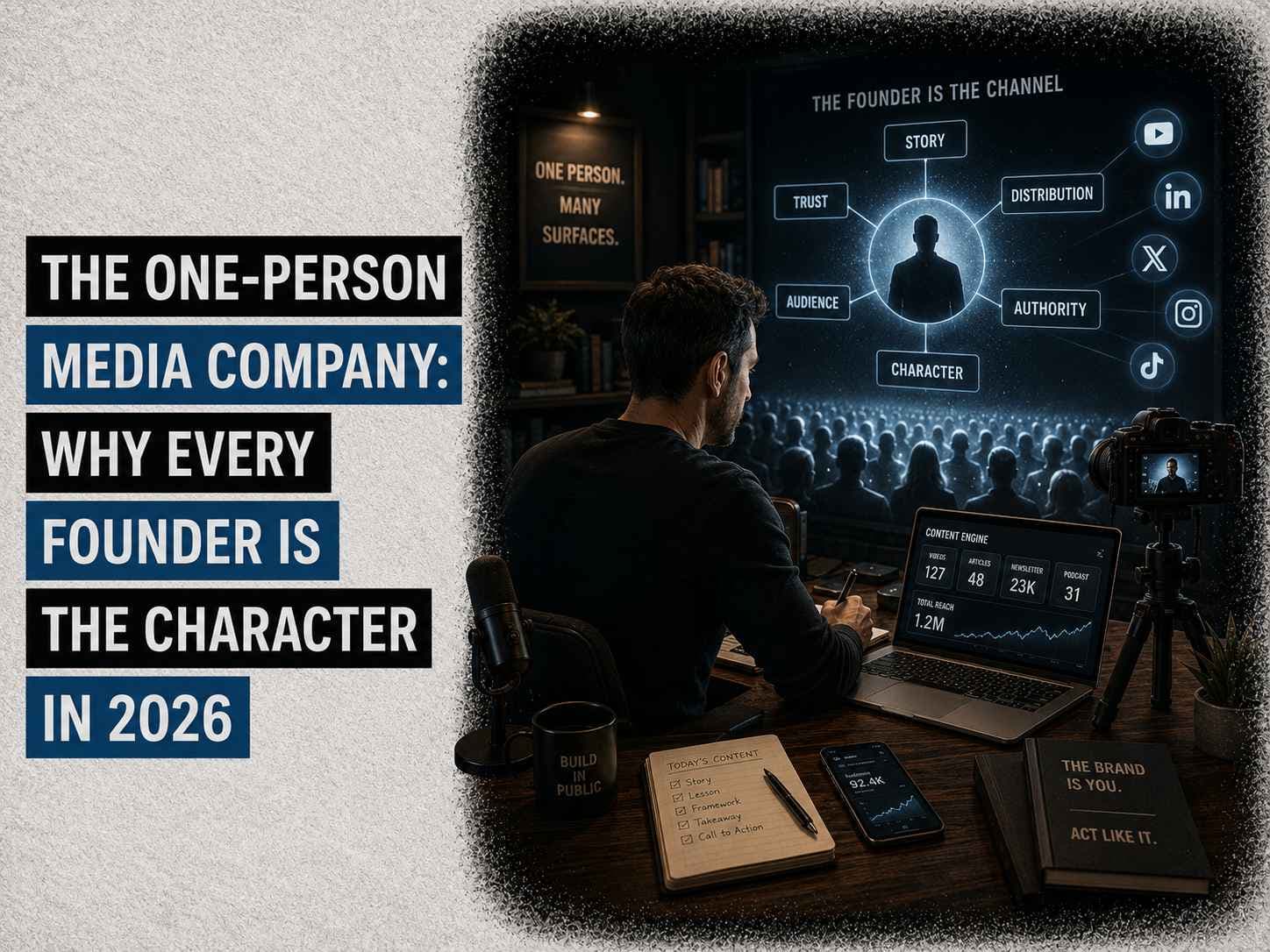
AJ Kumar explains why the founder is the character now. The one-person media company turns identity into IP, and Disney built the original playbook.
Key Takeaways
Walt Disney did not animate Mickey Mouse. Ub Iwerks did. Walt built the franchise system that turned the character into the most valuable IP in entertainment history.
The founder skill of 2026 is character architecture. Not content. Not posting. The ability to design a character people attach to.
Disney 2025 revenue hit $94 billion. The machine still runs on Walt's playbook: character, world, goods, spin-offs.
Your brain treats fictional characters like real people. Parasocial attachment compounds into revenue when the founder owns the IP.
Apply the 3C Formula to a one-person media company. Content drives attention. Commerce captures it. Concert deepens it.
The Ub trap kills most founders. They treat content as content. The founder is the character. The character is the business.
Walt Disney did not draw Mickey Mouse.
Walt Disney did not draw Mickey Mouse. Ub Iwerks did. Ub was the animator who brought Mickey to life. He drew up to 700 sketches a day at the peak of production. Walt himself said he would put Ub up against any animator alive.
But the world thought Walt drew Mickey. Ub did not get the credit he felt he deserved. He left to start his own studio. Six years later, he went bankrupt. He returned to Disney and worked there until he died in 1971.
That story bothered me for years. Ub was the most talented animator of his era. He created the most famous character in entertainment history. So why did he fail at his own studio? And if Ub drew Mickey, what exactly did Walt do?
The answer is the founder skill that built Disney into a $94 billion empire. It is the same skill that builds a brand moat no competitor can copy. And it is not the skill you think it is.
Ub was the better animator. Walt was the better founder.
Ub was the better animator. Walt was the better founder. That difference is the entire lesson.
Ub had craft mastery. He could draw faster, cleaner, and more expressively than anyone in the room. Walt had franchise logic. He saw how a character becomes a world. How a world becomes a portfolio of stories. How a portfolio of stories becomes an economic engine that compounds for a century.
That gap is brutal because most founders are trying to be Ub. They obsess over the craft. The perfect post, the perfect video, the perfect pitch. Meanwhile, Walt is building the system that compounds craft into a brand people attach to for life.
The founder skill is not the production of the asset. It is the architecture of the character economy around the asset. Ub made Mickey visible. Walt made Mickey valuable.
Your brain attaches to characters before it buys from companies.

Your brain attaches to characters before it buys from companies. That is not marketing copy. It is neuroscience.
Melanie Green and Timothy Brock published foundational work in the Journal of Personality and Social Psychology in 2000. They showed something simple. When a reader is transported into a narrative, beliefs and attitudes shift. No logical argument matches the effect.
The fMRI evidence that followed is stronger. The brain processes a fictional character through the same mentalizing network it uses to track a real person. The temporoparietal junction lights up. The medial prefrontal cortex activates. Your brain does not draw a hard line between Mickey Mouse and your closest friend.
That is why Disney built an empire on parasocial attachment. Mickey is not a cartoon. Mickey is an entity your brain treats as real. Every time a child cries when they meet Mickey at the park, that is the neuroscience working as designed.
Walt understood this in 1928 without an fMRI machine. Most founders still miss it in 2026 with one in every research lab.
Disney built a four-part character economy loop.
Step one. Create a compelling character with a specific personality. Walt designed Mickey's voice, attitude, and emotional range. He voiced Mickey himself for nearly two decades.
Step two. Introduce the character inside a world. Steamboat Willie was not a short film. It was a doorway into a universe.
Step three. Produce more stories that deepen the world. New cartoons, new characters, new arcs. Each new piece raises the value of every earlier piece.
Step four. Sell goods that let the audience carry the character into their own life. Merchandise, theme parks, live experiences. Disneyland did not sell rides. It sold proximity to characters people already loved.
The same structure shows up in every modern founder media empire. The Personal Media Company Model I built in GURU, INC. has five components: programming, distribution, monetization, operations, and measurement.
Disney is the proof of what happens when all five run in sync. Martha Stewart is the proof of what happens when one founder runs a company alone.
The founder is the character now.
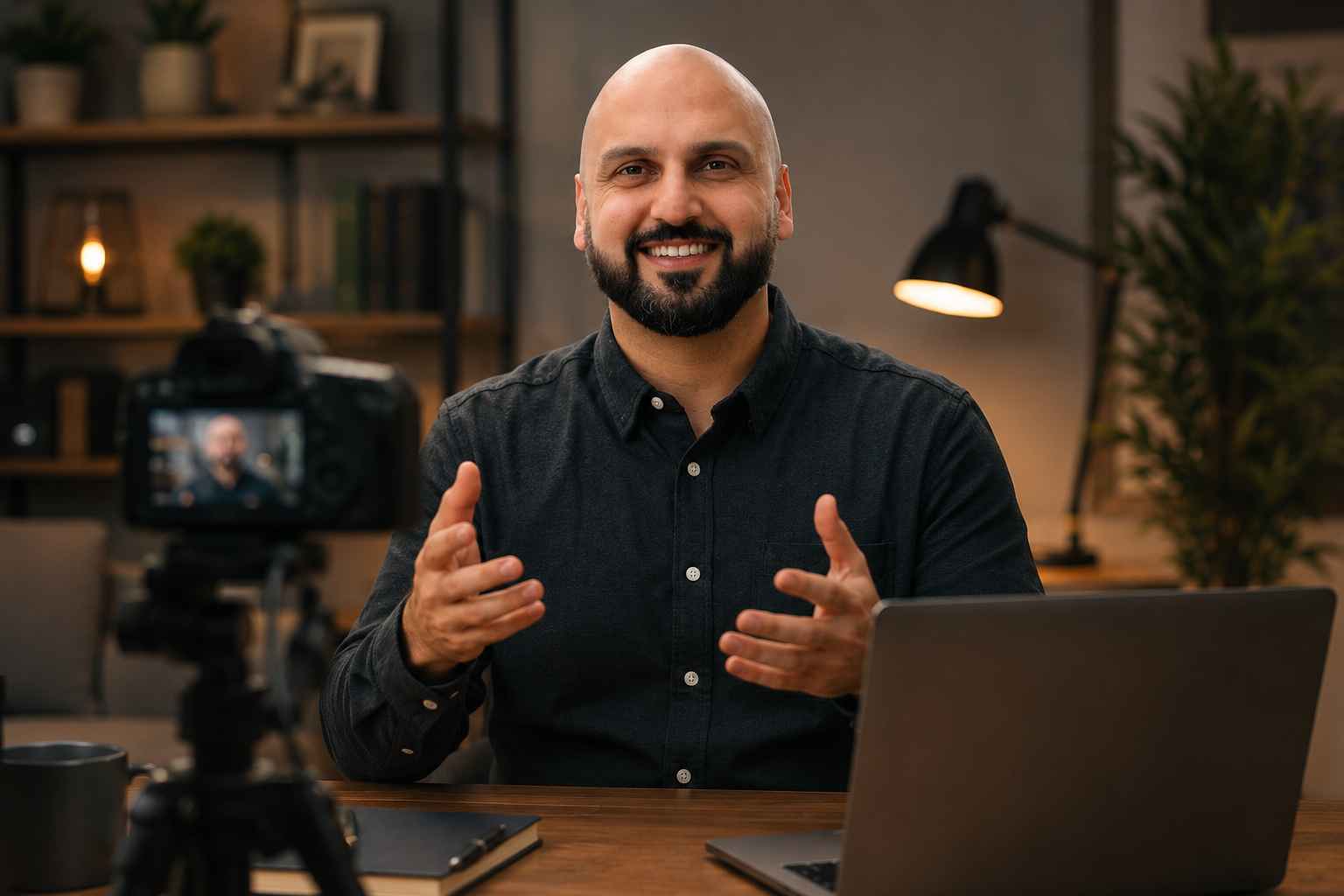
For most of the twentieth century, character creation required a studio. You needed animators, writers, directors, distributors, and a hundred million dollars. The economics blocked everyone but Disney, Warner Brothers, and a handful of corporate giants. The character was always a separate entity, owned by the studio, performed by talent who could be swapped out.
YouTube broke that economy. Instagram broke it again. TikTok finished the job. The cost to produce, distribute, and monetize a character collapsed to zero. A founder with a phone can now build what used to require a forty-story studio building in Burbank.
But the character is no longer a cartoon. The character is the founder. You are Mickey Mouse now. Your face, your voice, your story, your point of view. That is the IP your business will compound around for the next decade.
I run a marketing firm that grows YouTube channels for founders. In twenty months, we have generated 3.6 million watch hours for personal brands. The demand for character-driven founder content is accelerating. The next $100 million brands will be founded by people who understood the new creator economics early.
Apply the 3C Formula to a one-person media company.
Apply the 3C Formula to a one-person media company. The structure scales from a single founder to a global empire.
The 3C Formula maps three revenue layers every personal media company runs in parallel. Content is the attraction layer. Free, public, character-driven media that builds attachment over time. Your podcast, YouTube channel, posts, and newsletter.
Commerce is the conversion layer. Products and services your character is uniquely qualified to sell. Books, courses, software, services, agencies. The character validates the offer, and the offer monetizes the attention.
Concert is the deepening layer. Live, in-person, premium experiences. Events, retreats, masterminds, paid communities. The Concert is where the audience does not just consume the character. They stand in the same room as the character.
Disney built all three. Disney films are content. Disney merchandise is commerce. Disneyland is the concert. Alex Hormozi did the same. His content is on the YouTube channel and the books. His commerce is the $100M Money Models book that sold 2,917,443 copies in twenty-four hours at $29. His concert is the live launch event in Las Vegas. He set a Guinness World Record there on August 17, 2025.
You do not need a billion-dollar studio for any of this. You need the three layers running in sync.
The Ub trap is treating content as content.

They post, they edit, they ship. They focus on the asset. The hook, the cut, the caption. They are doing Ub's job, not Walt's. The work is real, the craft compounds, but the brand does not.
Walt's job is harder. He has to know what character he is building. What world the character lives in. What goods does the character make possible? What concert deepens the attachment? He has to architect the whole machine while still showing up on camera.
The fix is the predicate change. You are not making content. You are building a character economy. The post is the input. The character is the output. The business is the compound interest.
Become the architect of your own character economy.
First, design the character. Your voice, your point of view, your origin story, your visible obsessions. The version of you the audience attaches to.
Second, build the world. The format, the recurring themes, the universe of ideas your character operates inside. Joel Osteen runs one show a week in a 45,000-seat venue and stretches it into a year of content. That is a world.
Third, layer the 3C. Content draws attention. Commerce monetizes it. Concert deepens it. Each layer feeds the next.
You are not behind. You are early. Most founders are still arguing about which hook works best. The ones who win the next decade are not making better hooks. They are building better characters. Ub made Mickey visible. Walt made Mickey valuable. Your job is both.
Frequently Asked Questions
Who actually created Mickey Mouse, Walt Disney or Ub Iwerks?
Mickey was a collaboration. Walt developed the concept, personality, and voice. Ub did the visual design and most of the early animation. The character could not have existed without both, but Walt owned the franchise logic that made Mickey valuable.
What does it mean to be a one-person media company?
A one-person media company is a founder who controls every layer of a media business alone. They write the content, host the show, sell the products, and own the audience relationship. The structure once required a studio and now runs on a phone.
What is character-driven storytelling for founders?
Character-driven storytelling treats the founder as the recurring protagonist of every piece of content. The audience does not attach to a logo or a service. They attach to a specific human with a point of view, a voice, and a visible journey.
How is the 3C Formula different from regular content marketing?
The 3C Formula treats Content, Commerce, and Concert as three revenue layers running in parallel, not a funnel. Content marketing tries to sell at the end. The 3C model builds attachment in Content, sells in Commerce, and deepens loyalty in Concert.
How much revenue does Disney generate today?
Disney reported roughly $94 billion in revenue for fiscal year 2025. Most of that revenue is downstream of the character-and-franchise model Walt designed almost a century ago.
Why do most founders fail to build a personal media company?
They confuse craft with architecture. They focus on the next post instead of the system that compounds. The founders who win in 2026 design the character, build the world, and layer the 3C. They do not chase the perfect hook.